
Marriage is a committed relationship in which two people promise to share their lives, support one another, and build a future together. In Christianity, marriage is often understood as a sacred covenant involving love, faithfulness, responsibility, and mutual respect. It can also provide the foundation for family life and a lasting partnership through both joyful and difficult experiences.
The Bible introduces marriage in the Book of Genesis. Adam and Eve are described as the first married couple, created to live in companionship and unity. Their story presents marriage as a close bond in which two people become “one flesh.” This expression emphasizes loyalty, cooperation, and the joining of two lives.
Throughout the Bible, marriage appears in many different stories. Abraham and Sarah shared a long journey marked by promises, waiting, and family challenges. Isaac and Rebekah formed a household and became the parents of Jacob and Esau. Ruth demonstrated faithfulness to her family and later married Boaz, beginning a family line connected with King David.
The teachings of Jesus also discuss marriage. Jesus emphasized that marriage should involve commitment and faithfulness rather than being treated casually. Christian teaching commonly encourages husbands and wives to love, forgive, respect, and care for one another. The Apostle Paul compared the loving relationship within marriage to Christ’s care for the Church.
Christian wedding ceremonies vary among denominations and cultures. They often include Bible readings, prayers, vows, rings, blessings, music, and the presence of witnesses. The couple publicly promises to remain faithful and support one another. Wedding rings commonly symbolize unity and continuing commitment because their circular shape has no visible beginning or end.
In the Catholic Church, marriage is one of the seven sacraments when it is celebrated between baptized Christians according to Church teaching. Other Christian traditions may describe it as a covenant, ordinance, or sacred institution. Despite differences in terminology, marriage is generally viewed as a serious and meaningful commitment.
Marriage requires patience, communication, trust, forgiveness, and shared effort. Couples may face disagreements, financial pressures, illness, and other difficulties, but they can grow stronger by working together. A printable marriage word search puzzle offers an enjoyable way to review important terms connected with love, vows, rings, family, covenant, faithfulness, partnership, and Christian wedding traditions.
We’ve dedicated a post to each of the Seven Sacraments: Anointing of the Sick, Baptism, Confirmation, Eucharist, Holy Orders, Marriage, and Reconciliation.
We have also curated seven books on the Seven Sacraments, each offering a unique perspective on this sacred theme. All seven books cover the complete set of sacraments, not just one individual sacrament. Every post in our Seven Sacraments series features a different book recommendation. Don’t miss them — a great read awaits you!
Related Word Searches:
Holy Orders | Baptism | Confirmation | Eucharist
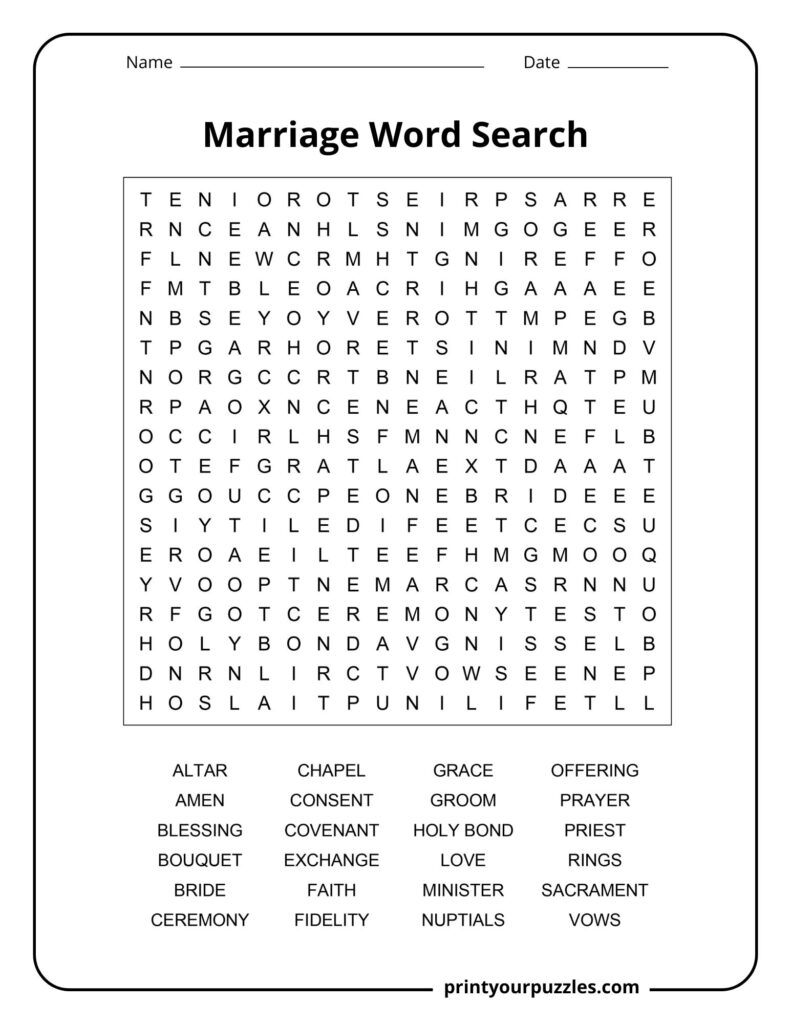
ALTAR, AMEN, BLESSING, BOUQUET, BRIDE, CEREMONY, CHAPEL, CONSENT, COVENANT, EXCHANGE, FAITH, FIDELITY, GRACE, GROOM, HOLY BOND, LOVE, MINISTER, NUPTIALS, OFFERING, PRAYER, PRIEST, RINGS, SACRAMENT, VOWS
ALTAR – Sacred table at the front of the church where the marriage ceremony takes place and the couple exchanges their vows before God.
AMEN – Solemn word of affirmation meaning “so be it,” spoken at the end of prayers during the wedding liturgy to confirm faith and agreement.
BLESSING – Sacred invocation through which God’s grace and protection are called upon the couple, consecrating their union and new life together.
BOUQUET – Arrangement of flowers carried by the bride, symbolizing fertility, new beginnings, and the beauty of love shared on the wedding day.
BRIDE – Woman entering the sacrament of marriage, presenting herself before God and the community to pledge lifelong love and fidelity to her spouse.
CEREMONY – Sacred liturgical celebration through which a couple publicly professes their vows before God, the priest, and witnesses, sealing their marriage sacramentally.
CHAPEL – Small sacred space or church where the marriage sacrament is celebrated, providing a holy environment for the couple’s encounter with God.
CONSENT – Free and deliberate agreement of both spouses to marry, considered the essential act that makes the sacrament of marriage valid before God.
COVENANT – Solemn and sacred agreement between spouses and God, reflecting the unbreakable bond of love and faithfulness that mirrors Christ’s relationship with the Church.
EXCHANGE – Mutual giving of vows and rings between the spouses, the central ritual act through which they publicly consecrate their love and commitment.
FAITH – Trust in God and in one another that sustains the couple throughout married life, forming the spiritual foundation of their sacramental union.
FIDELITY – Virtue of remaining faithful and loyal to one’s spouse for life, reflecting the unconditional love God has for humanity through the covenant of marriage.
GRACE – Divine gift received through the sacrament that strengthens the couple spiritually, helping them love each other and face life’s challenges together.
GROOM – Man entering the sacrament of marriage, committing himself before God and the community to love, honor, and remain faithful to his spouse for life.
HOLY BOND – Sacred and indissoluble union formed between spouses through marriage, blessed by God and recognized by the Church as a permanent spiritual commitment.
LOVE – Theological and human foundation of Christian marriage, understood as a selfless, unconditional gift of oneself to the other, inspired by God’s own love.
MINISTER – Ordained person who presides over the wedding ceremony, representing the Church and blessing the union in the name of God and the Christian community.
NUPTIALS – Formal term referring to the wedding rites and celebrations, encompassing all sacred rituals through which two people are united in Christian matrimony.
OFFERING – Act of presenting gifts during the wedding Mass, symbolizing the couple’s desire to give themselves entirely to God and to each other in love.
PRAYER – Conversation with God that accompanies the entire wedding celebration, asking for divine guidance, strength, and blessing upon the newly married couple.
PRIEST – Ordained minister who officiates the marriage sacrament, witnessing the couple’s vows on behalf of the Church and imparting God’s blessing upon their union.
RINGS – Circular bands exchanged by the spouses as visible symbols of eternal love and fidelity, worn daily as a reminder of their sacred marriage covenant.
SACRAMENT – One of the seven holy rites of the Catholic Church through which God’s grace is conferred, with marriage sanctifying the couple’s lifelong union.
VOWS – Solemn promises spoken by each spouse before God and witnesses, pledging love, fidelity, and commitment for better or worse, until death do them part.
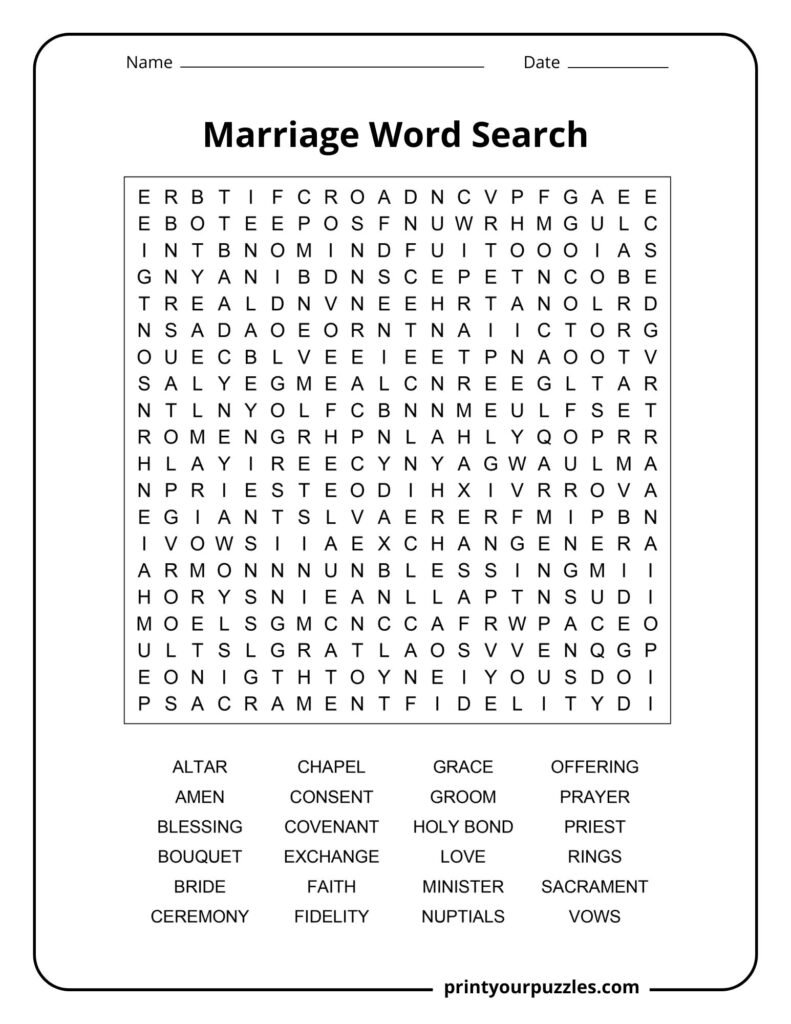
ALTAR, AMEN, BLESSING, BOUQUET, BRIDE, CEREMONY, CHAPEL, CONSENT, COVENANT, EXCHANGE, FAITH, FIDELITY, GRACE, GROOM, HOLY BOND, LOVE, MINISTER, NUPTIALS, OFFERING, PRAYER, PRIEST, RINGS, SACRAMENT, VOWS
Marriage is a sacred covenant between a man, a woman, and God, instituted by Christ, through which the couple receives divine grace to love faithfully for life.
A valid Catholic marriage requires free consent of both spouses, proper canonical form, absence of impediments, and celebration before a priest and two witnesses.
Yes, with special permission from the bishop. The Catholic spouse must promise to raise children in the faith, and the ceremony follows specific Church guidelines.
Yes, a sacramental marriage between two baptized persons, once consummated, is permanent and cannot be dissolved, reflecting Christ’s eternal and unconditional love for the Church.
God is the foundation and witness of the marriage covenant. The couple invites Him into their union, drawing strength and grace from His presence throughout married life.
The Lamb’s Supper: The Mass as Heaven on Earth by Scott Hahn. Focusing on the Eucharist as the heart of sacramental life, this compelling book reveals the profound connection between the Mass and the Book of Revelation, transforming how Catholics experience and understand worship.
It reflects marriage’s deep connection to family, motherhood, and the sacred gift of new life.
This allowed the community to raise any objections or impediments before the marriage was officially celebrated.
A grain cake was broken over the bride’s head to symbolize fertility, abundance, and good fortune for the newlyweds.
The custom lasted one full moon cycle, giving the name “honeymoon” to the couple’s first month together.
They confer the sacrament upon each other through their freely spoken vows, witnessed by the priest and community.