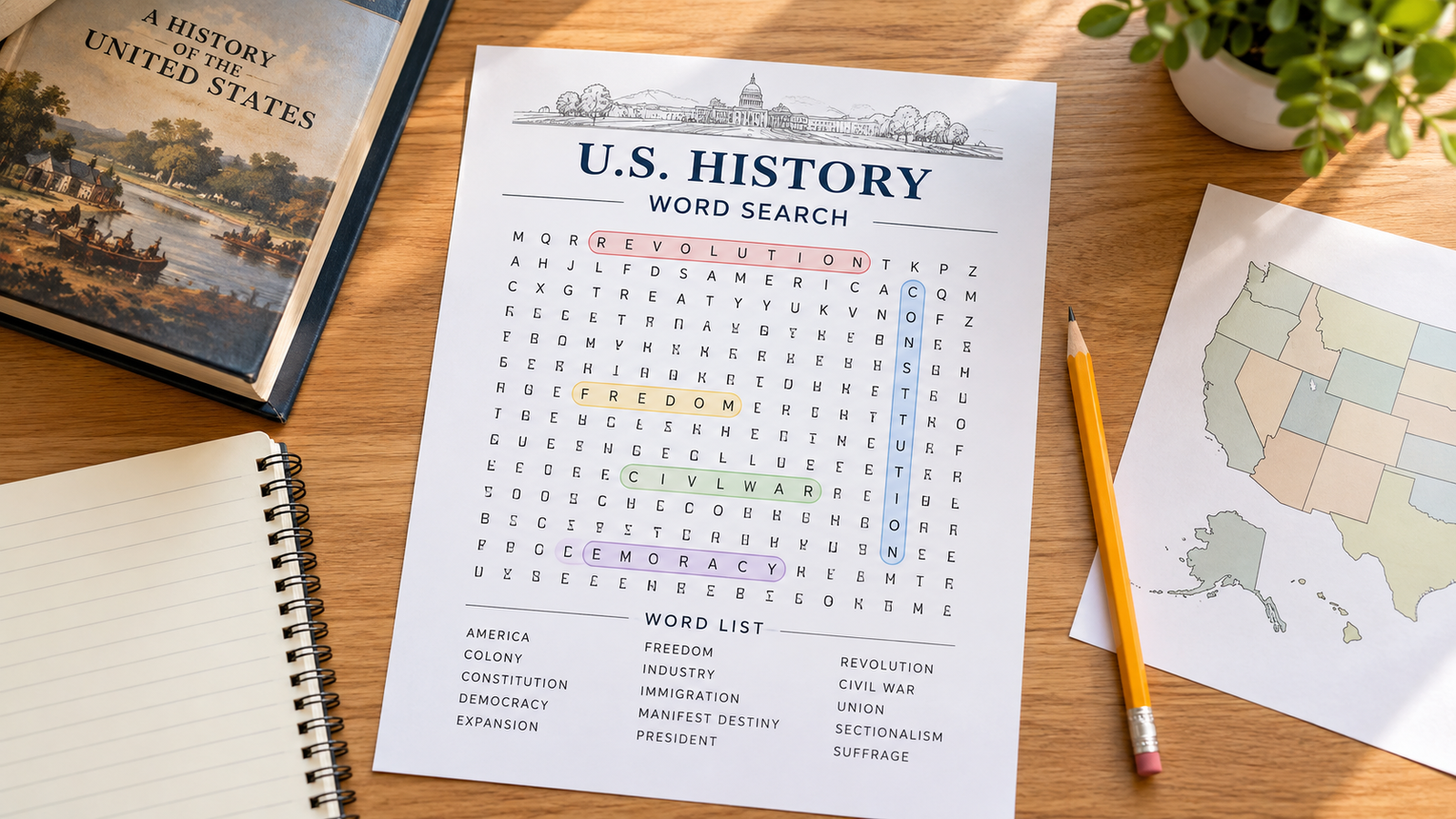
Word searches look deceptively simple — a grid of random letters hiding a list of words in plain sight. Yet most people tackle them the same inefficient way: reading left to right, row by row, hoping something jumps out. That approach works eventually, but it wastes time and mental energy. Whether you’re racing a friend, killing time on a flight, or sharpening your focus, knowing the right techniques can cut your solving time dramatically. Here’s how to approach a word search like a strategist, not a scanner. In this article, we’ll show you seven different and effective techniques that will help you solve any word search puzzle faster than ever before.
Systematic Scanning
Before diving into any clever tricks, build a solid foundation: systematic scanning. Rather than letting your eyes wander randomly across the grid, work in deliberate passes.
Choose a direction — left to right, top to bottom — and stick to it. Scan each row completely before moving to the next. Then, if needed, repeat the process scanning vertically (top to bottom, column by column), and again diagonally. This structured approach ensures you never miss a section of the grid and avoids the frustrating experience of circling the same area multiple times without realizing it.
The key is consistency. Random eye movement feels active but is surprisingly inefficient. Your brain is better at spotting patterns when it knows exactly where to look next. Think of it like mowing a lawn — overlapping, parallel passes cover everything without backtracking.
Target Rare Letters First
Not all letters are created equal in a word search. Common letters like E, T, A, and O appear throughout the grid naturally, making them terrible anchors for your search. Rare letters — Q, Z, X, J, and V — appear far less frequently, which means when you spot one, it’s almost certainly part of a hidden word.
Before scanning, scan your word list and circle any rare letters. Then hunt for those specific characters in the grid first. If you’re looking for “JAZZ,” don’t search for J, A, Z, Z in sequence — find the double Z in the grid and work outward from there. You’ll locate it in seconds rather than minutes.
This technique is especially powerful for long, exotic words. The word “QUARTZ” contains both Q and Z — two rare letters that give you two separate opportunities to anchor your search with minimal effort.
Look for Double Letters
Double letters are your best friends in a word search. Combinations like LL, SS, TT, OO, and EE are visually distinctive because they break the rhythm of varied characters. Your eye naturally notices repetition, even when you’re not consciously looking for it.
When scanning, train yourself to pause on any pair of identical adjacent letters. Then check your word list: does any word contain that double letter combination? Words like “COFFEE,” “BALLOON,” “LETTERS,” and “GRASSHOPPER” become instantly locatable once you spot their doubled characters.
This technique works in all directions — horizontal, vertical, and diagonal — because the visual “stutter” of a repeated letter stands out regardless of orientation. Practice pausing on doubles as you scan, and you’ll be surprised how quickly they lead you to complete words.
Focus on the Edges
Beginners tend to focus on the middle of the grid, assuming that’s where the action is. Experienced solvers know better: the edges and corners are prime real estate for hidden words, and they’re often overlooked.
Puzzle constructors frequently place words along the borders — running parallel to an edge, tucking into a corner, or starting in the last column. Because most people avoid the periphery during casual scanning, these words can sit undiscovered until the very end of a solve.
Make it a habit to explicitly scan all four edges early in your session. Run along the top row, the bottom row, the leftmost column, and the rightmost column before diving into the interior. Clearing the edges first also has a psychological benefit: it shrinks the perceived size of the puzzle and builds early momentum.
Search for Word Beginnings (and Endings)
When you’re looking for a specific word, your instinct is probably to search for the first letter. That’s reasonable, but it’s only half the strategy. Many solvers find equal success by searching for the last letter or a distinctive ending.
Suffixes like -TION, -ING, -LY, -EST, and -NESS are common in English word lists. If you spot a T-I-O-N sequence in the grid, check your list for any words ending in those letters. Similarly, prefixes like UN-, RE-, and PRE- give you a reliable starting cluster to hunt for.
This bidirectional thinking doubles your chances of locking onto a word quickly. Instead of hunting for one letter, you’re essentially setting two traps — one at each end of the word.

Use the Word List Strategically
Most people glance at the word list, pick a word at random, and start hunting. A faster approach is to prioritize your list before you start solving.
Sort the words mentally (or physically, if you’re allowed to mark the puzzle) by difficulty: shortest words and words with rare or doubled letters go first; long, common-letter words go last. Short words like “OX” or “JAB” are quick wins that get words off your list fast. Long words with distinctive letters like “XYLOPHONE” are easy to spot once you’ve trained your eye on the X.
Also, as you find and circle words in the grid, cross them firmly off your list. A cluttered word list forces your brain to re-read already-found words repeatedly, wasting mental bandwidth.
Relax Your Gaze (Use Peripheral Vision)
This is the most counterintuitive technique, but one of the most effective: stop focusing so hard.
When you stare intently at individual letters, you’re processing the grid in a slow, serial way — one character at a time. Instead, try softening your focus and taking in a wider field of view, similar to the relaxed gaze used in Magic Eye puzzles. Let your peripheral vision do more of the work.
Your visual system is surprisingly good at detecting familiar patterns — like the shape of a whole word — when it isn’t being micromanaged. Many seasoned solvers describe finding words “out of the corner of their eye” precisely because they weren’t hunting for them letter by letter. Periodically stepping back, both literally and mentally, can break a stuck streak and surface words you’ve been staring right past.
Putting It All Together
The fastest word search solvers don’t rely on a single technique — they layer them. Start with a quick edge scan, then hunt for rare and doubled letters, then work through the list systematically from most distinctive to least. Soften your gaze periodically to catch patterns your focused eye misses.
With practice, these techniques become second nature. What once took twenty minutes of frustrated squinting starts taking five. The grid stops feeling like a sea of chaos and starts looking exactly like what it is: a puzzle with a logical solution, waiting for the right approach to unlock it.
Ready to put these techniques to the test? Head over to PrintYourPuzzles.com, where you can download any of our curated collection of more than 300 printable word searches. Each puzzle comes packed with more than just a grid — every one includes definitions of all the keywords to find, plus an FAQ section and fun Did You Know facts, so you’re learning something new at the same time you’re enjoying the challenge. The perfect mix of entertainment and knowledge is just one download away.