Introduction to the Iranian Revolution Word Search
The Iranian Revolution was a major political and social upheaval that transformed Iran in 1978 and 1979. It ended the monarchy of Shah Mohammad Reza Pahlavi and replaced it with an Islamic Republic. The revolution brought together religious leaders, students, workers, merchants, nationalists, liberals, and left-wing groups, all of whom opposed the Shah for different reasons.
Under the Shah, Iran experienced rapid modernization, industrial growth, expanded education, and closer ties with the United States. His White Revolution introduced land reform, infrastructure projects, literacy programs, and greater rights for women. However, these changes also disrupted traditional communities, increased social tensions, and failed to satisfy many Iranians who felt excluded from political power and economic opportunity.
The Shah’s government remained highly authoritarian. Political parties were restricted, newspapers were censored, and opponents were monitored, imprisoned, or tortured by SAVAK, the state security organization. Many people also resented the unequal distribution of oil wealth, rising inflation, unemployment, housing shortages, and the visible contrast between wealthy elites and poorer urban and rural communities.
Foreign influence was another important source of anger. Many Iranians remembered the 1953 coup that removed Prime Minister Mohammad Mossadegh and strengthened the Shah’s rule with American and British support. This history contributed to deep distrust of the monarchy and the United States. Ayatollah Ruhollah Khomeini, a Shia cleric living in exile, became the most influential critic of the Shah and Western involvement.
During 1978, protests grew across the country. Demonstrations were followed by government repression, mourning ceremonies, strikes, and larger gatherings. On September 8, 1978, security forces opened fire on protesters in Tehran in an event known as Black Friday. Instead of ending the movement, the violence increased opposition and encouraged more workers, students, and merchants to join the revolution.
Communication technology played a crucial role. Cassette recordings of Khomeini’s speeches were copied and distributed through mosques, homes, markets, and religious networks. Photocopiers, newspapers, telephones, radio broadcasts, leaflets, and public sermons helped spread information and organize opposition. These tools performed a role similar to social media and smartphones in later protest movements.
The Shah left Iran on January 16, 1979, and Khomeini returned from exile on February 1. The monarchy collapsed soon afterward, and a referendum established the Islamic Republic.
With our Iranian Revolution Word Search, students can explore vocabulary connected to the Shah, Khomeini, SAVAK, Black Friday, oil, protests, exile, cassette tapes, monarchy, and the political transformation of Iran in 1979.
Related Word Searches:
Arab Spring | Cuban Revolution | Russian Revolution | Chinese Revolution | Jimmy Carter | Cold War
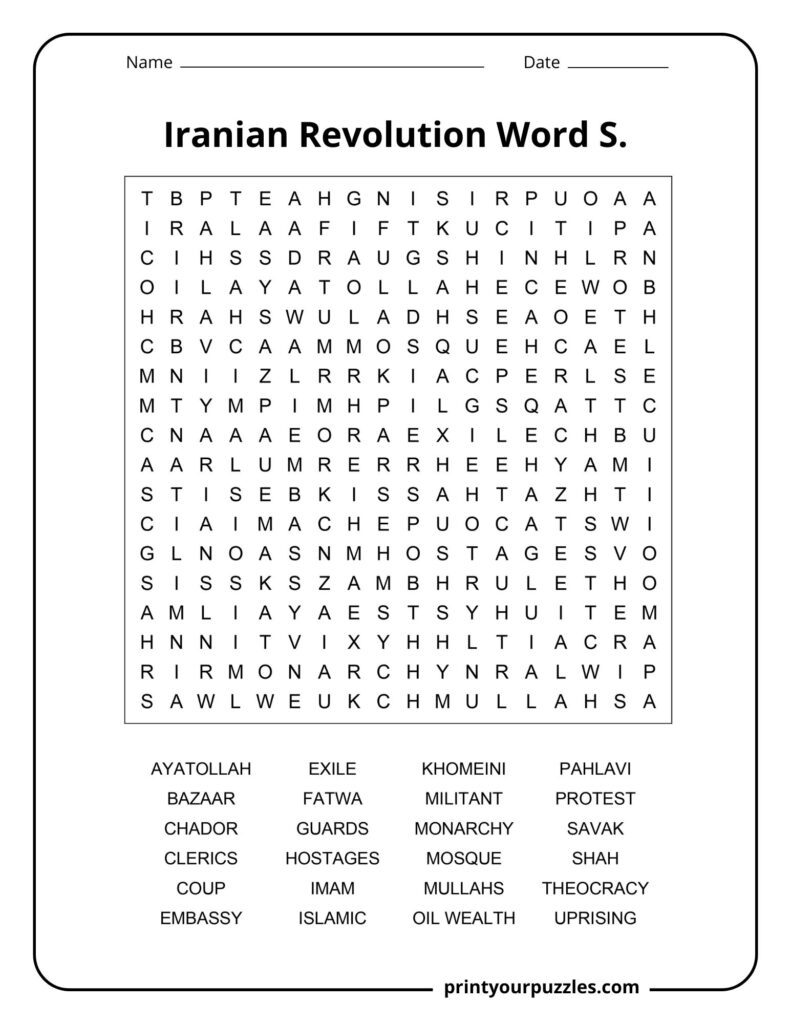
Medium Difficulty Word Search
Words to Find
AYATOLLAH, BAZAAR, CHADOR, CLERICS, COUP, EMBASSY, EXILE, FATWA, GUARDS, HOSTAGES, IMAM, ISLAMIC, KHOMEINI, MILITANT, MONARCHY, MOSQUE, MULLAHS, OIL WEALTH, PAHLAVI, PROTEST, SAVAK, SHAH, THEOCRACY, UPRISING
All Words Defined
AYATOLLAH – High-ranking Shia Muslim cleric holding supreme religious authority, a title given to top Islamic scholars who interpret religious law and guide the faithful in Iran.
BAZAAR – Traditional Iranian marketplace central to economic and political life, where merchants, artisans, and traders gathered, playing a key role in funding and supporting the revolutionary movement.
CHADOR – Full-body cloak worn by Iranian women covering everything except the face, becoming a powerful symbol of Islamic identity and religious resistance during and after the revolution.
CLERICS – Islamic religious scholars and leaders who wielded enormous influence during the revolution, mobilizing the population against the Shah and establishing theocratic governance in post-revolutionary Iran.
COUP – Forceful seizure of government power, referencing the 1953 CIA-backed overthrow of Prime Minister Mosaddegh, which restored the Shah and planted deep seeds of anti-Western resentment.
EMBASSY – Foreign diplomatic mission, notably the United States Embassy in Tehran, seized by revolutionary students in 1979, triggering a 444-day hostage crisis that reshaped US-Iran relations dramatically.
EXILE – Forced or voluntary absence from one’s homeland, experienced by Khomeini for fifteen years and later by the Shah, whose departure from Iran in January 1979 marked the revolution’s triumph.
FATWA – Formal religious ruling issued by an Islamic authority on matters of law and conduct, used during the revolution to legitimize political actions and later to condemn perceived enemies of Islam.
GUARDS – Referring to the Islamic Revolutionary Guard Corps, an elite military force created after 1979 to protect the new Islamic Republic and suppress internal opposition and counter-revolutionary threats.
HOSTAGES – Fifty-two American diplomats and citizens held captive for 444 days after revolutionary students stormed the US Embassy in Tehran, creating an international crisis that defined early revolutionary Iran.
IMAM – Revered Islamic leader and prayer guide; in Shia Islam, imams hold deep spiritual significance. Khomeini was widely called Imam, elevating his status beyond ordinary clerical ranks to near-sacred authority.
ISLAMIC – Relating to Islam and its principles, central to the revolution’s ideology as Khomeini established an Islamic Republic, replacing secular monarchy with governance rooted in Sharia and religious jurisprudence.
KHOMEINI – Ayatollah Ruhollah Khomeini, the supreme religious leader who led the 1979 Iranian Revolution, overthrew the Shah, and founded the Islamic Republic, ruling as Supreme Leader until his death in 1989.
MILITANT – A person aggressively active in pursuing political or religious goals, describing both revolutionary fighters who overthrew the Shah and hardline Islamists who enforced strict religious rule afterward.
MONARCHY – System of rule by a king or emperor, embodied in Iran by the Pahlavi dynasty. The Shah’s autocratic monarchy was seen as corrupt, Westernized, and oppressive, making it the revolution’s primary target.
MOSQUE – Islamic house of worship that served as the primary gathering place for revolutionary organizing, where clerics delivered politically charged sermons that mobilized millions of Iranians against the Shah’s regime.
MULLAHS – Islamic clergy who lead prayers, teach religious law, and issue rulings. In revolutionary Iran, mullahs became powerful political figures, filling government positions and enforcing Islamic principles across society.
OIL WEALTH – Iran’s vast petroleum resources that funded the Shah’s modernization programs but also fueled inequality and foreign interference, making control of oil a central grievance driving revolutionary sentiment among Iranians.
PAHLAVI – The dynastic name of Iran’s last royal family. Mohammad Reza Shah Pahlavi ruled until 1979, pursuing rapid Westernization through the White Revolution while suppressing dissent through the feared SAVAK secret police.
PROTEST – Mass public demonstrations that brought millions of Iranians into the streets demanding the Shah’s removal, representing one of history’s largest popular uprisings and ultimately forcing his departure from Iran.
SAVAK – The Shah’s brutal secret police organization, notorious for surveillance, torture, and elimination of political opponents. SAVAK’s ruthless tactics generated widespread fear and intense hatred, fueling popular support for the revolution.
SHAH – Persian title meaning king, specifically referring to Mohammad Reza Shah Pahlavi, Iran’s last monarch, whose authoritarian rule, close ties to the West, and repressive policies ultimately triggered the 1979 revolution.
THEOCRACY – A system of government where religious leaders rule in the name of God. Khomeini’s concept of Velayat-e Faqih established clerical rule in Iran, making it the world’s first modern Islamic theocratic republic.
UPRISING – A popular mass rebellion where large groups of citizens collectively rise against an established authority, perfectly describing the millions of Iranians who took to the streets demanding the Shah’s removal in 1979.
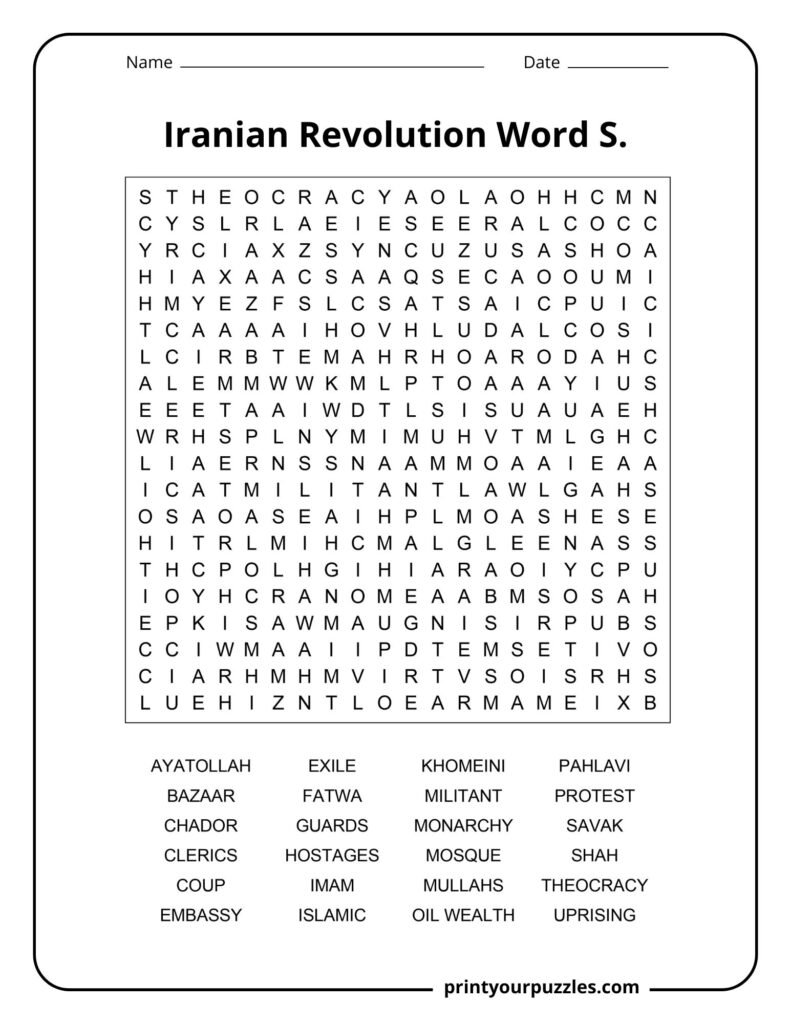
Hard Difficulty Word Search
Words to Find
AYATOLLAH, BAZAAR, CHADOR, CLERICS, COUP, EMBASSY, EXILE, FATWA, GUARDS, HOSTAGES, IMAM, ISLAMIC, KHOMEINI, MILITANT, MONARCHY, MOSQUE, MULLAHS, OIL WEALTH, PAHLAVI, PROTEST, SAVAK, SHAH, THEOCRACY, UPRISING
6 Key FAQs About the Iranian Revolution
5 Curious "Did You Know?" Facts About the Iranian Revolution