Michelin is a French company best known for tires, but its history began with a much broader family business. In the late nineteenth century, brothers André and Édouard Michelin became involved in a struggling manufacturing company in Clermont-Ferrand, France. They recognized that the rapidly growing popularity of bicycles and automobiles could create a major new market, especially if tires became easier to repair, replace, and use.
A breakthrough came when the brothers developed an improved removable pneumatic tire for bicycles. At the time, fixing a puncture could be a slow and difficult process because tires were often permanently attached to the wheel. Michelin’s removable design made repairs much more practical and helped establish the company as an innovator. As automobiles became more common, Michelin adapted its technology for cars and began building a reputation for durability, performance, and technical improvement.
The brothers also understood that selling tires meant encouraging people to travel. In 1900, they introduced the Michelin Guide, originally giving motorists useful information about roads, repair shops, fuel stations, hotels, and restaurants. The business logic was clever: the more people drove, the sooner their tires would need replacing.
Over time, the restaurant section became increasingly important. Michelin began using anonymous inspectors to evaluate restaurants, and its star-rating system developed into one of the most respected distinctions in international dining. One star indicates a very good restaurant in its category, two stars recognize cooking worth a detour, and three stars are reserved for exceptional cuisine worth a special journey. Michelin Guides later expanded to cover restaurants and hotels in many cities and countries, giving the tire company an unexpected but lasting influence on gastronomy.
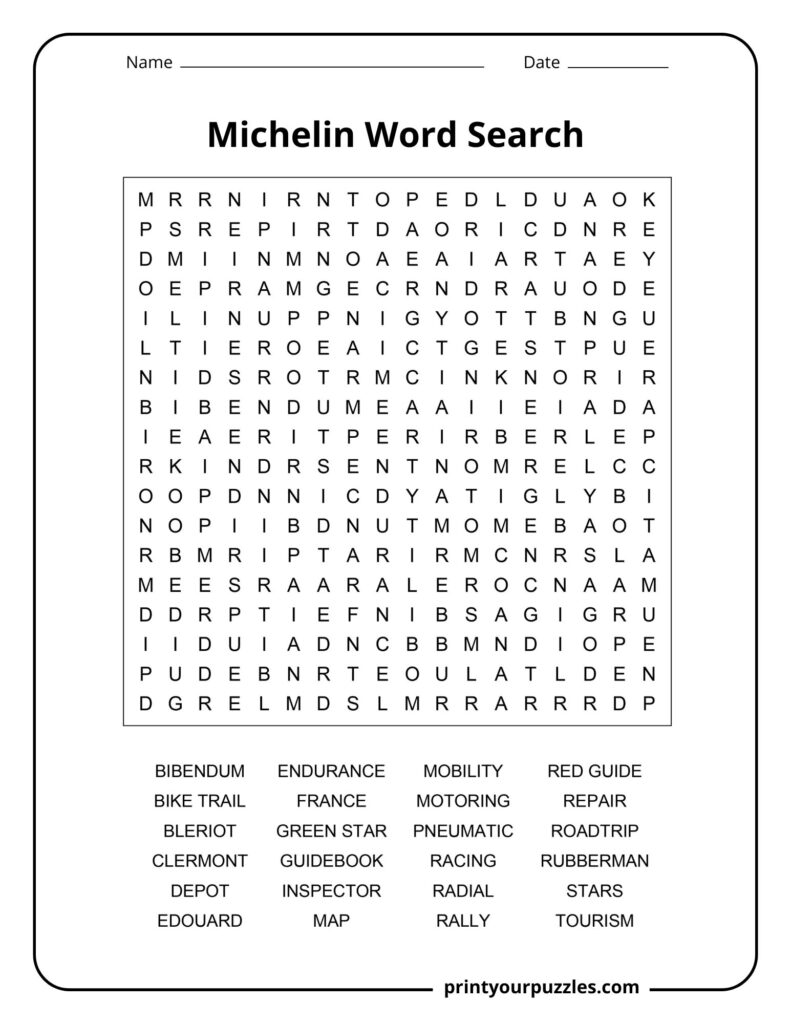
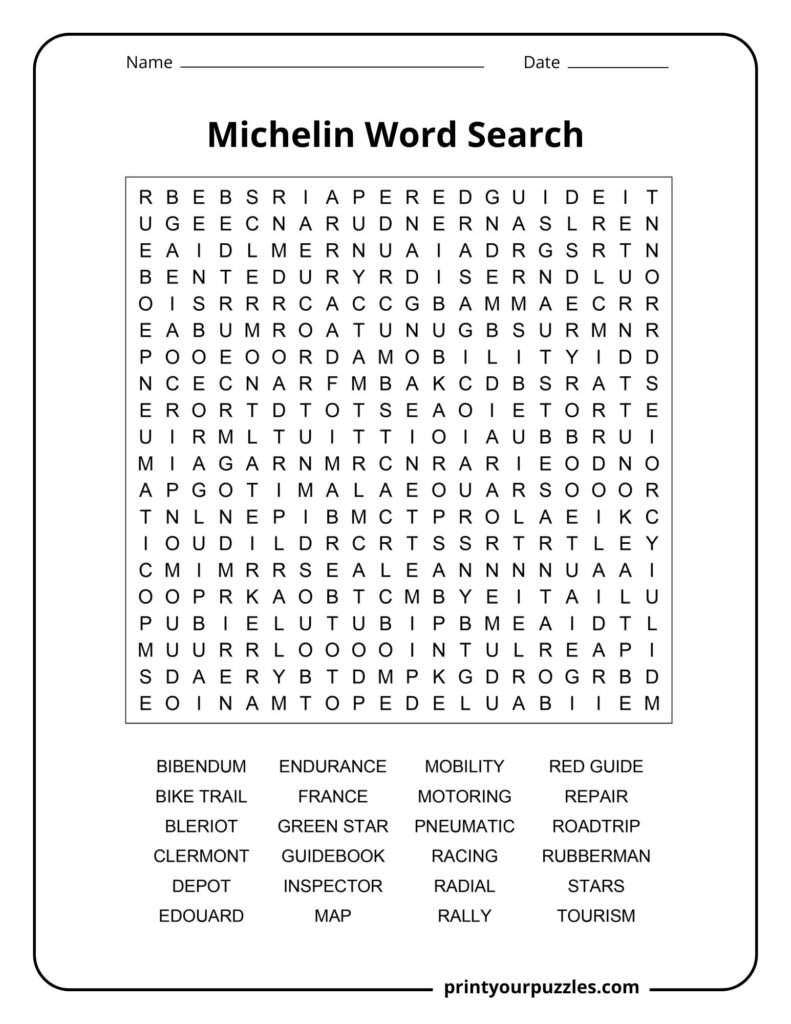
A Michelin word search can connect these unusual parts of the company’s history through terms such as tires, roads, maps, travel, stars, restaurants, inspectors, Bibendum, and motorsport.
Michelin also created one of advertising’s most recognizable mascots, the Michelin Man, officially known as Bibendum. Introduced in the 1890s, the figure made from stacked tires gave the company a distinctive personality and helped strengthen its public image.
From a family manufacturing business to an international tire company and respected authority on restaurants and travel, Michelin grew through engineering, clever marketing, and an understanding of how transportation habits were changing. Few brands have built such a successful connection between driving and fine dining.
Related Word Searches:
Ford | Tesla | General Electric | Red Bull
BIBENDUM – The official name of the Michelin Man mascot, created in 1898. Shaped from a stack of tires, Bibendum became one of the world’s most recognisable brand icons, symbolising safety, endurance, and Michelin’s rubber expertise.
BIKE TRAIL – Michelin has produced detailed cycling maps and trail guides for over a century, helping cyclists navigate roads and paths across Europe, reflecting the brand’s deep commitment to all forms of mobility and outdoor exploration.
BLERIOT – Louis Blériot, the pioneering French aviator who made the first Channel crossing in 1909, relied on Michelin tires. This association helped cement Michelin’s reputation as a trusted partner in early aviation and transportation history.
CLERMONT – Clermont-Ferrand, a city in the Auvergne region of France, is the birthplace and global headquarters of Michelin, founded there in 1889 by Édouard and André Michelin, and remains the heart of the company’s operations today.
EDOUARD – Édouard Michelin was co-founder of the Michelin company alongside his brother André. His vision and engineering drive helped transform a small rubber factory into a global leader in tire manufacturing and travel guide publishing.
ENDURANCE – Endurance has been central to Michelin’s identity since its earliest days. From gruelling road races to transcontinental expeditions, Michelin tires were engineered to withstand extreme conditions, proving their reliability across the most demanding journeys imaginable.
FRANCE – France is both the birthplace of Michelin and the country most shaped by its legacy. From Clermont-Ferrand to Paris, Michelin’s maps, guides, and tires played a defining role in building France’s culture of travel and gastronomy.
GREEN STAR – Introduced in 2020, the Michelin Green Star is awarded to restaurants that demonstrate outstanding commitment to sustainable and environmentally responsible gastronomy, recognizing chefs who champion ethical sourcing, reduced waste, and a greener future for fine dining.
GUIDEBOOK – The Michelin Guide, first published in 1900 as a free booklet for motorists, evolved into the world’s most prestigious restaurant and hotel reference, awarding coveted stars that can define or transform a chef’s entire career overnight.
INSPECTOR – Michelin’s anonymous restaurant inspectors are highly trained professionals who dine incognito to evaluate establishments fairly. Their identities are kept secret to ensure unbiased assessments, making the Michelin star system one of the most credible in gastronomy.
MAP – Michelin has been publishing road maps since the early twentieth century. These precise and beautifully produced maps helped generations of drivers navigate Europe, and Michelin cartography remains widely respected for its accuracy and clarity across many countries.
MOBILITY – Mobility is at the core of everything Michelin does. Beyond tires, the company invests in sustainable transport solutions, urban mobility research, and connected vehicle technologies, aiming to make movement safer, cleaner, and more efficient for everyone worldwide.
MOTORING – The rise of motoring in the early twentieth century was inseparable from Michelin’s growth. The brand provided drivers with reliable tires, road maps, and guides, becoming an essential companion to the new era of automobile travel.
PNEUMATIC – Michelin revolutionised transport in 1891 by developing the first detachable pneumatic bicycle tire. This air-filled design offered superior comfort and grip, and the technology was soon adapted for automobiles, fundamentally changing how vehicles performed on roads everywhere.
RACING – Michelin has a rich motorsport heritage, supplying tires for Formula One, Le Mans, MotoGP, and rally championships. Racing provided a proving ground for tire technologies that were later refined and introduced into everyday consumer products for road use.
RADIAL – The radial tire, patented by Michelin in 1946, was a landmark engineering breakthrough. Its unique internal structure offered better fuel efficiency, longer tread life, and improved handling compared to older bias-ply designs, and it is now the global industry standard.
RALLY – Rally racing has long been a stage for Michelin to showcase tire durability and performance under extreme conditions. From the Monte Carlo Rally to the Dakar, Michelin-equipped vehicles have consistently demonstrated the brand’s engineering excellence on challenging terrain.
RED GUIDE – The Red Guide is the iconic annual Michelin publication rating restaurants and hotels. Its distinctive red cover became a symbol of culinary authority, and receiving a star from the Red Guide is considered one of the highest honours in the food world.
REPAIR – In the early days of motoring, punctures were frequent. Michelin’s development of easily detachable and repairable tires was a practical revolution, empowering drivers to fix flats themselves on the roadside and continue their journeys with minimal delay or assistance.
ROAD TRIP – The concept of the road trip was popularised in part by Michelin, whose guides and maps encouraged drivers to explore new destinations. Michelin transformed long-distance driving from a mechanical ordeal into a pleasurable and culturally enriching adventure.
RUBBERMAN – The Michelin Man is affectionately nicknamed the Rubberman due to his body made entirely of stacked tires. This friendly figure has appeared in advertising worldwide for over a century, embodying Michelin’s expertise in rubber and tire manufacturing.
STARS – Michelin stars are the ultimate distinction in the culinary world. One star signals a very good restaurant, two stars an excellent one worth a detour, and three stars mark an exceptional establishment worth a special journey to experience.
TOURISM – Michelin helped invent modern tourism by publishing the first travel guides for French motorists in 1900. These guides listed fuel stops, hotels, and restaurants, encouraging people to explore their country by car and discover the pleasures of travel.