
IBM is one of the most important names in the history of computing and business technology. Its roots go back to the early twentieth century, when several companies making tabulating machines, time-recording equipment, and other business devices were combined into a new organization. In 1911, these businesses became the Computing-Tabulating-Recording Company, or CTR, which provided machines that helped companies and governments organize information more efficiently.
A major turning point came when Thomas J. Watson Sr. joined the company in 1914. He helped reshape its culture, strengthen its sales organization, and push the business toward international expansion. As the company’s ambitions grew, CTR adopted the name International Business Machines, or IBM, in 1924. The new name reflected a broader identity and the company’s growing role in business technology around the world.
IBM became especially important as data processing evolved from mechanical machines to electronic computers. During the mid-twentieth century, its large mainframe systems were used by banks, universities, corporations, government agencies, and scientific organizations. The System/360, introduced in the 1960s, was a major milestone because it created a family of compatible computers that customers could expand as their needs changed.
The company later entered personal computing with the IBM PC in 1981. Its design helped establish standards that influenced the computer industry for years and made the term “PC” familiar to millions of users.
These printable IBM word searches can connect these different stages through terms such as tabulators, mainframes, System/360, PC, data, software, Watson, research, and computing.
IBM continued to evolve as technology changed. It expanded into software, consulting, cloud computing, cybersecurity, artificial intelligence, and quantum computing, while its research laboratories contributed to advances in storage, semiconductors, computer science, and other fields.
From early business machines to advanced digital systems, IBM grew by repeatedly adapting to new forms of information technology. Its history shows how a company can move from mechanical data processing to mainframes, personal computers, artificial intelligence, and modern computing services while remaining closely connected with the needs of businesses and institutions.
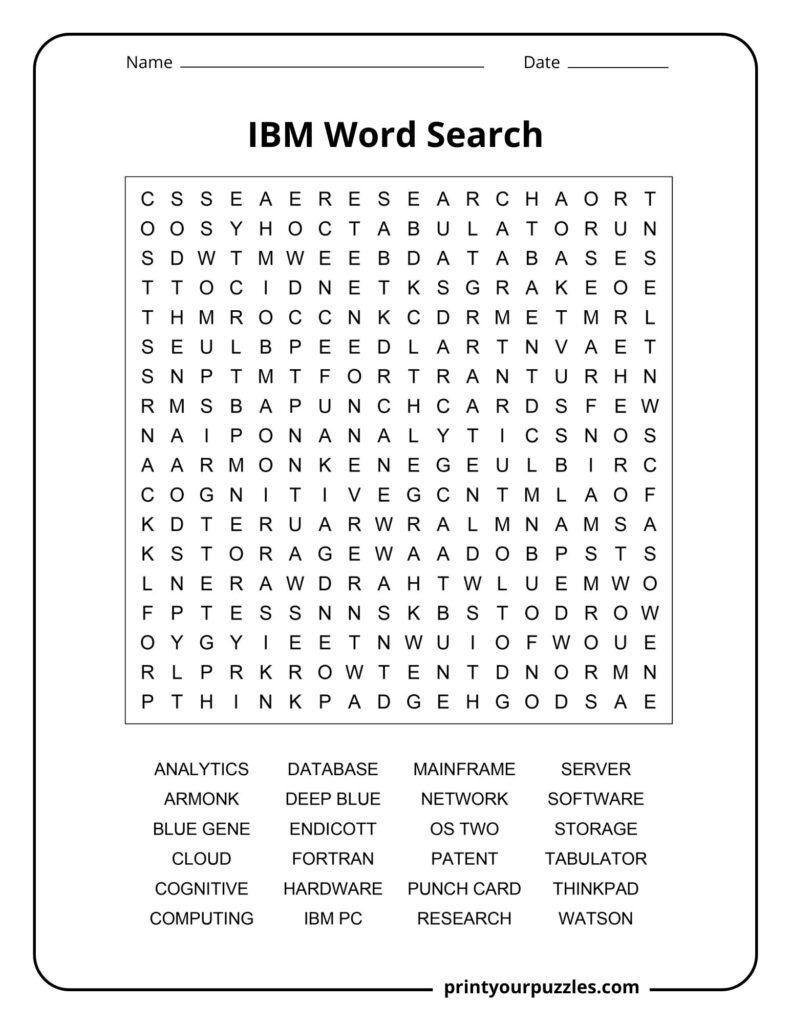
ANALYTICS, ARMONK, BLUE GENE, CLOUD, COGNITIVE, COMPUTING, DATABASE, DEEP BLUE, ENDICOTT, FORTRAN, HARDWARE, IBM PC, MAINFRAME, NETWORK, OS TWO, PATENT, PUNCH CARD, RESEARCH, SERVER, SOFTWARE, STORAGE, TABULATOR, THINKPAD, WATSON
ANALYTICS – The systematic analysis of data and statistics to discover patterns and improve business decisions, a core IBM service offering since the mainframe era.
ARMONK – Small town in New York State where IBM established its global headquarters in 1964, remaining the company’s official corporate home to this day.
BLUE GENE – IBM’s series of supercomputers designed for high-performance scientific computing, breaking multiple world speed records and advancing research in biology, physics, and climate modeling.
CLOUD – Internet-based computing infrastructure and services that IBM embraced through its IBM Cloud platform, transforming how businesses store, manage, and process their data remotely.
COGNITIVE – IBM’s term for artificial intelligence systems that simulate human thought, most famously represented by Watson, capable of learning, reasoning, and understanding natural language.
COMPUTING – The foundational discipline IBM has shaped since 1911, driving the evolution from mechanical tabulation machines to mainframes, personal computers, and today’s cloud-based systems.
DATABASE – Organized systems for storing and retrieving structured information, with IBM pioneering relational database technology through research that gave birth to the SQL language.
DEEP BLUE – IBM’s legendary chess-playing computer that defeated world champion Garry Kasparov in 1997, marking a historic milestone in artificial intelligence and machine computation.
ENDICOTT – Town in New York State considered IBM’s birthplace, where founder Thomas Watson Sr. built early manufacturing facilities and established the company’s foundational corporate culture.
FORTRAN – Formula Translation programming language developed by IBM in 1957, becoming the first widely adopted high-level language and revolutionizing how scientists and engineers write software.
HARDWARE – Physical computing components that IBM has designed and manufactured for over a century, from early punch card machines to today’s advanced servers and quantum processors.
IBM PC – The personal computer IBM launched in 1981, setting industry standards that defined the modern PC era and reshaping how individuals and businesses use computers.
MAINFRAME – Large, powerful centralized computers that remain IBM’s flagship product, processing massive transaction volumes for banks, governments, and enterprises around the world every day.
NETWORK – Interconnected systems enabling communication between computers, an area where IBM contributed foundational technologies including SNA architecture that shaped modern enterprise networking infrastructure.
OS TWO – IBM’s graphical operating system launched in 1987 as an advanced alternative to DOS, featuring multitasking capabilities but ultimately losing the desktop market to Microsoft Windows.
PATENT – IBM has led the world in annual patent filings for decades, protecting thousands of innovations yearly across computing, artificial intelligence, semiconductors, and cloud technologies.
PUNCH CARD – Early data storage medium using holes in paper cards to encode information, which IBM industrialized and dominated commercially for decades before electronic storage emerged.
RESEARCH – IBM Research is one of the world’s largest corporate research organizations, with laboratories across multiple continents producing breakthroughs in quantum computing, AI, and materials science.
SERVER – Powerful computers that manage network resources and deliver data to other machines, with IBM’s server lines powering critical infrastructure for enterprises and institutions globally.
SOFTWARE – Programs and operating systems that IBM has developed since its earliest days, evolving from simple machine instructions to enterprise platforms managing complex global business operations.
STORAGE – Technologies for preserving digital data, where IBM pioneered critical innovations including the hard disk drive, invented in 1956 at IBM’s San Jose research laboratory.
TABULATOR – Electromechanical machine that processed punch cards to compile statistics, IBM’s original core product descended from Herman Hollerith’s invention used in the 1890 US Census.
THINKPAD – IBM’s iconic line of business laptops introduced in 1992, celebrated for durability, reliability, and the distinctive TrackPoint pointing device, later sold to Lenovo in 2005.
WATSON – IBM’s flagship AI platform named after founder Thomas Watson, gaining worldwide fame in 2011 by defeating human champions on the television quiz show Jeopardy.
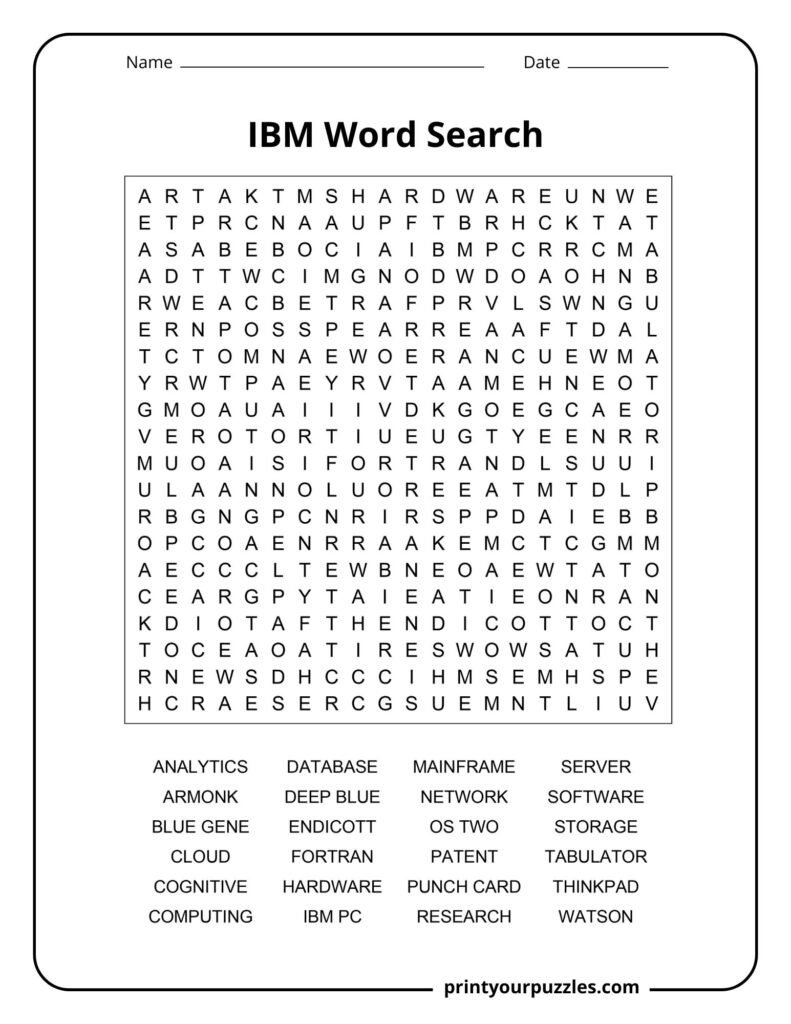
ANALYTICS, ARMONK, BLUE GENE, CLOUD, COGNITIVE, COMPUTING, DATABASE, DEEP BLUE, ENDICOTT, FORTRAN, HARDWARE, IBM PC, MAINFRAME, NETWORK, OS TWO, PATENT, PUNCH CARD, RESEARCH, SERVER, SOFTWARE, STORAGE, TABULATOR, THINKPAD, WATSON
IBM was founded in 1911 as the Computing-Tabulating-Recording Company by Charles Ranlett Flint, later renamed International Business Machines in 1924 under Thomas Watson Sr.
The 1981 release of the IBM PC revolutionized personal computing, establishing hardware and software standards that shaped the entire technology industry for decades afterward.
Facing declining hardware profits in the 1990s, IBM strategically shifted toward consulting, software, and cloud services, selling its PC division to Lenovo in 2005.
IBM pioneered practical AI through Deep Blue’s chess victory in 1997 and Watson’s Jeopardy win in 2011, later expanding into enterprise AI and cognitive computing solutions.
IBM has topped global patent rankings for over two decades, with research labs worldwide delivering breakthroughs in quantum computing, blockchain, semiconductor design, and artificial intelligence.
The Greatest Capitalist Who Ever Lived: Tom Watson Jr. and the Epic Story of How IBM Created the Digital Age by Marc Wortman & Ralph Watson McElvenny. Wortman masterfully weaves IBM’s epoch-defining technological gambles with gripping family drama, turning the Watson dynasty into near-Shakespearean figures who literally built the digital age.
Before focusing on technology, IBM’s predecessor company sold various products including cheese slicers and meat scales, reflecting its diverse commercial origins before Watson’s leadership.
IBM’s RAMAC 350 stored just 5 megabytes across 50 spinning platters and weighed over a ton, yet revolutionized data storage forever by replacing magnetic tape systems.
Thomas Watson Sr. enforced a strict white shirt and dark suit dress code company-wide, creating IBM’s legendary corporate culture nicknamed the “Big Blue” professional identity.
IBM computers and engineers played a critical role in the Apollo space program, providing essential computing power and technical support throughout NASA’s historic Moon landing missions.
From tabulating machines to mainframes, then personal computers, and finally cloud and AI services, IBM has radically transformed its entire business model across different technological eras.