
General Electric, often known simply as GE, has a long history connected with electricity, engineering, manufacturing, and technological innovation. The company was formed in 1892 through the merger of Edison General Electric Company and Thomson-Houston Electric Company, two important businesses competing in the rapidly developing electrical industry. Thomas Edison’s earlier work on electric lighting, power systems, and related inventions helped create part of the foundation from which GE emerged.
The timing was important. During the late nineteenth and early twentieth centuries, electricity was beginning to transform homes, factories, transportation, and cities. GE grew by producing equipment that helped generate, distribute, and use electrical power. As demand increased, the company expanded its factories, research facilities, and product lines, becoming closely associated with the wider electrification of American life.
Research became one of GE’s greatest strengths. The company established industrial laboratories where scientists and engineers worked on new materials, lighting, motors, turbines, electronics, and other technologies. This investment in research allowed GE to move into many different industries instead of depending on a single product. Over time, its name appeared on everything from household appliances and light bulbs to locomotives, aircraft engines, medical equipment, and power-generation systems.
That extraordinary variety makes a General Electric word search a particularly broad topic. Electricity, Edison, turbines, appliances, aviation, laboratories, engineering, and industry all represent different stages in the company’s growth.
During the twentieth century, GE became one of America’s largest industrial corporations. It expanded internationally and entered fields such as broadcasting, healthcare technology, aerospace, finance, and energy. Products carrying the GE name became familiar in everyday homes, while much larger GE systems operated behind the scenes in hospitals, factories, airports, and power plants.
General Electric changed significantly over time, entering and leaving different businesses as markets and technology evolved. Even so, its history remains closely linked with electrification, industrial research, and modern engineering. From the early electrical age to advanced aviation and energy systems, GE’s growth shows how a company can expand by repeatedly applying scientific knowledge to new industries.
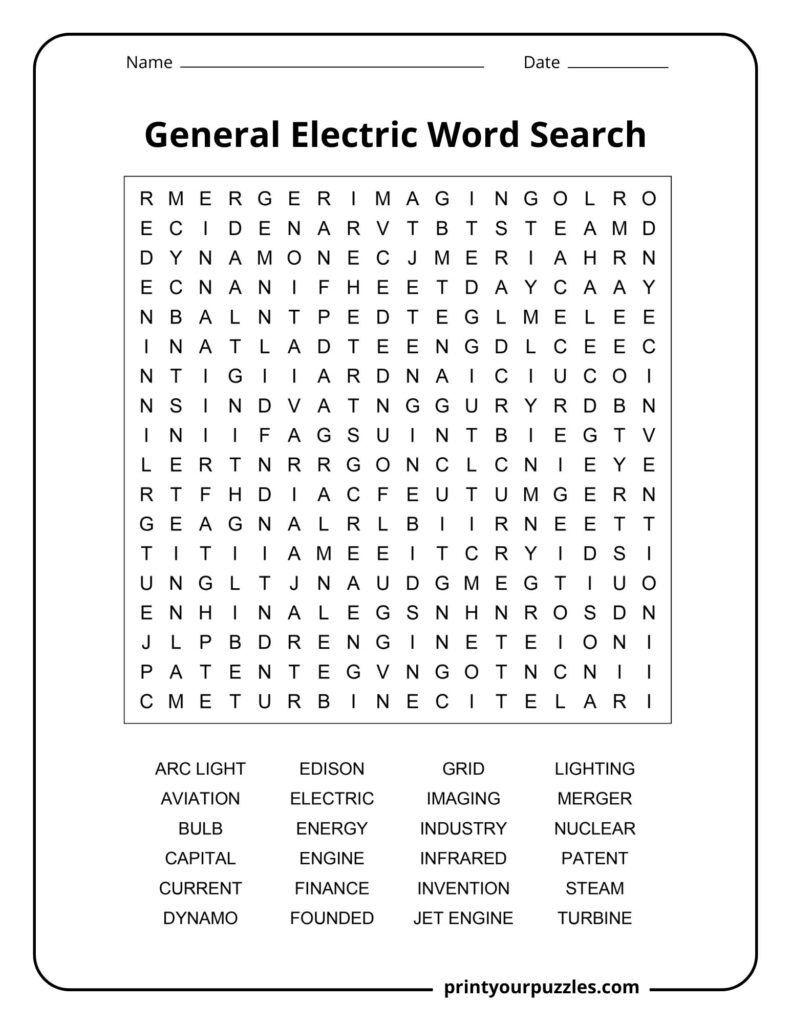
ARC LIGHT, AVIATION, BULB, CAPITAL, CURRENT, DYNAMO, EDISON, ELECTRIC, ENERGY, ENGINE, FINANCE, FOUNDED, GRID, IMAGING, INDUSTRY, INFRARED, INVENTION, JET ENGINE, LIGHTING, MERGER, NUCLEAR, PATENT, STEAM, TURBINE
ARC LIGHT – An early electric lighting technology that produces intense illumination by maintaining an electrical arc between two carbon electrodes, widely used in industrial and theatrical settings during GE’s early years.
AVIATION – General Electric became a major force in the aerospace industry by developing powerful and reliable jet engines, powering both commercial airliners and military aircraft across the globe.
BULB – The incandescent light bulb, closely associated with Thomas Edison and later GE, revolutionized how humanity illuminated homes, streets, and workplaces, becoming one of history’s most transformative inventions.
CAPITAL – GE Capital grew into one of the largest financial services divisions in the world, offering lending, leasing, and investment solutions before being largely dismantled after the 2008 financial crisis.
CURRENT – Electrical current was central to GE’s founding mission, as the company pioneered the transmission, distribution, and practical application of both alternating and direct current in everyday use.
DYNAMO – The dynamo, an early electrical generator converting mechanical energy into electricity, was fundamental to GE’s origins and helped establish the infrastructure for modern electrical power systems worldwide.
EDISON – Thomas Alva Edison, one of history’s greatest inventors, co-founded the company that became General Electric, shaping its early identity around innovation, electricity, and practical technological solutions.
ELECTRIC – Electricity is the very foundation of General Electric’s identity, driving over a century of innovation in power generation, distribution, appliances, lighting, and industrial applications around the world.
ENERGY – GE has long been a global leader in energy production, developing technologies for fossil fuel, nuclear, wind, and gas power generation that supply electricity to millions worldwide.
ENGINE – From steam turbines to gas and jet engines, GE’s engineering capabilities transformed industrial power, aviation, and energy sectors, establishing the company as a premier global engine manufacturer.
FINANCE – Financial services became a massive pillar of GE’s business model throughout the late twentieth century, with GE Capital eventually representing nearly half of the entire company’s total revenues.
FOUNDED – General Electric was founded in 1892 through the merger of Edison General Electric and Thomson-Houston Electric Company, creating one of the most influential corporations in American industrial history.
GRID – The electrical grid represents one of GE’s most enduring contributions, as the company helped design, build, and modernize power distribution networks supplying electricity reliably to cities and industries worldwide.
IMAGING – GE Healthcare became a world leader in medical imaging technology, producing advanced MRI machines, CT scanners, and X-ray systems that transformed diagnostic medicine and patient care globally.
INDUSTRY – General Electric helped define American industrial might for over a century, operating across aviation, energy, healthcare, finance, and manufacturing, making it a benchmark of large-scale industrial enterprise.
INFRARED – GE contributed significantly to infrared technology development, with applications ranging from military sensing systems and night vision equipment to industrial thermal cameras and advanced scientific research tools.
INVENTION – Innovation and invention have been core to GE’s DNA since its founding, producing thousands of patents across lighting, power, aviation, medical devices, and communications throughout its long history.
JET ENGINE – GE Aviation developed some of the most powerful and fuel-efficient jet engines ever built, including the GE90, powering Boeing and other aircraft used by airlines across the world.
LIGHTING – Lighting was GE’s original business, growing from Edison’s incandescent bulb into a global enterprise encompassing fluorescent, LED, and specialty lighting solutions for residential, commercial, and industrial markets.
MERGER – GE itself was born from a merger and later pursued numerous strategic acquisitions and consolidations, using mergers as a key tool to expand into new industries and global markets.
NUCLEAR – GE became a pioneer in nuclear energy, designing and building boiling water reactors that supplied clean electricity to power plants across the United States and internationally for decades.
PATENT – Patents have been central to GE’s competitive strategy since Edison’s era, with the company accumulating tens of thousands of patents protecting innovations across nearly every industry it entered.
STEAM – Steam power was central to GE’s early industrial growth, with the company engineering advanced steam turbines and systems that drove factories, power plants, and locomotives across America and beyond.
TURBINE – GE’s gas and steam turbines are among the most advanced in the world, generating electricity for power plants globally and representing one of the company’s most enduring engineering achievements.
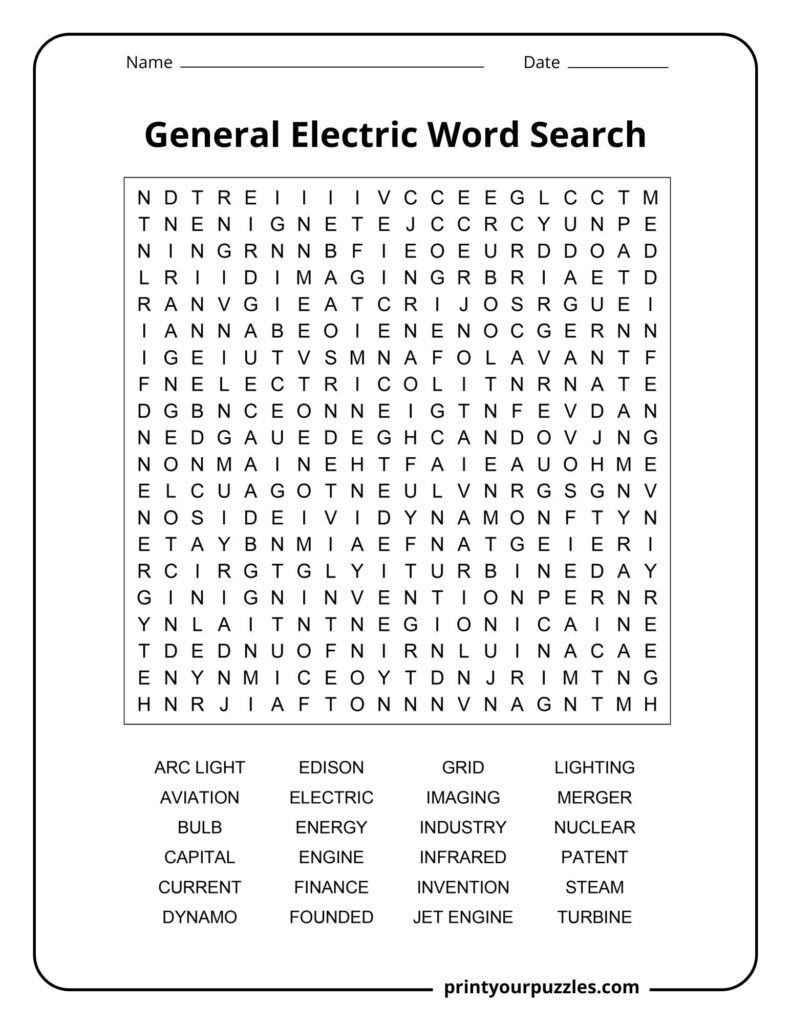
ARC LIGHT, AVIATION, BULB, CAPITAL, CURRENT, DYNAMO, EDISON, ELECTRIC, ENERGY, ENGINE, FINANCE, FOUNDED, GRID, IMAGING, INDUSTRY, INFRARED, INVENTION, JET ENGINE, LIGHTING, MERGER, NUCLEAR, PATENT, STEAM, TURBINE
General Electric was founded in 1892, formed by the merger of Edison General Electric and Thomson-Houston Electric Company, creating one of America’s most influential industrial corporations.
Thomas Alva Edison was central to GE’s creation, his pioneering work in electricity, lighting, and invention laying the foundation for the company’s early identity and long-term success.
The incandescent light bulb was GE’s defining early product, revolutionizing artificial lighting worldwide and establishing the company as a leader in electrical innovation and consumer technology.
Over decades, GE diversified into aviation, healthcare, finance, nuclear energy, and media, becoming one of the world’s largest and most complex conglomerates across multiple global industries.
GE underwent dramatic restructuring in the early 2000s through 2020s, selling major divisions, spinning off GE Healthcare and GE Vernova, and refocusing its core identity around aerospace.
Power Failure: The Rise and Fall of an American Icon by William D. Cohan. Cohan masterfully traces GE’s breathtaking arc from Edison’s lightbulb to corporate implosion, weaving meticulous reporting with page-turning narrative flair into the definitive cautionary tale of American industrial capitalism.
General Electric was one of the original members of the Dow Jones Industrial Average in 1896, remaining listed for over a century before being removed in 2018.
General Electric owned NBC for many years after acquiring RCA in 1986, making it one of the few industrial conglomerates to control a major American broadcasting and entertainment network.
During World War II, GE built the United States’ first operational jet engine in 1942, based on British designs, forever transforming military and commercial aviation history.
The iconic GE monogram logo has remained remarkably consistent since the 1890s, making it one of the most enduring and recognizable corporate identity symbols in global business history.
At its peak in 2000, General Electric became the most valuable company on earth, reaching a market capitalization of nearly 600 billion dollars under legendary CEO Jack Welch’s leadership.