Introduction to the Alaska Word Search
Glaciers, mountains, whales, bears, northern lights, and endless wilderness make Alaska feel larger than ordinary imagination. Located in the Pacific region, Alaska is the largest state in the United States by far, yet it has fewer than one million residents. Juneau is the capital, Anchorage is the largest city, and the state’s nickname, The Last Frontier, reflects its vast landscapes and spirit of exploration.
Alaska’s size is difficult to picture. It is larger than Texas, California, and Montana combined, with coastlines, islands, forests, tundra, rivers, mountain ranges, and Arctic landscapes spread across an enormous area. Denali, the tallest peak in North America, rises in the Alaska Range, while thousands of glaciers slowly shape valleys and coastlines. In summer, some northern communities experience nearly continuous daylight; in winter, long nights can bring the breathtaking glow of the Northern Lights.
An Alaska word search can introduce students and puzzle lovers to a state filled with dramatic geography, wildlife, and history. For thousands of years, Alaska has been home to Indigenous peoples, including Iñupiat, Yup’ik, Aleut, Tlingit, Haida, Athabascan, and many others. Their cultures, languages, art, and knowledge of the land and sea remain essential to Alaska’s identity. The United States purchased Alaska from Russia in 1867, and it became the 49th state in 1959.
Wildlife is one of Alaska’s greatest symbols. Moose, caribou, wolves, bald eagles, puffins, salmon, seals, sea otters, humpback whales, orcas, and brown bears all live in its varied environments. Food also reflects these cold waters and wild landscapes: salmon, halibut, crab, reindeer sausage, berries, sourdough bread, and traditional Native foods connect people to both land and sea. The economy includes fishing, oil, tourism, transportation, outdoor recreation, scientific research, and natural resources.
Whether visitors come to cruise past glaciers, watch bears catch salmon, hike through national parks, or learn about Arctic life, Alaska offers an unforgettable sense of scale. As you complete this free printable Alaska word search, look for words connected to its animals, mountains, cultures, history, and natural wonders. Every hidden word offers another way to discover why Alaska truly stands apart from every other American state.
Ready to travel through the Pacific States and beyond? Try our Hawaii word search, Washington word search, Oregon word search, and the full US States Word Searches collection.
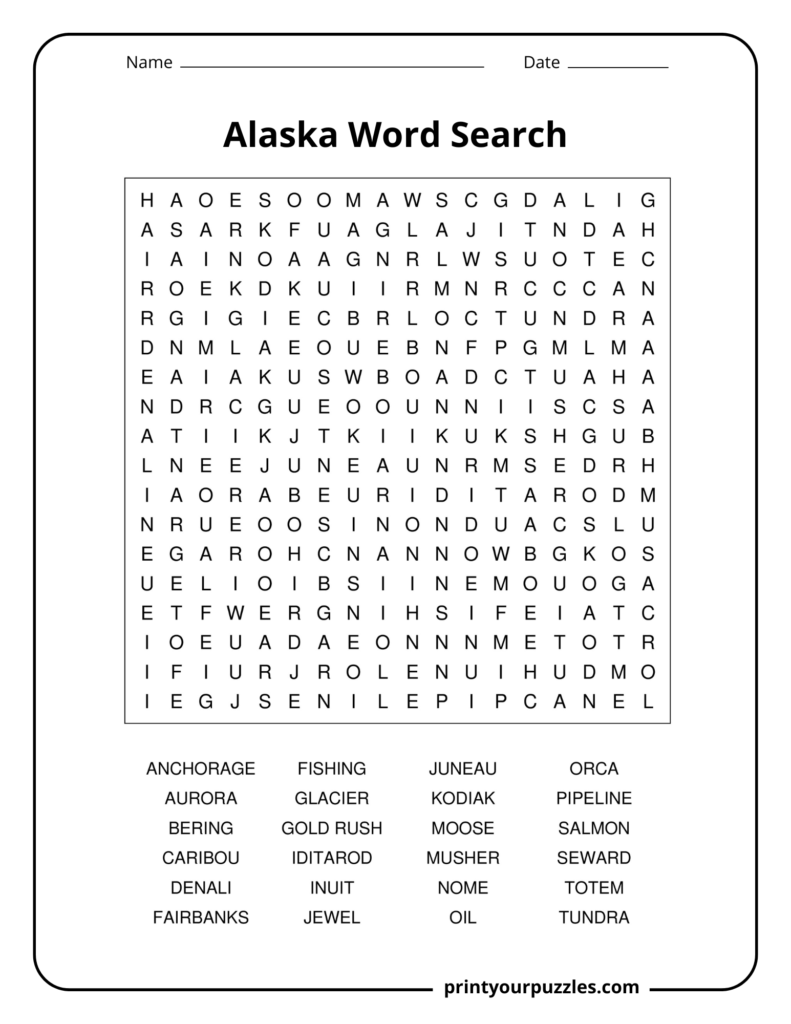
Medium Difficulty Word Search
Words to Find
ANCHORAGE, AURORA, BERING, CARIBOU, DENALI, FAIRBANKS, FISHING, GLACIER, GOLD RUSH, IDITAROD, INUIT, JEWEL, JUNEAU, KODIAK, MOOSE, MUSHER, NOME, OIL, ORCA, PIPELINE, SALMON, SEWARD, TOTEM, TUNDRA
All Words Defined
ANCHORAGE – Alaska’s largest city with over 290,000 residents, serving as the state’s economic and cultural hub. Located in south-central Alaska, it’s a gateway to wilderness adventures and outdoor activities.
AURORA – The Aurora Borealis or Northern Lights, a spectacular natural light display visible in Alaska’s night sky. Caused by solar particles colliding with Earth’s atmosphere, creating colorful dancing lights.
BERING – Named after Vitus Bering, the Danish explorer who led Russian expeditions discovering Alaska in 1741. The Bering Sea and Bering Strait separate Alaska from Russia by 55 miles.
CARIBOU – Large migratory deer species found throughout Alaska’s tundra and boreal forests. These animals travel in vast herds, providing essential resources for Alaska Native peoples and supporting Arctic ecosystems.
DENALI – North America’s highest peak at 20,310 feet, formerly called Mount McKinley. The name means “the high one” in the native Athabascan language, representing Alaska’s most iconic natural landmark.
FAIRBANKS – Alaska’s second-largest city located in the interior, known for extreme temperature variations and excellent aurora viewing. Founded during the gold rush, it serves as a cultural and educational center.
FISHING – A cornerstone of Alaska’s economy and culture, with commercial fishing generating billions annually. Salmon, halibut, and crab fisheries support communities and provide world-renowned seafood to global markets.
GLACIER – Massive rivers of ice covering much of Alaska, with over 100,000 glaciers statewide. These ancient ice formations shape landscapes, attract tourists, and serve as climate change indicators worldwide.
GOLD RUSH – The late 1890s Klondike and Nome gold rushes brought thousands of prospectors to Alaska. This transformative period established towns, sparked population growth, and shaped Alaska’s frontier character permanently.
IDITAROD – The famous 1,000-mile dog sled race from Anchorage to Nome, held annually since 1973. Commemorates a historic serum run and celebrates Alaska’s mushing heritage through grueling wilderness competition.
INUIT – Indigenous peoples inhabiting Alaska’s Arctic and sub-Arctic regions for thousands of years. Their rich culture, subsistence lifestyle, and traditional knowledge remain vital to Alaska’s identity and communities today.
JEWEL – Jewel Kilcher, Grammy-nominated singer-songwriter raised in Homer, Alaska. Her music often reflects her Alaskan upbringing and frontier lifestyle, achieving international fame in the 1990s.
JUNEAU – Alaska’s capital city, accessible only by boat or plane, with no road connections. Nestled between mountains and sea, it serves as the state’s political center with approximately 32,000 residents.
KODIAK – Alaska’s largest island, famous for massive Kodiak brown bears weighing up to 1,500 pounds. The island also features rich fishing grounds and a significant Alaska Native cultural presence.
MOOSE – Alaska’s largest land mammal, with bulls weighing up to 1,600 pounds and standing seven feet tall. These iconic animals inhabit forests and wetlands, providing important subsistence resources.
MUSHER – A dog sled driver who commands and cares for sled dog teams. Mushers maintain Alaska’s traditional transportation method, competing in races and providing wilderness tours throughout the state.
NOME – Historic gold rush town on Alaska’s western coast, famous as the Iditarod’s finish line. Despite its remote location on the Bering Sea, Nome remains a vibrant community and regional hub.
OIL – Alaska’s primary revenue source since the 1968 Prudhoe Bay discovery, providing billions in state income. The petroleum industry transformed Alaska’s economy and funds essential government services through oil taxes.
ORCA – Killer whales inhabiting Alaska’s coastal waters, particularly Southeast Alaska and Prince William Sound. These intelligent marine mammals attract wildlife enthusiasts and play crucial roles in marine ecosystems.
PIPELINE – The Trans-Alaska Pipeline System stretches 800 miles from Prudhoe Bay to Valdez, transporting crude oil across permafrost and mountain ranges. Completed in 1977, it revolutionized Alaska’s economy.
SALMON – Five species of Pacific salmon return to Alaska’s rivers annually in massive spawning runs. These fish support commercial and subsistence fisheries, wildlife, and represent Alaska’s natural abundance.
SEWARD – Named after William Seward, the U.S. Secretary of State who purchased Alaska from Russia in 1867. The coastal town serves as a major port and gateway to Kenai Fjords National Park.
TOTEM – Carved wooden poles created by Alaska Native peoples, particularly Tlingit, Haida, and Tsimshian cultures. These monuments tell stories, commemorate events, and display family crests through intricate artistic designs.
TUNDRA – Vast treeless Arctic landscape covering much of northern Alaska, characterized by permafrost and low-growing vegetation. This harsh but beautiful ecosystem supports unique wildlife adapted to extreme conditions.
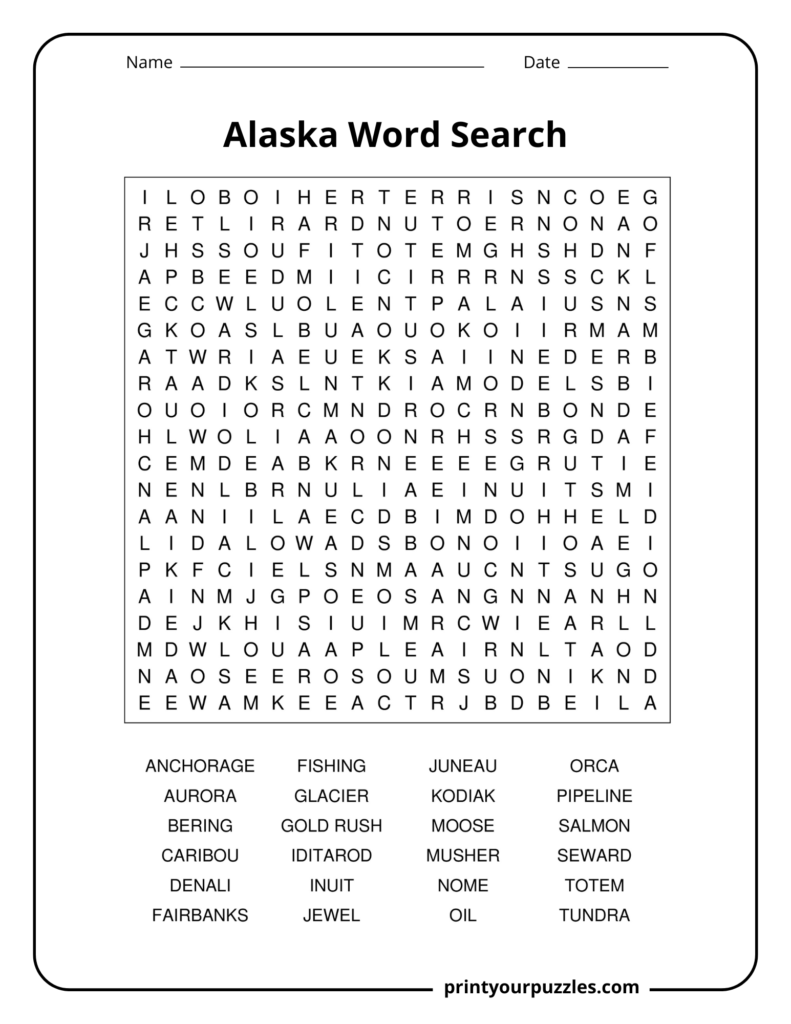
Hard Difficulty Word Search
Words to Find
ANCHORAGE, AURORA, BERING, CARIBOU, DENALI, FAIRBANKS, FISHING, GLACIER, GOLD RUSH, IDITAROD, INUIT, JEWEL, JUNEAU, KODIAK, MOOSE, MUSHER, NOME, OIL, ORCA, PIPELINE, SALMON, SEWARD, TOTEM, TUNDRA
6 Key FAQs About Alaska
5 Curious "Did You Know?" Facts About Alaska