
Good Friday is a Christian observance that remembers the crucifixion and death of Jesus Christ. It takes place during Holy Week, two days before Easter Sunday, and its date changes each year because Easter follows a movable calendar. Despite the word “Good” in its name, the day is solemn rather than festive, focusing on sacrifice, suffering, forgiveness, and the meaning of Jesus’s death in Christian belief.
According to the New Testament, Jesus was arrested in Jerusalem, questioned by religious and Roman authorities, and sentenced to death by crucifixion. He was forced to carry his cross toward Golgotha, also known as Calvary, where he was crucified alongside two other men. Christians believe that his death was an act of love and sacrifice that opened the way to forgiveness and reconciliation with God.
The origin of the English name “Good Friday” is not completely certain. Some explanations suggest that “good” once carried the meaning of holy or spiritually important. Others connect the name with the belief that, although the events were painful, they ultimately led to the hope and joy of Easter Sunday.
Churches observe Good Friday in different ways. Services are often quiet and reflective, with prayers, Bible readings, hymns, and periods of silence. Some congregations read the story of the Passion, while others follow the Stations of the Cross, a series of scenes that recall Jesus’s journey to crucifixion. Crosses may be covered or displayed without decoration, and church bells may remain silent.
Fasting and abstinence are also common traditions. Many Catholics avoid eating meat, while some Christians eat simpler meals or reduce their food as an act of devotion. In several countries, public processions, dramatic reenactments, and candlelight ceremonies bring communities together.
Good Friday is observed as a public holiday in some nations, but not everywhere. Businesses, schools, and government offices may close depending on local customs and laws. The day forms part of the Easter Triduum, which begins on Holy Thursday and continues through Easter Sunday.
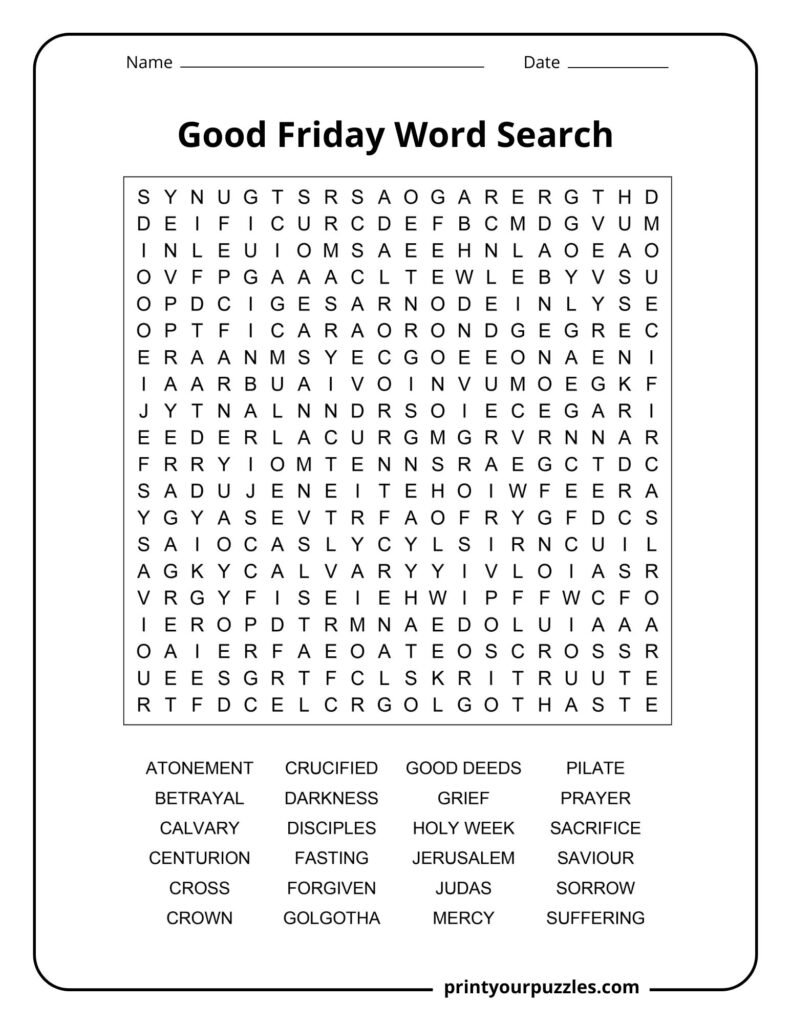
Explore the people, places, symbols, and Christian traditions connected with this solemn occasion through this Good Friday word search, featuring 24 carefully selected words inspired by Holy Week, prayer, the cross, Jerusalem, sacrifice, faith, and reflection.
Related Word Searches:
Easter | April | Spring | Passover | Palm Sunday
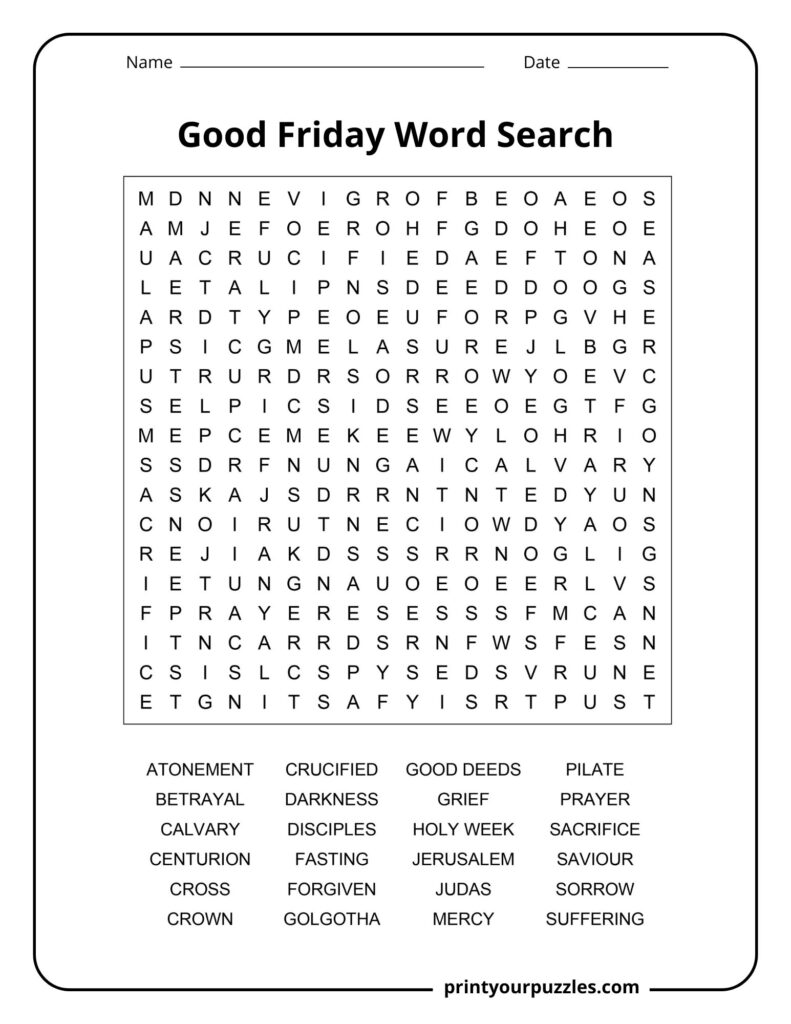
ATONEMENT, BETRAYAL, CALVARY, CENTURION, CROSS, CROWN, CRUCIFIED, DARKNESS, DISCIPLES, FASTING, FORGIVEN, GOLGOTHA, GOOD DEEDS, GRIEF, HOLY WEEK, JERUSALEM, JUDAS, MERCY, PILATE, PRAYER, SACRIFICE, SAVIOUR, SORROW, SUFFERING
ATONEMENT – The act of making amends for sin through sacrifice. On Good Friday, Christians believe Jesus atoned for all of humanity’s sins by giving his life on the cross.
BETRAYAL – The act of being disloyal to someone who trusted you. Judas Iscariot betrayed Jesus to the chief priests for thirty pieces of silver, leading directly to his arrest.
CALVARY – The hill outside Jerusalem where Jesus was crucified. Also known as Golgotha, Calvary is the sacred site central to the entire Good Friday story of sacrifice.
CENTURION – A Roman military officer commanding about a hundred soldiers. At the crucifixion, a centurion witnessed Jesus die and declared him to be the Son of God.
CROSS – The wooden structure on which Jesus was crucified. The cross is the most recognized symbol of Christianity, representing both suffering and the ultimate hope of salvation.
CROWN – Roman soldiers twisted thorns into a crown and pressed it onto Jesus’s head to mock his title as King of the Jews, causing him pain and humiliation before his crucifixion.
CRUCIFIED – Put to death by being nailed or bound to a cross. Jesus was crucified between two criminals on Good Friday, fulfilling the prophecies written about him in scripture.
DARKNESS – According to the Gospels, darkness covered the land for three hours while Jesus hung on the cross, a powerful sign of mourning and the weight of the moment.
DISCIPLES – The twelve followers chosen by Jesus to learn his teachings and spread his message. On Good Friday, most fled in fear, though some stayed close to witness the crucifixion.
FASTING – Voluntarily going without food or certain meals as an act of prayer and reflection. Many Christians fast on Good Friday as a way to honour Jesus’s suffering and sacrifice.
FORGIVEN – Released from guilt or blame for wrongdoing. One of Jesus’s last acts on the cross was to ask God to forgive those who crucified him, showing boundless mercy and love.
GOLGOTHA – An Aramaic word meaning “place of the skull,” referring to the hill where Jesus was crucified. It is the same location as Calvary and holds deep significance in Christian faith.
GOOD DEEDS – Acts of kindness and charity done for others. On Good Friday, many Canadians perform good deeds in memory of Jesus’s selfless love and as a way to live out his teachings.
GRIEF – Deep sorrow felt after a great loss. Good Friday is a day of grief for Christians worldwide, mourning the suffering and death of Jesus before the joy of Easter Sunday arrives.
HOLY WEEK – The final week of Lent leading up to Easter Sunday. Holy Week begins with Palm Sunday and includes Good Friday, making it the most sacred period in the Christian calendar.
JERUSALEM – The ancient city where Jesus was arrested, tried, and crucified. Jerusalem remains one of the holiest cities in the world and the historical setting of the entire Good Friday story.
JUDAS – One of the twelve disciples who betrayed Jesus to the authorities for thirty pieces of silver. His name has since become a symbol of treachery and disloyalty throughout history.
MERCY – Compassion shown toward someone in one’s power. Good Friday reflects God’s mercy toward humanity, offering forgiveness through the sacrifice of Jesus rather than punishment for sin.
PILATE – Pontius Pilate was the Roman governor who sentenced Jesus to death. Despite finding no guilt in him, Pilate yielded to the demands of the crowd and ordered the crucifixion.
PRAYER – A personal or communal conversation with God. Prayer is central to Good Friday observances, with Christians attending services and spending time in quiet reflection and solemn worship.
SACRIFICE – The giving up of something precious for a greater purpose. Jesus’s death on the cross is seen as the ultimate sacrifice, offered freely out of love to bring salvation to all people.
SAVIOUR – One who rescues others from harm or sin. Christians refer to Jesus as the Saviour because his death and resurrection are believed to have saved humanity from sin and eternal separation from God.
SORROW – A feeling of deep sadness and regret. Good Friday is marked by sorrow as believers reflect on the pain and suffering Jesus endured, and on the weight of human sin he carried.
SUFFERING – The experience of pain, hardship, and anguish. Jesus endured tremendous physical and spiritual suffering during his arrest, trial, and crucifixion, which forms the heart of the Good Friday observance.
ATONEMENT, BETRAYAL, CALVARY, CENTURION, CROSS, CROWN, CRUCIFIED, DARKNESS, DISCIPLES, FASTING, FORGIVEN, GOLGOTHA, GOOD DEEDS, GRIEF, HOLY WEEK, JERUSALEM, JUDAS, MERCY, PILATE, PRAYER, SACRIFICE, SAVIOUR, SORROW, SUFFERING
Good Friday commemorates the crucifixion and death of Jesus Christ. It falls on the Friday before Easter Sunday and is one of the most solemn days in the Christian calendar.
Despite marking a day of suffering and death, it is called “Good” because Christians believe Jesus’s sacrifice brought salvation and hope to all humanity, making it ultimately a blessed day.
In Canada, Good Friday is a federal statutory holiday. Many Canadians attend church services, fast, reflect quietly, and abstain from certain activities as a mark of respect and mourning.
Services typically include readings of the Passion narrative, prayers, hymns, and a period of silent reflection. Many churches hold a three-hour service marking the time Jesus hung on the cross.
No, Good Friday changes each year because it depends on Easter, which follows the lunar calendar. It falls between late March and late April, always on the Friday before Easter Sunday.
Unlike some holidays that vary by region, Good Friday is universally recognized across Canada, giving workers and students a day off to observe or reflect.
Churches worldwide drape altars in black or deep purple on Good Friday, symbolizing mourning, penance, and the solemnity of Jesus’s suffering and death on the cross.
These spiced buns marked with a cross on top were traditionally baked and eaten on Good Friday, symbolizing the crucifixion and carrying deep spiritual meaning for centuries.
Dramatic outdoor processions reenacting Jesus’s walk to Calvary, known as the Via Crucis, have been held in Catholic communities around the world for more than five centuries.
The Toronto Stock Exchange closes on Good Friday, making it one of the rare statutory holidays when both financial markets and most government offices shut down completely across Canada.