
Pi Day is an informal celebration of mathematics held each year on March 14. The date is written as 3/14 in the month-day format commonly used in the United States, matching the first three digits of pi: 3.14. Pi, represented by the Greek letter π, is one of the most famous numbers in mathematics and appears whenever people calculate measurements involving circles.
Pi describes the relationship between a circle’s circumference and its diameter. No matter how large or small a circle is, dividing the distance around it by the distance across its center always gives approximately 3.14159. The digits continue endlessly without repeating in a regular pattern, making pi an irrational number. For everyday calculations, people often use 3.14 or the fraction 22/7 as convenient approximations.
Mathematicians have studied pi for thousands of years. Ancient civilizations in Egypt, Babylon, China, India, and Greece developed methods for estimating its value. The Greek mathematician Archimedes produced an especially influential approximation by comparing polygons drawn inside and outside a circle. Modern computers have calculated trillions of digits, although most scientific and engineering tasks require only a small number of them.
Pi Day became increasingly popular during the late twentieth century. Physicist Larry Shaw organized a well-known celebration at the Exploratorium science museum in San Francisco in 1988. Activities included walking around a circular space and eating fruit pies, using the similarity between the words “pi” and “pie.” In 2009, the U.S. House of Representatives formally recognized March 14 as National Pi Day.
Schools often celebrate with math games, circle-measuring experiments, digit-recitation contests, puzzles, crafts, and pie-themed snacks. Students may measure round objects, divide each circumference by its diameter, and discover that the result is always close to pi. Some enthusiasts begin special activities at 1:59, forming the sequence 3.14159.
March 14 is also the birthday of physicist Albert Einstein, adding another connection with science and discovery. Pi Day shows that mathematics can be practical, surprising, creative, and enjoyable.
Explore circles, numbers, formulas, geometry, famous mathematicians, and playful traditions with this printable Pi Day word search puzzle, featuring 24 carefully selected words inspired by calculations, measurements, digits, pies, classrooms, and the fascinating number that never ends.
Related Word Searches:
March | Spring | April Fools’ Day | National Book Lovers Day | Earth Day
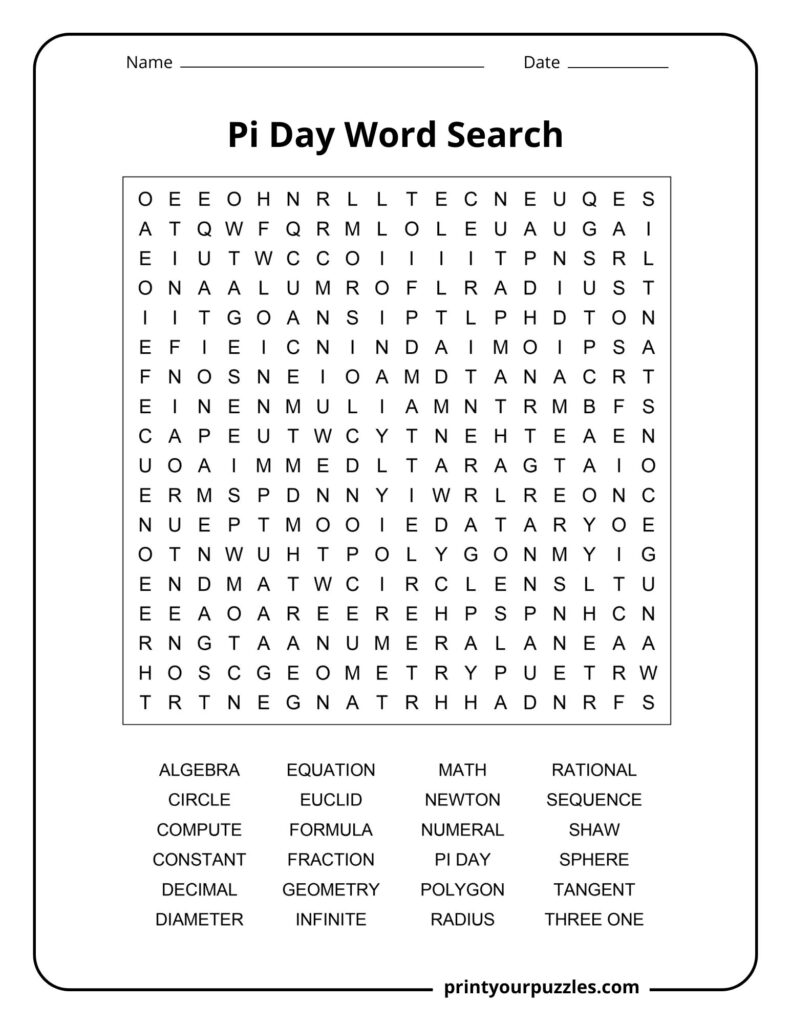
ALGEBRA, CIRCLE, COMPUTE, CONSTANT, DECIMAL, DIAMETER, EQUATION, EUCLID, FORMULA, FRACTION, GEOMETRY, INFINITE, MATH, NEWTON, NUMERAL, PI DAY, POLYGON, RADIUS, RATIONAL, SEQUENCE, SHAW, SPHERE, TANGENT, THREE ONE
ALGEBRA – A branch of mathematics that uses symbols and letters to represent numbers and quantities, solving equations and exploring relationships between variables.
CIRCLE – A perfectly round geometric shape where every point on its boundary is equidistant from the center, fundamental to understanding Pi.
COMPUTE – To perform mathematical calculations or process numerical data systematically, often used when determining complex values like Pi’s decimal digits.
CONSTANT – A fixed, unchanging numerical value in mathematics, such as Pi, which always equals approximately 3.14159 regardless of circle size.
DECIMAL – A number system using base ten with a point separating whole numbers from fractional parts, essential for expressing Pi’s infinite digits.
DIAMETER – A straight line passing through the center of a circle connecting two opposite points, exactly twice the length of the radius.
EQUATION – A mathematical statement asserting that two expressions are equal, using symbols and numbers to represent and solve complex relationships.
EUCLID – An ancient Greek mathematician whose foundational work in geometry shaped our understanding of circles, shapes, and mathematical proofs still used today.
FORMULA – A mathematical rule or relationship expressed using symbols and numbers, used to calculate values like circumference, area, and other geometric measurements.
FRACTION – A numerical representation showing division of one number by another, expressing parts of a whole, often used to approximate Pi.
GEOMETRY – The branch of mathematics studying shapes, sizes, angles, and spatial relationships, within which Pi plays a central and essential role.
INFINITE – Describing something without end or limit, perfectly characterizing Pi’s decimal expansion, which continues forever without repeating any predictable pattern.
MARCH TEN – A date reference connected to Pi Day celebrations, observed on March 14th, honoring the mathematical constant Pi worldwide.
MATH – The science of numbers, quantities, shapes, and patterns, providing the universal language through which Pi and countless constants are explored.
NEWTON – Sir Isaac Newton, the brilliant mathematician and physicist who calculated Pi to sixteen decimal places and revolutionized mathematical and scientific thinking.
NUMERAL – A symbol or written character used to represent a number, essential in expressing Pi’s infinite sequence of non-repeating decimal digits.
PI DAY – An annual celebration held on March 14th honoring the mathematical constant Pi, marked by events, competitions, and enthusiastic pie eating worldwide.
POLYGON – A closed flat shape with straight sides and angles, used historically to approximate Pi by inscribing and circumscribing circles with increasing sides.
RADIUS – The distance from the center of a circle to any point on its edge, exactly half the diameter and key to Pi calculations.
RATIONAL – Describing numbers expressible as a simple fraction of two integers, which Pi is notably not, making it an irrational number instead.
SEQUENCE – An ordered list of numbers following a specific pattern or rule, such as Pi’s digits, which form an infinite non-repeating numerical sequence.
SPHERE – A perfectly round three-dimensional shape where every surface point is equidistant from the center, whose volume and surface area formulas both require Pi.
TANGENT – A straight line touching a circle or curve at exactly one point without crossing it, a fundamental concept in geometry and trigonometry.
THREE ONE – A reference to 3.1, the beginning of Pi’s decimal value, symbolically representing the famous mathematical constant approximated as 3.14159.
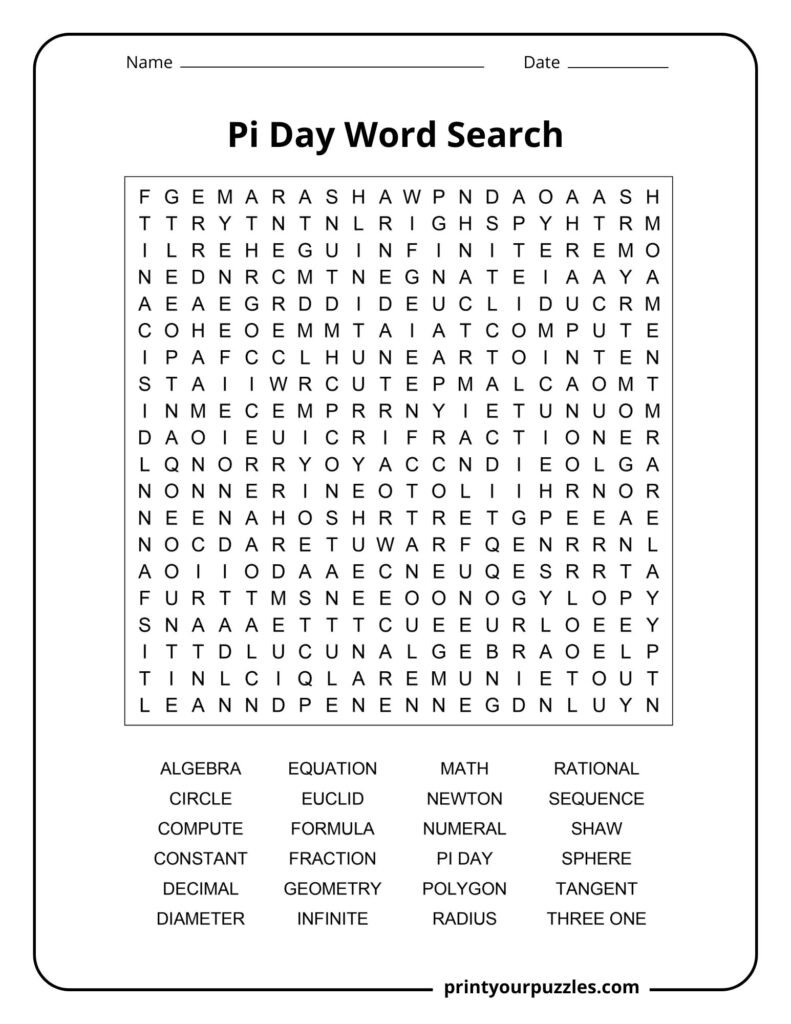
ALGEBRA, CIRCLE, COMPUTE, CONSTANT, DECIMAL, DIAMETER, EQUATION, EUCLID, FORMULA, FRACTION, GEOMETRY, INFINITE, MATH, NEWTON, NUMERAL, PI DAY, POLYGON, RADIUS, RATIONAL, SEQUENCE, SHAW, SPHERE, TANGENT, THREE ONE
Pi Day is celebrated every year on March 14th, written as 3/14, matching Pi’s first three digits: 3.14, honoring mathematics globally.
Pi is essential because it connects a circle’s circumference to its diameter, appearing in geometry, physics, engineering, and countless real-world scientific calculations.
Physicist Larry Shaw founded Pi Day in 1988 at the San Francisco Exploratorium, where staff celebrated with circular marches and pie eating festivities.
People celebrate by eating pie, reciting Pi digits, organizing math competitions, attending lectures, and engaging in fun educational activities promoting mathematics appreciation worldwide.
Yes, UNESCO officially designated March 14th as the International Day of Mathematics in 2019, recognizing Pi Day’s global importance in promoting mathematical education.
Take a look to Wikipedia and National Day Calendar about Pi Day.
But don’t forget to return—only Print Your Puzzles lets you download and print a National Boyfriend Day word search!
Albert Einstein was born on March 14th, 1879, making Pi Day a double celebration honoring both the famous constant and this brilliant physicist.
In 2022, Google engineer Emma Haruka Iwao broke the world record by computing Pi to 100 trillion decimal places using cloud computing technology.
Babylonians and Egyptians approximated Pi around 1900 BC, using values close to 3.125 and 3.1605 respectively for their architectural and astronomical calculations.
The world record for memorizing Pi belongs to Rajveer Meena of India, who recited 70,000 digits blindfolded over ten consecutive hours in 2015.
Pi is used in GPS technology, musical sound waves, medical imaging, engineering structures, and even describing the natural winding patterns of rivers worldwide.