Introduction to the Remembrance Day Word Search
Remembrance Day is observed each year on November 11 to honor members of the armed forces who died during wars and military service. It is especially important in Canada, the United Kingdom, Australia, New Zealand, and other Commonwealth countries. The occasion combines public ceremonies, personal reflection, historical education, and gratitude for those who served.
The date is connected with the end of fighting in the First World War. An armistice between Germany and the Allied powers took effect at the eleventh hour of the eleventh day of the eleventh month in 1918. Although the peace settlement came later, November 11 became a powerful symbol of the moment when the conflict’s major battles stopped.
The observance was originally called Armistice Day and focused mainly on those who died during the First World War. After the Second World War and later conflicts, its meaning expanded to remember military personnel from many different periods. In the United States, November 11 is known as Veterans Day and honors all military veterans, while Memorial Day specifically remembers those who died in service.
The red poppy is the best-known symbol of Remembrance Day. Poppies grew in fields damaged by fighting in Belgium and northern France, and they became closely associated with the poem “In Flanders Fields,” written by Canadian physician and soldier John McCrae. People often wear artificial poppies and make donations to organizations that support veterans and their families.
Ceremonies commonly take place at war memorials and cenotaphs. They may include wreath-laying, military music, prayers, speeches, the reading of names, and the playing of the “Last Post.” At 11:00 a.m., many people observe two minutes of silence to remember the dead and reflect on the consequences of war. Flags may be lowered, and veterans, service members, officials, students, and community groups often participate.
Schools may teach students about the world wars, peace, sacrifice, and the experiences of soldiers and civilians. Remembrance Day is generally solemn rather than celebratory, emphasizing respect and thoughtful reflection.
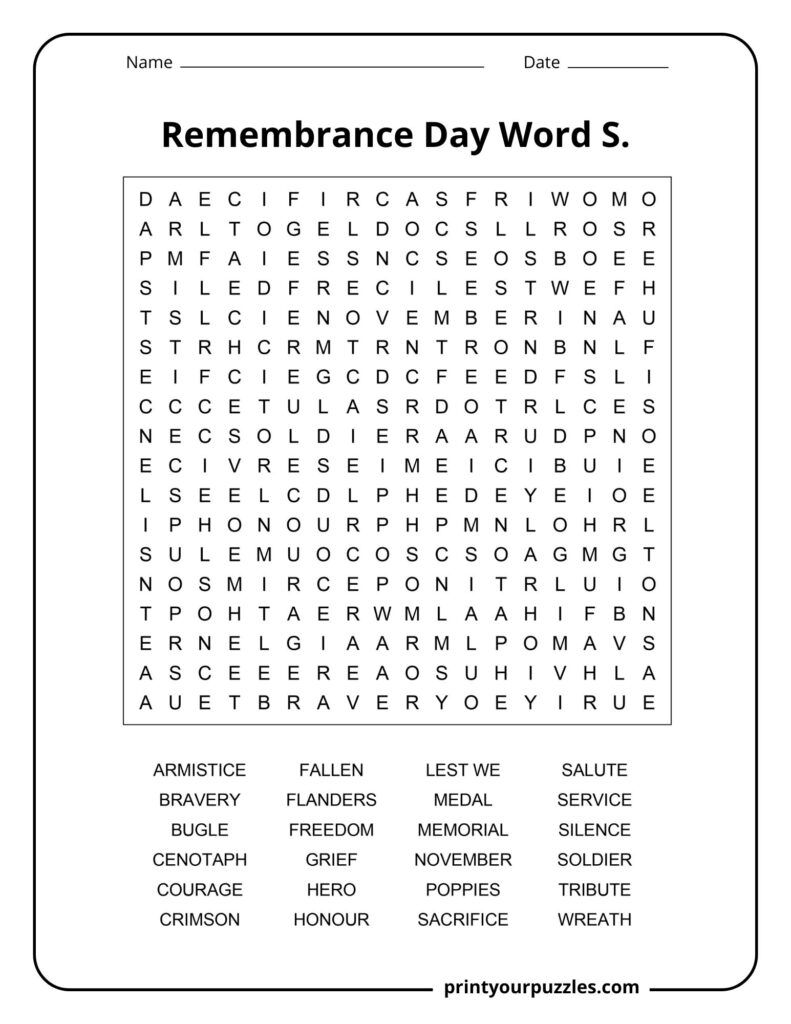
Honor the history, symbols, ceremonies, and spirit of remembrance with this Remembrance Day word search, featuring 24 carefully selected words inspired by poppies, veterans, memorials, peace, courage, wreaths, silence, and the lasting importance of November 11.
We invite you to discover two important days observed in the United Kingdom: Boxing Day and Spring Bank Holiday.
Related Word Searches:
Veterans Day | Memorial Day | November | Canada Day | Independence Day
Medium Difficulty Word Search
Words to Find
ARMISTICE, BRAVERY, BUGLE, CENOTAPH, COURAGE, CRIMSON, FALLEN, FLANDERS, FREEDOM, GRIEF, HERO, HONOUR, LEST WE, MEDAL, MEMORIAL, NOVEMBER, POPPIES, SACRIFICE, SALUTE, SERVICE, SILENCE, SOLDIER, TRIBUTE, WREATH
All Words Defined
ARMISTICE – An official agreement between opposing forces to stop fighting, marking the end of World War One on the 11th hour of the 11th day of the 11th month, 1918.
BRAVERY – The quality of facing danger, fear or adversity with courage and determination, shown by countless soldiers who fought selflessly for their country and fellow comrades.
BUGLE – A brass military instrument used to signal commands on the battlefield, and traditionally played at Remembrance ceremonies to sound the Last Post as a farewell to the fallen.
CENOTAPH – An empty tomb or monument erected in honour of soldiers whose bodies were never recovered, with the most famous UK example standing in Whitehall, London.
COURAGE – The inner strength that allows individuals to act in the face of great fear or danger, demonstrated daily by servicemen and women who risked everything for peace and freedom.
CRIMSON – A deep, rich shade of red strongly associated with the poppy, symbolising the blood shed by soldiers on the battlefields of Europe and beyond during times of war.
FALLEN – A respectful term used to refer to all military personnel who lost their lives in service of their country, honoured every year during Remembrance ceremonies across the United Kingdom.
FLANDERS – A region of Belgium where some of World War One’s bloodiest battles took place, immortalised in the famous poem “In Flanders Fields” describing poppies growing over soldiers’ graves.
FREEDOM – The fundamental right to live without oppression or tyranny, which millions of soldiers fought and died to protect and preserve for future generations throughout both World Wars.
GRIEF – The deep sorrow and emotional pain felt by families, friends and communities who lost loved ones to war, a feeling that unites nations every Remembrance Sunday in shared mourning.
HERO – A person who displays exceptional bravery, selflessness and sacrifice in the face of danger, a title rightly given to every serviceman and woman who served their country with honour.
HONOUR – The deep respect and recognition given to those who served and sacrificed during conflict, and a core value that guides military conduct, ceremony and the act of remembrance itself.
LEST WE – The opening words of the Ode of Remembrance, derived from Laurence Binyon’s poem, pledging that those who gave their lives in war shall never be forgotten by future generations.
MEDAL – A metal decoration awarded to military personnel in recognition of bravery, distinguished service or participation in a campaign, often worn proudly by veterans during Remembrance Day parades.
MEMORIAL – A structure, ceremony or dedicated space created to preserve the memory of those who died in conflict, ensuring their sacrifice is acknowledged and respected by all future generations.
NOVEMBER – The eleventh month of the year and the time when Remembrance Day is observed, with the two-minute silence held on the eleventh day to mark the end of World War One.
POPPIES – Red flowers that grew abundantly across the war graves of Flanders after World War One, now worn as a widely recognised symbol of remembrance and respect for the fallen.
SACRIFICE – The act of giving up something precious, including one’s own life, for the benefit of others, representing the ultimate gift made by soldiers who died defending their nation and values.
SALUTE – A formal military gesture of respect performed by raising the hand to the forehead, used during ceremonies to honour fallen soldiers, visiting dignitaries and the national flag.
SERVICE – The commitment and dedication shown by military personnel who voluntarily put their lives at risk to protect their country, its people and the values of democracy and peace.
SILENCE – The two-minute pause observed across the United Kingdom every Remembrance Day, during which all activity stops as a mark of collective respect and reflection for those lost in war.
SOLDIER – A trained member of an army who serves on the frontline during conflict, many of whom made the ultimate sacrifice during the World Wars and other military campaigns throughout history.
TRIBUTE – A public act of gratitude and respect shown towards those who served in the armed forces, expressed through ceremonies, wreaths, poems, memorials and the wearing of the red poppy.
WREATH – A circular arrangement of flowers and foliage, traditionally made with red poppies, laid at war memorials and cenotaphs by dignitaries and families as a symbol of honour and remembrance.
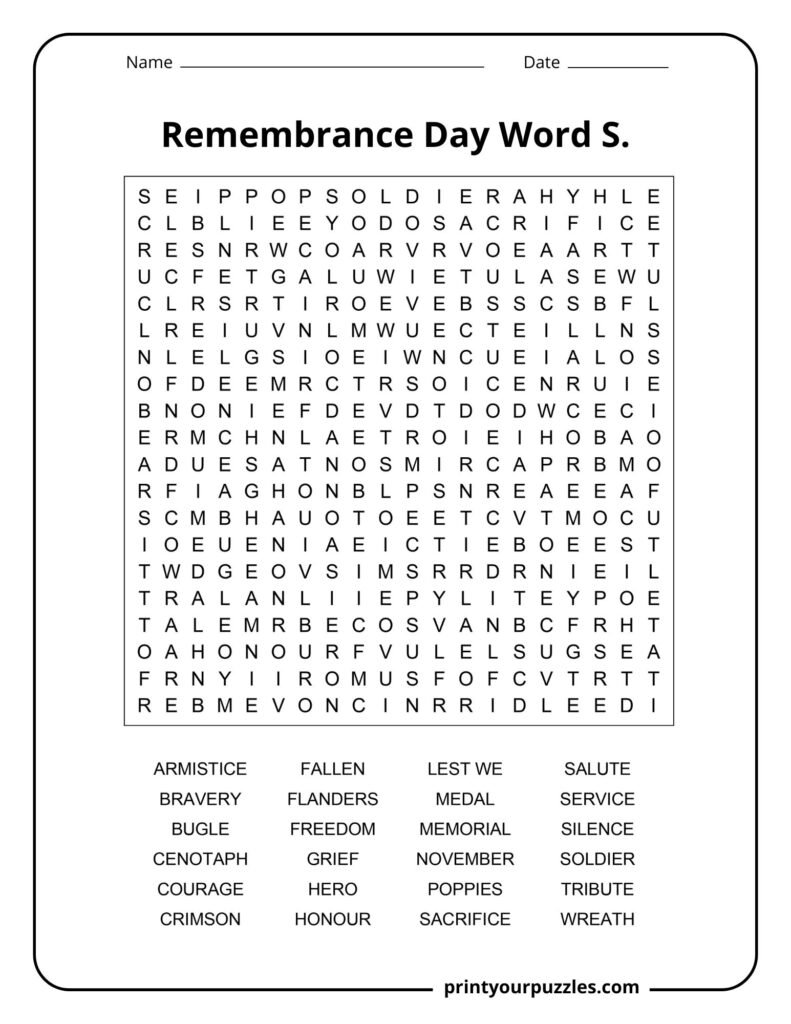
Hard Difficulty Word Search
Words to Find
ARMISTICE, BRAVERY, BUGLE, CENOTAPH, COURAGE, CRIMSON, FALLEN, FLANDERS, FREEDOM, GRIEF, HERO, HONOUR, LEST WE, MEDAL, MEMORIAL, NOVEMBER, POPPIES, SACRIFICE, SALUTE, SERVICE, SILENCE, SOLDIER, TRIBUTE, WREATH
5 Key FAQs About Remembrance Day
5 Curious "Did You Know?" Facts About Remembrance Day