Introduction to the Columbus Day Word Search
Columbus Day is observed in the United States on the second Monday of October. It traditionally commemorates Christopher Columbus’s arrival in the Americas on October 12, 1492, during his first voyage across the Atlantic Ocean. The day has long been connected with exploration, migration, Italian American heritage, and discussions about the lasting effects of European contact with the Americas.
Columbus was an Italian navigator sailing for the Spanish monarchs Ferdinand and Isabella. He hoped to find a westward sea route to Asia but instead reached islands in the Caribbean. Although he did not discover a previously unknown or uninhabited land, his voyages helped begin sustained contact between Europe and the Americas. This contact changed world history through trade, settlement, cultural exchange, conflict, disease, and colonization.
The holiday became especially meaningful to many Italian Americans during the nineteenth and twentieth centuries. At a time when Italian immigrants often faced discrimination, celebrations honoring Columbus provided an opportunity to express cultural pride and claim a visible place within American society. Parades, ceremonies, music, flags, and community gatherings became common traditions in several cities.
Today, Columbus Day is interpreted in different ways. Some people continue to recognize it as a celebration of Italian American heritage and maritime exploration. Others criticize the holiday because European colonization brought violence, forced labor, displacement, and devastating diseases to Indigenous peoples. For this reason, many communities now observe Indigenous Peoples’ Day on the same date, honoring the histories, cultures, achievements, and resilience of Native peoples.
These different perspectives make the occasion an opportunity for thoughtful learning. Schools, museums, and families may examine Columbus’s voyages, the societies already living in the Americas, and the consequences of contact between continents. Understanding the holiday fully means considering both its traditional importance and the experiences that older accounts sometimes overlooked.
Columbus Day is a federal holiday, although observances vary among states, cities, schools, and workplaces. Some people attend parades or cultural festivals, while others participate in educational programs, Indigenous events, or discussions about history and identity.
Explore the people, voyages, symbols, and historical debates associated with the occasion through this Columbus Day word search printable, featuring vocabulary inspired by navigation, exploration, Italian American heritage, Indigenous cultures, ocean travel, and the events that reshaped connections between continents.
Related Word Searches:
October | Autumn | Presidents’ Day | Veterans Day | Thanksgiving
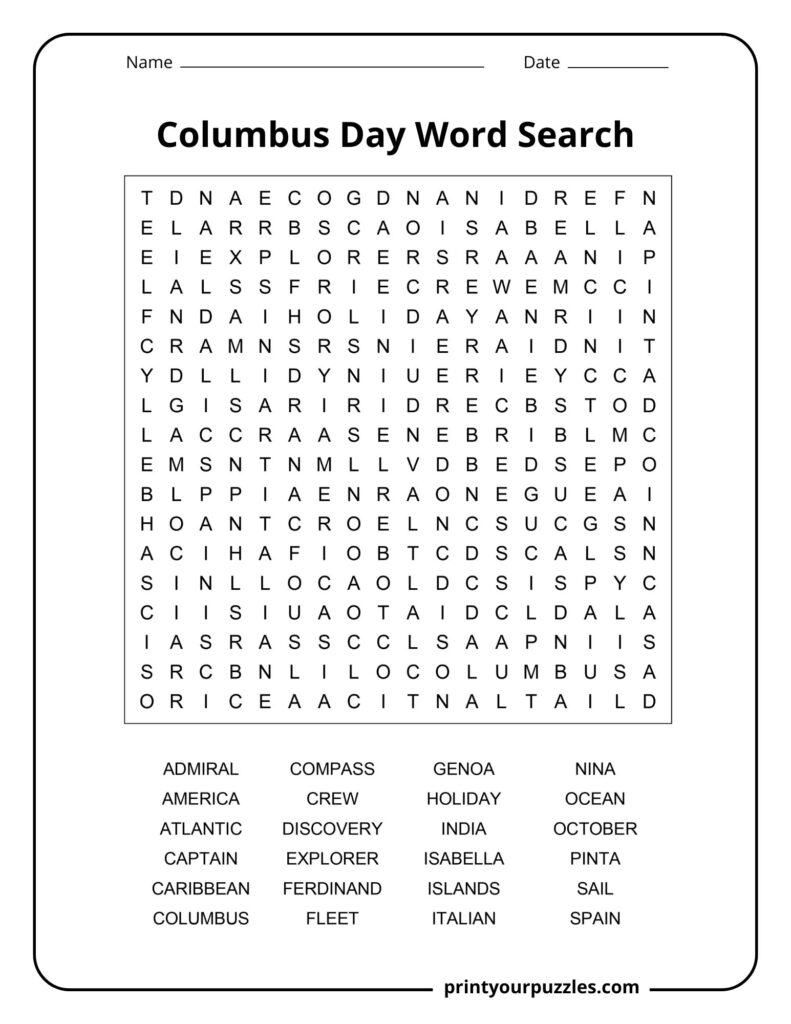
Medium Difficulty Word Search
Words to Find:
ADMIRAL, AMERICA, ATLANTIC, CAPTAIN, CARIBBEAN, COLUMBUS, COMPASS, CREW, DISCOVERY, EXPLORER, FERDINAND, FLEET, GENOA, HOLIDAY, INDIA, ISABELLA, ISLANDS, ITALIAN, NINA, OCEAN, OCTOBER, PINTA, SAIL, SPAIN
All Words Defined
ADMIRAL – A high-ranking naval officer commanding a fleet or naval forces. Columbus was given the title Admiral of the Ocean Sea by the Spanish monarchs for his voyages.
AMERICA – The continents discovered by Columbus in 1492, later named after Amerigo Vespucci. The Americas include North, South, and Central America, representing the New World to Europeans.
ATLANTIC – The ocean Columbus crossed in 1492 to reach the Americas. It separates Europe and Africa from the Americas, covering approximately twenty percent of Earth’s total surface area.
CAPTAIN – The person in command of a ship and its crew. Columbus served as captain during his historic voyages, responsible for navigation, decisions, and the vessel’s safety.
CARIBBEAN – The sea and island region where Columbus first landed in 1492. It includes numerous islands between North and South America, featuring tropical climate and diverse cultures today.
COLUMBUS – Christopher Columbus, the Italian explorer who sailed for Spain in 1492 and reached the Americas. His voyages initiated widespread European exploration and colonization of the Western Hemisphere.
COMPASS – A navigation instrument showing magnetic north, essential for sea voyages. Columbus used a magnetic compass to help navigate across the Atlantic Ocean during his historic expeditions westward.
CREW – The sailors and workers aboard a ship who operate the vessel. Columbus’s crew numbered approximately ninety men across his three ships during the first voyage to America.
DISCOVERY – The act of finding something previously unknown. Columbus’s 1492 voyage led to European discovery of the Americas, though indigenous peoples had inhabited these lands for millennia.
EXPLORER – A person who travels to unfamiliar places to learn about them. Columbus was a famous explorer seeking a western route to Asia, instead encountering the Americas.
FERDINAND – King Ferdinand II of Aragon, who along with Queen Isabella, sponsored Columbus’s voyages. He ruled Spain jointly with his wife and supported exploration efforts for wealth.
FLEET – A group of ships sailing together under one command. Columbus’s first fleet consisted of three ships: the Niña, the Pinta, and the Santa María during his voyage.
GENOA – The Italian city-state where Christopher Columbus was born in 1451. Located on the Mediterranean coast, Genoa was a major maritime republic and center of trade and navigation.
HOLIDAY – Columbus Day is a United States holiday commemorating Columbus’s arrival in the Americas on October 12, 1492. It is observed on the second Monday of October annually nationwide.
INDIA – Columbus’s intended destination when he sailed west in 1492. He sought a faster trade route to Asia’s riches, mistakenly believing he had reached the Indies upon landing.
ISABELLA – Queen Isabella I of Castile, who sponsored
Columbus’s expeditions along with King Ferdinand. She provided financial support and royal approval for his voyages to find new trade routes.
ISLANDS – Small landmasses surrounded by water. Columbus first landed on islands in the Bahamas, later exploring Caribbean islands including Cuba, Hispaniola, and others during multiple voyages westward.
ITALIAN – Relating to Italy, Columbus’s nationality and birthplace. Though born in Genoa, Italy, Columbus sailed under the Spanish flag and served the Spanish crown throughout his expeditions.
NINA – One of Columbus’s three ships on his first voyage in 1492. This small caravel was the fastest vessel and successfully returned to Spain, carrying news of discovery.
OCEAN – A vast body of saltwater covering Earth’s surface.
Columbus crossed the Atlantic Ocean, believing he could reach Asia by sailing west, leading to his historic discovery of America.
OCTOBER – The tenth month of the year when Columbus reached the Americas on October 12, 1492. Columbus Day is celebrated in October, specifically on the second Monday.
PINTA – One of Columbus’s three ships during his first voyage across the Atlantic. The Pinta was a fast caravel that first sighted land in the Bahamas on October 12, 1492.
SAIL – Fabric attached to ships’ masts to catch wind for propulsion. Columbus’s ships used multiple sails to cross the Atlantic Ocean, relying on wind power for movement.
SPAIN – The European country that sponsored Columbus’s voyages to find new trade routes. Spain became a dominant colonial power following Columbus’s discoveries in the Americas during exploration.
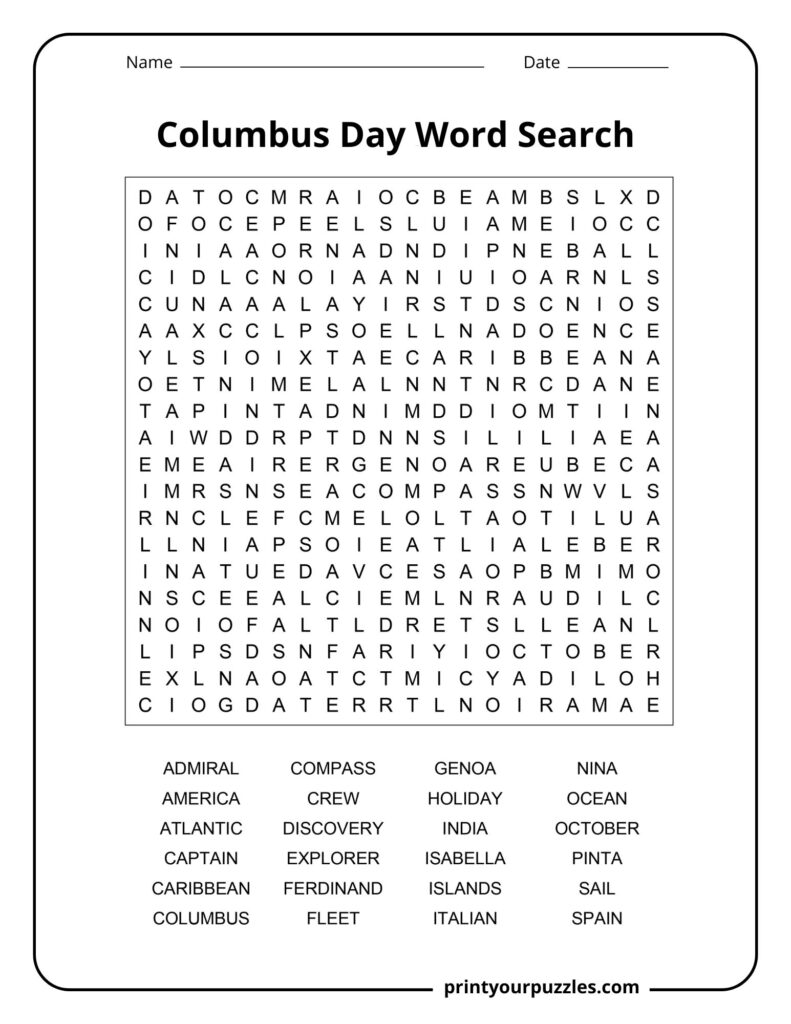
Hard Difficulty Word Search
Words to Find:
ADMIRAL, AMERICA, ATLANTIC, CAPTAIN, CARIBBEAN, COLUMBUS, COMPASS, CREW, DISCOVERY, EXPLORER, FERDINAND, FLEET, GENOA, HOLIDAY, INDIA, ISABELLA, ISLANDS, ITALIAN, NINA, OCEAN, OCTOBER, PINTA, SAIL, SPAIN
5 Key FAQs About Columbus Day
5 Curious "Did You Know?" Facts About Columbus Day