
Indigenous Peoples’ Day is a holiday that honors the history, cultures, traditions, and contributions of Indigenous peoples in the United States. Observed on the second Monday of October, it offers an opportunity to learn more about Native communities, recognize their lasting influence, and reflect on important parts of American history. The day is celebrated in many states, cities, schools, universities, and organizations, although its official status and name can vary from place to place.
The holiday developed partly as an alternative to Columbus Day. Supporters of Indigenous Peoples’ Day wanted greater recognition of the Native peoples who lived throughout the Americas for thousands of years before Christopher Columbus arrived in 1492. They also sought to encourage a fuller understanding of colonization and its consequences, including warfare, displacement, disease, forced assimilation, and the loss of Indigenous lands.
However, Indigenous Peoples’ Day is not only about difficult chapters of the past. It also celebrates the resilience and achievements of Native peoples. Hundreds of federally recognized tribes exist across the United States, each with its own history, identity, customs, languages, and traditions. Indigenous communities have contributed greatly to agriculture, environmental knowledge, art, music, storytelling, government, military service, and many other areas of American life.
Schools and community organizations may observe the day through educational programs, museum visits, cultural events, storytelling, traditional music, art exhibitions, or discussions about Native history. Learning about important leaders, tribal nations, treaties, languages, and cultural practices can help people understand how diverse Indigenous societies have always been.
An **Indigenous Peoples’ Day word search** can provide a simple and engaging way to introduce vocabulary connected with the holiday. Words related to tribes, culture, heritage, land, traditions, history, and community can encourage learners to explore the subject beyond the puzzle itself.
Indigenous Peoples’ Day ultimately invites people to recognize that Native American history is not limited to the distant past. Indigenous peoples and nations remain active communities today, preserving traditions while contributing to modern society. By exploring their histories and perspectives, learners can gain a broader and more complete understanding of the United States and the many peoples who have shaped it.
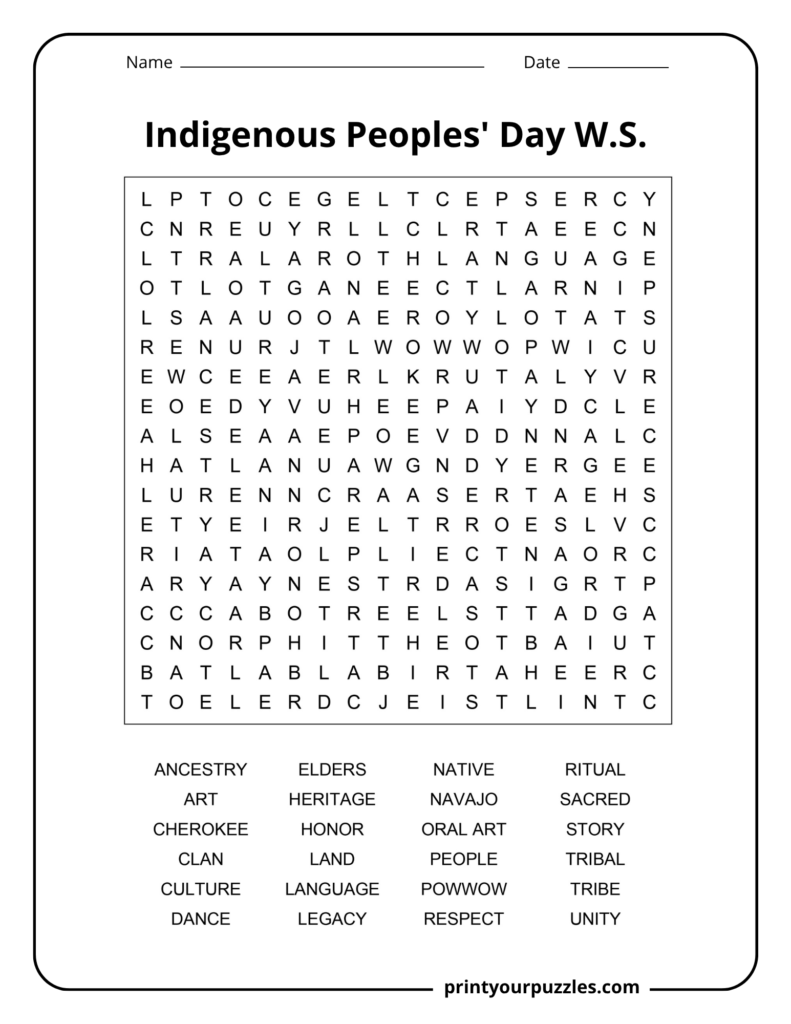
ANCESTRY, ART, CHEROKEE, CLAN, CULTURE, DANCE, ELDERS, HERITAGE, HONOR, LAND, LANGUAGE, LEGACY, NATIVE, NAVAJO, ORAL ART, PEOPLE, POWWOW, RESPECT, RITUAL, SACRED, STORY, TRIBAL, TRIBE, UNITY
ANCESTRY – The family and cultural background passed down through generations, connecting Indigenous people with their relatives, communities, traditions, homelands, and shared histories across many centuries.
ART – Creative expression through painting, carving, weaving, pottery, beadwork, jewelry, music, and other forms that reflect the identities, traditions, stories, and experiences of Indigenous communities.
CHEROKEE – A major Indigenous people originally from the southeastern United States, known for their distinct language, government, cultural traditions, and resilience following forced removal during the 1800s.
CLAN – A traditional social group based on family relationships or shared ancestry that can help organize community responsibilities, identity, kinship, leadership, and cultural traditions within Indigenous nations.
CULTURE – The shared customs, beliefs, languages, arts, foods, ceremonies, values, and traditions that help shape the identity and everyday life of an Indigenous community.
DANCE – An important form of cultural expression used by many Indigenous communities during ceremonies, celebrations, gatherings, and storytelling traditions, often accompanied by music, drums, and special clothing.
ELDERS – Respected older members of Indigenous communities who may preserve knowledge, languages, stories, traditions, values, and teachings while guiding younger generations and supporting cultural continuity.
HERITAGE – The traditions, history, beliefs, knowledge, languages, and customs inherited from previous generations and preserved by Indigenous peoples as important parts of their cultural identity.
HONOR – A principle of showing deep respect and appreciation for Indigenous peoples, their ancestors, traditions, achievements, histories, cultures, and continuing contributions to modern communities and society.
LAND – A central part of many Indigenous cultures, providing food, resources, identity, spiritual connections, and ancestral ties while carrying historical importance for Native nations and communities.
LANGUAGE – A system of communication that carries stories, knowledge, traditions, and cultural identity, with many Indigenous communities working actively to protect and revitalize their ancestral languages.
LEGACY – The lasting influence of Indigenous ancestors, leaders, traditions, knowledge, achievements, and cultural practices that continue to shape communities and inspire future generations across the United States.
NATIVE – A term commonly used to describe Indigenous peoples whose ancestors lived in the Americas long before European colonization, including members of many distinct nations and communities.
NAVAJO – One of the largest Indigenous nations in the United States, with a rich cultural heritage, distinctive language, artistic traditions, and extensive homelands across the American Southwest.
ORAL ART – The tradition of preserving and sharing knowledge through spoken stories, songs, legends, speeches, and teachings, allowing Indigenous communities to pass cultural knowledge between generations.
PEOPLE – A community connected by shared identity, culture, history, language, ancestry, or traditions, emphasizing the living individuals and societies celebrated during Indigenous Peoples’ Day each year.
POWWOW – A gathering where Indigenous people and visitors may come together for dancing, singing, drumming, socializing, competitions, cultural celebration, and the sharing of traditions and community pride.
RESPECT – The recognition and appreciation of Indigenous peoples, cultures, histories, rights, traditions, and perspectives, encouraging thoughtful learning and understanding rather than stereotypes, misunderstandings, or cultural appropriation.
RITUAL – A traditional action or ceremony performed according to cultural or spiritual customs, often carrying special meaning for a community and connecting participants with shared beliefs.
SACRED – Describes something regarded as spiritually important or worthy of special respect, including certain places, objects, ceremonies, traditions, stories, or natural features within Indigenous cultures.
STORY – A spoken or written account that can preserve history, explain traditions, teach values, entertain listeners, and pass important cultural knowledge from one generation to another.
TRIBAL – Relating to an Indigenous tribe or nation, including its government, citizens, traditions, lands, cultural practices, institutions, identity, and relationships with other communities or governments.
TRIBE – A term commonly used for an Indigenous political and cultural community whose members may share ancestry, traditions, history, government, language, territory, or a collective identity.
UNITY – The idea of people supporting one another and working together while recognizing differences, strengthening communities through cooperation, shared purpose, mutual respect, and collective cultural pride.
Related Word Searches:
Columbus Day | October | Autumn | Thanksgiving | Constitution Day
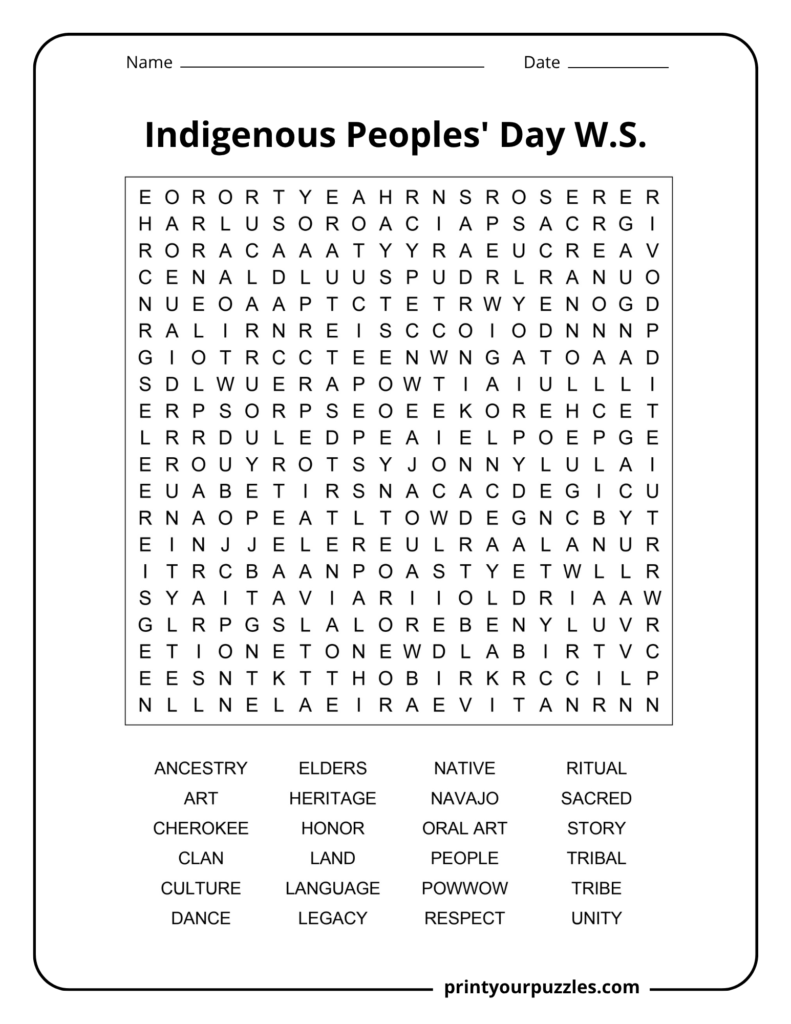
ANCESTRY, ART, CHEROKEE, CLAN, CULTURE, DANCE, ELDERS, HERITAGE, HONOR, LAND, LANGUAGE, LEGACY, NATIVE, NAVAJO, ORAL ART, PEOPLE, POWWOW, RESPECT, RITUAL, SACRED, STORY, TRIBAL, TRIBE, UNITY
Indigenous Peoples’ Day is a holiday honoring the histories, cultures, achievements, and continuing presence of Native peoples and Indigenous communities throughout the United States.
It is observed on the second Monday of October, the same date traditionally associated with Columbus Day in the United States.
The holiday was created to recognize Indigenous perspectives, celebrate Native cultures, and encourage greater awareness of colonization, displacement, resilience, and historical contributions.
Indigenous Peoples’ Day is not a separate federal holiday, although many states, cities, schools, universities, and organizations officially recognize or observe it.
People can learn about Native history, support Indigenous artists and organizations, attend cultural events, visit museums, read Native authors, and explore tribal traditions.
Yes. It is observed on the second Monday of October, encouraging recognition of Indigenous histories and perspectives alongside discussions about European exploration and colonization.
Yes. South Dakota began observing Native American Day in 1990, making it an early statewide effort to honor Indigenous peoples and their heritage.
Yes. More than 570 federally recognized tribes exist across the United States, each with its own history, government, traditions, identity, and cultural practices.
Yes. Native communities continue speaking and revitalizing numerous Indigenous languages through schools, cultural programs, recordings, dictionaries, and efforts led by elders and younger generations.
Yes. Modern powwows often feature dancing, drumming, singing, competitions, crafts, and social gatherings where participants celebrate traditions while strengthening community connections.