
Quantum physics is the branch of science that explains how matter and energy behave at extremely small scales. It focuses on atoms, electrons, photons, and other particles that are too tiny to observe directly with ordinary microscopes. Although quantum physics may seem strange, it helps scientists understand the basic building blocks of everything around us, from the air we breathe to the electronic devices we use each day.
In everyday life, objects usually follow predictable rules. A ball has a particular position, moves along a clear path, and reacts to forces in ways described by classical physics. At the quantum level, however, particles can behave very differently. An electron does not always have one definite position before it is measured. Instead, scientists describe the probability of finding it in different locations. This idea is known as superposition, meaning that a quantum system can exist in several possible states until a measurement is made.
Another important concept is wave-particle duality. Tiny objects such as electrons and photons can behave like particles in some experiments and like waves in others. Quantum particles can also become connected through a phenomenon called entanglement. When two particles are entangled, measuring one can provide information about the other, even when they are separated by a great distance.
Quantum physics also explains why atoms are stable. Electrons occupy specific energy levels around an atomic nucleus. They can move from one energy level to another by absorbing or releasing a particular amount, or quantum, of energy. These energy changes often produce light and help scientists understand the colors and chemical properties of different elements.
The principles of quantum physics have led to many important technologies. Lasers, computer chips, solar cells, medical imaging equipment, and modern communication systems all depend on quantum ideas. Scientists are also developing quantum computers, which may eventually solve certain complex problems much faster than traditional computers.
Exploring a printable quantum physics word search can introduce key vocabulary such as atom, photon, electron, energy, wave, particle, probability, superposition, and entanglement. Learning these terms provides a useful foundation for understanding a fascinating scientific theory that challenges everyday intuition while explaining how nature works at its smallest level.
Related Word Searches:
Physics | Atom | Energy | Matter | Dark Matter | Electricity
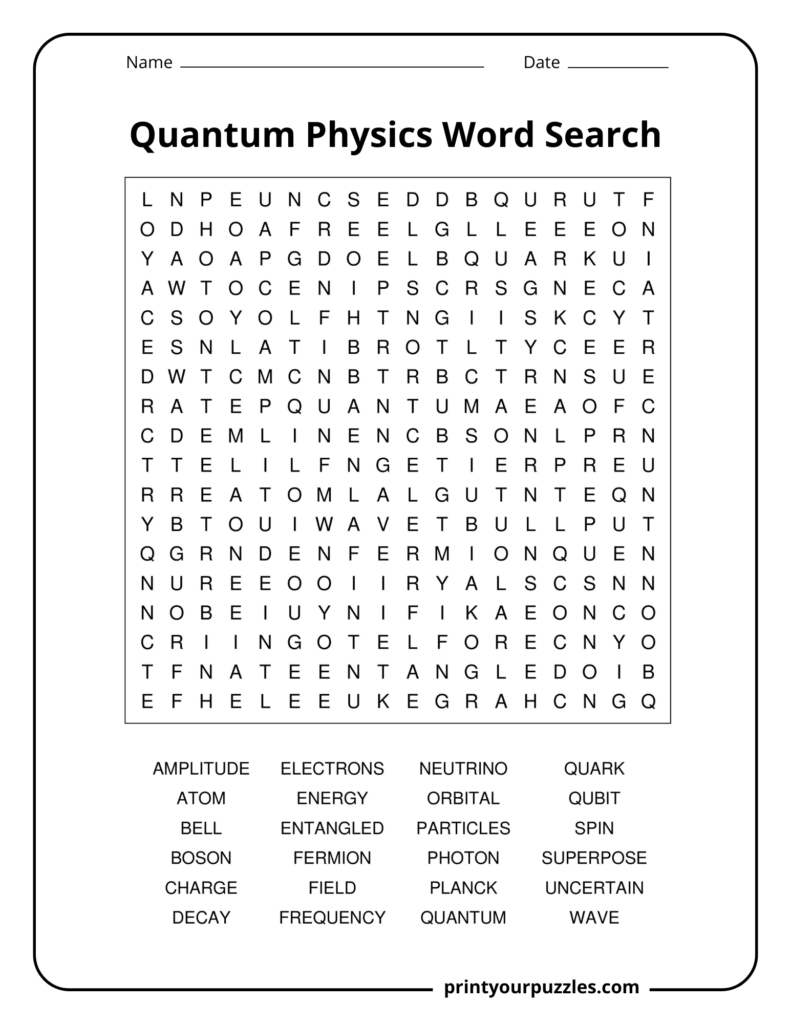
AMPLITUDE, ATOM, BELL, BOSON, CHARGE, DECAY, ELECTRONS , ENERGY, ENTANGLED, FERMION, FIELD, FREQUENCY, NEUTRINO, ORBITAL, PARTICLES, PHOTON, PLANCK, QUANTUM, QUARK, QUBIT, SPIN, SUPERPOSE, UNCERTAIN, WAVE
AMPLITUDE – The maximum extent of a wave’s oscillation or the probability measure in quantum mechanics that determines the likelihood of finding a particle in a particular state.
ATOM – The smallest unit of ordinary matter that forms a chemical element, consisting of a nucleus surrounded by electrons, fundamental to understanding quantum behavior.
BELL – Refers to physicist John Bell and his theorem proving quantum entanglement creates correlations between particles that cannot be explained by classical physics or local hidden variables.
BOSON – A particle with integer spin that follows Bose-Einstein statistics, including photons and gluons, which can occupy the same quantum state simultaneously without restriction.
CHARGE – An intrinsic property of matter that causes electromagnetic interactions, measured in positive or negative values, and is conserved in all quantum processes and particle interactions.
DECAY – The spontaneous transformation of an unstable atomic nucleus or particle into different particles, releasing energy according to quantum mechanical probability rules over characteristic time periods.
ELECTRONS – Negatively charged subatomic particles orbiting atomic nuclei with specific quantum energy levels, exhibiting both wave and particle properties fundamental to chemistry and electricity.
ENERGY – A fundamental property of physical systems quantized in discrete packets at atomic scales, conserved in all processes, and related to frequency through Planck’s constant.
ENTANGLED – A quantum phenomenon where particles become correlated so that measuring one instantly affects the other regardless of distance, defying classical physics and enabling quantum computing.
FERMION – Particles with half-integer spin following Pauli exclusion principle, including electrons, protons, and neutrons, which cannot occupy identical quantum states, forming matter’s stable structure.
FIELD – A physical quantity having a value at every point in space and time, with quantum fields describing fundamental particles as excitations in underlying fields.
FREQUENCY – The rate of wave oscillation measured in cycles per second, directly proportional to photon energy according to Planck’s equation, determining electromagnetic radiation characteristics.
NEUTRINO – An extremely light, electrically neutral particle that interacts only through weak nuclear force and gravity, produced in nuclear reactions, traveling at nearly light speed.
ORBITAL – The mathematical function describing the probability distribution of an electron’s position around an atomic nucleus, characterized by quantum numbers determining energy and angular momentum.
PARTICLES – Discrete units of matter or energy with specific quantum properties like mass, charge, and spin, including fundamental particles like quarks and composite particles.
PHOTON – A massless quantum particle of light and electromagnetic radiation, carrying energy proportional to its frequency, exhibiting both wave and particle properties simultaneously.
PLANCK – Max Planck founded quantum theory by discovering energy quantization, establishing Planck’s constant, the fundamental scale relating energy and frequency in quantum mechanics.
QUANTUM – The minimum discrete amount of any physical property involved in an interaction, representing the fundamental unit of energy, momentum, or other quantities at atomic scales.
QUARK – Fundamental particles combining in groups of two or three to form protons, neutrons, and other hadrons, bound by strong nuclear force and never observed isolated.
QUBIT – The quantum computing equivalent of a classical bit, capable of existing in superposition states of both zero and one simultaneously, enabling exponentially powerful computation.
SPIN – An intrinsic form of angular momentum carried by particles, quantized in half-integer or integer values, affecting magnetic properties and determining whether particles are fermions or bosons.
SUPERPOSE – The quantum principle allowing systems to exist in multiple states simultaneously until measured, with the final state being a probabilistic combination of all possible states.
UNCERTAIN – Heisenberg’s uncertainty principle states that certain pairs of physical properties like position and momentum cannot be simultaneously measured with arbitrary precision, reflecting fundamental quantum limits.
WAVE – The wavelike behavior exhibited by particles at quantum scales, described by wave functions determining probability distributions, central to understanding quantum mechanical phenomena and interference patterns.
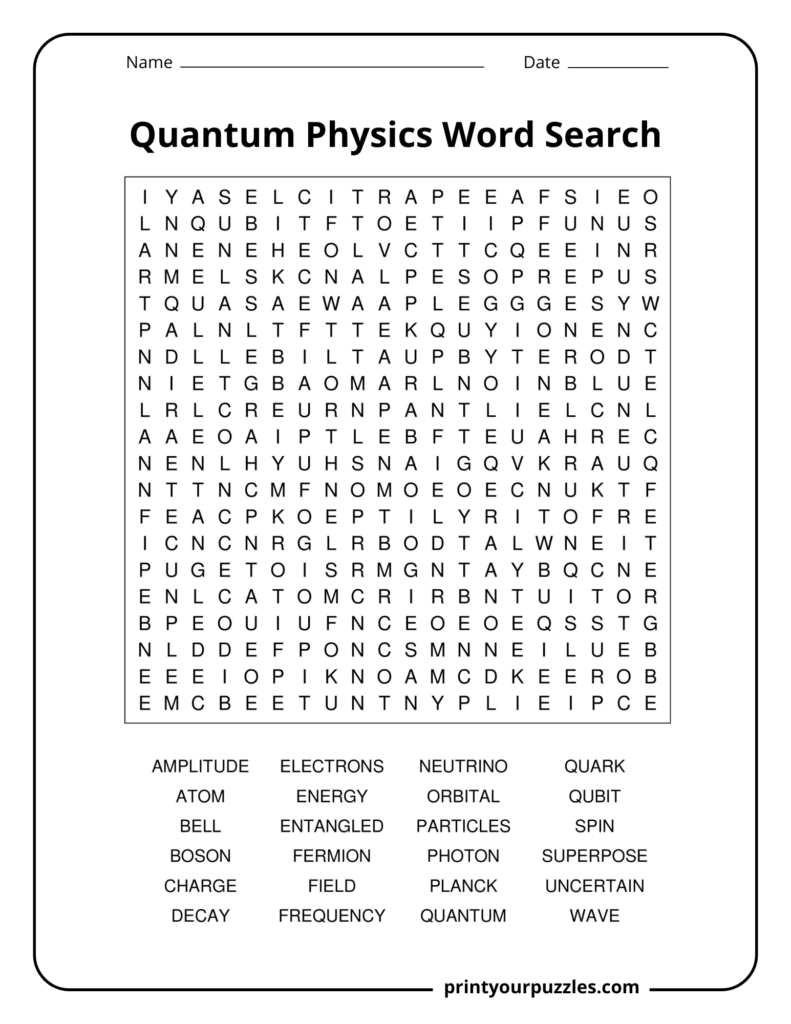
AMPLITUDE, ATOM, BELL, BOSON, CHARGE, DECAY, ELECTRONS , ENERGY, ENTANGLED, FERMION, FIELD, FREQUENCY, NEUTRINO, ORBITAL, PARTICLES, PHOTON, PLANCK, QUANTUM, QUARK, QUBIT, SPIN, SUPERPOSE, UNCERTAIN, WAVE
Quantum physics is the branch of science studying matter and energy behavior at atomic and subatomic scales, where particles exhibit both wave and particle properties simultaneously.
Quantum entanglement occurs when particles become interconnected so that measuring one instantly affects the other, regardless of distance, creating correlations that defy classical physics explanations.
Heisenberg’s uncertainty principle states that certain property pairs, like position and momentum, cannot be simultaneously measured with perfect precision, representing fundamental quantum mechanical limitations.
Classical physics describes macroscopic objects with predictable, deterministic behavior, while quantum physics governs microscopic scales where outcomes are probabilistic and particles exhibit wave-particle duality.
Quantum physics enables modern technologies including lasers, semiconductors, MRI machines, solar cells, LED lights, transistors, and emerging quantum computers promising revolutionary computational power.
Quantum tunneling allows particles to pass through energy barriers they classically couldn’t overcome, enabling nuclear fusion in stars and making flash memory drives and smartphone technology possible.
The observer effect demonstrates that simply measuring a quantum system collapses its wave function, forcing particles to choose definite states from multiple simultaneous possibilities, fundamentally altering outcomes.
If an atom were expanded to stadium size, its nucleus would be a marble at center field, with electrons like dust specks orbiting the upper seats, making matter surprisingly hollow.
When entangled particles are separated, measuring one instantly affects the other across any distance, seemingly violating Einstein’s speed limit, though information itself cannot travel faster than light.
By exploiting superposition and entanglement, quantum computers can simultaneously process vast combinations of possibilities, potentially revolutionizing cryptography, drug discovery, and artificial intelligence within decades.