
The Roaring Twenties refers to the decade of the 1920s, a period remembered for economic growth, cultural change, new technology, and a feeling of modern excitement. After World War I, many Americans wanted prosperity, entertainment, and a return to normal life. The decade seemed energetic and full of possibility, especially in growing cities.
The economy expanded quickly during much of the 1920s. Factories produced more goods, businesses advertised new products, and many families bought items such as radios, refrigerators, washing machines, and automobiles. Credit and installment plans made it easier for people to buy things immediately and pay for them over time. This helped create a new consumer culture.
Automobiles changed daily life in powerful ways. Henry Ford’s assembly line made cars more affordable for many Americans, and roads, gas stations, suburbs, and travel habits began to change. Radio also became a major part of home life, bringing music, news, sports, and advertising into living rooms across the country. Movies, movie stars, and professional sports became important parts of popular culture.
Music and social life also changed during the Roaring Twenties. Jazz became one of the sounds of the decade, and dances, clubs, and new fashions reflected a more modern style. Flappers became a symbol of changing ideas about women’s independence, clothing, and public life. Women had also gained the right to vote with the 19th Amendment in 1920, although equality was still far from complete.
The Harlem Renaissance was another major part of the decade. In Harlem and other communities, African American writers, musicians, artists, and thinkers created powerful works of literature, music, and art. Figures such as Langston Hughes, Duke Ellington, and Zora Neale Hurston helped shape American culture.
The decade also had serious problems beneath the surface. Prohibition banned the sale of alcoholic drinks, but speakeasies, bootlegging, and organized crime grew. Farmers struggled, many workers remained poor, racial discrimination continued, immigration restrictions increased, and stock market speculation created danger. In 1929, the Stock Market Crash helped bring the Roaring Twenties to an end and led into the Great Depression.
This Roaring Twenties word search helps students review vocabulary connected to jazz, flappers, radio, cars, Harlem, Prohibition, speakeasies, credit, boom, and crash. A Roaring Twenties Word Search can make this exciting but complicated decade easier to understand by connecting key terms with its culture, changes, problems, and consequences.
Related Word Searches:
Great Depression | 1929 Stock Market Crash | Calvin Coolidge | Warren G. Harding | Progressive Era | Gilded Age
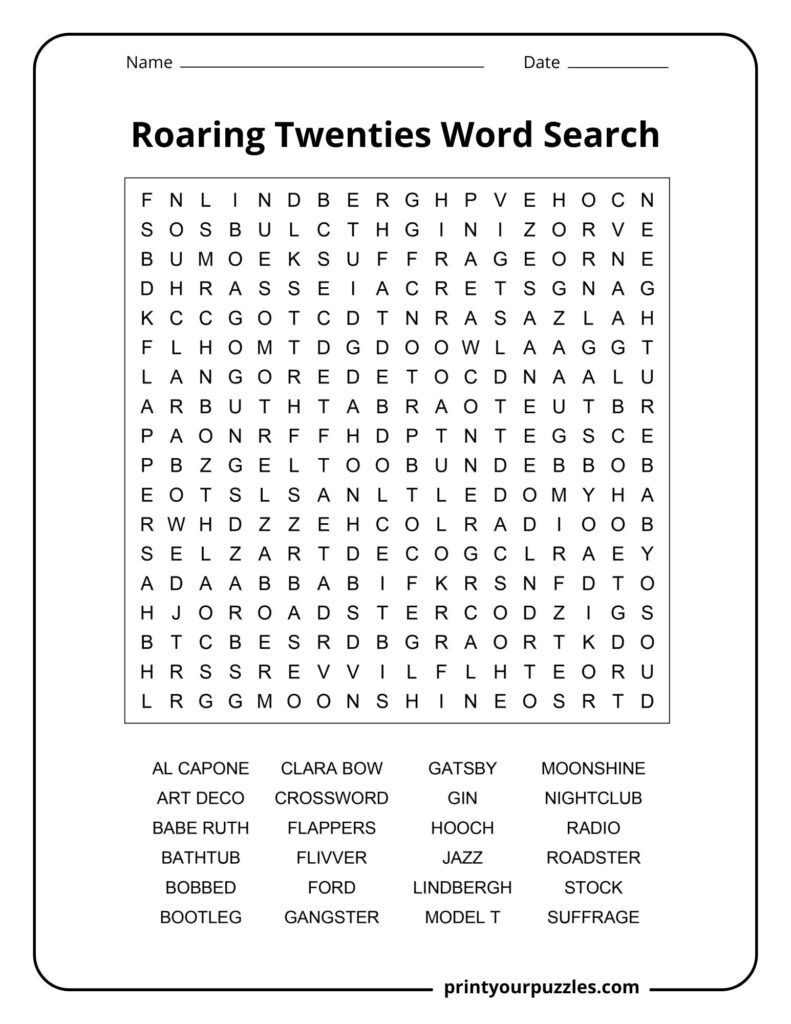
AL CAPONE, ART DECO, BABE RUTH, BATHTUB, BOBBED, BOOTLEG, CLARA BOW, CROSSWORD, FLAPPERS, FLIVVER, FORD, GANGSTER, GATSBY, GIN, HOOCH, JAZZ, LINDBERGH, MODEL T, MOONSHINE, NIGHTCLUB, RADIO, ROADSTER, STOCK, SUFFRAGE
AL CAPONE – Notorious Chicago gangster who controlled illegal alcohol trade during Prohibition. His criminal empire made him infamous as America’s most wanted man during the 1920s.
ART DECO – Elegant decorative style featuring geometric shapes, bold colors, and luxurious materials. It dominated architecture, fashion, and design throughout the decade, symbolizing modernism and glamour.
BABE RUTH – Legendary baseball player whose powerful home runs transformed the sport. The “Sultan of Swat” became America’s first modern sports celebrity during this golden age.
BATHTUB – Associated with homemade “bathtub gin,” illegally produced alcohol mixed in bathtubs during Prohibition. This dangerous practice resulted in many toxic drinks that sometimes caused blindness or death.
BOBBED – Short, chin-length haircut worn by rebellious young women. This daring style rejected traditional long hair, symbolizing women’s newfound independence and modern attitudes in society.
BOOTLEG – Illegally manufactured or smuggled alcohol sold during Prohibition. Bootleggers risked arrest to supply speakeasies and private customers with banned liquor, creating massive criminal enterprises and widespread corruption.
CLARA BOW – Silent film star known as the “It Girl,” embodying 1920s youth and vivacity. Her magnetic screen presence and modern persona made her Hollywood’s biggest box office draw.
CROSSWORD – Word puzzle that became a national craze after the first crossword book published in 1924. Millions of Americans obsessed over these brain-teasers in newspapers daily.
FLAPPERS – Young women who defied convention by wearing short skirts, cutting hair, smoking, drinking, and dancing wildly. They symbolized the decade’s liberated, rebellious spirit and changing social norms.
FLIVVER – Slang term for an inexpensive automobile, especially the Model T Ford. This affordable car revolutionized American transportation, making vehicles accessible to middle-class families nationwide.
FORD – Henry Ford’s automobile company that mass-produced affordable Model T cars using assembly line techniques. His innovations revolutionized manufacturing and made car ownership possible for average Americans.
GANGSTER – Organized criminals who profited enormously from bootlegging during Prohibition. Violent turf wars between rival gangs, like Capone’s outfit, dominated cities with tommy guns and corruption throughout.
GATSBY – Title character from F. Scott Fitzgerald’s iconic novel “The Great Gatsby,” published in 1925. The book captured the era’s excess, materialism, and disillusionment perfectly.
GIN – Popular alcoholic spirit often illegally produced in bathtubs during Prohibition. “Gin joints” and speakeasies served this drink despite federal bans, fueling widespread criminal activity and disrespect.
HOOCH – Slang term for illegally made or poor-quality alcohol during Prohibition. Often dangerously distilled, hooch could contain toxic methanol that caused serious illness, blindness, or death to consumers.
JAZZ – Revolutionary American music genre born in New Orleans, featuring improvisation and syncopated rhythms. It defined the decade’s soundtrack, inspiring new dances and shocking traditional society with energetic sounds.
LINDBERGH – Charles Lindbergh became an international hero after completing the first solo nonstop transatlantic flight in 1927. His daring achievement captured imaginations worldwide and advanced aviation dramatically.
MODEL T – Ford’s affordable, mass-produced automobile that revolutionized American life. Nicknamed the “Tin Lizzie,” over fifteen million were sold, transforming transportation, commerce, and social mobility completely.
MOONSHINE – Illegally distilled corn whiskey produced in secret, often in rural areas during Prohibition. Moonshiners operated hidden stills at night, evading federal agents while supplying thirsty customers nationwide.
NIGHTCLUB – Entertainment venues featuring jazz music, dancing, and illegal alcohol. These glamorous establishments flourished despite Prohibition laws, offering sophisticated urban entertainment and attracting fashionable crowds nightly.
RADIO – Revolutionary communication technology that brought entertainment, news, and music into millions of homes. Commercial broadcasting exploded during the twenties, creating shared national culture and transforming leisure time.
ROADSTER – Sporty, open-top automobile popular among wealthy youth seeking excitement and freedom. These sleek cars symbolized the decade’s emphasis on speed, style, and breaking away from tradition.
STOCK – Shares in companies traded on Wall Street. Rampant speculation and easy credit fueled a soaring stock market bubble that eventually crashed catastrophically in October 1929.
SUFFRAGE – Women’s right to vote, finally achieved nationwide with the Nineteenth Amendment’s ratification in 1920. This monumental victory followed decades of activism and fundamentally transformed American democracy forever.
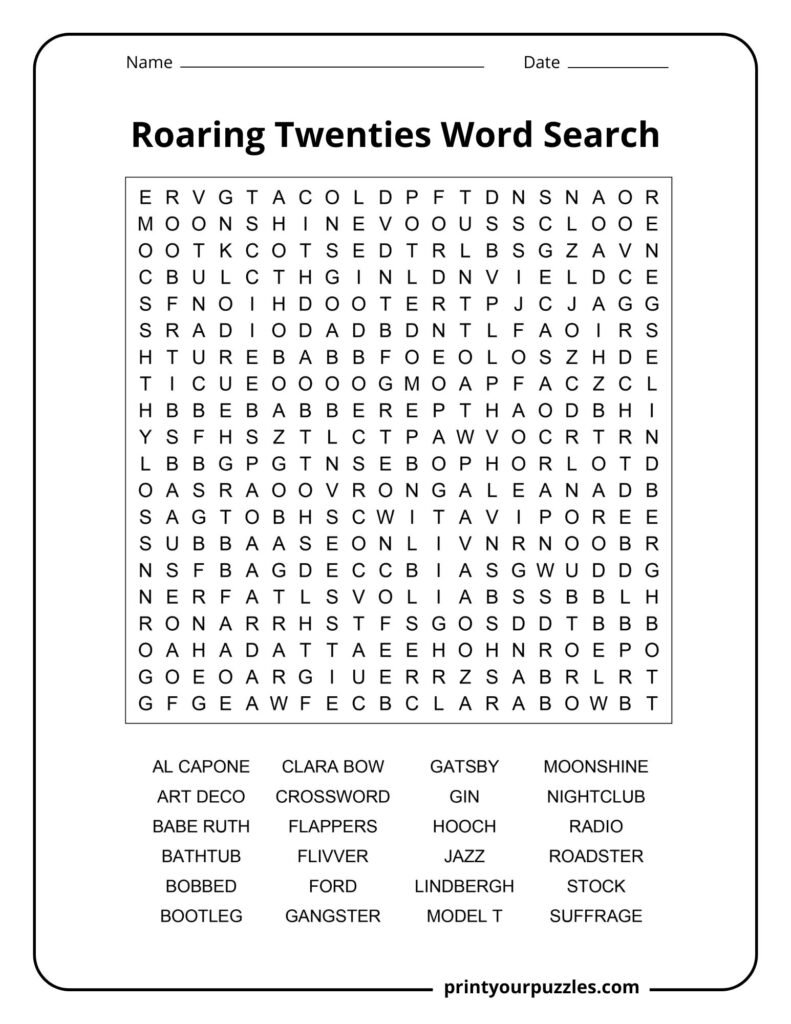
AL CAPONE, ART DECO, BABE RUTH, BATHTUB, BOBBED, BOOTLEG, CLARA BOW, CROSSWORD, FLAPPERS, FLIVVER, FORD, GANGSTER, GATSBY, GIN, HOOCH, JAZZ, LINDBERGH, MODEL T, MOONSHINE, NIGHTCLUB, RADIO, ROADSTER, STOCK, SUFFRAGE
The decade “roared” with dramatic social change, economic prosperity, cultural innovation, and rebellious energy. Jazz music, flappers, new technologies, and wild parties created an atmosphere of excitement and liberation.
Prohibition banned alcohol production and sales from 1920-1933. Instead of eliminating drinking, it created massive illegal bootlegging operations, speakeasies, organized crime syndicates, and widespread corruption throughout American society.
Women gained voting rights in 1920, entered the workforce in larger numbers, wore shorter dresses, cut their hair, smoked publicly, and enjoyed newfound social freedoms that challenged traditional expectations.
Jazz revolutionized American music with improvisation and African American rhythms. It became the decade’s soundtrack, inspiring new dances, challenging racial barriers, and symbolizing modern youth’s rebellious spirit.
The era ended abruptly with the October 1929 stock market crash. Reckless speculation, excessive borrowing, and economic inequality triggered the catastrophic collapse that launched the devastating Great Depression.
Flappers boldly applied lipstick in public, shocking older generations. Previously, only actresses wore visible makeup. This defiant act represented women’s liberation and rejection of Victorian modesty standards.
Daredevils perched atop flagpoles for days or weeks, attracting huge crowds. Alvin “Shipwreck” Kelly became famous by sitting for 49 days straight, epitomizing the decade’s bizarre entertainment crazes.
“The Jazz Singer” revolutionized cinema by synchronizing dialogue and music with film. Silent movie stars suddenly needed good voices, ending many careers while launching Hollywood’s golden age.
After the first crossword book published in 1924, America went puzzle-crazy. Libraries banned dictionaries because enthusiasts monopolized them, and trains added dictionaries for commuters solving puzzles.
Previously, pale skin signified wealth and status. After Chanel accidentally got sunburned, tanned skin became fashionable, symbolizing leisure time for vacations rather than indoor factory work.