
The Book of Esther tells one of the most dramatic stories in the Bible, combining courage, danger, royal politics, and an unexpected rescue. Set within the Persian Empire, the story follows Esther, a young Jewish woman who becomes queen and eventually risks her life to protect her people. Although the book never directly mentions God by name, its events have traditionally been understood as showing how providence can work through human choices, timing, and courage.
Esther was raised by her older cousin Mordecai after losing her parents. When King Ahasuerus, commonly identified with the Persian king Xerxes I, searched for a new queen, Esther was brought to the royal palace and chosen. Following Mordecai’s advice, she initially kept her Jewish identity secret. Her position at court would later become extremely important.
The central conflict begins with Haman, a powerful official who becomes furious when Mordecai refuses to bow before him. Instead of punishing Mordecai alone, Haman develops a plan to destroy all the Jewish people throughout the empire. When Mordecai learns of the decree, he urges Esther to approach the king and ask for help.
This was a dangerous decision because appearing before the king without being summoned could result in death. Esther asks the Jewish community to fast for three days before she enters the king’s presence. She then carefully arranges two banquets for the king and Haman, eventually revealing both her Jewish identity and Haman’s plot.
The situation changes dramatically. Haman is executed on the very gallows he had prepared for Mordecai, while Esther and Mordecai receive authority to help the Jewish people defend themselves. Their deliverance becomes the foundation of the Jewish festival of Purim, which continues to commemorate the events described in Esther.
An Esther word search offers a simple and engaging way to explore important people, places, ideas, and events from this remarkable biblical story. As you search for each word, you can revisit themes such as bravery, loyalty, identity, justice, fasting, leadership, and hope.
Esther’s story remains memorable because she begins as an unlikely heroine but chooses to act when the future of her people is threatened. Her courage demonstrates how one person’s decisions can have enormous consequences, making the Book of Esther a powerful story of responsibility, wisdom, and standing up for others.
Related Word Searches:
Women of the Bible | Old Testament | Daniel and the Lion’s Den | David and Goliath | Books of the Bible
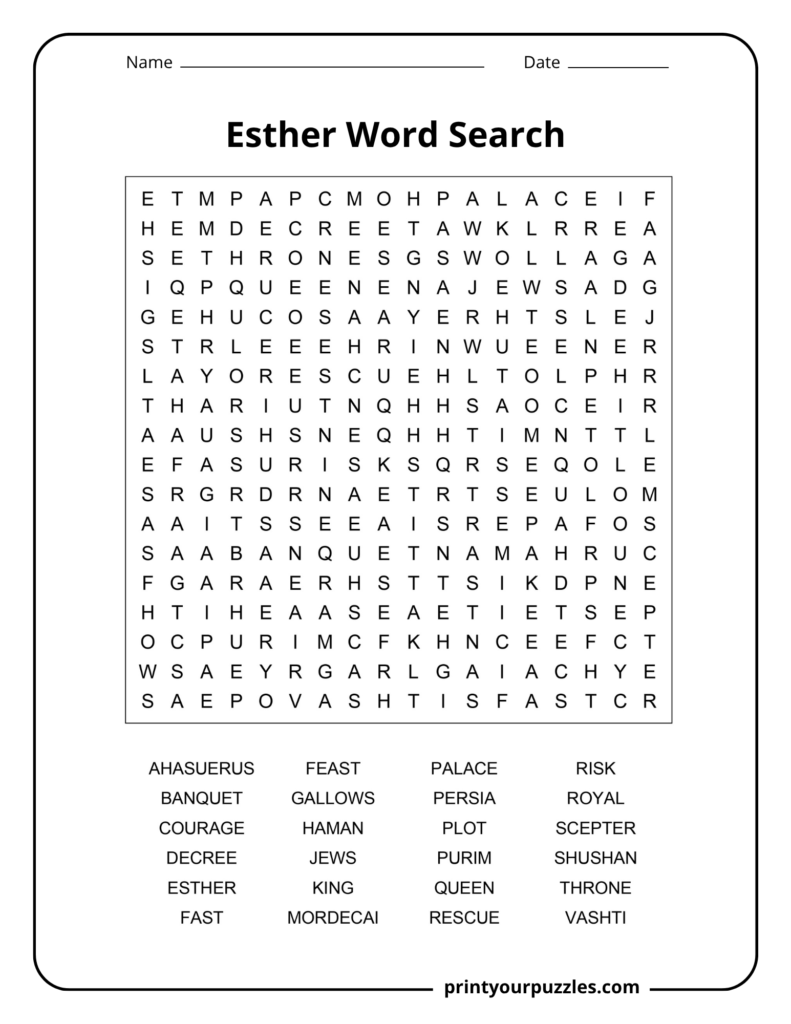
AHASUERUS, BANQUET, COURAGE, DECREE, ESTHER, FAST, FEAST, GALLOWS, HAMAN, JEWS, KING, MORDECAI, PALACE, PERSIA, PLOT, PURIM, QUEEN, RESCUE, RISK, ROYAL, SCEPTER, SHUSHAN, THRONE, VASHTI
AHASUERUS – Persian king in the Book of Esther, commonly identified with Xerxes I, whose decisions concerning Esther, Haman, and Mordecai shape the story’s dramatic events.
BANQUET – Special meal arranged by Esther for King Ahasuerus and Haman, where she carefully prepares to reveal her identity and expose Haman’s dangerous plot.
COURAGE – Essential quality shown by Esther when she risks approaching the king without being summoned, knowing that her actions could save the Jewish people.
DECREE – Official royal order used first to threaten the Jewish population and later to permit them to defend themselves against those planning their destruction.
ESTHER – Jewish woman who becomes queen of Persia and bravely uses her position, intelligence, and influence to protect her people from Haman’s deadly plan.
FAST – Period without food observed by Esther and the Jewish community for three days before she approaches the king during a dangerous and uncertain moment.
FEAST – Celebration associated with joy and deliverance in Esther’s story, especially connected with Purim and the Jewish people’s survival after Haman’s plan fails.
GALLOWS – Structure Haman prepares for Mordecai’s execution, but the plan reverses dramatically, and Haman himself is ultimately executed on the same structure instead.
HAMAN – Powerful Persian official who becomes enraged with Mordecai and creates a plan to destroy the Jewish people throughout the empire before being defeated.
JEWS – People threatened by Haman’s decree throughout the Persian Empire, whose survival becomes the central concern of Esther, Mordecai, and the wider biblical story.
KING – Ruler of the Persian Empire who chooses Esther as queen and later responds favorably when she reveals Haman’s plot against her Jewish people.
MORDECAI – Esther’s older cousin and guardian who encourages her to act courageously, refuses to honor Haman, and later receives an important position within Persia.
PALACE – Royal residence where Esther lives as queen and where important conversations, banquets, decisions, and confrontations influence the fate of the Jewish population.
PERSIA – Great ancient empire in which Esther’s story takes place, ruled by King Ahasuerus and containing many provinces inhabited by different peoples, including Jews.
PLOT – Secret plan created by Haman to eliminate the Jews after his anger toward Mordecai grows into hatred against an entire group of people.
PURIM – Jewish festival commemorating the deliverance described in Esther, traditionally celebrated with feasting, gifts, charity, and the public reading of the Book of Esther.
QUEEN – Royal title given to Esther after she is chosen by Ahasuerus, placing her in a position that eventually allows her to protect her people.
RESCUE – Deliverance of the Jewish population from Haman’s planned destruction, achieved through Esther’s bravery, Mordecai’s guidance, royal intervention, and a dramatic reversal of circumstances.
RISK – Danger Esther accepts when entering the king’s presence without an invitation, an action that could have resulted in her death under Persian royal law.
ROYAL – Word describing the king, queen, palace, authority, and official commands that form the political setting surrounding Esther’s actions and the Jewish people’s deliverance.
SCEPTER – Royal object extended by King Ahasuerus toward Esther, signaling that she may safely approach him despite appearing before the king without being summoned.
SHUSHAN – Persian city, also called Susa, where much of Esther’s story unfolds, including events involving the royal palace, Haman, Mordecai, and the king.
THRONE – Symbol of royal power and authority associated with King Ahasuerus, whose decisions from his position of leadership strongly affect Esther and her people.
VASHTI – Queen before Esther who refuses the king’s command to appear before his guests, loses her royal position, and creates the opportunity for Esther’s selection.
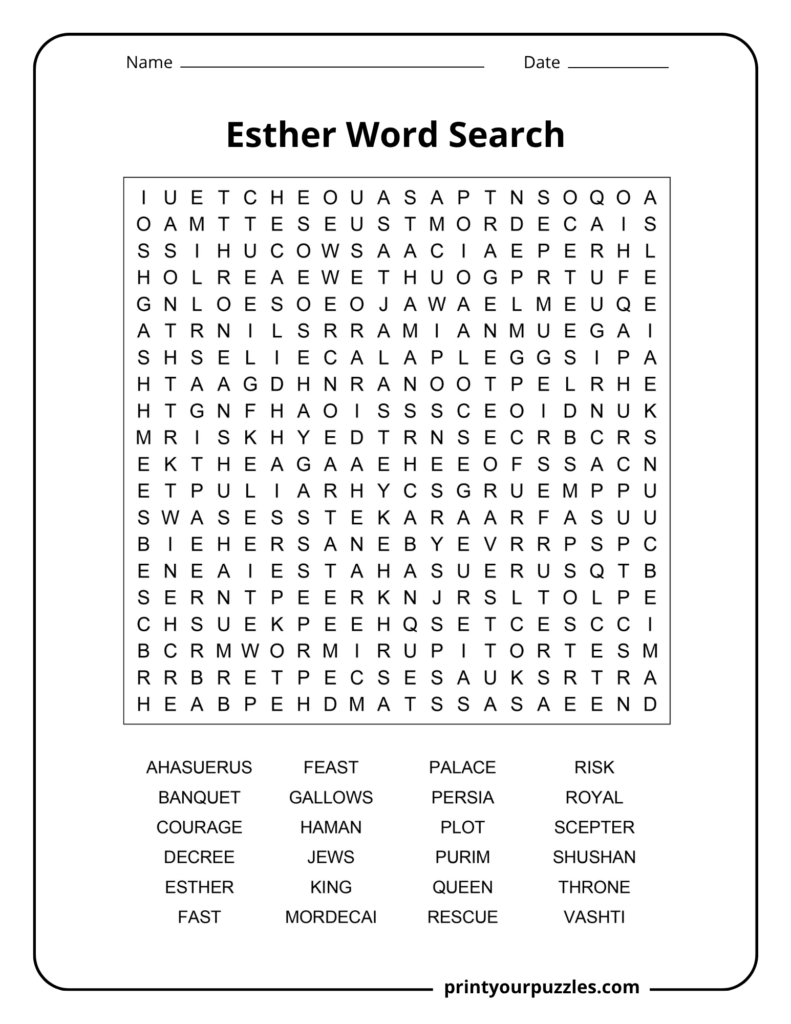
AHASUERUS, BANQUET, COURAGE, DECREE, ESTHER, FAST, FEAST, GALLOWS, HAMAN, JEWS, KING, MORDECAI, PALACE, PERSIA, PLOT, PURIM, QUEEN, RESCUE, RISK, ROYAL, SCEPTER, SHUSHAN, THRONE, VASHTI
Esther was a Jewish woman who became queen of Persia and courageously used her position to help save her people from Haman’s deadly plan.
Mordecai was Esther’s older cousin and guardian who advised her, opposed Haman, and encouraged Esther to speak to the king on behalf of the Jews.
Esther approached King Ahasuerus without being summoned because she needed to expose Haman’s plot and plead for the protection of the Jewish people.
Haman was a powerful Persian official who hated Mordecai and planned to destroy the Jewish population, but his scheme ultimately led to his downfall.
Purim is a Jewish festival celebrating the deliverance described in Esther, remembering how the Jewish people escaped destruction through courage, strategy, and dramatic reversal.
Esther was also known as Hadassah, a Hebrew name meaning “myrtle.” She used the name Esther while living within the Persian royal court.
Queen Vashti was removed after refusing the king’s command, and Esther was later chosen from among many young women to become the new queen.
Persian court rules made approaching the king without an invitation dangerous, but Esther accepted the risk because she wanted to protect her threatened people.
Haman used lots, called “pur,” to determine when his plan against the Jews would occur, helping explain the later name of the festival Purim.
Unlike many biblical books, Esther does not explicitly name God, yet readers often see themes of providence, reversal, courage, and deliverance throughout its story.