
Oklahoma carries a powerful mix of stories across its prairies, cities, rivers, and red-dirt roads. Located in the Southeast, where the Great Plains meet the South, the state has Oklahoma City as both its capital and largest city. Known as The Sooner State, Oklahoma is shaped by Native American history, ranching traditions, energy production, strong communities, and wide-open landscapes that seem to change with the weather.
The land itself is varied and full of character. Oklahoma includes grasslands, forests, lakes, mesas, rolling hills, river valleys, and parts of the Ozark and Ouachita regions. The Red River forms much of the southern border with Texas, while the Arkansas and Canadian rivers have helped shape settlement, transportation, and agriculture. Tornadoes and dramatic storms are also part of Oklahoma’s identity, making the state an important place for learning about weather and the Great Plains. These themes give an Oklahoma word search many interesting words to explore.
Oklahoma’s history cannot be understood without recognizing the importance of Native American nations. The state is home to many tribal nations, including the Cherokee, Chickasaw, Choctaw, Muscogee, Seminole, Osage, Comanche, Kiowa, and many others. In the nineteenth century, forced removals brought many Indigenous peoples to Indian Territory, a painful history that remains central to the state’s story. Oklahoma became the 46th state in 1907, combining Indian Territory and Oklahoma Territory into one state.
Energy, agriculture, and transportation have long shaped Oklahoma’s economy. Oil and natural gas helped build cities, businesses, and fortunes, while cattle ranching, wheat, cotton, soybeans, and poultry remain important. Route 66 also runs through Oklahoma, linking the state to one of America’s most famous highways and the spirit of road trips, small towns, diners, and roadside landmarks.
Oklahoma culture has its own strong sound and flavor. Country music, Western traditions, rodeos, Native art, college sports, chicken-fried steak, barbecue, fried onion burgers, pecan pie, and cornbread all reflect different parts of local life. As you complete this free printable Oklahoma word search, look for words connected to its plains, tribal nations, weather, rivers, foods, music, and Route 66 heritage.
Explore more Southeast States puzzles with our Texas word search, Kansas word search, Arkansas word search, and the full US States Word Searches collection.
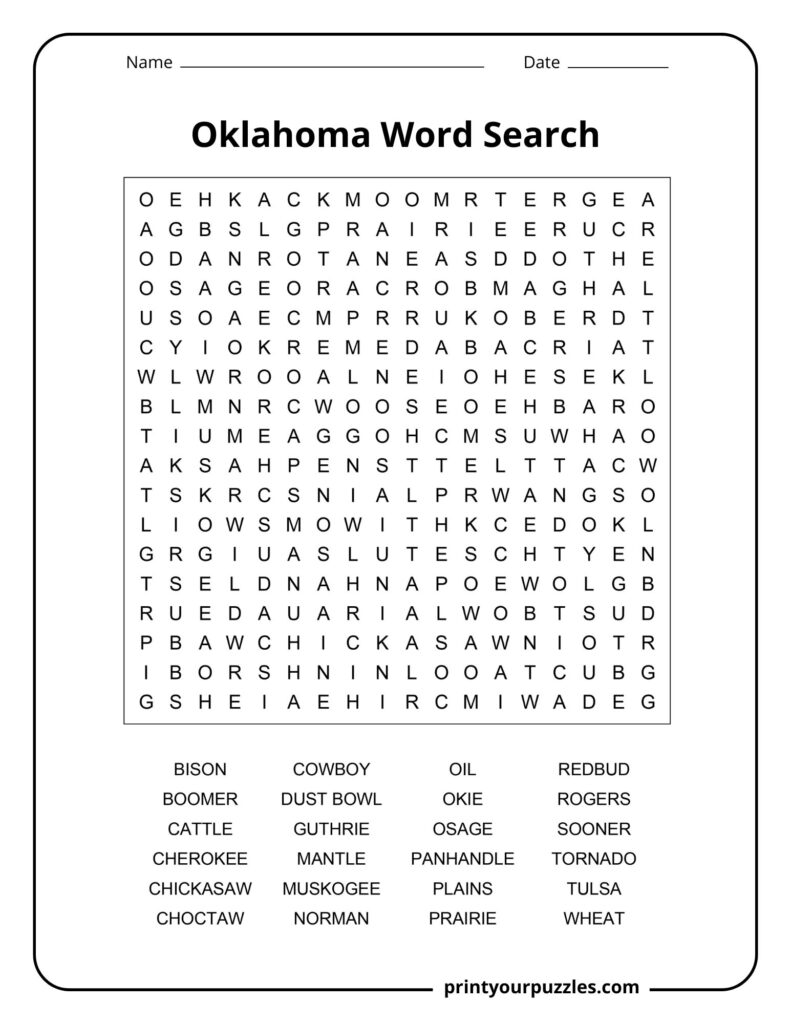
BISON, BOOMER, CATTLE, CHEROKEE, CHICKASAW, CHOCTAW, COWBOY, DUST BOWL, GUTHRIE, MANTLE, MUSKOGEE, NORMAN, OIL, OKIE, OSAGE, PANHANDLE, PLAINS, PRAIRIE, REDBUD, ROGERS, SOONER, TORNADO, TULSA, WHEAT
BISON – Large American buffalo that historically roamed Oklahoma’s plains in vast herds. These iconic animals were central to Native American culture and are now protected.
BOOMER – Settlers who rushed into Oklahoma Territory during the 1889 Land Run. The term refers to those advocating for opening Indian Territory lands to settlement.
CATTLE – Oklahoma’s ranching industry is fundamental to its economy and heritage. The state has a rich cowboy culture and remains a major beef producer today.
CHEROKEE – One of the Five Civilized Tribes relocated to Oklahoma via the Trail of Tears. They established a strong presence with their capital in Tahlequah.
CHICKASAW – Native American tribe forcibly relocated to Oklahoma in the 1830s. They established a prosperous nation in south-central Oklahoma with significant cultural and economic contributions.
CHOCTAW – One of the Five Civilized Tribes forcibly removed to Oklahoma during the Trail of Tears. They established a prosperous nation in southeastern Oklahoma with rich cultural traditions.
COWBOY – Symbol of Oklahoma’s western heritage and ranching culture. Cowboys represent the frontier spirit, rodeo tradition, and rural lifestyle that defines the state’s identity.
DUST BOWL – Devastating 1930s environmental disaster caused by severe drought and poor farming practices. Oklahoma suffered tremendously, forcing thousands to migrate westward seeking opportunity.
GUTHRIE – Oklahoma’s first state capital from 1907 to 1910. Also honors folk singer Woody Guthrie, born in Okemah, who chronicled American working-class struggles.
MANTLE – Mickey Mantle, legendary baseball player born in Spavinaw, Oklahoma. This Hall of Fame New York Yankees center fielder is one of baseball’s greatest icons.
MUSKOGEE – City in eastern Oklahoma named after the Muscogee Creek Nation. Known for its military presence, diverse culture, and as Merle Haggard’s “Okie from Muskogee” inspiration.
NORMAN – Home to the University of Oklahoma, the state’s flagship university. This vibrant college town in central Oklahoma features strong academics, athletics, and cultural attractions.
OIL – Petroleum industry that transformed Oklahoma’s economy in the early twentieth century. Oil discoveries created boom towns and wealth, making energy a cornerstone industry.
OKIE – Colloquial term for Oklahoma residents. Initially derogatory during the Dust Bowl migration, it’s now embraced as a badge of pride representing resilience and identity.
OSAGE – Native American tribe relocated to Oklahoma, they retained mineral rights that made them wealthy when oil was discovered beneath their reservation lands.
PANHANDLE – Oklahoma’s narrow northwestern region bordering Kansas, Colorado, New Mexico, and Texas. This flat, sparsely populated area features wheat farming and oil production.
PLAINS – Vast, flat grasslands characterizing much of Oklahoma’s geography. These rolling prairies define the landscape and historically supported buffalo herds and Native settlements.
PRAIRIE – Grassland ecosystem covering much of Oklahoma, featuring native grasses and wildflowers. Prairies supported diverse wildlife and shaped the state’s agricultural development patterns.
REDBUD – Oklahoma’s official state tree, known for vibrant pink-purple spring blossoms. These small native trees bloom before leaves emerge, creating stunning springtime displays statewide.
ROGERS – Will Rogers, beloved humorist, actor, and social commentator born in Oologah. His witty observations about American life made him an iconic entertainment figure.
SOONER – University of Oklahoma’s mascot and nickname for settlers who entered land illegally before official 1889 runs. Now represents state pride and OU athletics.
TORNADO – Oklahoma experiences frequent severe tornadoes due to its location in Tornado Alley. These violent storms shape building codes, emergency preparedness, and cultural awareness.
TULSA – Oklahoma’s second-largest city, known as the “Oil Capital of the World.” This diverse metropolitan area features strong energy, aerospace, and telecommunications industries.
WHEAT – Major agricultural crop in Oklahoma, particularly in the western plains region. The state ranks among top wheat producers nationally, supporting rural economies.
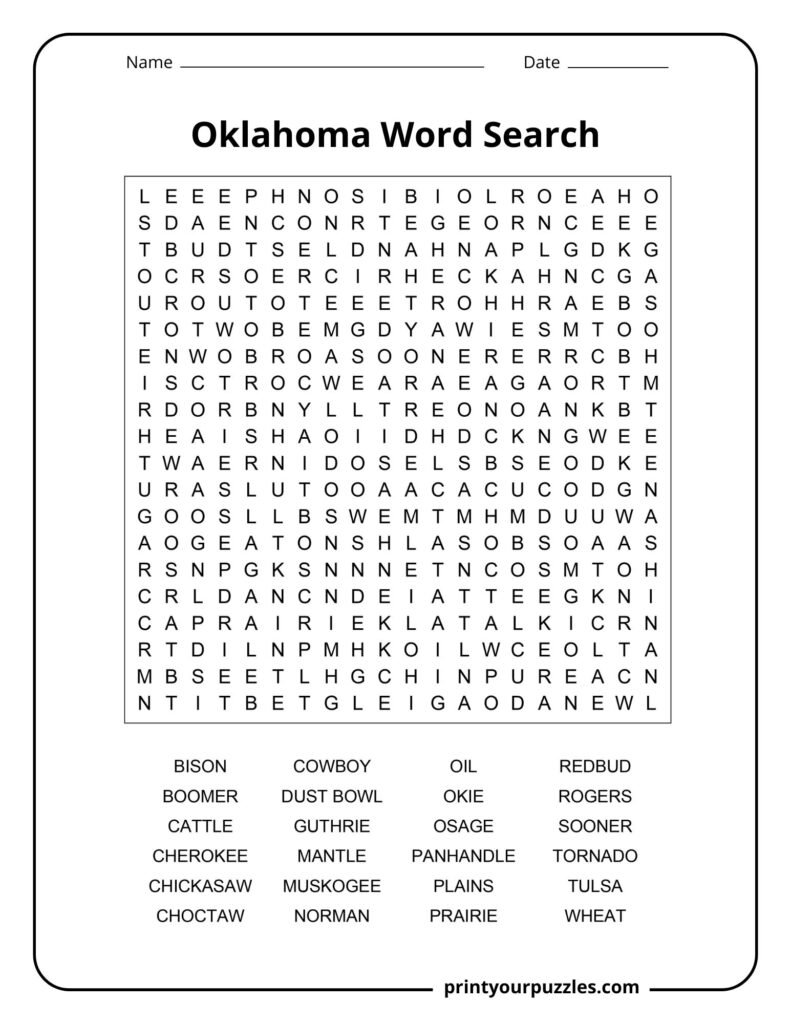
BISON, BOOMER, CATTLE, CHEROKEE, CHICKASAW, CHOCTAW, COWBOY, DUST BOWL, GUTHRIE, MANTLE, MUSKOGEE, NORMAN, OIL, OKIE, OSAGE, PANHANDLE, PLAINS, PRAIRIE, REDBUD, ROGERS, SOONER, TORNADO, TULSA, WHEAT
Oklahoma is known for its Native American heritage, oil and gas industry, cowboy culture, severe weather including tornadoes, and the Land Run of 1889 that opened territory for settlement.
“Sooner” originally referred to settlers who entered Oklahoma Territory illegally before official Land Runs. Today, it’s the University of Oklahoma’s mascot and represents state pride statewide.
Oklahoma City is the state capital and largest city. Tulsa, known as the former “Oil Capital of the World,” is the second-largest. Norman and Broken Arrow are other significant cities.
Oklahoma sits in Tornado Alley due to its central plains location where cold, dry air from Canada collides with warm, moist Gulf air, creating ideal conditions for severe tornadoes.
Oklahoma is home to 39 federally recognized tribes, including the Cherokee, Chickasaw, Choctaw, Creek, and Seminole nations—the Five Civilized Tribes relocated here during the 1830s Trail of Tears.
For official state records and government services, visit the Oklahoma State Portal. If you are planning a trip, check out Travel Oklahoma.
Oklahoma boasts over 200 man-made lakes, more than any U.S. state. These reservoirs provide recreation, flood control, and water supply, creating over 1 million surface acres of water.
Sylvan Goldman invented the shopping cart in Oklahoma City in 1936. His revolutionary idea transformed retail shopping worldwide, starting at his Humpty Dumpty supermarket chain.
Oklahoma’s official state meal includes chicken-fried steak, barbecue pork, fried okra, squash, cornbread, biscuits, sausage and gravy, grits, corn, strawberries, black-eyed peas, and pecan pie.
Carl Magee invented the world’s first parking meter, installed in Oklahoma City on July 16, 1935. This innovation revolutionized urban parking management and traffic control globally.
“Oklahoma” derives from Choctaw words “okla” meaning people and “humma” meaning red. Chief Allen Wright of the Choctaw Nation proposed this name meaning “red people” in 1866.