Few state capitals feel as closely tied to the water as Annapolis. Sailboats fill the harbor, narrow streets wind past brick buildings, and the Chesapeake Bay shapes both the city’s appearance and its traditions. Maryland’s capital may be compact, but its influence reaches far beyond its size through politics, naval history, colonial architecture, and maritime culture.
Annapolis became the capital of Maryland in 1694, replacing St. Mary’s City. Its name honors Princess Anne, who later became Queen Anne of Great Britain. During the eighteenth century, the city developed into an important port and political center, benefiting from trade across the Chesapeake region.
Several major events in early American history took place here. The Continental Congress met in the Maryland State House after the Revolutionary War. In 1783, George Washington resigned his military commission inside the building, helping establish the principle that the armed forces remain under civilian authority. Congress also ratified the Treaty of Paris there in 1784, officially confirming American independence.
Walking through the historic district is one of the best ways to experience Annapolis. Visitors can explore streets lined with preserved homes, churches, shops, and government buildings before touring the Maryland State House, the oldest state capitol still in continuous legislative use. Another memorable activity is visiting the United States Naval Academy, founded in 1845, where exhibitions and guided tours introduce the traditions and training of future naval officers.
The city also rewards those who spend time near the waterfront. Boat tours, sailing excursions, and harbor walks offer views of the Severn River and Chesapeake Bay. Galleries, small museums, live performances, and public events add an artistic dimension, while the architecture itself often feels like an open-air history lesson.
Food is another important part of Annapolis life. Maryland blue crabs, crab cakes, oysters, and rockfish appear on many local menus, often served in restaurants overlooking the water. These seafood traditions connect the capital directly to the Chesapeake Bay and the communities that have worked along its shores for generations.
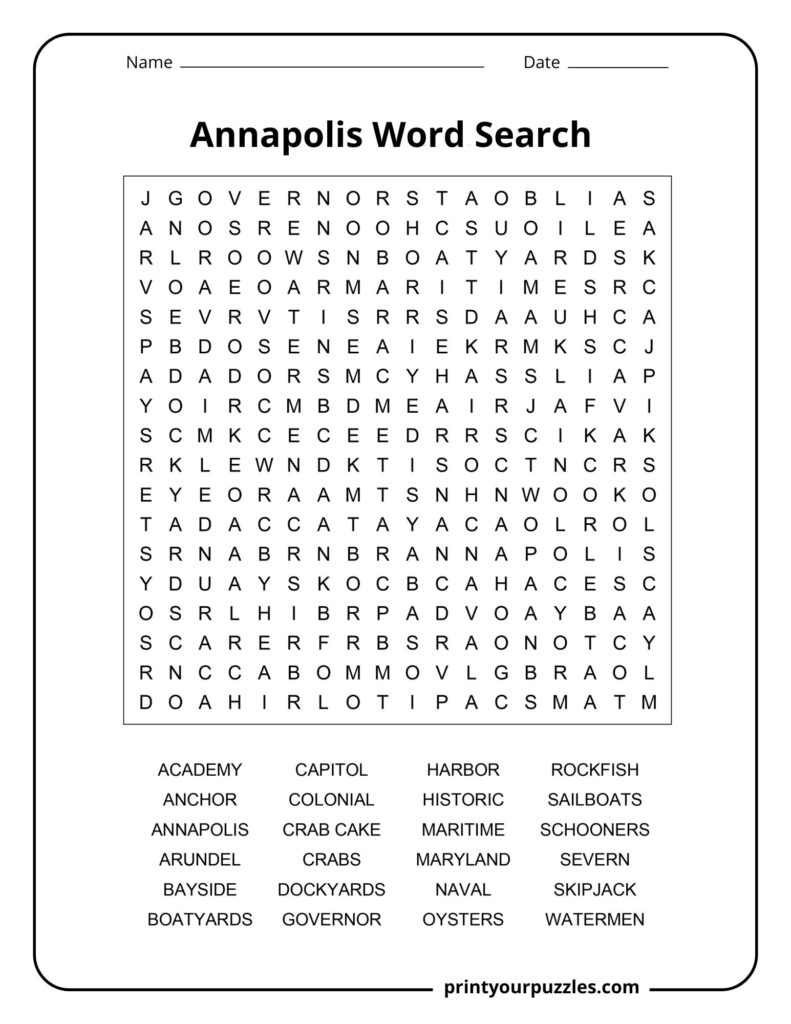
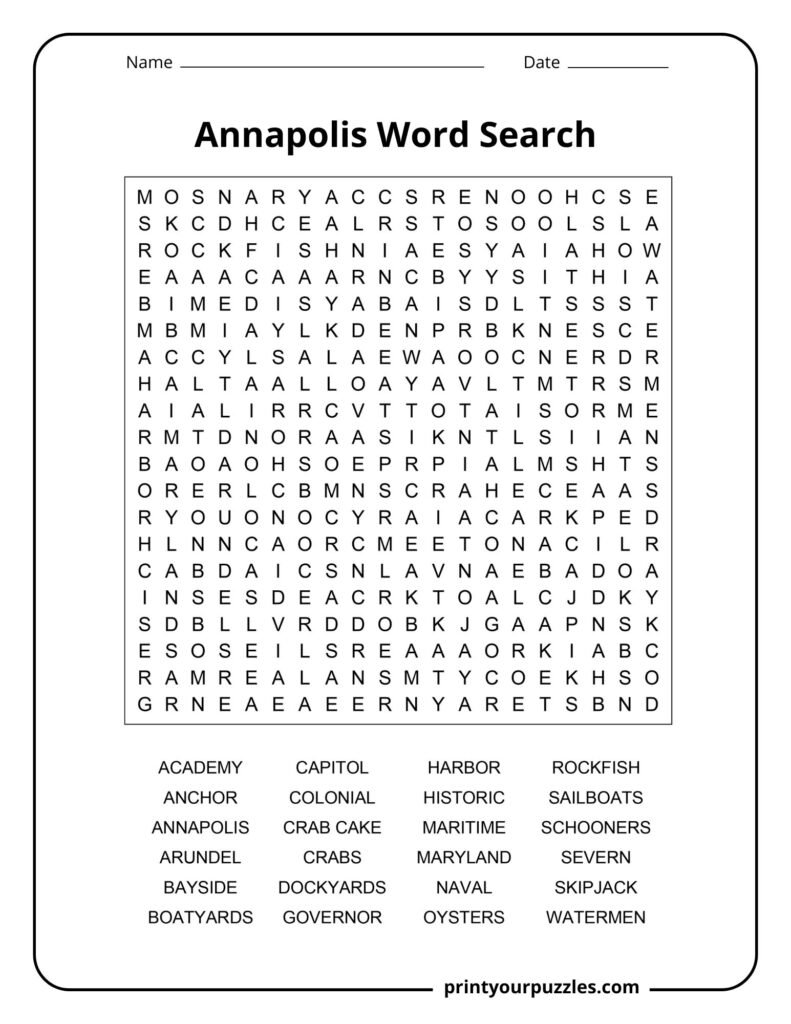
An Annapolis word search can introduce readers to terms linked with the State House, Naval Academy, sailing, colonial history, and Chesapeake cuisine. Blending national significance with waterfront charm, Annapolis offers a capital-city experience that feels both historic and lively.
Related Word Searches:
Maryland | Dover | Harrisburg | Richmond | Trenton
ACADEMY, ANCHOR, ANNAPOLIS, ARUNDEL, BAYSIDE, BOATYARDS, CAPITOL, COLONIAL, CRAB CAKE, CRABS, DOCKYARDS, GOVERNOR, HARBOR, HISTORIC, MARITIME, MARYLAND, NAVAL, OYSTERS, ROCKFISH, SAILBOATS, SCHOONERS, SEVERN, SKIPJACK, WATERMEN
ACADEMY – The United States Naval Academy, founded in 1845, is a prestigious military service academy that trains future Navy and Marine Corps officers on its Annapolis waterfront campus.
ANCHOR – A fundamental maritime symbol representing Annapolis’s deep connection to naval heritage, sailing tradition, and the Chesapeake Bay’s enduring influence on the city’s identity and economy.
ANNAPOLIS – Maryland’s capital city since 1694, known as “America’s Sailing Capital,” featuring colonial architecture, the U.S. Naval Academy, and serving as a major Chesapeake Bay maritime center.
ARUNDEL – Anne Arundel County surrounds Annapolis, named after Lady Anne Arundell, wife of Maryland’s first proprietor. The county was established in 1650 and encompasses the capital city.
BAYSIDE – Describes Annapolis’s prime location on the Chesapeake Bay, offering stunning waterfront views, maritime activities, and a lifestyle centered around the water and coastal living.
BOATYARDS – Shipbuilding and boat repair facilities that have operated in Annapolis for centuries, supporting the city’s maritime economy through construction, maintenance, and restoration of various watercraft.
CAPITOL – The Maryland State House, built in 1772, is the oldest state capitol in continuous legislative use and briefly served as the United States Capitol in 1783-1784.
COLONIAL – Refers to Annapolis’s remarkably preserved
eighteenth-century architecture and history, including colonial-era brick buildings, streets, and important Revolutionary War sites that attract visitors worldwide.
CRAB CAKE – Maryland’s signature dish featuring lump crabmeat with minimal filler, seasoned with Old Bay. Annapolis restaurants serve this iconic Chesapeake Bay delicacy as a regional culinary specialty.
CRABS – Blue crabs are central to Annapolis culture and cuisine. Steamed with Old Bay seasoning, these Chesapeake Bay crustaceans represent the region’s seafood heritage and watermen traditions.
DOCKYARDS – Naval and commercial docking facilities along Annapolis’s waterfront where ships are built, repaired, and maintained, supporting both military operations and the local maritime industry throughout history.
GOVERNOR – Maryland’s chief executive resides and works in Annapolis, the state capital. The Governor’s Mansion, built in 1868, stands as one of the nation’s oldest continuously occupied executive residences.
HARBOR – Annapolis Harbor is a protected deep-water port on the Severn River that accommodates countless sailboats, yachts, and vessels, making it a world-renowned sailing destination and maritime hub.
HISTORIC – Annapolis preserves more eighteenth-century buildings than any other American city. Its historic district features colonial architecture, cobblestone streets, and sites significant to Revolutionary and early American history.
MARITIME – Annapolis’s identity centers on maritime culture, including sailing, boating, naval traditions, shipbuilding, and Chesapeake Bay watermen. The city hosts major sailing events and regattas annually.
MARYLAND – Annapolis has served as Maryland’s state capital since 1694, housing state government operations, the legislature, and governor’s office in this historic Chesapeake Bay waterfront city.
NAVAL – The U.S. Naval Academy’s presence defines Annapolis. Midshipmen training, Navy football games, and military ceremonies create a distinctive atmosphere in this military-connected community of tradition.
OYSTERS – Chesapeake Bay oysters are harvested and served throughout Annapolis. These mollusks, eaten raw or cooked, represent the region’s aquaculture heritage and remain a beloved local delicacy.
ROCKFISH – Maryland’s state fish, also called striped bass, is a prized Chesapeake Bay species. Annapolis restaurants feature this local catch, grilled, broiled, or blackened in traditional preparations.
SAILBOATS – Hundreds of sailboats fill Annapolis Harbor year-round. The city hosts the United States Sailboat Show annually, cementing its reputation as “America’s Sailing Capital” and sailing enthusiast destination.
SCHOONERS – Historic multi-masted sailing vessels once common in Chesapeake Bay commerce. Several restored schooners operate from Annapolis today, offering tours and connecting visitors to maritime heritage.
SEVERN – The Severn River flows into Annapolis Harbor and the Chesapeake Bay. This tidal estuary borders the Naval Academy grounds and provides protected waters for sailing and recreation.
SKIP JACK – Traditional Chesapeake Bay sailing workboat with distinctive raked masts, used historically for oyster dredging. These wooden vessels represent Maryland’s watermen heritage and maritime craftsmanship traditions.
WATERMEN – Traditional Chesapeake Bay workers who harvest crabs, oysters, and fish for their livelihood. These independent watermen maintain centuries-old traditions using skills passed through generations.
ACADEMY, ANCHOR, ANNAPOLIS, ARUNDEL, BAYSIDE, BOATYARDS, CAPITOL, COLONIAL, CRAB CAKE, CRABS, DOCKYARDS, GOVERNOR, HARBOR, HISTORIC, MARITIME, MARYLAND, NAVAL, OYSTERS, ROCKFISH, SAILBOATS, SCHOONERS, SEVERN, SKIPJACK, WATERMEN