Harrisburg grew where the Susquehanna River creates one of the most distinctive settings among American state capitals. Bridges cross the broad water, wooded hills rise nearby, and historic neighborhoods sit beside museums, markets, and cultural venues. Pennsylvania’s capital combines political importance with industrial history, riverfront recreation, and a surprisingly varied local character.
The city developed during the eighteenth century and was named for John Harris, whose family played an important role in the early settlement of the area. Its position along the Susquehanna made Harrisburg a natural transportation center, especially as canals and railroads expanded during the nineteenth century. The city later became closely connected with steel, manufacturing, and the movement of goods across Pennsylvania.
One of the most enjoyable places to explore is the State Museum of Pennsylvania, where exhibits cover archaeology, Native American history, industry, transportation, art, and the natural environment. Families may also enjoy the Whitaker Center for Science and the Arts, which combines educational exhibits with live performances and cultural programming.
Harrisburg’s riverfront provides a completely different experience. Visitors can walk or cycle through Riverfront Park, enjoy views across the Susquehanna, or cross to City Island, where recreation, seasonal activities, and sporting events create a relaxed contrast with downtown streets. The river is not simply scenic; it has shaped Harrisburg’s growth for generations.
Food adds another layer to the city. The historic Broad Street Market brings together vendors offering baked goods, meats, produce, prepared dishes, and international flavors. Pennsylvania Dutch influences remain visible in the wider region through foods such as pretzels, sausages, pies, and hearty comfort dishes.
Art and performance are also part of Harrisburg life. Galleries, theaters, public murals, concerts, and community festivals contribute to a cultural scene that extends beyond the city’s governmental role. Nearby historic neighborhoods reveal Victorian architecture and streets that reflect different periods of urban development.
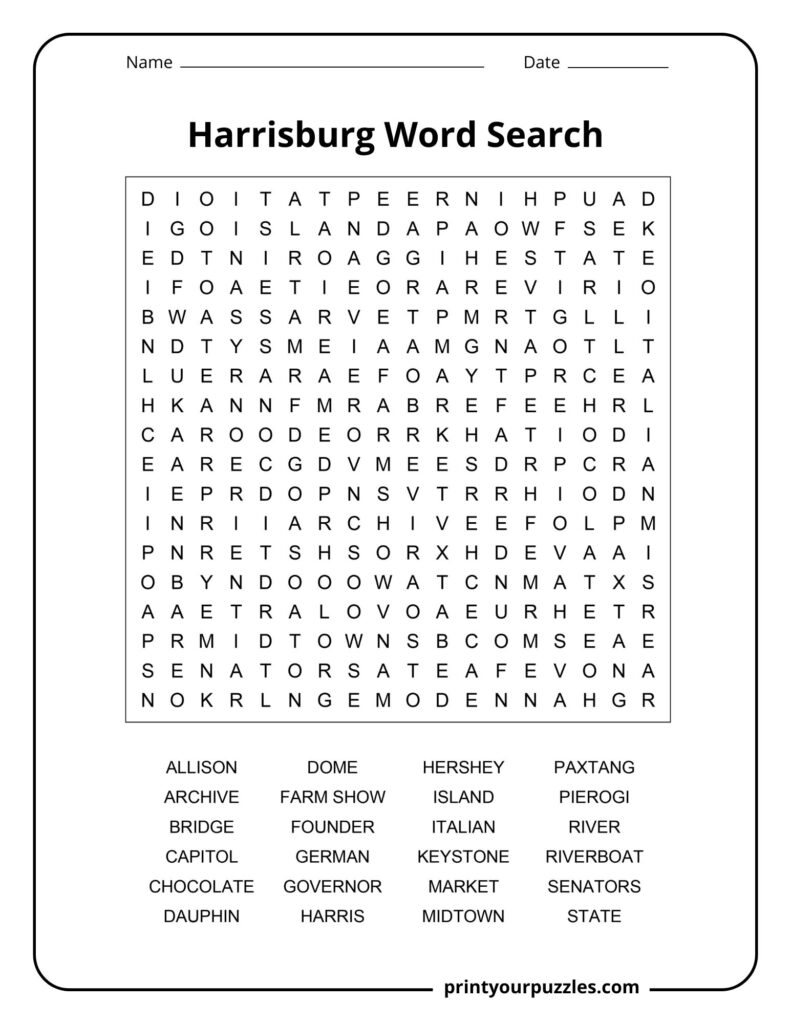
A Harrisburg word search can introduce readers to vocabulary connected with the Susquehanna River, transportation, museums, markets, industry, food, and Pennsylvania history. With river walks, cultural attractions, and a strong sense of place, Harrisburg offers much more than many visitors initially expect from the state capital.
Related Word Searches:
Pennsylvania | Trenton | Annapolis | Dover | Columbus
ALLISON – Allison Hill is a historic neighborhood in Harrisburg known for its diverse community, cultural heritage, and working-class roots dating back to the city’s industrial era.
ARCHIVE – The Pennsylvania State Archives preserves historical documents, records, and artifacts, serving as the official repository for Commonwealth history and government records in Harrisburg.
BRIDGE – Multiple bridges span the Susquehanna River connecting Harrisburg to surrounding areas, including the historic Market Street Bridge and Harvey Taylor Bridge, vital transportation arteries.
CAPITOL – Pennsylvania’s State Capitol building features a magnificent Renaissance-style dome and houses the General Assembly. This architectural masterpiece was completed in 1906 and dominates Harrisburg’s skyline.
CHOCOLATE – Harrisburg’s proximity to Hershey makes chocolate central to the region’s identity, with the famous chocolate factory just miles away creating sweet economic ties.
DAUPHIN – Dauphin County, named after French royalty, encompasses Harrisburg as its county seat, governing the region since 1785 with rich agricultural and industrial heritage
throughout.
DOME – The Capitol’s iconic green-tiled dome rises 272 feet, inspired by St. Peter’s Basilica in Rome, serving as Harrisburg’s most recognizable landmark visible throughout downtown.
FARM SHOW – The Pennsylvania Farm Show, held annually each January in Harrisburg, is the nation’s largest indoor agricultural exposition showcasing farming, livestock, food, and rural culture.
FOUNDER – John Harris, the city’s founder, established a trading post and ferry service in 1705, creating the settlement that would become Pennsylvania’s capital city.
GERMAN – German immigrants significantly shaped Harrisburg’s culture, contributing traditional foods, crafts, architecture, and strong work ethic that influenced the city’s industrial development and character.
GOVERNOR – The Governor’s Residence in Harrisburg serves as the official home of Pennsylvania’s governor, representing executive power and hosting important state functions and ceremonies.
HARRIS – John Harris Jr., son of the founder, laid out Harrisburg’s street plan in 1785 and donated land for government buildings, cementing his legacy.
HERSHEY – Milton Hershey built his chocolate empire near Harrisburg, creating a company town and chocolate dynasty that transformed the region economically and culturally forever.
ISLAND – City Island sits in the Susquehanna River offering parks, sports facilities, and the Harrisburg Senators baseball stadium, providing recreational space for residents and visitors.
ITALIAN – Italian immigrants brought vibrant culture, cuisine, and strong community bonds to Harrisburg, establishing restaurants, bakeries, and neighborhoods that enriched the city’s diversity.
KEYSTONE – Pennsylvania’s nickname, the Keystone State, reflects its central role in American history, with Harrisburg serving as the governmental heart of this crucial commonwealth.
MARKET – Broad Street Market, established in 1860, is one of America’s oldest continuously operating farmers’ markets, offering fresh produce, meats, and prepared foods year-round.
MIDTOWN – Midtown neighborhood features tree-lined streets, historic homes, and vibrant business districts, representing Harrisburg’s architectural heritage and ongoing urban revitalization efforts in recent decades.
PAXTANG – Paxtang is a small borough adjacent to Harrisburg, maintaining its own identity while being part of the greater capital region’s suburban residential community.
PIEROGI – These Eastern European dumplings reflect Harrisburg’s diverse immigrant heritage, particularly Polish and Ukrainian communities, becoming beloved comfort food throughout the region’s restaurants.
RIVER – The Susquehanna River flows through Harrisburg, shaping its geography, history, and economy. This mighty waterway provided transportation and commerce for centuries of development.
RIVERBOAT – The Pride of the Susquehanna riverboat offers scenic cruises from Harrisburg’s waterfront, providing tours, dining experiences, and unique views of the capital city’s skyline.
SENATORS – The Harrisburg Senators minor league baseball team plays at FNB Field on City Island, providing affordable family entertainment and connecting residents to America’s pastime.
STATE – As Pennsylvania’s state capital since 1812, Harrisburg serves as the seat of government, housing legislative, executive, and judicial branches in its historic downtown district.