Bacteria are microscopic living organisms found almost everywhere on Earth. They live in soil, water, air, plants, animals, and the human body. Although bacteria are too small to see without a microscope, they play an enormous role in nature, health, food production, and many everyday processes. Some bacteria can cause illness, but many others are harmless or extremely beneficial.
Most bacteria consist of only one cell. Unlike the cells of plants and animals, bacterial cells do not have a nucleus. They come in several common shapes, including round, rod-shaped, and spiral forms. Bacteria reproduce mainly by dividing into two identical cells, allowing some populations to grow very quickly when temperature, moisture, and nutrients are suitable.
People often associate bacteria with infections, but harmful bacteria represent only a small part of the bacterial world. Certain species can cause illnesses such as strep throat, food poisoning, tuberculosis, and some types of pneumonia. Antibiotics may be used to treat bacterial infections, although they do not work against viruses. The incorrect or excessive use of antibiotics can also contribute to antibiotic resistance, making some infections more difficult to treat.
Beneficial bacteria are essential to human health. Trillions of microorganisms live in and on the body, especially within the digestive system. Many help break down food, produce important vitamins, and support the immune system. Foods such as yogurt, cheese, pickles, and sauerkraut are also produced with the help of bacterial fermentation.
In nature, bacteria recycle nutrients by breaking down dead plants and animals. Some improve soil fertility by converting nitrogen into forms that plants can use. Scientists also use bacteria in biotechnology, medicine, environmental cleanup, and the production of useful substances such as enzymes and insulin.
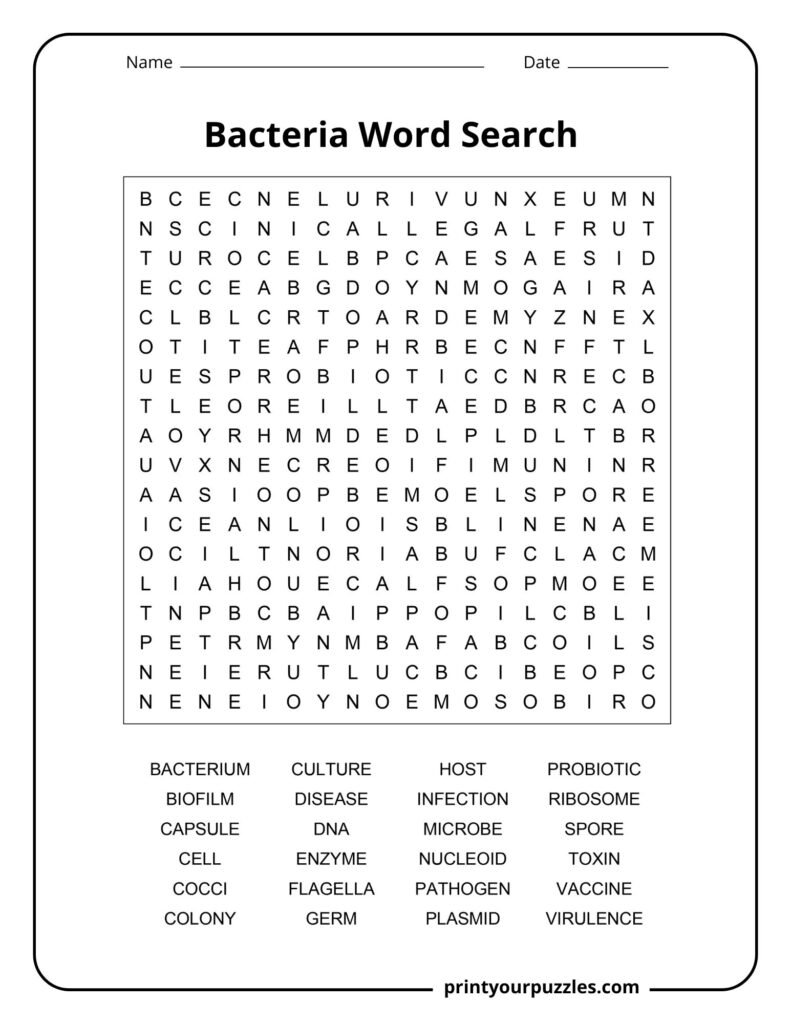
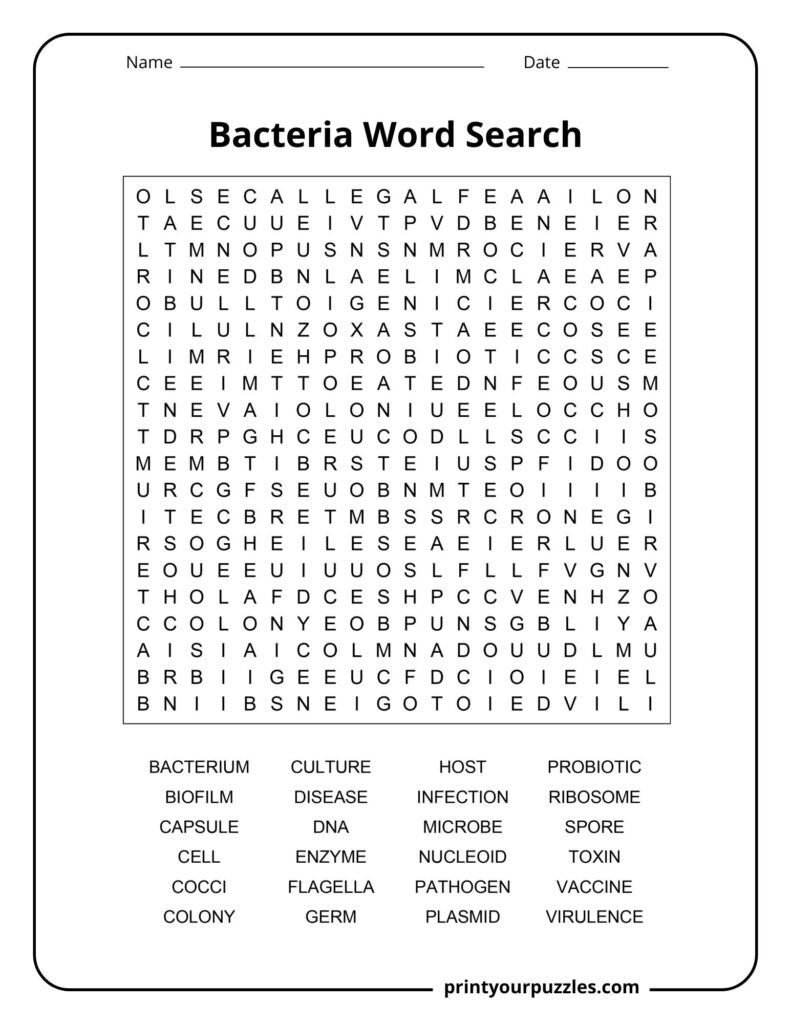
This printable bacteria word search puzzle introduces important vocabulary connected with bacterial structure, growth, health, disease, and scientific study. As you search for each hidden term, you can review how bacteria live, reproduce, interact with other organisms, and influence the world around us. It is an entertaining way to explore organisms that may be invisible to the human eye but are essential to life on Earth.
Related Word Searches:
Cell | Biology | DNA | Microscope | Cell Division | Ecology
BACTERIUM, BIOFILM, CAPSULE, CELL, COCCI, COLONY, CULTURE, DISEASE, DNA, ENZYME, FLAGELLA, GERM, HOST, INFECTION, MICROBE, NUCLEOID, PATHOGEN, PLASMID, PROBIOTIC, RIBOSOME, SPORE, TOXIN, VACCINE, VIRULENCE
BACTERIUM – A single-celled microorganism without a nucleus, usually classified by its shape, structure, and behavior. A bacterium may be helpful, harmless, or capable of causing disease.
BIOFILM – A community of bacteria and other microorganisms attached to a surface and protected by a sticky layer, often making them harder to remove or treat.
CAPSULE – A protective outer coating surrounding some bacterial cells. It helps bacteria retain moisture, attach to surfaces, and sometimes avoid destruction by the body’s immune system.
CELL – The basic unit of life. A bacterial cell contains genetic material, cytoplasm, ribosomes, and a membrane, but it does not have a true enclosed nucleus.
COCCI – Round or spherical bacteria that may occur alone, in pairs, chains, or clusters. Their arrangement often helps scientists identify particular bacterial groups and individual species.
COLONY – A visible group of bacteria growing together on a solid surface, usually developing from one original cell and often displaying a distinctive color, shape, or texture.
CULTURE – A laboratory-grown population of bacteria maintained in suitable nutrients and conditions. Scientists use cultures to identify microorganisms, study their behavior, and test different possible treatments.
DISEASE – A condition that disrupts normal body functions. Certain bacteria cause disease by invading tissues, damaging cells, producing toxins, or triggering harmful responses from the immune system.
DNA – The molecule carrying genetic instructions in bacteria and other living organisms. Bacterial DNA controls growth, reproduction, metabolism, and many characteristics passed to newly formed cells.
ENZYME – A protein that speeds up chemical reactions inside or outside bacterial cells. Enzymes help bacteria digest nutrients, produce energy, build structures, and survive changing conditions.
FLAGELLA – Long, whip-like structures used by some bacteria for movement. By rotating their flagella, bacterial cells can travel toward nutrients or away from potentially harmful environments.
GERM – An informal term for a microorganism that may cause illness. Germ can refer to bacteria, viruses, fungi, or other tiny infectious agents found in many environments.
HOST – A living organism that provides nutrients, shelter, or suitable conditions for bacteria. The relationship may be harmless, helpful, or harmful to the host’s health and survival.
INFECTION – The invasion and multiplication of harmful microorganisms inside the body. A bacterial infection may remain localized or spread, producing symptoms and sometimes requiring medical treatment.
MICROBE – A microscopic organism or biological agent too small to see without magnification. The term includes bacteria, fungi, protozoa, microscopic algae, and sometimes certain viruses.
NUCLEOID – The irregular region inside a bacterial cell where its main chromosome is located. Unlike a nucleus, the nucleoid is not enclosed by a protective membrane.
PATHOGEN – A microorganism capable of causing disease in a host. Pathogenic bacteria may invade tissues, release toxins, avoid immune defenses, or compete with normal beneficial microbes.
PLASMID – A small circular piece of DNA separate from the bacterial chromosome. Plasmids can carry useful traits, including antibiotic resistance, and may pass between different bacteria.
PROBIOTIC – A live microorganism that may provide health benefits when consumed in suitable amounts. Probiotic bacteria are commonly found in fermented foods and some dietary products.
RIBOSOME – A tiny cellular structure that builds proteins by following genetic instructions. Bacterial ribosomes are essential for growth and are targeted by several types of antibiotics.
SPORE – A highly resistant, dormant structure produced by certain bacteria during unfavorable conditions. It can survive heat, dryness, or chemicals and later return to active growth.
TOXIN – A poisonous substance produced by some bacteria. Bacterial toxins can damage cells, disrupt normal body processes, and cause symptoms ranging from mild illness to severe disease.
VACCINE – A preparation that trains the immune system to recognize and fight a specific pathogen. Some vaccines protect against serious bacterial diseases and reduce their spread.
VIRULENCE – The degree of harm or disease-causing ability shown by a pathogen. Virulence depends on factors such as toxins, attachment, invasion, and resistance to immune defenses.
BACTERIUM, BIOFILM, CAPSULE, CELL, COCCI, COLONY, CULTURE, DISEASE, DNA, ENZYME, FLAGELLA, GERM, HOST, INFECTION, MICROBE, NUCLEOID, PATHOGEN, PLASMID, PROBIOTIC, RIBOSOME, SPORE, TOXIN, VACCINE, VIRULENCE