
This Lyndon B. Johnson word search celebrates the life and legacy of America’s 36th president, who served from 1963 to 1969 during one of the most turbulent periods in American history. Lyndon Baines Johnson, born in Stonewall, Texas, in 1908, rose from humble beginnings to become one of the most influential and controversial presidents of the 20th century. He assumed office following President John F. Kennedy‘s assassination in Dallas and went on to win a landslide election in 1964.
Johnson’s presidency was defined by his ambitious “Great Society” programs, which created Medicare and Medicaid, advanced civil rights through landmark legislation, and declared war on poverty. However, his legacy was complicated by the escalation of the Vietnam War, which ultimately overshadowed his domestic achievements and led him to decline seeking reelection in 1968.
This comprehensive Lyndon B. Johnson word search printable goes beyond a typical puzzle by including detailed definitions for all 24 terms, helping you understand the historical significance of each word. You’ll also find a helpful FAQ section answering key questions about LBJ’s presidency and a fascinating “Did You Know?” section revealing surprising facts—like how Johnson named his entire family, including both daughters and even his dog, with the initials LBJ.
This word search printable serves as both an engaging activity and a complete educational resource, perfect for classroom use, homeschooling, or anyone interested in presidential history and the transformative 1960s era.
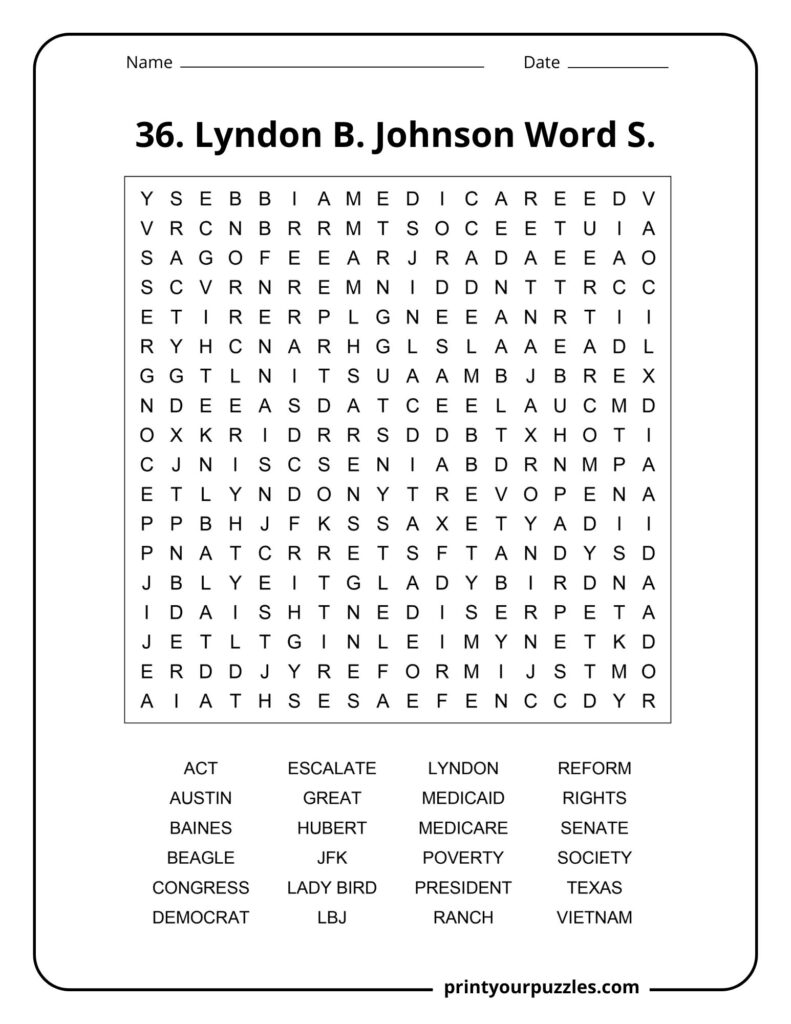
ACT, AUSTIN, BAINES, BEAGLE, CONGRESS, DEMOCRAT, ESCALATE, GREAT, HUBERT, JFK, LADY BIRD, LBJ, LYNDON, MEDICAID, MEDICARE, POVERTY, PRESIDENT, RANCH, REFORM, RIGHTS, SENATE, SOCIETY, TEXAS, VIETNAM
ACT – Refers to landmark legislation passed during Johnson’s presidency, particularly the Civil Rights Act of 1964, which outlawed discrimination based on race, color, religion, or national origin.
AUSTIN – The capital city of Texas where Johnson attended the University of Texas and began his political career, remaining deeply connected to throughout his life.
BAINES – Lyndon Johnson’s middle name, honoring his mother’s maiden name. He often used the full name Lyndon Baines Johnson to emphasize his Texas heritage and family roots.
BEAGLE – Johnson famously owned beagles named Him and Her, causing controversy when photographed lifting them by their ears, claiming it was how to handle the breed.
CONGRESS – The legislative body where Johnson served with distinction in both the House of Representatives and Senate before becoming Vice President, mastering its complex procedures brilliantly.
DEMOCRAT – The political party Johnson belonged to throughout his career, representing its progressive wing and championing civil rights, social welfare programs, and domestic reform initiatives.
ESCALATE – Describes Johnson’s controversial decision to dramatically increase American military involvement in Vietnam, deploying hundreds of thousands of troops and intensifying bombing campaigns against North Vietnam.
GREAT – References the “Great Society,” Johnson’s ambitious domestic program aimed at eliminating poverty and racial injustice through sweeping legislative reforms including education, healthcare, and civil rights.
HUBERT – Hubert Humphrey served as Johnson’s Vice President from 1965-1969, later becoming the Democratic presidential nominee in 1968 but losing to Richard Nixon narrowly.
JFK – John F. Kennedy, the president whom Johnson served as Vice President. Johnson assumed the presidency after Kennedy’s assassination in Dallas on November 22, 1963.
LADY BIRD – Claudia Alta “Lady Bird” Johnson, LBJ’s wife and First Lady, known for her beautification projects, environmental advocacy, and shrewd business acumen in building their fortune.
LBJ – The commonly used initials for Lyndon Baines Johnson, becoming his popular identifier. He even named his daughters Lynda Bird and Luci Baines to share initials.
LYNDON – Johnson’s first name, given at birth in Stonewall, Texas in 1908. He grew up in the Texas Hill Country in modest circumstances during difficult times.
MEDICAID – Federal and state program established in 1965 providing healthcare coverage to low-income Americans, families, elderly, and disabled individuals, representing major expansion of social safety net.
MEDICARE – Federal health insurance program created in 1965 for Americans aged 65 and older, later expanded to include younger disabled people, representing Johnson’s landmark achievement.
POVERTY – Johnson declared an “War on Poverty” in 1964, launching programs like Head Start, Job Corps, and food stamps to help disadvantaged Americans achieve economic opportunity.
PRESIDENT – The office Johnson assumed after Kennedy’s assassination, winning election in his own right in 1964 by a landslide before declining to seek reelection in 1968.
RANCH – The LBJ Ranch in Stonewall, Texas, served as Johnson’s “Texas White House” where he conducted business, entertained dignitaries, and relaxed away from Washington’s pressures.
REFORM – Johnson pushed extensive reforms in civil rights, education, healthcare, immigration, environmental protection, and poverty reduction, achieving unprecedented legislative success during his first years.
RIGHTS – Civil rights became Johnson’s defining domestic achievement, signing the Civil Rights Act of 1964 and Voting Rights Act of 1965 despite his southern background.
SENATE – Johnson served as Senator from Texas from 1949-1961, becoming Majority Leader in 1955 and earning reputation as the most effective legislative leader ever.
SOCIETY – The “Great Society” was Johnson’s vision for America: elimination of poverty and racial injustice through comprehensive federal programs addressing education, healthcare, urban problems, and environment.
TEXAS – Johnson’s home state where he was born, educated, and began his political career. His Texas identity profoundly shaped his personality, politics, and presidential style.
VIETNAM – The war that overshadowed Johnson’s presidency, escalating from advisory role to major combat involving over 500,000 troops, ultimately dividing the nation and ending his career.
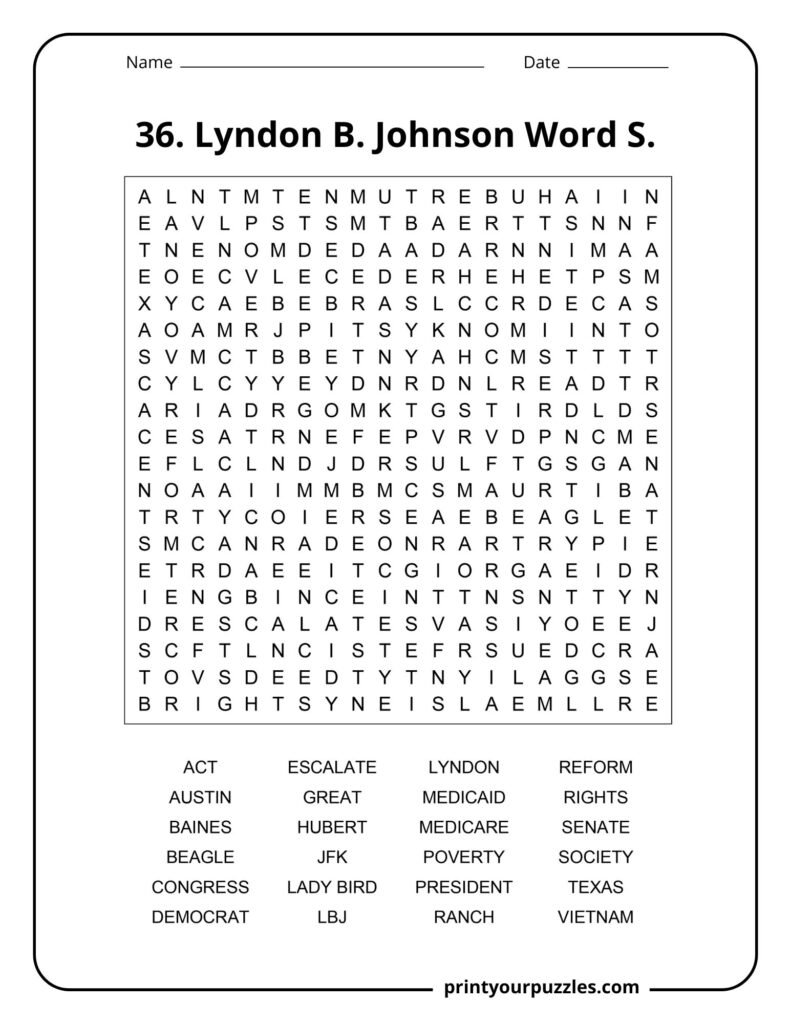
ACT, AUSTIN, BAINES, BEAGLE, CONGRESS, DEMOCRAT, ESCALATE, GREAT, HUBERT, JFK, LADY BIRD, LBJ, LYNDON, MEDICAID, MEDICARE, POVERTY, PRESIDENT, RANCH, REFORM, RIGHTS, SENATE, SOCIETY, TEXAS, VIETNAM
Johnson became President on November 22, 1963, after President John F. Kennedy’s assassination in Dallas, Texas. He was sworn in aboard Air Force One, then won election in 1964.
The Great Society was Johnson’s ambitious domestic agenda aimed at eliminating poverty and racial injustice through federal programs including Medicare, Medicaid, education funding, environmental protection, and urban development initiatives.
Johnson signed the landmark Civil Rights Act of 1964, banning discrimination, and the Voting Rights Act of 1965, protecting African Americans’ voting rights despite fierce opposition from southern Democrats.
Johnson declined to run due to the Vietnam War’s unpopularity, which divided the nation and his party. Growing protests, casualties, and declining approval ratings made reelection unlikely.
Johnson dramatically escalated U.S. involvement in Vietnam, increasing troops from 16,000 advisors to over 500,000 combat soldiers, intensifying bombing campaigns, and transforming it into America’s war.
For official administration records and historical biography, visit the Lyndon B. Johnson page in the White House Archives. If you are planning a trip or looking for personal papers, check out the official LBJ Presidential Library.
The Years of Lyndon Johnson (series) by Robert A. Caro. Widely considered the greatest modern political biography. Caro’s multi-volume masterpiece reveals LBJ’s ruthless genius and towering contradictions.
Johnson’s wife was Lady Bird, and he named both daughters Lynda Bird and Luci Baines. Even his dog was Little Beagle Johnson, ensuring everyone shared the LBJ initials.
He would lean over people, invade their personal space, grab lapels, and use physical dominance combined with persuasion to convince legislators to support his bills remarkably effectively.
Johnson famously held conferences in the bathroom, discussing policy and politics while using the facilities, making visitors extremely uncomfortable but demonstrating his unconventional leadership style and dominance.
He’d drive visitors toward a lake screaming that the brakes failed, then splash into the water. The car floated, revealing the joke while terrified passengers realized it was amphibious.
In 1928, he taught impoverished students in Cotulla, Texas. This experience profoundly shaped his commitment to education reform and fighting poverty throughout his political career.