
This Warren G. Harding word search invites you to explore the life and presidency of America’s twenty-ninth president through an engaging puzzle format. Warren Gamaliel Harding was born in Ohio in 1865 and rose from newspaper publisher to become president in 1921. His journey from Marion, Ohio, where he owned the Marion Star, to the White House represented the American dream, yet his presidency would become one of the most controversial in United States history.
Harding served as president from March 1921 until his sudden death in August 1923 during a trip to San Francisco. He campaigned on a promise of “return to normalcy” after World War I, winning a landslide victory that reflected Americans’ desire for stability. However, his administration became infamous for corruption scandals, particularly Teapot Dome, where cabinet members accepted bribes to lease federal oil reserves to private companies.
This Warren G. Harding word search printable goes beyond a simple puzzle by providing comprehensive educational resources. Each of the 24 words includes a detailed 20-30 word definition explaining its historical significance. The word search printable also features a helpful FAQ section answering common questions about Harding’s presidency and legacy, plus a fascinating “Did You Know?” section revealing surprising facts—like how Harding once gambled away White House china in a poker game!
Whether you’re a student studying American presidents, an educator seeking classroom materials, or a history enthusiast, this Warren G. Harding word search offers both entertainment and education, making presidential history accessible and memorable through interactive learning.
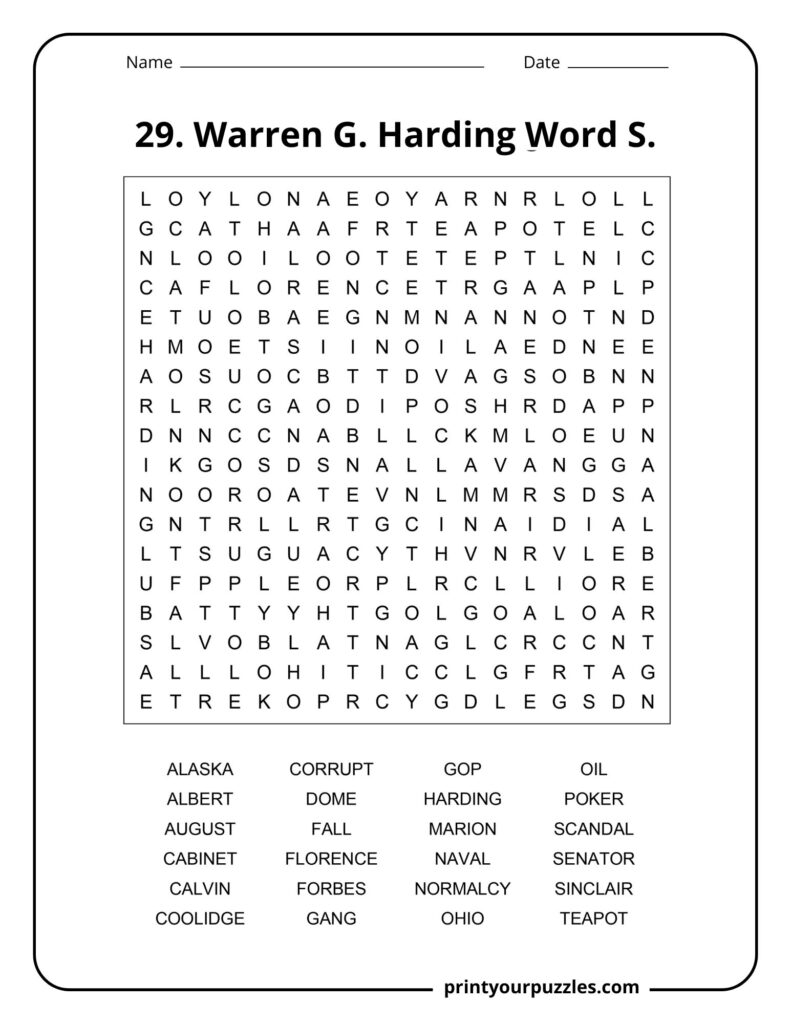
ALASKA, ALBERT, AUGUST, CABINET, CALVIN, COOLIDGE, CORRUPT, DOME, FALL, FLORENCE, FORBES, GANG, GOP, HARDING, MARION, NAVAL, NORMALCY, OHIO, OIL, POKER, SCANDAL, SENATOR, SINCLAIR, TEAPOT
ALASKA – Harding became the first sitting president to visit Alaska in 1923, during a western tour shortly before his unexpected death in San Francisco.
ALBERT – Albert Fall served as Harding’s Secretary of Interior and was convicted for accepting bribes in the Teapot Dome scandal, becoming the first cabinet member imprisoned.
AUGUST – Warren G. Harding died suddenly on August 2, 1923, in San Francisco, California, likely from a heart attack, ending his scandal-plagued presidency after just two years.
CABINET – Harding’s cabinet included both respected figures like Herbert Hoover and Charles Evans Hughes, and corrupt cronies who caused major scandals that tarnished his presidential legacy.
CALVIN – Calvin Coolidge served as Harding’s Vice President and succeeded him after his sudden death, becoming the thirtieth President of the United States in August 1923.
COOLIDGE – Calvin Coolidge, Harding’s vice president, restored public confidence in the presidency after Harding’s death and the subsequent exposure of widespread corruption within the administration.
CORRUPT – Harding’s administration became synonymous with corruption, as multiple scandals involving his appointees, particularly the Ohio Gang, severely damaged his presidential reputation and historical legacy.
DOME – Teapot Dome was a Wyoming naval oil reserve at the center of a massive bribery scandal involving Harding’s Interior Secretary Albert Fall and private oil companies.
FALL – Albert Bacon Fall, Harding’s Interior Secretary, accepted bribes to lease federal oil reserves to private companies, becoming the first U.S. cabinet member convicted of crimes.
FLORENCE – Florence Kling Harding was Warren’s ambitious wife who strongly supported his political career and served as an influential First Lady, though their marriage was reportedly
troubled.
FORBES – Charles Forbes headed the Veterans Bureau under Harding and was convicted of fraud and bribery, stealing millions from disabled veterans in one of the administration’s major scandals.
GANG – The “Ohio Gang” was Harding’s inner circle of political cronies from Ohio who engaged in widespread corruption, bribery, and illegal activities during his presidency.
GOP – The Republican Party (Grand Old Party) nominated Harding as a compromise candidate in 1920, and he won the presidency with a landslide victory promising normalcy.
HARDING – Warren Gamaliel Harding served as the twenty-ninth U.S. President from 1921 until his death in 1923, remembered mainly for administrative scandals despite some accomplishments.
MARION – Marion, Ohio was Harding’s hometown where he owned and published the Marion Star newspaper and conducted his famous “front porch” presidential campaign in 1920.
NAVAL – Naval oil reserves at Teapot Dome and Elk Hills were illegally leased to private oil companies by Interior Secretary Fall, creating the biggest scandal of Harding’s presidency.
NORMALCY – Harding’s 1920 campaign promised a “return to normalcy” after World War I and progressive reforms, appealing to Americans desiring stability and traditional values after turbulent times.
OHIO – Harding was born, raised, and built his political career in Ohio, serving as state senator, lieutenant governor, and U.S. senator before becoming president.
OIL – Oil reserves were at the heart of Teapot Dome, where Interior Secretary Fall secretly leased federal petroleum reserves to private companies in exchange for personal bribes.
POKER – Harding enjoyed playing poker regularly with his friends, hosting card games at the White House where bootleg liquor flowed freely despite Prohibition being in effect.
SCANDAL – Multiple scandals plagued Harding’s administration, including Teapot Dome, Veterans Bureau fraud, and Justice Department corruption, severely damaging his reputation and historical standing among presidents.
SENATOR – Before becoming president, Harding served as a U.S. Senator from Ohio from 1915 to 1921, where his amiable personality made him popular among colleagues.
SINCLAIR – Harry Sinclair was an oil tycoon who bribed Interior Secretary Albert Fall to gain control of the Teapot Dome oil reserves, playing a central role in Harding’s administration.
TEAPOT – Teapot Dome in Wyoming was a naval oil reserve illegally leased to private interests, creating the defining scandal of Harding’s presidency and a symbol of government corruption.
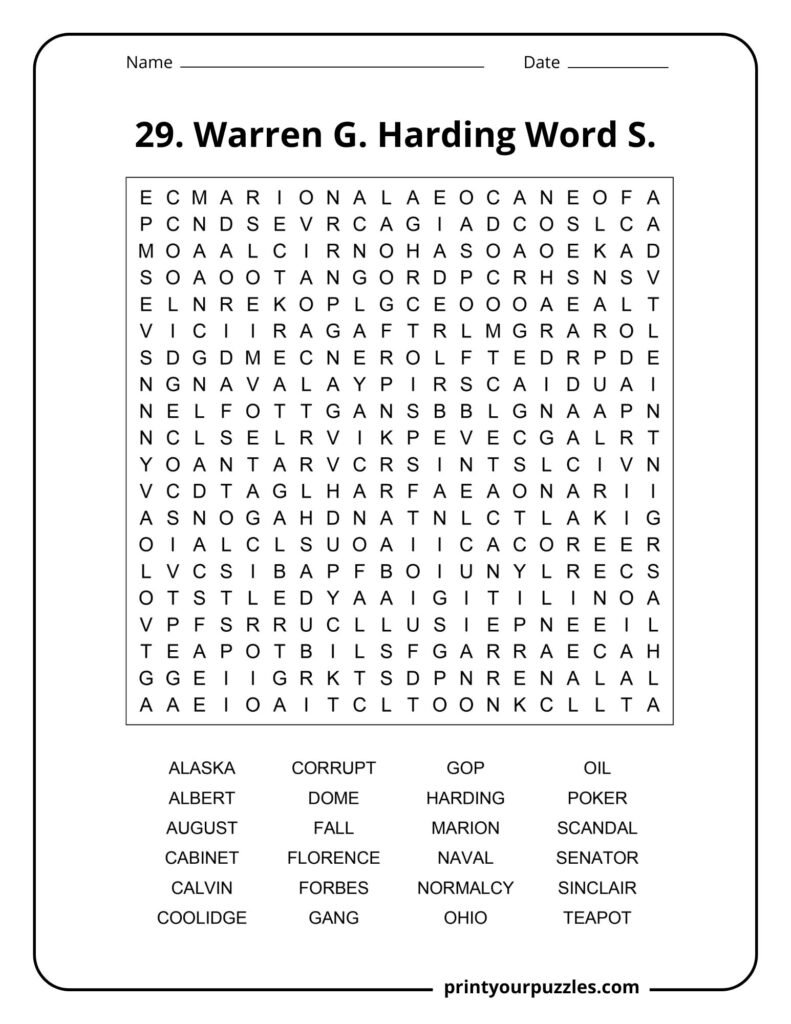
ALASKA, ALBERT, AUGUST, CABINET, CALVIN, COOLIDGE, CORRUPT, DOME, FALL, FLORENCE, FORBES, GANG, GOP, HARDING, MARION, NAVAL, NORMALCY, OHIO, OIL, POKER, SCANDAL, SENATOR, SINCLAIR, TEAPOT
Harding’s presidency was marred by massive corruption scandals, including Teapot Dome, and his appointment of dishonest cronies called the Ohio Gang who betrayed public trust through widespread fraud.
Teapot Dome involved Interior Secretary Albert Fall illegally leasing federal oil reserves to private companies in exchange for bribes, becoming American history’s worst cabinet-level scandal until Watergate.
Harding’s 1920 campaign slogan promised Americans stability and traditional values after World War I’s disruptions, progressive era reforms, and social upheaval, appealing to voters seeking peace and prosperity.
Harding died suddenly on August 2, 1923, in San Francisco during a western tour, likely from a heart attack or stroke, though the exact cause remains debated.
Most historians believe Harding was unaware of the full extent of corruption, though he realized before his death that trusted friends had betrayed him, reportedly causing him great distress.
For official administration records and historical biography, visit the Warren G. Harding page in the White House Archives. If you are planning a trip, visit the official Harding Presidential Sites.
Florence Harding: The First Lady, the Jazz Age, and the Death of America’s Most Scandalous President by Carl Sferrazza Anthony. A fascinating angle on a scandal-ridden presidency, told through his formidable wife, revealing the corruption and intrigue of the Harding era.
Harding regularly hosted poker games with friends at the White House, where illegal bootleg whiskey flowed freely, even though Prohibition banned alcohol nationwide throughout his entire presidency.
Harding embraced new technology by installing a radio in the White House and becoming the first president to have his voice broadcast over radio, helping modernize presidential communications.
Harding ran his successful “front porch campaign” from his Marion, Ohio home, where over 600,000 visitors came to hear him speak, avoiding expensive nationwide travel and appearances.
According to historical accounts, Harding lost an entire set of White House china during a poker game, demonstrating his reckless gambling habits and casual attitude toward presidential responsibilities.
Despite political opposition, Harding commuted the sentence of socialist leader Eugene Debs, who was imprisoned for opposing World War I, and even invited him to the White House afterward.