
The burning bush is one of the most memorable events in the Bible. The story appears in the Book of Exodus and describes how God called Moses to lead the Israelites out of slavery in Egypt. It marks an important turning point in Moses’ life and introduces the mission that would shape the rest of the Exodus story.
Before this event, Moses had left Egypt and settled in the land of Midian. He married Zipporah and worked as a shepherd for her father, Jethro. One day, while guiding the flock near Mount Horeb, also called the mountain of God, Moses noticed a bush that was on fire but was not being consumed by the flames.
Curious about the unusual sight, Moses moved closer. God called to him from the bush and told him not to approach further. Moses was instructed to remove his sandals because he was standing on holy ground. God then identified Himself as the God of Abraham, Isaac, and Jacob, connecting Moses’ calling with the earlier promises made to Israel’s ancestors.
God explained that He had seen the suffering of the Israelites in Egypt and had heard their cries. He chose Moses to confront Pharaoh and bring the people out of slavery. Moses felt uncertain and questioned whether he was capable of completing such a difficult task. God promised to be with him and gave him signs to demonstrate divine authority.
During the conversation, Moses asked what name he should give if the Israelites questioned who had sent him. God answered, “I AM WHO I AM,” a statement that has inspired extensive reflection about God’s eternal nature and identity. Moses was told to speak with the elders of Israel and announce that God had remembered His people.
The burning bush represents God’s presence, holiness, power, and compassion. It also shows that biblical leaders sometimes experienced fear and doubt before accepting their responsibilities. Moses did not begin as a confident leader, but his encounter with God prepared him for the challenges ahead.
This printable burning bush word search puzzle offers a beautifukl way to review important names, places, symbols, and ideas connected with this biblical event. While completing the puzzle, readers can remember Moses’ calling, the holy ground, God’s name, the suffering Israelites, and the beginning of their journey toward freedom.
Related Word Searches:
Moses | Ten Commandments | Red Sea Crossing | Old Testament
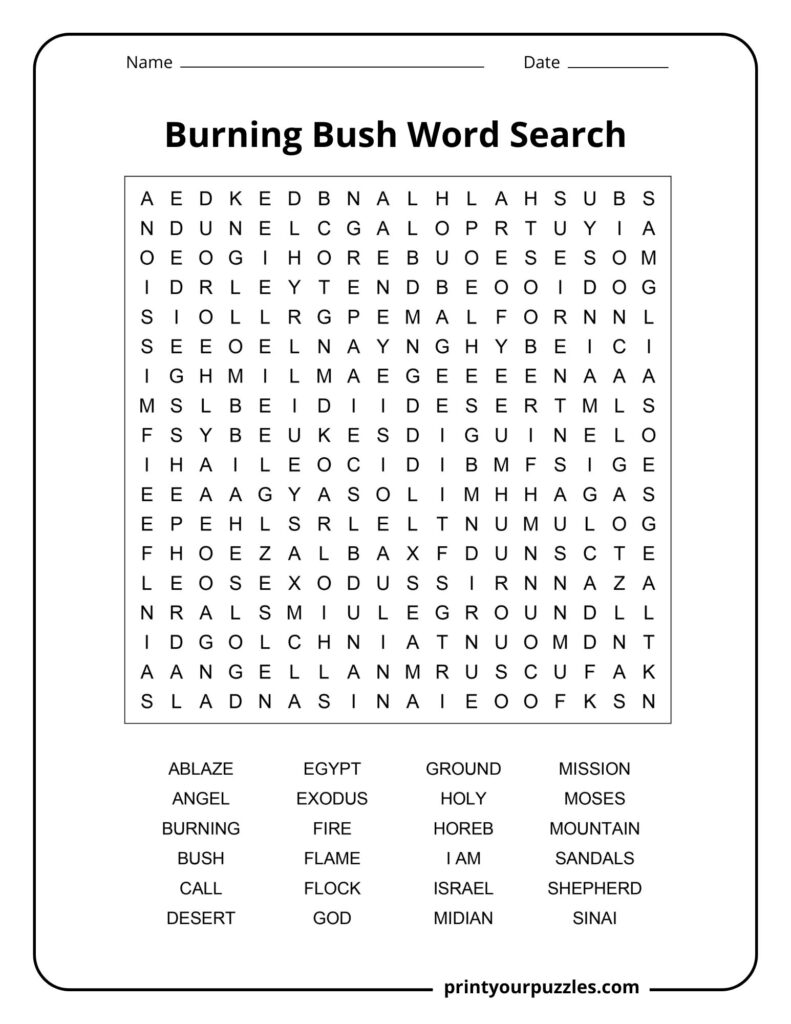
ABLAZE, ANGEL, BURNING, BUSH, CALL, DESERT, EGYPT, EXODUS, FIRE, FLAME, FLOCK, GOD, GROUND, HOLY, HOREB, I AM, ISRAEL, MIDIAN, MISSION, MOSES, MOUNTAIN, SANDALS, SHEPHERD, SINAI
ABLAZE – On fire with flames; burning brightly. The bush was ablaze with fire yet remained unconsumed, demonstrating God’s miraculous power and divine presence to Moses in the wilderness.
ANGEL – A heavenly messenger or spiritual being sent by God. The angel of the Lord appeared to Moses in flames within the burning bush, initiating God’s divine communication and revelation.
BURNING – Being consumed or appearing to be consumed by fire. The bush was burning but not destroyed, symbolizing God’s eternal nature and His holy presence manifesting in an extraordinary, miraculous way.
BUSH – A small shrubby plant or thorny acacia tree. The ordinary desert bush became extraordinary when God chose it as the location to reveal Himself and deliver His message to Moses.
CALL – God’s summons or divine invitation to serve a specific purpose. Moses received his call to lead the Israelites out of Egyptian bondage when God spoke from the burning bush on Mount Horeb.
DESERT – A dry, barren wilderness region with little vegetation. Moses encountered the burning bush while tending sheep in the Midian desert, far from Egypt where he had fled after killing an Egyptian.
EGYPT – The ancient North African nation where Israelites suffered in slavery. God commissioned Moses at the burning bush to return to Egypt and demand Pharaoh release His people from their oppressive bondage and suffering.
EXODUS – The departure or mass migration of people from one place. The burning bush encounter initiated the Exodus, where Moses would lead the Israelites from Egyptian slavery to freedom in the Promised Land.
FIRE – Combustion producing heat, light, and flames. The fire in the bush represented God’s holy presence, purity, and power, consuming yet preserving, destroying evil while protecting what is sacred and chosen.
FLAME – The visible, gaseous part of a fire. The flames within the bush drew Moses’ attention, appearing supernatural since they burned continuously without consuming the bush itself, revealing divine mystery and presence.
FLOCK – A group of sheep or goats under a shepherd’s care. Moses was tending his father-in-law Jethro’s flock when he led them to Mount Horeb, where he encountered the burning bush and received his divine commission.
GOD – The supreme creator and divine being of the universe. God revealed Himself to Moses in the burning bush, identifying Himself as the God of Abraham, Isaac, and Jacob, eternal and compassionate toward suffering Israel.
GROUND – The solid surface of the earth beneath one’s feet. God commanded Moses to remove his sandals because the ground surrounding the burning bush was holy, consecrated by the divine presence manifesting in that sacred location.
HOLY – Sacred, set apart, morally pure and spiritually perfect. The ground around the burning bush was made holy by God’s presence, requiring reverence and respect, symbolized by Moses removing his sandals before approaching closer.
HOREB – The mountain of God, also known as Sinai. Moses encountered the burning bush on Mount Horeb while shepherding, the same mountain where God would later give the Ten Commandments to Israel through Moses.
I AM – God’s self-revealed name meaning eternal, self-existent being. When Moses asked God’s name, He declared “I Am Who I Am,” revealing His eternal nature, unchanging character, and absolute existence beyond human comprehension.
ISRAEL – The descendants of Jacob who became God’s chosen people. God heard Israel’s cries from Egyptian bondage and revealed His plan to Moses at the burning bush to deliver them to freedom and establish them.
MIDIAN – The desert region east of Egypt where Moses fled. After killing an Egyptian, Moses escaped to Midian, married, became a shepherd, and encountered God at the burning bush, transforming his exile into purpose.
MISSION – A specific task or divine assignment to accomplish. God gave Moses the mission to confront Pharaoh, demand Israel’s freedom, and lead God’s people from slavery in Egypt to the land flowing with milk and honey.
MOSES – The Hebrew leader chosen by God to deliver Israel. Raised in Pharaoh’s palace but exiled as a fugitive, Moses encountered God at the burning bush and became the greatest prophet and liberator in Israel’s history.
MOUNTAIN – A large elevated landform rising above surrounding terrain. The mountain of Horeb, where the burning bush appeared, was called God’s mountain, a place of divine revelation, encounter, and significant spiritual transformation for Moses.
SANDALS – Footwear consisting of soles fastened to the feet by straps. God commanded Moses to remove his sandals as a sign of reverence and humility, acknowledging he stood on holy ground in God’s sacred presence.
SHEPHERD – One who tends, guards, and cares for sheep. Moses worked as a shepherd in Midian after fleeing Egypt, and this humble role prepared him to shepherd God’s people Israel from bondage to freedom.
SINAI – The wilderness region and mountain where God revealed Himself. Also called Horeb, Mount Sinai was where Moses saw the burning bush and later received the Law, making it central to Israel’s covenant relationship.
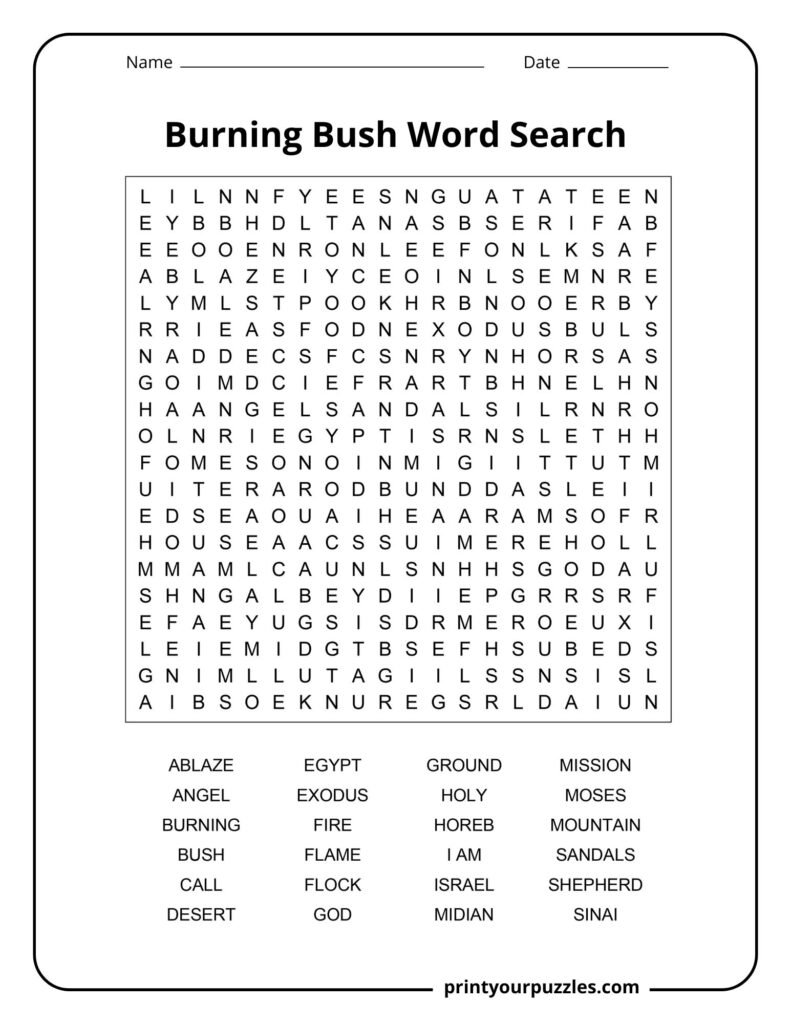
ABLAZE, ANGEL, BURNING, BUSH, CALL, DESERT, EGYPT, EXODUS, FIRE, FLAME, FLOCK, GOD, GROUND, HOLY, HOREB, I AM, ISRAEL, MIDIAN, MISSION, MOSES, MOUNTAIN, SANDALS, SHEPHERD, SINAI
The burning bush appeared on Mount Horeb, also called Mount Sinai, in the Midian desert. Moses encountered it while shepherding his father-in-law Jethro’s flock in this remote wilderness location.
The bush remained unconsumed to demonstrate God’s miraculous power and eternal nature. This supernatural sign captured Moses’ attention and revealed that he was witnessing a divine manifestation, not an ordinary fire.
God revealed His name as “I Am Who I Am” and commanded Moses to return to Egypt. He commissioned Moses to lead the enslaved Israelites to freedom in the Promised Land.
The burning bush marks Moses’ divine calling and the beginning of Israel’s exodus from slavery. This encounter established Moses as God’s chosen prophet and liberator, fundamentally shaping Jewish and Christian faith.
The burning bush symbolizes God’s holy presence, eternal nature, and ability to dwell among His people without destroying them. It represents divine revelation, calling, purification, and God’s compassionate intervention in human suffering.
After fleeing Egypt at age 40, Moses spent 40 years as a shepherd in Midian before encountering the burning bush. His divine calling came at an age when most would consider retirement.
Biblical scholars suggest the burning bush was likely a thorny acacia, common in the Sinai desert. The Hebrew word “seneh” used in Scripture shares roots with “Sinai,” possibly connecting the bush to the mountain.
Saint Catherine’s Monastery at Mount Sinai’s base, built in the 6th century, contains a chapel marking the traditional burning bush site. A transplanted bush descendant reportedly grows there today.
Despite witnessing the miraculous burning bush, Moses made five excuses to avoid leading Israel. He claimed inadequacy, anonymity, lack of credibility, poor speaking ability, and finally begged God to send someone else.
The Quran references Moses’ encounter with the burning bush, calling the location the “blessed valley of Tuwa.” Islamic tradition honors this event as a profound moment of divine revelation and prophetic calling.