
Feudalism was a system of political, military, and social relationships that shaped much of medieval Europe from approximately the ninth to the fifteenth centuries. It developed in a world where central governments were often weak, warfare was frequent, and travel and communication were difficult. In this environment, land, protection, loyalty, and military service became closely connected.
Kings depended on powerful nobles to govern territories and provide soldiers. In return, rulers granted land, income, or legal privileges to these nobles. A person who received such benefits from a lord became known as a vassal. Vassals promised loyalty, advice, and military assistance through ceremonies of homage and fealty.
The land or rights granted in exchange for service were often called a fief. Great nobles could divide their territories among lesser lords and knights, creating several levels of obligation. Knights served as trained mounted warriors who defended land, joined military campaigns, and protected the interests of their lords. Some received estates or income to support their equipment, horses, and households.
Feudal relationships among nobles were closely connected to manorialism, the rural economic system that supported medieval society. A manor might include farmland, villages, mills, forests, pastures, a church, and the lord’s residence. Most people worked in agriculture, producing food and goods for the local community.
Many peasants were serfs, meaning they were legally tied to the land they farmed. They owed labor, rent, or part of their harvest to the lord and usually needed permission to leave the estate. In return, they received protection and the right to cultivate fields. Their lives were often difficult, but village customs and shared work also created strong local communities.
The medieval Church was another major landowner and source of authority. Bishops, monasteries, and abbeys controlled estates, collected income, preserved written knowledge, and influenced law, education, morality, and government. Castles also became important symbols of feudal power, serving as military defenses, noble residences, administrative centers, and places of refuge.
Feudalism was never identical throughout Europe, and historians continue to debate how broadly the term should be used. Stronger monarchies, expanding towns, trade, paid armies, peasant resistance, the Black Death, and new military technologies gradually weakened the system.
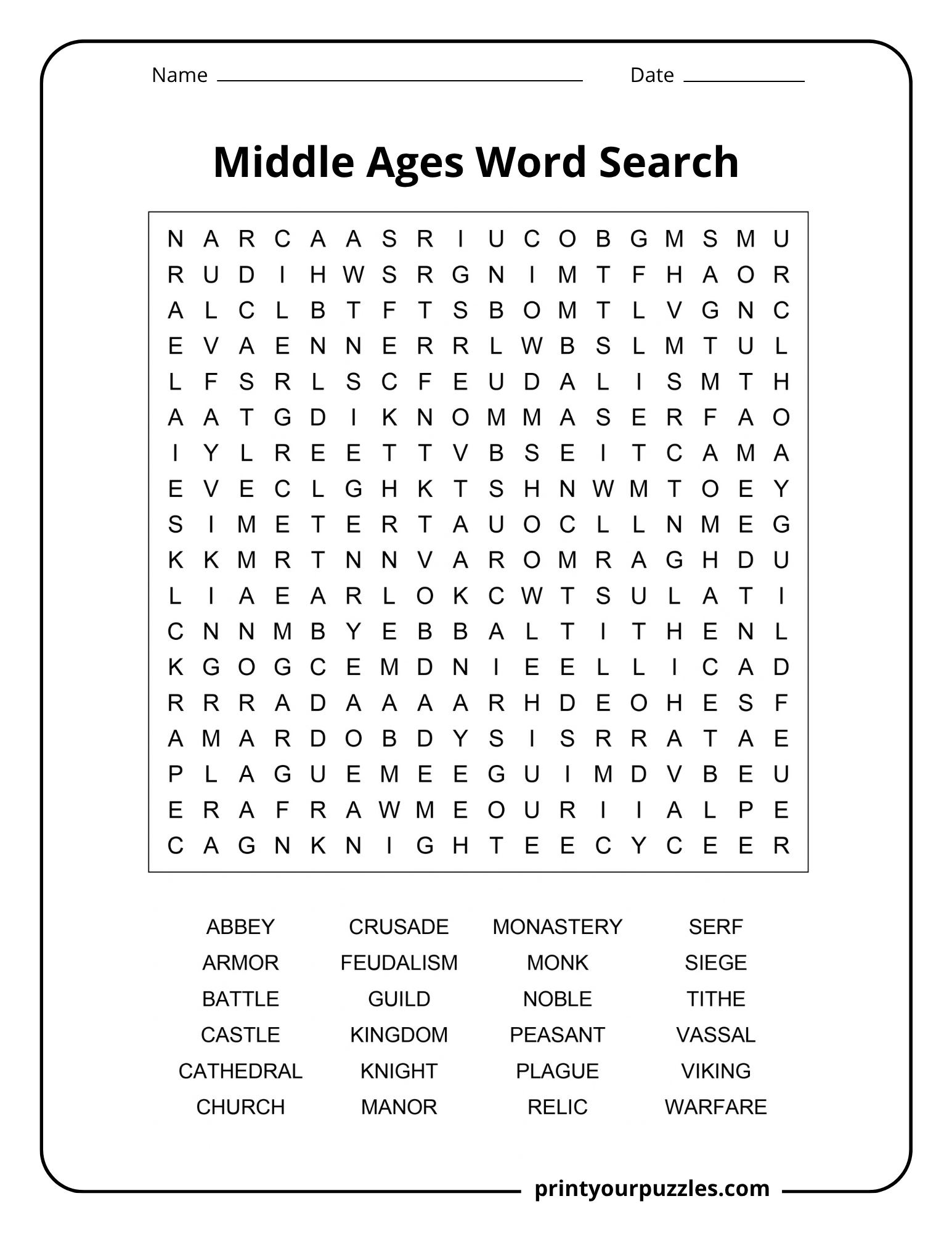
With this Feudalism word search, students can explore vocabulary connected to kings, lords, vassals, fiefs, knights, manors, serfs, castles, loyalty, land, and service.
Related Word Searches:
Carolingian Empire | Byzantine Empire | Viking Age | Ancient Rome | Ancient Japan | Silk Road
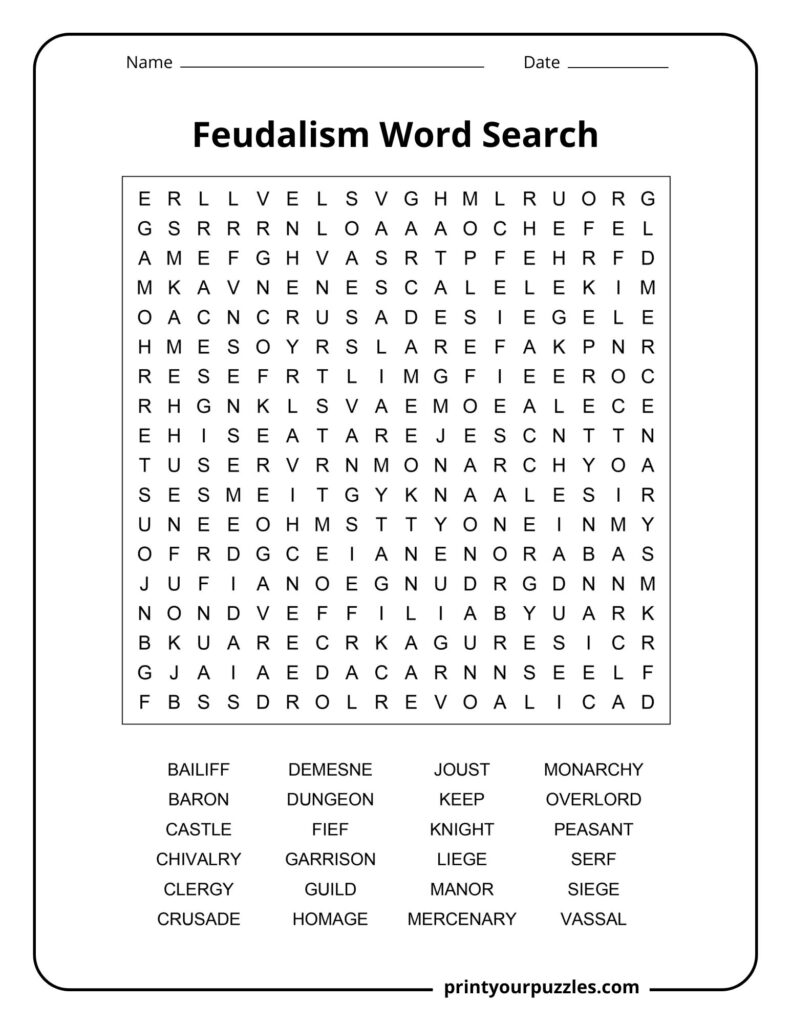
BAILIFF, BARON, CASTLE, CHIVALRY, CLERGY, CRUSADE, DEMESNE, DUNGEON, FIEF, GARRISON, GUILD, HOMAGE, JOUST, KEEP, KNIGHT, LIEGE, MANOR, MERCENARY, MONARCHY, OVERLORD, PEASANT, SERF, SIEGE, VASSAL
BAILIFF – A royal or lord’s officer responsible for managing an estate, collecting taxes, enforcing laws, and overseeing peasant workers within a feudal territory.
BARON – A powerful nobleman who held land directly from the king in exchange for military service and loyalty, forming the highest tier of the feudal nobility.
CASTLE – A fortified stone residence built by nobles to defend territory, project power, shelter soldiers and peasants during attacks, and serve as an administrative center.
CHIVALRY – A strict code of conduct followed by knights emphasizing bravery, loyalty, honor, courtesy toward women, and protection of the weak and the Church.
CLERGY – The religious class of medieval society including priests, bishops, monks, and abbots who provided spiritual guidance, education, and wielded significant political influence.
CRUSADE – A series of religious military campaigns launched by European Christians to reclaim the Holy Land from Muslim control, deeply shaping medieval politics and society.
DEMESNE – The portion of a feudal lord’s land kept under his direct control and worked by serfs, distinct from land granted to vassals as fiefs.
DUNGEON – A dark underground prison chamber located beneath a castle used to confine enemies, criminals, and captives, often under harsh and brutal conditions.
FIEF – A piece of land granted by a lord to a vassal in exchange for military service, loyalty, and other feudal obligations forming the system’s foundation.
GARRISON – A body of troops permanently stationed inside a castle or fortified town to defend it against enemy attacks and maintain order in surrounding territories.
GUILD – An organized association of skilled craftsmen or merchants in medieval towns that regulated trade practices, set quality standards, and trained apprentices in specific crafts.
HOMAGE – A formal ceremonial act in which a vassal knelt before his lord, pledged loyalty and obedience, and officially acknowledged the feudal bond between them.
JOUST – A competitive mounted combat event between two armored knights charging at each other with lances, held during tournaments to display martial skill and bravery.
KEEP – The strongest and most secure tower within a castle complex, serving as the lord’s residence and the last line of defense during enemy sieges.
KNIGHT – A trained armored warrior on horseback who served a lord in exchange for land or payment, bound by chivalric ideals of honor and courage.
LIEGE – A sovereign lord to whom a vassal owed absolute loyalty and military service, forming the most important and binding relationship within the feudal hierarchy.
MANOR – The basic economic and social unit of feudal society, consisting of a lord’s household, farmland, villages, and the serfs who worked the land.
MERCENARY – A professional soldier who fought exclusively for financial payment rather than loyalty or feudal obligation, often hired during wars when regular forces proved insufficient.
MONARCHY – A system of government in which a king or queen held supreme authority over a realm, delegating power to nobles in exchange for loyalty and service.
OVERLORD – A supreme lord who held authority over lesser lords and vassals, sitting at the top of the feudal chain and commanding their military and political allegiance.
PEASANT – A low-ranking agricultural worker who formed the majority of medieval society, farming land owned by nobles in exchange for protection and the right to live there.
SERF – A bound agricultural laborer legally tied to a lord’s land, unable to leave without permission, and obligated to work and pay dues to their master.
SIEGE – A military strategy involving surrounding and blockading a castle or fortified city to cut off supplies and force surrender through starvation, bombardment, or negotiation.
VASSAL – A person who received land from a lord in exchange for sworn loyalty, military service, and various other feudal duties within the hierarchical medieval system.
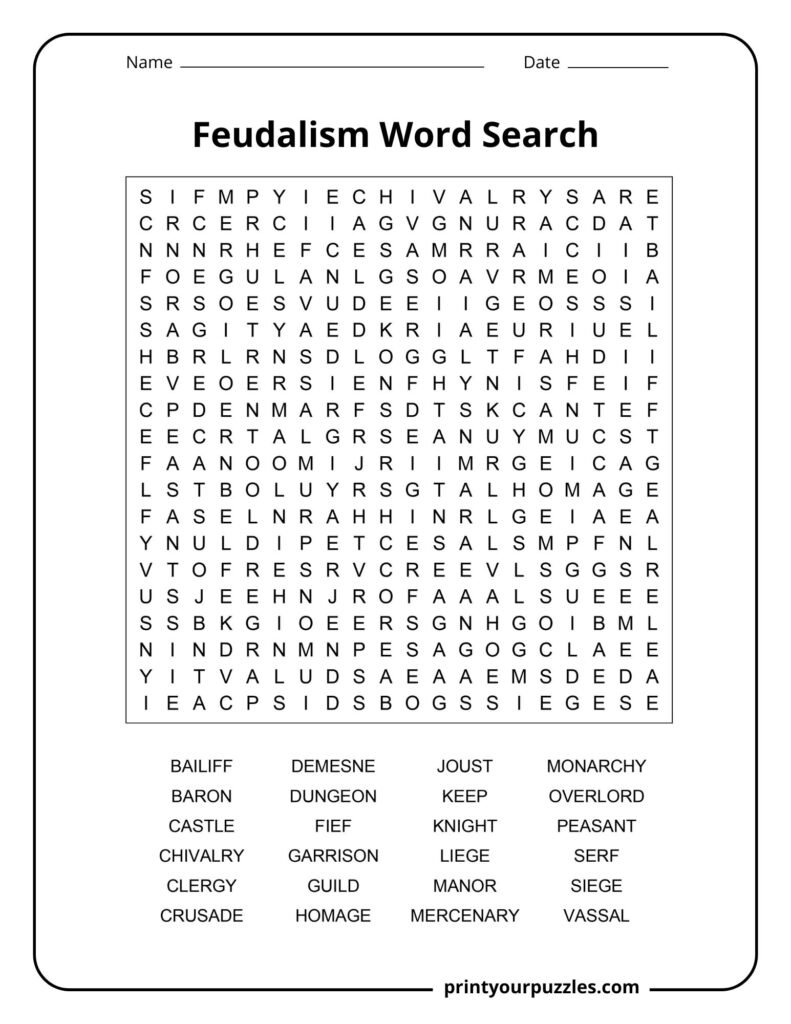
BAILIFF, BARON, CASTLE, CHIVALRY, CLERGY, CRUSADE, DEMESNE, DUNGEON, FIEF, GARRISON, GUILD, HOMAGE, JOUST, KEEP, KNIGHT, LIEGE, MANOR, MERCENARY, MONARCHY, OVERLORD, PEASANT, SERF, SIEGE, VASSAL
Feudalism was a medieval political and social system where land was exchanged for military service and loyalty, creating a strict hierarchy of kings, nobles, knights, and peasants.
Feudalism emerged in Europe around the 9th century, following the collapse of the Carolingian Empire, and became the dominant social and political structure throughout medieval Western Europe.
The key figures were the king, who owned all land, powerful lords and barons, knights who provided military service, and serfs and peasants who worked the land.
Daily life was strictly determined by social rank. Peasants and serfs farmed land and owed labor to lords, while nobles managed estates, administered justice, and prepared for warfare.
Feudalism gradually collapsed due to the Black Death, which reduced the peasant workforce, the rise of powerful centralized monarchies, growing merchant classes, and the increasing use of paid armies.
Feudal Society by Marc Bloch. Bloch revolutionized medieval history by weaving sociology, anthropology, and meticulous archival research into a fluid, panoramic narrative of lords, vassals, and everyday feudal life.
Most knights managed their estates during peacetime, supervising agricultural work and collecting dues, only answering their lord’s military call when warfare or tournaments actually demanded it.
The Church controlled roughly one third of all European land, collected tithes from peasants, and wielded enormous political and economic power rivaling even the most powerful secular lords.
Despite being bound to the land, some serfs accumulated small savings over years of work and were occasionally permitted by their lords to buy their own freedom officially.
When male heirs were absent, noblewomen could legally inherit fiefs, manage entire estates, negotiate political alliances, and even command castle defenses during their husband’s absence or death.
England’s Magna Carta of 1215 emerged directly from feudal tensions between King John and rebellious barons, establishing for the first time that even kings were bound by law.