
The Stone Age was the longest period of human prehistory, beginning more than three million years ago and ending at different times in different regions as metalworking became more common. It is called the Stone Age because early humans relied heavily on stone to make tools, weapons, and cutting implements. However, they also used wood, bone, antler, animal skins, and other natural materials.
Historians usually divide the Stone Age into three main periods: the Paleolithic, Mesolithic, and Neolithic. The Paleolithic, or Old Stone Age, was the earliest and longest phase. The Mesolithic marked a period of transition after the last Ice Age, while the Neolithic, or New Stone Age, brought farming, animal domestication, permanent villages, and more specialized crafts.
Different human species lived during the Stone Age, including Homo Habilis, Homo Erectus, Neanderthals, and Homo Sapiens. Over time, people developed more advanced tools, language, cooperation, and survival strategies. Most Paleolithic communities lived as hunter-gatherers, moving with the seasons to find animals, fish, water, fruits, nuts, roots, and other resources.
Stone Age people created hand axes, scrapers, blades, spear points, harpoons, and arrowheads by shaping flint and other rocks. The control of fire was another major achievement. Fire provided warmth, protection, light, and a way to cook food. It also allowed humans to survive in colder regions and gather together around camps.
Shelters included caves, temporary huts, and structures made from wood, branches, hides, or animal bones. People made clothing from skins and used bone needles for sewing. Cave paintings, carved figurines, jewelry, musical instruments, and burial practices suggest that Stone Age communities also developed symbolic thought, storytelling, spiritual beliefs, and artistic traditions.
During the Neolithic period, farming gradually transformed human life. People cultivated crops, domesticated animals, built permanent homes, stored food, produced pottery, and wove textiles. These innovations made larger settlements possible and helped create more complex societies. Many modern practices, including farming, sewing, fishing, food storage, pottery, weaving, and permanent housing, developed from Stone Age solutions to everyday needs.
The Stone Age was not a simple or unchanging era. It included enormous advances in technology, cooperation, art, communication, and food production.
With this Stone Age word search, students can explore vocabulary connected to the Paleolithic, Mesolithic, Neolithic, hunter-gatherers, flint, fire, cave art, spears, pottery, farming, domestication, shelters, and stone tools.
Related Word Searches:
Neolithic Revolution | Ancient Mesopotamia | Ancient Egypt | Ancient China | Mayan Civilization | Inca Empire
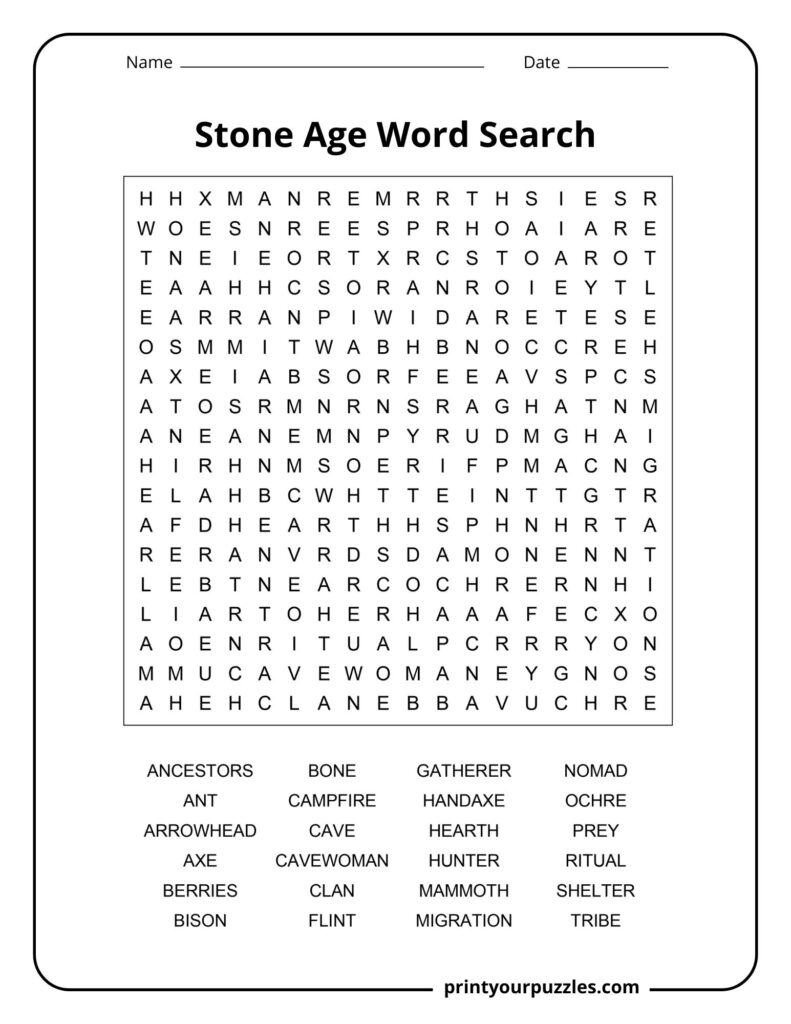
ANCESTORS, ANT, ARROWHEAD, AXE, BERRIES, BISON, BONE, CAMPFIRE, CAVE, CAVEWOMAN, CLAN, FLINT, GATHERER, HANDAXE, HEARTH, HUNTER, MAMMOTH, MIGRATION, NOMAD, OCHRE, PREY, RITUAL, SHELTER, TRIBE
ANCESTORS – People from whom we are descended, who lived thousands of years ago during the Stone Age, surviving through hunting, gathering, and adapting to harsh natural environments.
ANT – Small insect that lived alongside early humans, sometimes consumed as a food source, and whose organized colony behavior may have inspired early human cooperative survival strategies.
ARROWHEAD – Sharpened stone tip fastened to an arrow shaft, carefully crafted by Stone Age hunters using flint-knapping techniques to create an effective weapon for hunting animals.
AXE – Essential Stone Age tool made by shaping and sharpening stone, used for chopping wood, hunting, butchering animals, and defending against predators or rival human groups.
BERRIES – Small wild fruits gathered by Stone Age people as an important food source, providing vital nutrients and energy, carefully identified to avoid poisonous varieties found in nature.
BISON – Large, powerful prehistoric mammal hunted by Stone Age groups for meat, hide, and bones, representing a crucial survival resource across grasslands and open landscapes of ancient times.
BONE – Hard animal remains used by Stone Age people as raw material for crafting tools, needles, and ornaments, and also cracked open to extract nutritious marrow inside.
CAMPFIRE – Controlled fire built at a campsite providing warmth, protection from predators, light during darkness, and a central gathering place where Stone Age communities cooked food and socialized.
CAVE – Natural rock shelter used by Stone Age humans as protection from weather and predators, sometimes decorated with remarkable paintings depicting animals, hunting scenes, and symbolic human expressions.
CAVEWOMAN – Female member of Stone Age society who played essential roles in gathering food, raising children, crafting clothing, tending fires, and preserving the knowledge of her community.
CLAN – Small, tightly bonded group of Stone Age families living and surviving together, sharing resources, knowledge, and responsibilities, forming the basic social unit of prehistoric human communities.
FLINT – Hard, sharp-edged stone widely used during the Stone Age to craft cutting tools, weapons, and fire-starting implements, valued for its ability to fracture into precise, useful shapes.
GATHERER – Member of a Stone Age community responsible for collecting wild plants, fruits, roots, nuts, and insects, providing a reliable and essential food supply to sustain the group.
HANDAXE – Versatile, teardrop-shaped stone tool held directly in the hand, used for cutting, scraping, and digging tasks, considered one of the most important inventions of early human prehistory.
HEARTH – Designated fire area inside a cave or shelter where Stone Age families cooked meals, gathered for warmth, shared stories, and performed rituals central to community life.
HUNTER – Skilled Stone Age individual who tracked and killed wild animals using handcrafted weapons, providing meat and materials for clothing, tools, and shelter for the entire community.
MAMMOTH – Enormous prehistoric elephant-like creature covered in thick fur, hunted by Stone Age people for its meat, tusks, bones, and hide, eventually becoming extinct thousands of years ago.
MIGRATION – Seasonal or permanent movement of Stone Age groups across landscapes in search of food, water, and shelter, following animal herds and adapting to changing environmental conditions.
NOMAD – Stone Age person or group with no permanent home, constantly moving across territories to follow seasonal food sources, avoid harsh weather, and discover new resources for survival.
OCHRE – Natural reddish-brown mineral pigment ground into powder and used by Stone Age people to create cave paintings, decorate their bodies, and perform symbolic or ceremonial rituals.
PREY – Wild animals actively hunted by Stone Age groups for food and resources, including deer, bison, and mammoths, representing both a survival necessity and a significant cultural symbol.
RITUAL – Ceremonial practice performed by Stone Age communities to mark important life events, honor nature, seek spiritual protection, or strengthen social bonds within the group through shared symbolic actions.
SHELTER – Protective structure built or found by Stone Age people using natural materials like branches, animal hides, and stone, providing safety from weather, predators, and cold temperatures.
TRIBE – Larger social group of Stone Age people sharing common ancestry, language, and customs, cooperating for mutual protection, food gathering, and the transmission of cultural knowledge across generations.
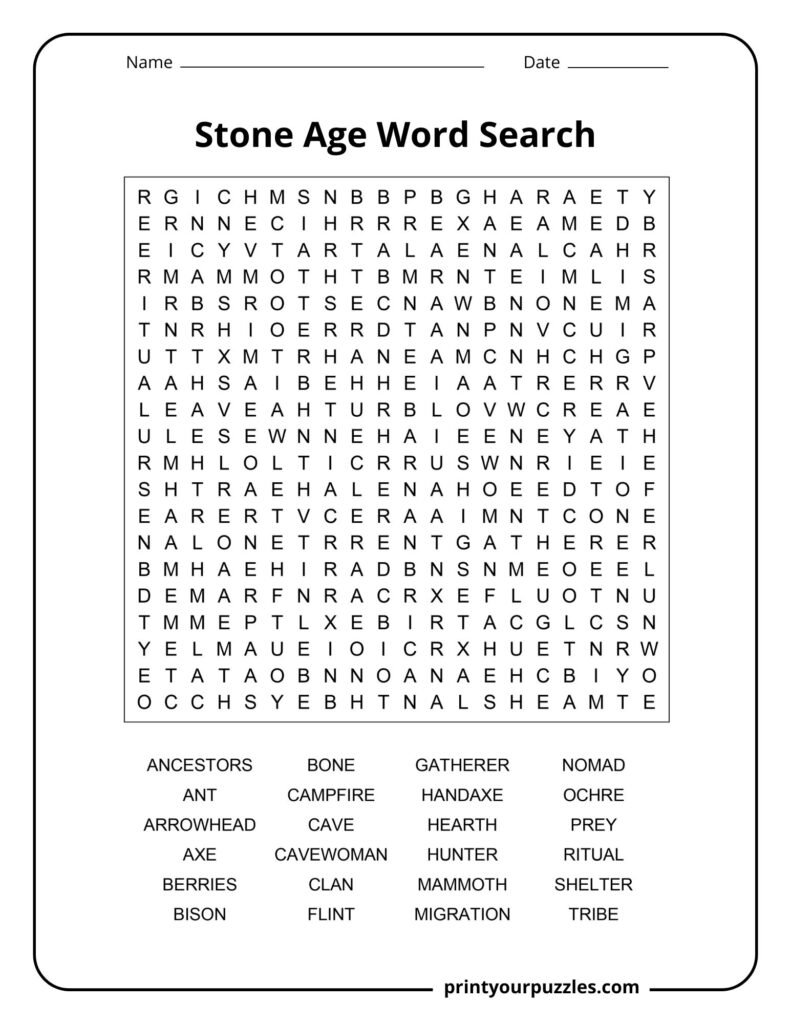
ANCESTORS, ANT, ARROWHEAD, AXE, BERRIES, BISON, BONE, CAMPFIRE, CAVE, CAVEWOMAN, CLAN, FLINT, GATHERER, HANDAXE, HEARTH, HUNTER, MAMMOTH, MIGRATION, NOMAD, OCHRE, PREY, RITUAL, SHELTER, TRIBE
The Stone Age began approximately 3.3 million years ago and ended around 3,000 BCE, varying by region, when humans gradually discovered metals and transitioned into the Bronze Age.
Stone Age people survived by hunting wild animals, fishing, and gathering berries, nuts, roots, and plants, maintaining a varied diet entirely dependent on their surrounding natural environment.
Early Stone Age humans sheltered in natural caves, later building simple structures using branches, animal hides, and bones, always choosing locations close to water and food sources.
Stone Age people created fire by striking flint against iron pyrite or by rapidly rotating a wooden stick against dry wood, generating enough friction and heat to ignite.
Stone Age people communicated through spoken language, hand gestures, and symbolic cave paintings and carvings, gradually developing increasingly complex ways to share knowledge, tell stories, and express meaning.
The Lost Civilizations of the Stone Age by Richard Rudgley. Oxford-trained scholar Rudgley fuses rigorous archaeological evidence with gripping, accessible prose — revealing Stone Age mastery of surgery, astronomy, and art in genuinely surprising, page-turning fashion.
Cave paintings discovered in Spain and France, some over 40,000 years old, reveal that Stone Age humans created remarkably detailed and beautiful artwork using ochre and natural pigments.
Archaeological evidence shows that Stone Age humans drilled and filled damaged teeth using primitive flint tools, proving that basic dental care existed nearly 14,000 years ago.
Early humans crafted necklaces, bracelets, and decorative ornaments from shells, animal teeth, and bones, suggesting that personal adornment and symbolic self-expression existed long before modern civilization developed.
Dogs were the first animals domesticated by humans during the Stone Age, serving as hunting companions, guards, and possibly emotional companions, forming a bond that continues today.
Archaeological discoveries reveal that Stone Age groups exchanged tools, materials, and goods across surprisingly large distances, indicating organised trade networks and meaningful contact between geographically separated human communities.