Introduction to the Arab Spring Word Search
The Arab Spring was a major wave of protests, uprisings, and political revolutions that began in Tunisia in December 2010 and spread across North Africa and the Middle East during 2011 and 2012. Although each country had its own problems, protesters across the region shared many demands, including greater freedom, political reform, economic opportunity, dignity, and an end to corruption and government abuse.
The movement began after Mohamed Bouazizi, a young Tunisian street vendor, set himself on fire on December 17, 2010, following mistreatment by local officials. His death became a powerful symbol of public frustration with unemployment, poverty, police harassment, and a lack of opportunity. Large demonstrations forced Tunisia’s longtime president, Zine El Abidine Ben Ali, to leave the country in January 2011.
Tunisia’s uprising inspired protests in Egypt, Libya, Yemen, Bahrain, Syria, and several other Arab nations. In Egypt, enormous crowds gathered in Cairo’s Tahrir Square and demanded the resignation of President Hosni Mubarak. Demonstrators used marches, strikes, sit-ins, speeches, and public occupations to challenge authoritarian governments. Young people, women, workers, journalists, lawyers, students, and civil society groups all played important roles.
The results differed greatly from country to country. Leaders were removed in Tunisia, Egypt, Libya, and Yemen, while the uprising in Bahrain was suppressed. In Syria, peaceful protests developed into a devastating civil war. Libya also entered a prolonged period of conflict and political division. Some governments introduced limited reforms, but others increased censorship, surveillance, arrests, and repression.
Modern communication technology became one of the defining features of the Arab Spring. Mobile phones, digital cameras, satellite television, blogs, text messages, Facebook, Twitter, and YouTube helped protesters share information, organize demonstrations, document violence, and reach international audiences. Citizen journalism allowed ordinary people to report events when official media were censored. These tools still influence protests today, although governments also use internet shutdowns, digital surveillance, online propaganda, and social media monitoring to control opposition.
The Arab Spring raised great hopes for democracy and political change, but its long-term consequences were complicated. It encouraged millions of people to speak publicly about injustice, corruption, unemployment, inequality, and human rights. At the same time, several countries experienced instability, displacement, renewed authoritarian rule, or civil war. The movement demonstrated both the power of mass protest and the difficulty of building stable democratic institutions.
Through this Arab Spring word search, students can explore vocabulary connected to Tunisia, Tahrir Square, protest, revolution, democracy, corruption, youth activism, social media, reform, repression, and citizen journalism. These terms help explain how the Arab Spring transformed politics across the region and influenced later protest movements around the world.
Related Word Searches:
Iranian Revolution | Decolonization Era | Cuban Revolution | Velvet Revolution | Berlin Wall | Russian Revolution
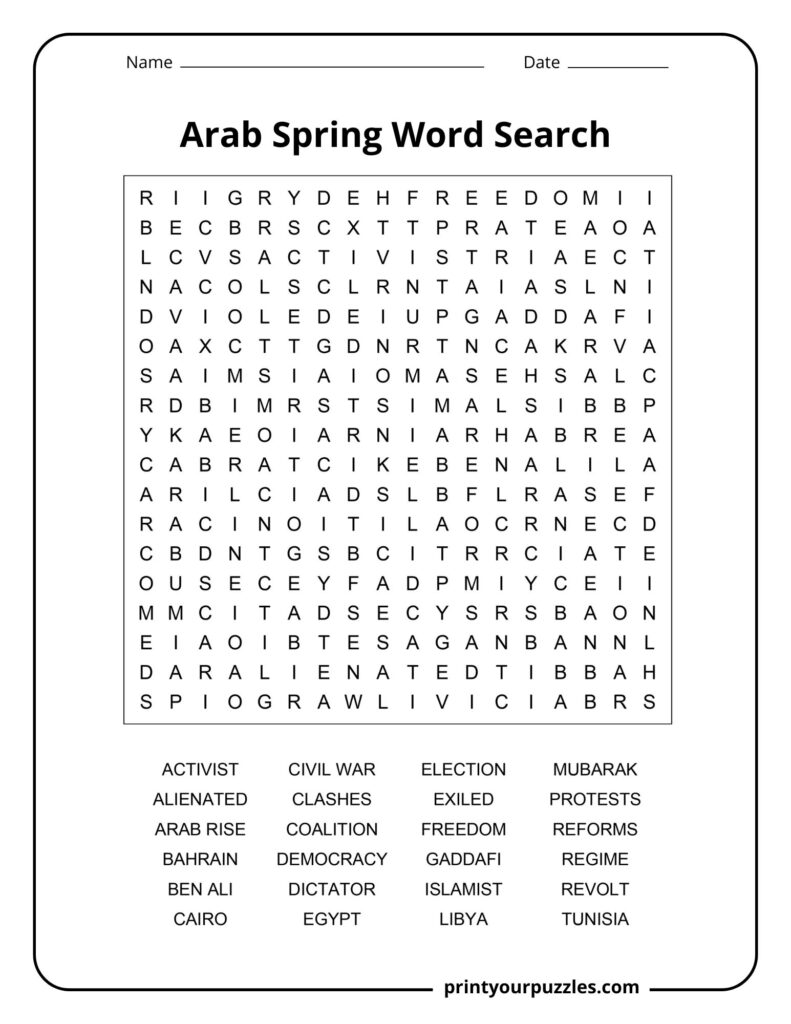
Medium Difficulty Word Search
Words to Find
ACTIVIST, ALIENATED, ARAB RISE, BAHRAIN, BEN ALI, CAIRO, CIVIL WAR, CLASHES, COALITION, DEMOCRACY, DICTATOR, EGYPT, ELECTION, EXILED, FREEDOM, GADDAFI, ISLAMIST, LIBYA, MUBARAK, PROTESTS, REFORMS, REGIME, REVOLT, TUNISIA
All Words Defined
ACTIVIST – A person who campaigns vigorously for political or social change, often taking direct action through protests, demonstrations, or organizing movements to challenge existing power structures.
ALIENATED – Feeling isolated, estranged, and disconnected from society or government, a widespread sentiment among Arab populations who felt excluded from political power and economic opportunities.
ARAB RISE – The collective awakening of Arab citizens demanding dignity, rights, and political reform, marking a historic shift in popular consciousness across the Middle East and North Africa.
BAHRAIN – A small Gulf island kingdom where Shia-majority protesters rose against the Sunni monarchy in 2011, demanding political reforms before demonstrations were violently suppressed with Saudi military assistance.
BEN ALI – Zine El Abidine Ben Ali, Tunisia’s autocratic president for 23 years, whose corrupt and repressive rule was ended when mass protests forced him to flee to Saudi Arabia.
CAIRO – Egypt’s sprawling capital city and symbolic heart of the Arab Spring, where millions gathered in Tahrir Square demanding the resignation of President Hosni Mubarak in early 2011.
CIVIL WAR – Armed conflict between opposing groups within a country, a devastating outcome seen in Libya, Syria, and Yemen as uprisings transformed into prolonged, destructive military confrontations.
CLASHES – Violent confrontations between protesters and security forces, or between rival factions, resulting in deaths and injuries that intensified public anger and international attention during the uprisings.
COALITION – An alliance of different political groups, rebel factions, or international nations joining forces toward a common goal, such as NATO’s military coalition that intervened in Libya.
DEMOCRACY – A system of government where citizens hold political power through free elections and civil liberties, the central demand of millions of Arab Spring protesters across the region.
DICTATOR – An authoritarian ruler who holds absolute power, suppresses opposition, and governs without democratic accountability, the type of leader that Arab Spring protesters collectively rose up against.
EGYPT – The Arab world’s most populous nation, where the 18-day Tahrir Square uprising successfully ousted President Hosni Mubarak in February 2011, inspiring movements across the entire region.
ELECTION – A formal process of democratic voting to choose political leaders, eagerly demanded by protesters and subsequently held in Tunisia, Egypt, and Libya following their successful revolutions.
EXILED – Forced to leave one’s homeland due to political persecution or popular uprising, a fate that befell several Arab leaders including Tunisia’s Ben Ali and Egypt’s Mubarak.
FREEDOM – The fundamental human right to speak, assemble, and participate politically without fear of repression, the most powerful and universal rallying cry of all Arab Spring movements.
GADDAFI – Muammar Gaddafi, Libya’s eccentric and brutal ruler for 42 years, who was overthrown and killed in October 2011 after a NATO-backed rebel uprising ended his regime.
ISLAMIST – A political actor or party advocating governance based on Islamic principles, groups that gained significant electoral influence following the Arab Spring, most notably Egypt’s Muslim Brotherhood.
LIBYA – A North African oil-rich nation where protests against Gaddafi escalated into full civil war, eventually resulting in NATO military intervention and the dictator’s dramatic capture and death.
MUBARAK – Hosni Mubarak, Egypt’s president for 30 years, whose government was characterized by corruption, emergency law, and repression before mass protests forced his historic resignation in 2011.
PROTESTS – Mass public demonstrations where citizens collectively express political grievances, the defining feature of the Arab Spring that swept through numerous countries with remarkable speed and determination.
REFORMS – Changes to political, economic, or social systems demanded by protesters, ranging from constitutional amendments to free elections, that governments either implemented or violently refused to introduce.
REGIME – An authoritarian government system maintaining power through repression, corruption, and control of state institutions, the primary target of Arab Spring protesters demanding fundamental systemic political change.
REVOLT – A collective act of defiance and rebellion against oppressive authority, embodying the spirit of millions of ordinary citizens who risked their lives demanding dignity and political change.
TUNISIA – The small North African nation where the Arab Spring began in December 2010, sparked by Mohamed Bouazizi’s self-immolation, successfully transitioning to democracy and inspiring uprisings across the region.
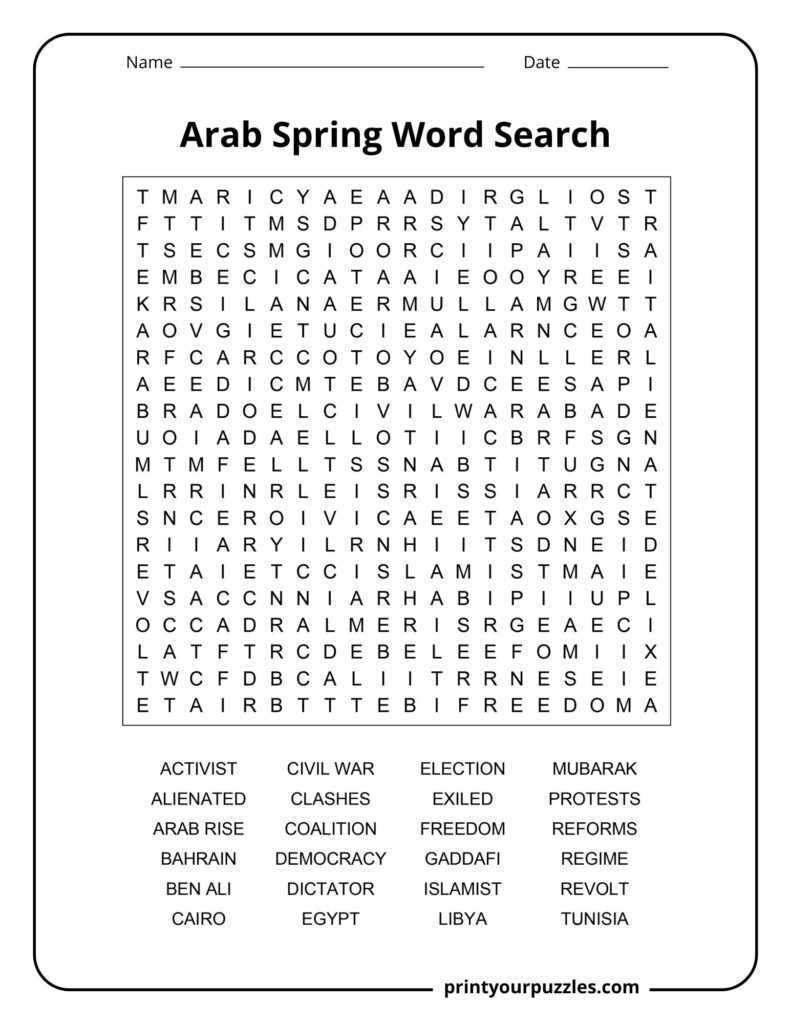
Hard Difficulty Word Search
Words to Find
ACTIVIST, ALIENATED, ARAB RISE, BAHRAIN, BEN ALI, CAIRO, CIVIL WAR, CLASHES, COALITION, DEMOCRACY, DICTATOR, EGYPT, ELECTION, EXILED, FREEDOM, GADDAFI, ISLAMIST, LIBYA, MUBARAK, PROTESTS, REFORMS, REGIME, REVOLT, TUNISIA
6 Key FAQs About the Arab Spring
5 Curious "Did You Know?" Facts About the Arab Spring