Ford is one of the most important names in automotive history, closely associated with mass production, American industry, and the development of affordable cars. The Ford Motor Company was founded in Detroit, Michigan, in 1903 by Henry Ford and a group of investors, but Ford’s interest in automobiles had begun years earlier. He experimented with engines and early motor vehicles while working as an engineer, convinced that cars could eventually become practical transportation for ordinary families rather than luxury machines for the wealthy.
The company’s major breakthrough came with the Model T, introduced in 1908. It was designed to be durable, simple to operate, and relatively affordable. Demand grew rapidly, but Ford needed a faster and more efficient way to build enough cars. The company developed moving assembly-line methods that divided production into smaller repeated tasks. This greatly reduced the time required to assemble a vehicle and helped lower costs.
As production increased, the Model T became one of the most influential automobiles of its era. Ford expanded factories, dealerships, and distribution networks, helping car ownership spread across the United States. The company also became known for changes in factory organization and wages, although its labor history later included major conflicts and controversies.
Ford eventually moved far beyond the Model T. The Mustang became a symbol of American performance and style, while the F-Series developed into one of the company’s most important truck lines. Other familiar names have included Bronco, Explorer, Thunderbird, Focus, and Fiesta.
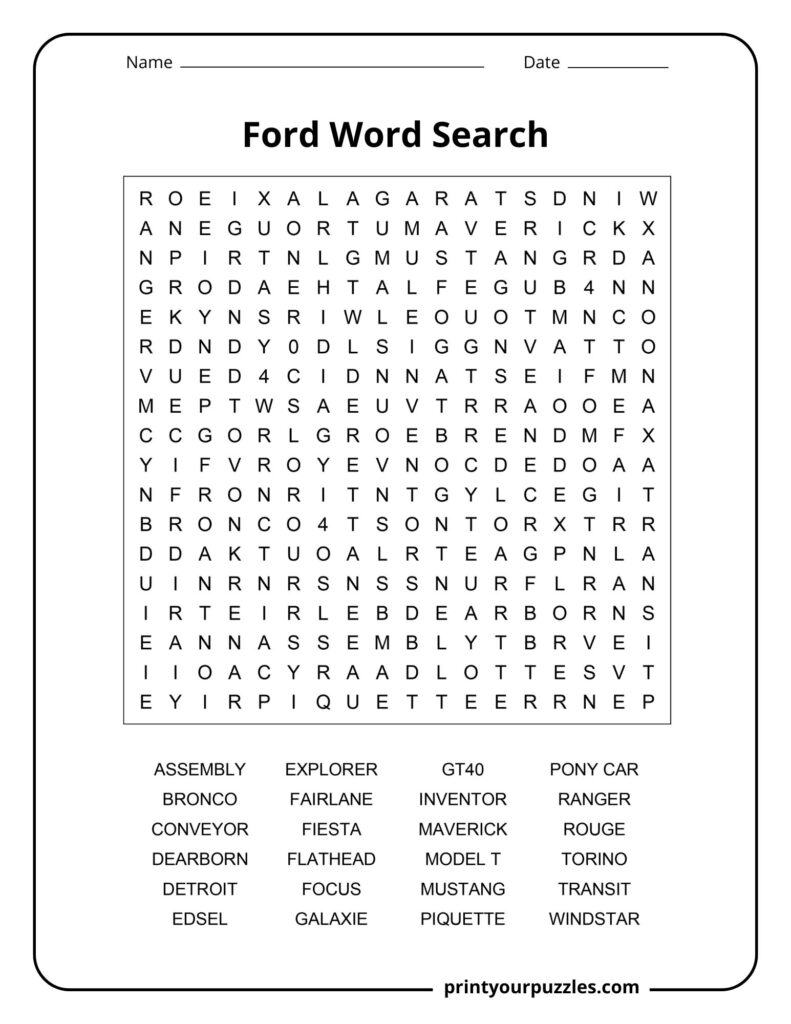
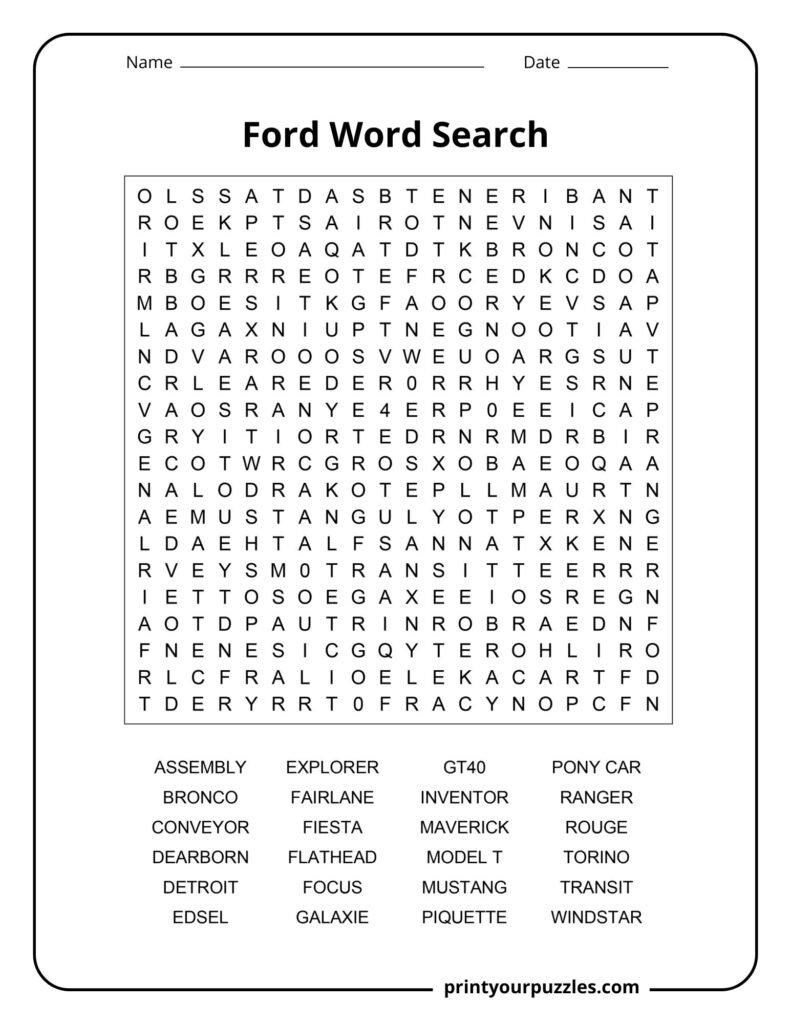
A printable Ford word search can connect these different stages through terms such as Detroit, Model T, Mustang, assembly line, trucks, engines, racing, and manufacturing.
From Henry Ford’s early mechanical experiments to an international automotive company, Ford grew by combining engineering, large-scale production, distribution, and strong brand recognition. Its history shows how one manufacturer helped transform the automobile from an expensive novelty into a central part of modern transportation.
Related Word Searches:
Tesla | Michelin | General Electric | Nvidia
ASSEMBLY, BRONCO, CONVEYOR, DEARBORN, DETROIT, EDSEL, EXPLORER, FAIRLANE, FIESTA, FLATHEAD, FOCUS, GALAXIE, GT40, INVENTOR, MAVERICK, MODEL T, MUSTANG, PIQUETTE, PONY CAR, RANGER, ROUGE, TORINO, TRANSIT, WINDSTAR
ASSEMBLY – The process of putting together vehicle parts on a moving production line, pioneered by Henry Ford in 1913 at the Highland Park plant, revolutionizing manufacturing worldwide.
BRONCO – A rugged off-road SUV first introduced by Ford in 1966, discontinued in 1996, then triumphantly revived in 2021 as a direct competitor to the Jeep Wrangler.
CONVEYOR – The mechanical belt system central to Ford’s moving assembly line, allowing workers to stay in place while car components moved past them, dramatically cutting production time.
DEARBORN – The Michigan city where Henry Ford was born and where Ford Motor Company established its world headquarters, home to the iconic River Rouge Complex and Ford’s global operations.
DETROIT – Known as the Motor City, Detroit became the birthplace of the American auto industry and the urban heart of Ford’s early manufacturing empire throughout the twentieth century.
EDSEL – Ford’s famously failed automobile brand launched in 1958, discontinued by 1960 after poor sales and public ridicule, becoming a legendary symbol of corporate miscalculation in automotive history.
EXPLORER – A full-size SUV introduced in 1991 that helped define the American sport utility vehicle boom, becoming one of Ford’s best-selling and most recognizable models for decades.
FAIRLANE – A classic Ford model produced from 1955 to 1970, named after Henry Ford’s Dearborn estate, representing mid-century American style and power during the golden age of motoring.
FIESTA – A compact subcompact car launched by Ford in Europe in 1976, becoming one of the brand’s longest-running and best-selling global models across multiple continents and generations.
FLATHEAD – Ford’s legendary V8 flathead engine introduced in 1932, the first affordable V8 for mass-market consumers, beloved by hot rodders and a milestone in American automotive engineering.
FOCUS – A compact car introduced globally in 1998, praised for its sharp European-influenced handling and design, becoming one of Ford’s top-selling models in worldwide markets for years.
GALAXIE – A full-size Ford produced from 1959 to 1974, known for its bold styling and performance heritage, often dominating NASCAR racing during the exciting early days of stock car competition.
GT40 – Ford’s legendary endurance racing car built to defeat Ferrari at Le Mans, achieving four consecutive victories from 1966 to 1969, cementing Ford’s place in motorsport history forever.
INVENTOR – A title closely associated with Henry Ford, who invented and refined mass production techniques, the moving assembly line, and accessible personal transportation that transformed modern industrial civilization globally.
MAVERICK – Originally a compact car from 1970 to 1977, the Maverick name was revived in 2022 as a highly popular compact pickup truck, winning new generations of budget-conscious buyers.
MODEL T – Ford’s groundbreaking automobile produced from 1908 to 1927, the first car made affordable for ordinary Americans through assembly line production, fundamentally changing society and personal mobility forever.
MUSTANG – Ford’s iconic pony car launched on April 17, 1964, creating an entirely new vehicle segment combining sporty styling with affordability, becoming one of the most beloved American cars ever built.
PIQUETTE – The Piquette Avenue Plant in Detroit where Henry Ford and his team secretly developed the Model T between 1904 and 1910, now a historic landmark and automotive museum.
PONY CAR – An automotive segment created by the Ford Mustang in 1964, describing affordable, sporty, compact cars with long hoods and short rear decks that inspired fierce competition from rivals.
RANGER – A compact pickup truck introduced by Ford in 1983, offering truck capability in a smaller package, discontinued in 2011 then successfully relaunched in 2019 to strong market demand.
ROUGE – The River Rouge Complex near Dearborn, Michigan, was Ford’s massive vertically integrated manufacturing fortress, once the world’s largest industrial facility, producing everything from raw steel to finished automobiles.
TORINO – A mid-size Ford produced from 1968 to 1976, named after the Italian city of Turin, popular in muscle car culture and famously featured in the television series Starsky and Hutch.
TRANSIT – Ford’s highly versatile commercial van sold globally since 1965, becoming Europe’s best-selling van for decades and a backbone vehicle for businesses, tradespeople, and emergency services around the world.
WINDSTAR – Ford’s minivan produced from 1994 to 2003, designed to compete in the family vehicle market dominated by Chrysler, later replaced by the Freestar as Ford shifted its product strategy.
ASSEMBLY, BRONCO, CONVEYOR, DEARBORN, DETROIT, EDSEL, EXPLORER, FAIRLANE, FIESTA, FLATHEAD, FOCUS, GALAXIE, GT40, INVENTOR, MAVERICK, MODEL T, MUSTANG, PIQUETTE, PONY CAR, RANGER, ROUGE, TORINO, TRANSIT, WINDSTAR