
Amazon began as an online bookstore and grew into one of the most influential technology and retail companies in the world. Jeff Bezos founded the business in 1994 after becoming interested in the extraordinary growth of the internet. He left a career in finance, moved to Seattle, and began building a company that could take advantage of online shopping before it became part of everyday life.
Books were a logical starting point because an online store could offer far more titles than a traditional bookstore could keep on its shelves. Amazon.com launched in 1995, initially operating on a relatively small scale, but orders soon began arriving from across the United States and other countries. Bezos had much bigger ambitions than selling books alone, and the company quickly expanded into music, videos, electronics, toys, and many other categories.
That rapid expansion helped transform Amazon from a specialized bookseller into a destination where people could shop for almost anything. Its marketplace later allowed independent sellers and businesses to offer products through the platform, increasing the selection even further. Large fulfillment centers, sophisticated inventory systems, and increasingly fast delivery became essential parts of the company’s growth.
Convenience also became central to Amazon’s identity. Features such as customer reviews, personalized recommendations, one-click purchasing, and Amazon Prime changed expectations about online shopping. Prime eventually grew beyond shipping to include digital services such as video and music.
Amazon also developed its own technology products. The Kindle helped popularize e-books, while Echo devices and the Alexa voice assistant brought the company into smart homes. At the same time, Amazon Web Services, commonly known as AWS, grew into a major cloud computing business used by companies and organizations around the world.
An Amazon word search puzzle can therefore include vocabulary connected with far more than shopping: books, Prime, Kindle, Alexa, delivery, warehouses, cloud computing, sellers, and digital services all represent different parts of the company’s development.
From a Seattle startup selling books online to a global business involved in retail, entertainment, logistics, devices, and computing, Amazon’s history shows how quickly an internet company can grow when technology, convenience, and ambitious expansion come together.
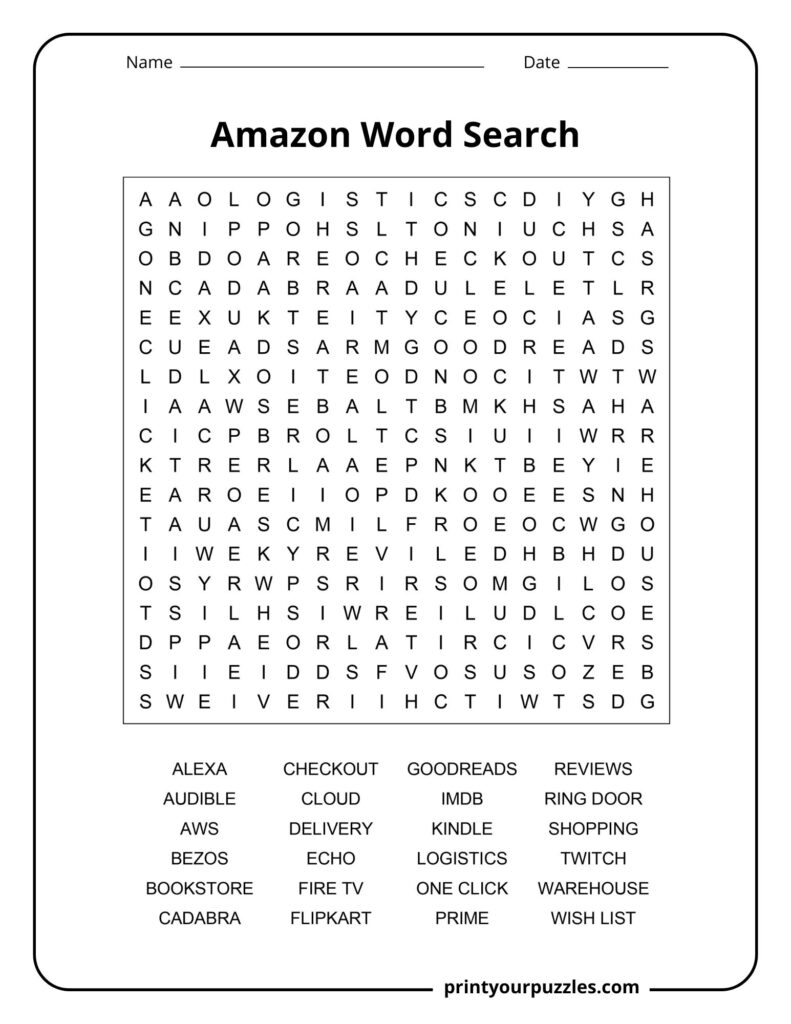
ALEXA, AUDIBLE, AWS, BEZOS, BOOKSTORE, CADABRA, CHECKOUT, CLOUD, DELIVERY, ECHO, FIRE TV, FLIPKART, GOODREADS, IMDB, KINDLE, LOGISTICS, ONE CLICK, PRIME, REVIEWS, RING DOOR, SHOPPING, TWITCH, WAREHOUSE, WISH LIST
ALEXA – Amazon’s voice-controlled virtual assistant, launched in 2014 alongside the Echo speaker, capable of playing music, answering questions, controlling smart home devices, and integrating with thousands of third-party skills.
AUDIBLE – Amazon’s audiobook and spoken-word content platform, acquired in 2008, offering hundreds of thousands of titles across genres, with subscription plans giving members monthly credits to purchase audiobooks.
AWS – Amazon Web Services, launched in 2006, is Amazon’s cloud computing division offering servers, storage, databases, and developer tools, now the world’s leading cloud platform powering millions of businesses globally.
BEZOS – Jeff Bezos founded Amazon in 1994 in his Bellevue garage, growing it from an online bookstore into a global technology and retail empire before stepping down as CEO in 2021.
BOOKSTORE – Amazon began in 1994 as an online bookstore, offering a vastly larger catalogue than physical stores. Books were the perfect first product: standard, shippable, and available from established distributors nationwide.
CADABRA – Amazon’s original name chosen by Bezos in 1994, inspired by “abracadabra.” It was quickly dropped after an attorney misheard it as “cadaver,” and the company was renamed Amazon shortly after.
CHECKOUT – Amazon revolutionised online checkout by patenting One-Click purchasing in 1999, allowing returning customers to buy instantly without re-entering payment or shipping details, dramatically reducing cart abandonment and friction.
CLOUD – Amazon pioneered commercial cloud computing with AWS, allowing companies to rent computing power instead of owning servers. This shift fundamentally changed how software is built, deployed, and scaled worldwide.
DELIVERY – Amazon transformed delivery expectations globally, introducing same-day and next-day shipping through an enormous fulfilment network, its own logistics fleet, drone delivery experiments, and Amazon Flex crowd-sourced drivers.
ECHO – Amazon’s smart speaker line, launched in 2014, integrating the Alexa assistant into the home. The cylindrical device redefined the smart speaker category and sparked an industry-wide race for voice computing.
FIRE TV – Amazon’s streaming media player and smart TV platform, launched in 2014, offering access to Prime Video, Netflix, and other services, competing directly with Roku and Apple TV in living rooms worldwide.
FLIPKART – India’s leading e-commerce platform that Amazon aggressively competed against for dominance in the Indian market. Walmart ultimately acquired Flipkart in 2018, blocking Amazon’s bid in a landmark retail rivalry.
GOODREADS – A social cataloguing platform for book lovers, acquired by Amazon in 2013, where readers track books, write reviews, and get recommendations, boasting over 150 million members and billions of book ratings.
IMDB – The Internet Movie Database, acquired by Amazon in 1998, is the world’s most authoritative source for film, television, and celebrity information, attracting hundreds of millions of visitors every month globally.
KINDLE – Amazon’s e-reader device, launched in 2007, sold out within hours and revolutionised reading by putting thousands of books in one portable device, establishing Amazon’s dominance in digital book publishing.
LOGISTICS – Amazon built one of the world’s most sophisticated private logistics networks, including fulfilment centres, sortation facilities, delivery stations, cargo aircraft, and last-mile vans, reducing dependence on UPS and FedEx.
ONE-CLICK – Amazon’s landmark One-Click patent, filed in 1999, allowed customers to purchase with a single click using saved details. It was controversially broad, licensed to Apple, and expired in 2017.
PRIME – Amazon Prime, launched in 2005, offers unlimited fast shipping, video streaming, music, and more for an annual fee. It now has over 200 million global subscribers and anchors Amazon’s customer loyalty strategy.
REVIEWS – Customer reviews, introduced early in Amazon’s history, became a cornerstone of its marketplace trust model, allowing buyers to make informed decisions and sellers to build reputations, reshaping consumer behaviour online permanently.
RING DOOR – Ring, maker of smart video doorbells, was acquired by Amazon in 2018 for over one billion dollars, expanding Amazon’s smart home ecosystem and raising significant public debate around residential surveillance and privacy.
SHOPPING – Amazon redefined online shopping by combining vast product selection, competitive pricing, customer reviews, and fast delivery under one roof, eventually surpassing traditional retailers and becoming the default starting point for product searches.
TWITCH – Amazon acquired the live game-streaming platform Twitch in 2014 for nearly one billion dollars, securing a dominant position in interactive entertainment and connecting millions of streamers with massive global audiences daily.
WAREHOUSE – Amazon operates hundreds of fulfilment warehouses worldwide, using robotics, conveyor systems, and sophisticated inventory algorithms to pick, pack, and ship millions of orders daily with extraordinary speed and accuracy.
WISH LIST – Amazon’s Wish List feature, one of its earliest social tools, lets users save desired products for future purchase or share with friends and family, making gift-giving easier and boosting long-term customer retention.
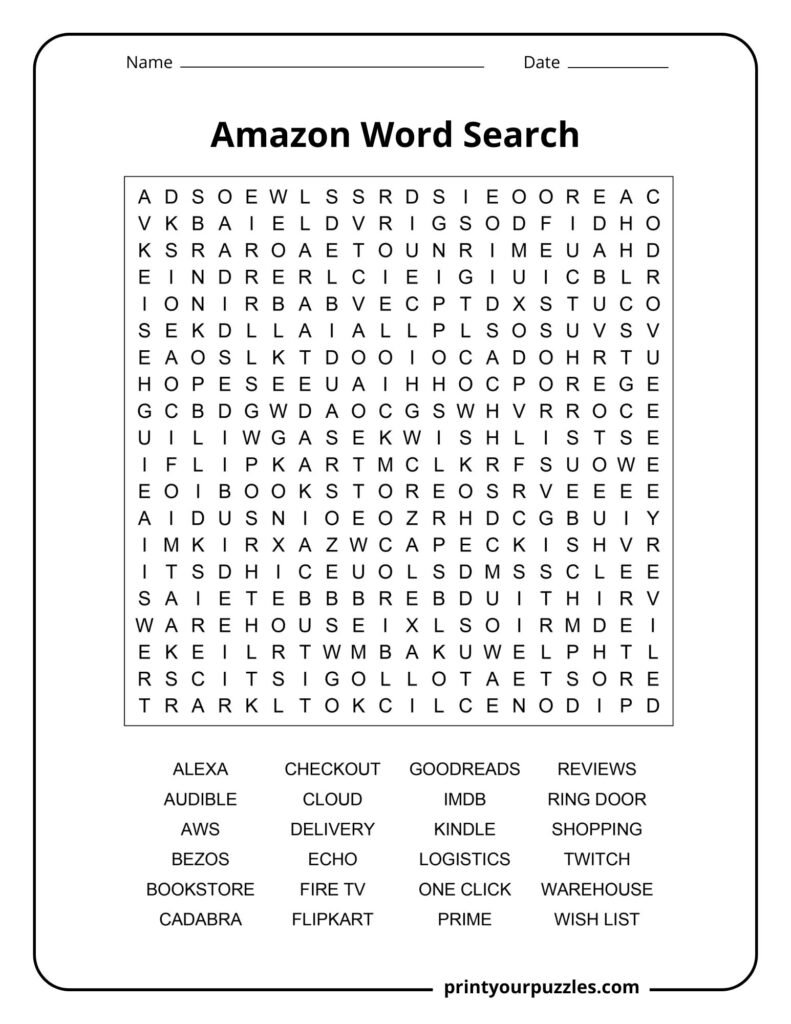
ALEXA, AUDIBLE, AWS, BEZOS, BOOKSTORE, CADABRA, CHECKOUT, CLOUD, DELIVERY, ECHO, FIRE TV, FLIPKART, GOODREADS, IMDB, KINDLE, LOGISTICS, ONE CLICK, PRIME, REVIEWS, RING DOOR, SHOPPING, TWITCH, WAREHOUSE, WISH LIST
Jeff Bezos founded Amazon in 1994, initially as an online bookstore, choosing the name for the world’s largest river to suggest vast scale and unlimited selection.
After mastering book sales, Amazon steadily expanded into music, electronics, clothing, and cloud services, transforming from a single-category retailer into the world’s most diversified technology and commerce company.
Launching Amazon Web Services in 2006 was pivotal, turning internal infrastructure into a profitable cloud business that today generates more operating income than the entire retail division combined.
Introduced in 2005, Prime’s annual fee model created deeply loyal customers who shop more frequently, spend significantly more, and rarely consider competitors, fundamentally reshaping expectations around delivery speed and membership value.
Amazon consistently prioritises long-term growth over short-term profit, reinvesting heavily into logistics, technology, and new categories, building customer trust through relentless convenience, competitive pricing, and continuous service expansion.
The Everything Store: Jeff Bezos and the Age of Amazon by Brad Stone. Stone masterfully draws on 300 interviews and years of insider reporting to deliver a gripping, nuanced portrait of Bezos and Amazon’s relentless rise from garage startup to global empire.
Bezos originally registered the company as Cadabra Inc. in 1994, but renamed it Amazon after a lawyer misheard the word as “cadaver.”
Bezos launched Amazon from his Bellevue, Washington garage with just a few employees, packing and shipping books personally while a bell rang every time a new order arrived.
For its first month of operation in 1995, Amazon exclusively sold books, with its very first sale being a copy of Douglas Hofstadter’s “Fluid Concepts and Creative Analogies.”
The iconic arrow beneath the Amazon wordmark stretches from the letter A to Z, symbolising that Amazon sells everything from A to Z and always delivers with a smile.
Bezos seriously considered naming the company Relentless.com, a domain he still owns today. Typing it into any browser automatically redirects visitors directly to the Amazon homepage.