Introduction to the Coca-Cola Word Search
Coca-Cola is one of the most recognizable beverage brands in the world, but its beginnings were surprisingly modest. The drink was created in Atlanta, Georgia, in 1886 by pharmacist John Stith Pemberton, who developed a flavored syrup that was mixed with carbonated water and sold at Jacobs’ Pharmacy. Pemberton’s bookkeeper, Frank M. Robinson, suggested the name Coca-Cola and wrote it in the flowing script that later became one of the most famous logos in advertising.
The business changed direction after entrepreneur Asa Candler gained control of the formula and brand. He saw much greater commercial potential in the drink and promoted Coca-Cola aggressively through coupons, signs, calendars, clocks, and other advertising materials. By the end of the nineteenth century, Coca-Cola was being sold well beyond Atlanta, and the company had begun building a distribution network across the United States.
Bottling was another crucial step in its growth. Originally served mainly at soda fountains, Coca-Cola became much easier to distribute once independent bottlers began selling it in bottles. This allowed people to buy the drink in stores, restaurants, and places far from traditional fountain counters. The famous contour bottle, introduced in the early twentieth century, gave the product an unmistakable shape and helped protect the brand from imitators.
Advertising continued to strengthen Coca-Cola’s identity. Campaigns connected the drink with refreshment, friendship, celebrations, sports, music, and shared moments. Its red-and-white color scheme became instantly recognizable, while Christmas advertising and other seasonal campaigns helped embed the brand deeply in popular culture.
A printable Coca-Cola word search puzzle can draw on this rich history through terms connected with Atlanta, soda fountains, bottles, advertising, flavors, logos, and global distribution. The brand later expanded with products such as Diet Coke and Coca-Cola Zero Sugar, while continuing to sell its original drink around the world.
From a pharmacy counter in Atlanta to an international beverage company, Coca-Cola grew through smart marketing, widespread bottling, memorable design, and consistent branding. Its story shows how a simple drink can become a cultural symbol recognized across generations and continents.
Related Word Searches:
McDonald’s | Starbucks | Heinz | Red Bull
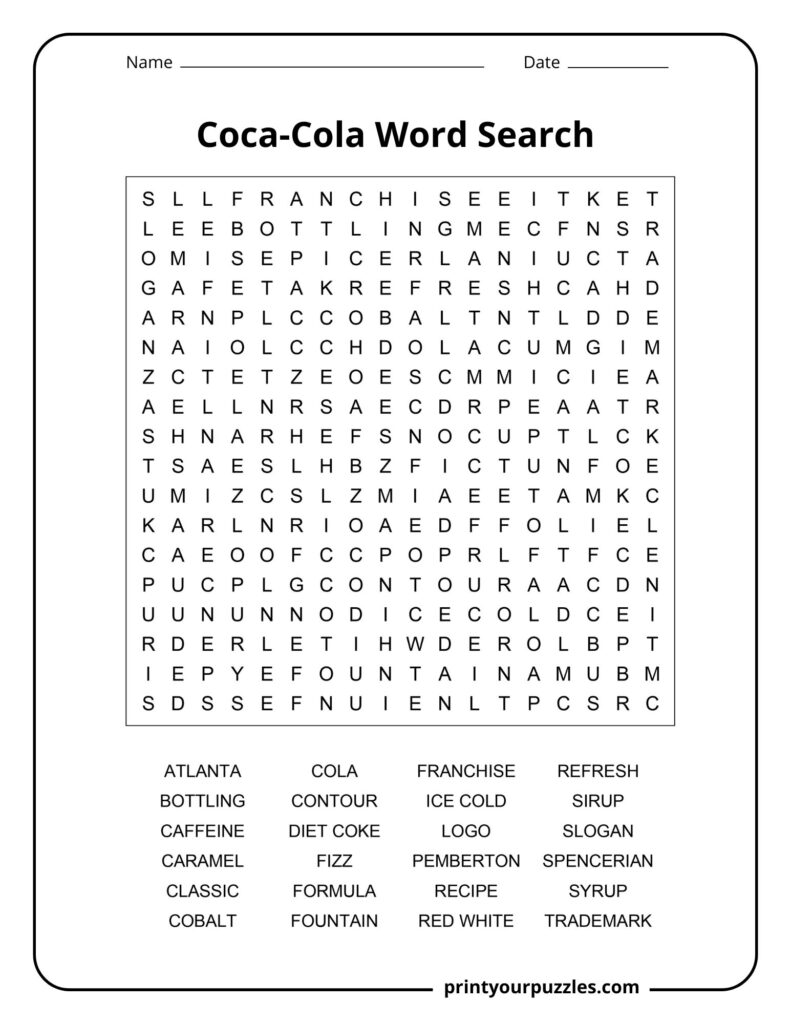
Medium Difficulty Word Search
Words to Find
ATLANTA, BOTTLING, CAFFEINE, CARAMEL, CLASSIC, COBALT, COLA, CONTOUR, DIET COKE, FIZZ, FORMULA, FOUNTAIN, FRANCHISE, ICE COLD, LOGO, PEMBERTON, RECIPE, RED WHITE, REFRESH, SIRUP, SLOGAN, SPENCERIAN, SYRUP, TRADEMARK
All Words Defined
ATLANTA – Birth city of Coca-Cola, where pharmacist John Pemberton created the original formula in 1886. The company’s global headquarters remains located there today.
BOTTLING – The industrial process of filling sealed glass or plastic containers with Coca-Cola. The first bottling franchise agreement was signed in 1899, expanding the brand nationwide.
CAFFEINE – Natural stimulant present in Coca-Cola, originally derived from kola nuts. It contributes to the drink’s energizing effect and is one of its most recognized active ingredients.
CARAMEL – The ingredient responsible for Coca-Cola’s distinctive dark brown color. It is produced by heating sugar and remains a key component of the drink’s visual identity.
CLASSIC – Name adopted in 1985 when Coca-Cola reintroduced its original formula after the failed “New Coke” launch. The word reassured loyal consumers and became a permanent part of the brand.
COBALT – Deep blue color of the original glass bottles used in early Coca-Cola history. The distinctive hue helped differentiate the product on shelves before the iconic contour bottle existed.
COLA – Refers to the kola nut, an African seed rich in caffeine that inspired part of Coca-Cola’s name. It originally contributed to the drink’s flavor and stimulating properties.
CONTOUR – The iconic hourglass-shaped Coca-Cola bottle, patented in 1915. Designed to be recognizable even in the dark, it remains one of the most famous packaging designs in history.
DIET COKE – Sugar-free Coca-Cola variant launched in 1982, targeting health-conscious consumers. It became the best-selling diet soft drink globally and introduced a bold, independent brand identity.
FIZZ – The lively carbonation that defines Coca-Cola’s sensory experience. The bubbles are produced by dissolving carbon dioxide under pressure, creating the drink’s signature effervescent texture.
FORMULA – Coca-Cola’s secret recipe, known as “Merchandise 7X,” created by Pemberton in 1886. It remains one of the most guarded trade secrets in the entire history of commerce.
FOUNTAIN – The original format in which Coca-Cola was first served in 1886, at Jacob’s Pharmacy in Atlanta. Soda fountains mixed syrup with carbonated water directly at the counter.
FRANCHISE – The business model that allowed independent bottlers to produce and distribute Coca-Cola under license. The first franchise agreement in 1899 was the foundation of the brand’s global expansion.
ICE COLD – A long-standing Coca-Cola advertising message emphasizing the ideal serving temperature. Serving the drink over ice became deeply associated with refreshment, pleasure, and the brand’s identity.
LOGO – Coca-Cola’s iconic red and white script, written in Spencerian calligraphy since 1886. Designed by bookkeeper Frank Mason Robinson, it is one of the most recognized logos worldwide.
PEMBERTON – John Stith Pemberton, the Atlanta pharmacist who invented Coca-Cola in 1886. He originally marketed it as a medicinal tonic before it evolved into a commercial soft drink.
RECIPE – The closely guarded set of ingredients and proportions that define Coca-Cola’s unique taste. Stored in a vault in Atlanta, it has been kept secret for over one hundred years.
RED WHITE – The bold red and white color combination that defines Coca-Cola’s global visual identity. These colors appear consistently across packaging, advertising, and merchandise throughout the brand’s entire history.
REFRESH – A central concept in Coca-Cola’s brand messaging for decades. The promise of refreshment has driven countless advertising campaigns, connecting the product to moments of joy and everyday pleasure.
SIRUP – The original spelling used by John Pemberton himself when he first recorded his Coca-Cola recipe. This early syrup concentrate was mixed with carbonated water at pharmacy soda fountains.
SLOGAN – Coca-Cola has used over sixty advertising slogans throughout its history. From “Delicious and Refreshing” in 1886 to “Taste the Feeling” today, each slogan reflects its evolving brand strategy.
SPENCERIAN – The elegant, flowing script style used to write the Coca-Cola logo since 1886. Spencerian penmanship was a popular American handwriting form of the era, giving the brand a distinctive visual signature.
SYRUP – The concentrated liquid formula shipped by Coca-Cola to bottlers and fountain operators worldwide. When mixed with carbonated water in correct proportions, it produces the final ready-to-drink beverage.
TRADEMARK – Coca-Cola officially registered its trademark in 1893, protecting its name and logo legally. This registration was a landmark step in establishing the brand as a protected commercial identity.
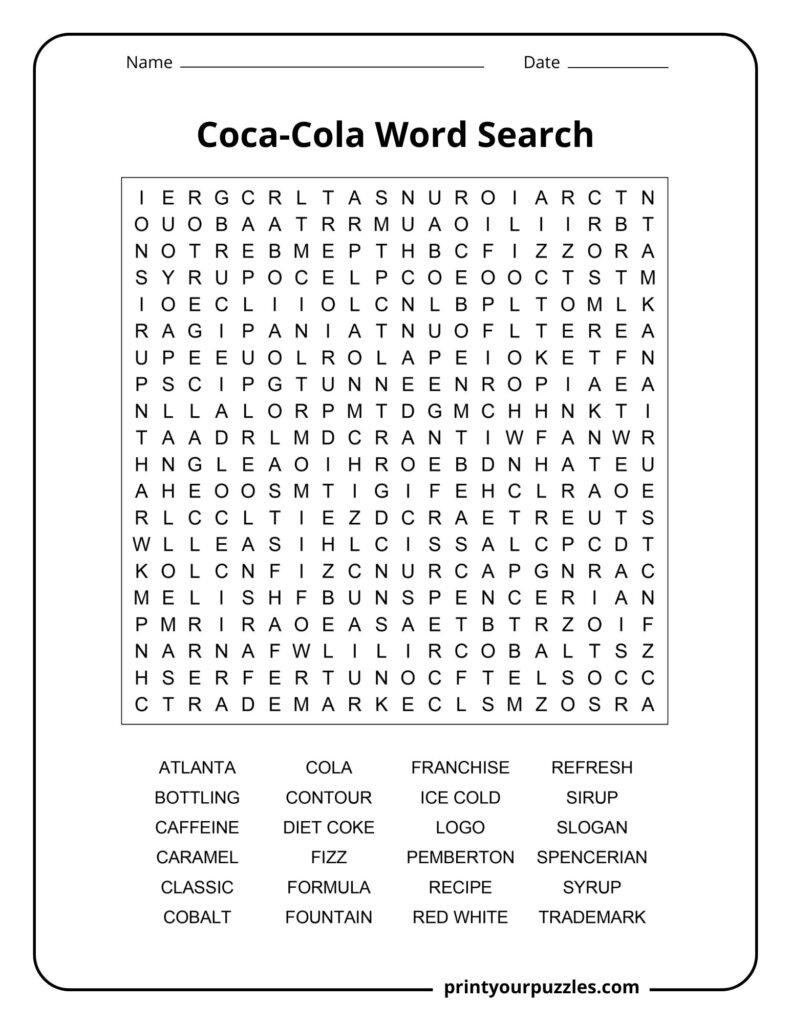
Hard Difficulty Word Search
Words to Find
ATLANTA, BOTTLING, CAFFEINE, CARAMEL, CLASSIC, COBALT, COLA, CONTOUR, DIET COKE, FIZZ, FORMULA, FOUNTAIN, FRANCHISE, ICE COLD, LOGO, PEMBERTON, RECIPE, RED WHITE, REFRESH, SIRUP, SLOGAN, SPENCERIAN, SYRUP, TRADEMARK
6 Key FAQs About the Coca-Cola Brand
5 Curious "Did You Know?" Facts About Coca-Cola