Microsoft is one of the most influential technology companies in the world, with a history closely tied to the rise of personal computing. The company was founded in 1975 by Bill Gates and Paul Allen, two childhood friends who shared a strong interest in computers and programming. Their first major opportunity came when they developed software for the Altair 8800, one of the early personal computers that attracted hobbyists during the 1970s.
Gates and Allen saw that software could become a major business of its own. They created Microsoft to write and license programs for the growing number of computer manufacturers. The company was initially based in New Mexico before moving to Washington State, where it eventually established its headquarters in Redmond. That move helped make Microsoft one of the technology companies most closely associated with the Seattle region.
A crucial turning point came in 1980, when IBM was preparing to launch its first personal computer and needed an operating system. Microsoft supplied MS-DOS, which became widely used as IBM-compatible PCs spread through homes and offices. Importantly, Microsoft was able to license its software to many computer makers, helping the company grow alongside the entire PC industry rather than depending on a single machine.
Windows later transformed Microsoft’s public identity. Beginning in the 1980s and becoming increasingly popular in the 1990s, Windows introduced a graphical environment with icons, menus, and mouse controls that made computers easier for many users. Microsoft Office also became central to everyday work, with Word, Excel, and PowerPoint becoming familiar tools in businesses, schools, and homes.
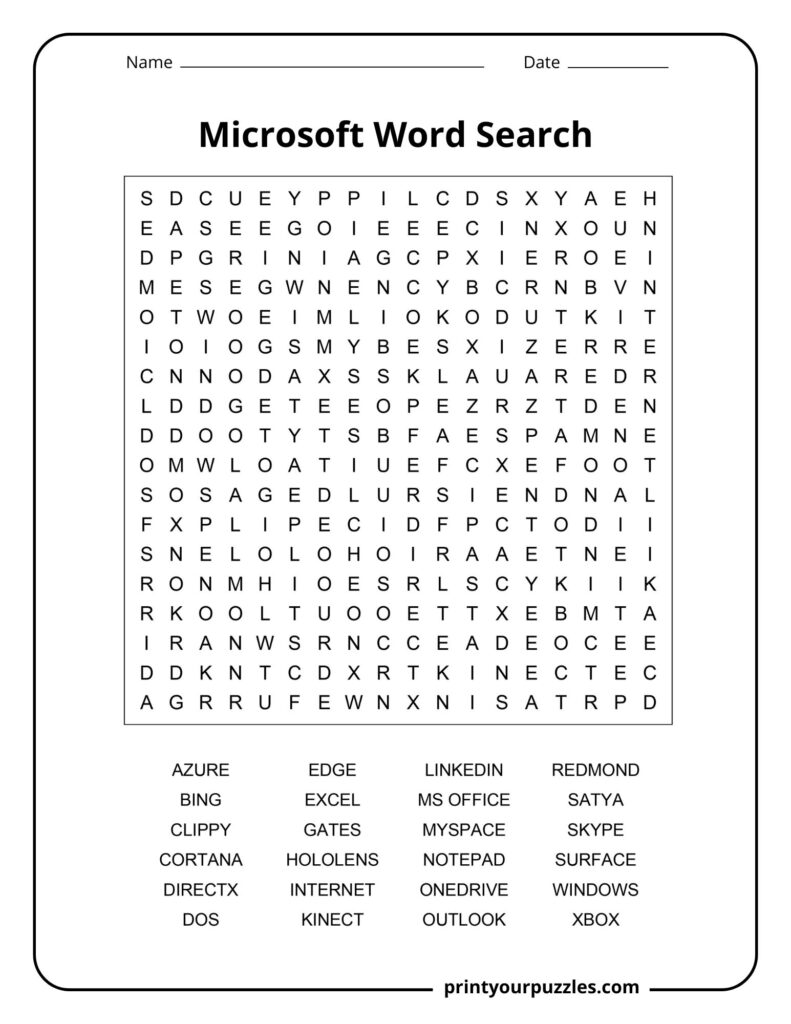
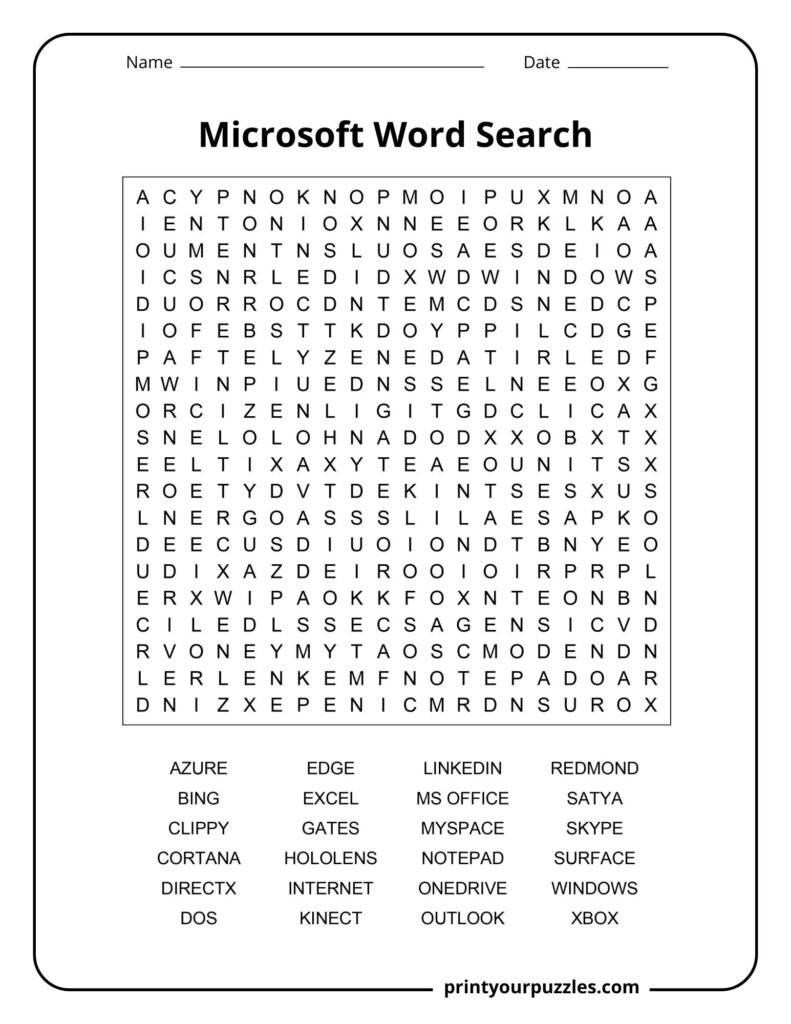
A printable Microsoft word search puzzle can connect these different stages through terms such as Gates, Allen, Washington, MS-DOS, Windows, Word, Excel, PowerPoint, Xbox, Azure, and software.
The company continued expanding beyond traditional PC programs. Xbox established Microsoft as a major force in video games, while Azure became an important cloud computing platform. Teams, cybersecurity services, artificial intelligence tools, and business software further broadened the company’s reach.
From two young programmers writing software for an early computer to a global technology company, Microsoft grew by recognizing that software could shape how people use hardware. Its history reflects the evolution of personal computing itself, from command lines and desktop PCs to cloud services, gaming, collaboration, and artificial intelligence.
Related Word Searches:
Apple | Google | IBM | Nvidia
AZURE, BING, CLIPPY, CORTANA, DIRECTX, DOS, EDGE, EXCEL, GATES, HOLOLENS, INTERNET, KINECT, LINKEDIN, MS OFFICE, MYSPACE, NOTEPAD, ONEDRIVE, OUTLOOK, REDMOND, SATYA, SKYPE, SURFACE, WINDOWS, XBOX
AZURE – Microsoft’s cloud computing platform launched in 2010, offering services like storage, analytics, and virtual machines to businesses and developers worldwide.
BING – Microsoft’s search engine launched in 2009 as a rebranding of Live Search, competing with Google by offering web, image, and video search capabilities.
CLIPPY – Microsoft Office’s animated paperclip assistant introduced in 1997, designed to help users navigate software, but widely criticized for being intrusive and annoying.
CORTANA – Microsoft’s virtual assistant launched in 2014, integrated into Windows 10, capable of answering questions, setting reminders, and managing tasks through voice commands.
DIRECTX – A collection of Microsoft APIs launched in 1995, enabling software developers to build high-performance multimedia applications and video games on Windows platforms.
DOS – Disk Operating System, Microsoft’s foundational text-based operating system from 1981, which powered early personal computers and established Microsoft’s dominance in the software industry.
EDGE – Microsoft’s web browser launched in 2015 to replace Internet Explorer, later rebuilt on the Chromium engine in 2020 for improved speed and compatibility.
EXCEL – Microsoft’s powerful spreadsheet application released in 1985, used globally for data analysis, financial modeling, and calculations, becoming a cornerstone of the Office suite.
GATES – Bill Gates, Microsoft’s co-founder who built the company from a small startup in 1975 into the world’s most valuable software corporation during the personal computer revolution.
HOLOLENS – Microsoft’s pioneering mixed reality headset unveiled in 2015, projecting holographic images into the real world, targeting enterprise applications in medicine, engineering, and education.
INTERNET – Microsoft embraced internet technology in the mid-1990s, launching Internet Explorer and integrating online features into Windows, fundamentally reshaping the company’s strategy and product direction.
KINECT – Microsoft’s revolutionary motion-sensing device released in 2010 for Xbox 360, allowing players to control games using body movements and voice without any physical controller.
LINKEDIN – Professional networking platform acquired by Microsoft in 2016 for 26 billion dollars, integrating with Microsoft 365 to enhance productivity and professional collaboration tools.
MS OFFICE – Microsoft Office, the flagship productivity suite launched in 1990, bundling Word, Excel, and PowerPoint, becoming the world’s most widely used software package in history.
MYSPACE – Though not acquired by Microsoft, Myspace represents the social media era Microsoft navigated while developing its own online services and competing in the digital space.
NOTEPAD – Microsoft’s simple text editor included with every Windows version since 1983, beloved for its minimalist design and reliability as a quick, lightweight writing tool.
ONEDRIVE – Microsoft’s cloud storage service launched in 2007 as SkyDrive, allowing users to store, sync, and share files seamlessly across devices and integrated Microsoft applications.
OUTLOOK – Microsoft’s email and personal information manager released in 1997, combining email, calendar, contacts, and tasks into one application widely used in corporate environments worldwide.
REDMOND – The Washington state city where Microsoft relocated its headquarters in 1986, becoming synonymous with the tech giant and a major hub of global technology innovation.
SATYA – Satya Nadella, Microsoft’s CEO since 2014, who transformed the company by prioritizing cloud computing, artificial intelligence, and a culture of growth mindset and collaboration.
SKYPE – Popular video and voice calling application acquired by Microsoft in 2011 for 8.5 billion dollars, revolutionizing long-distance communication before Teams emerged as its successor.
SURFACE – Microsoft’s premium line of hybrid laptop-tablet devices launched in 2012, showcasing Windows capabilities while competing directly with Apple and demonstrating Microsoft’s hardware design ambitions.
WINDOWS – Microsoft’s iconic graphical operating system launched in 1985, evolving through dozens of versions to become the world’s most widely used desktop operating system ever created.
XBOX – Microsoft’s gaming brand launched in 2001 with its first home console, growing into a major gaming ecosystem including Xbox Live, Game Pass, and cloud gaming services.
AZURE, BING, CLIPPY, CORTANA, DIRECTX, DOS, EDGE, EXCEL, GATES, HOLOLENS, INTERNET, KINECT, LINKEDIN, MS OFFICE, MYSPACE, NOTEPAD, ONEDRIVE, OUTLOOK, REDMOND, SATYA, SKYPE, SURFACE, WINDOWS, XBOX