Introduction to the Louisiana Purchase Word Search
The Louisiana Purchase changed the size and future of the United States in a dramatic way. In 1803, the United States bought a huge territory from France, gaining land west of the Mississippi River and opening a new chapter in the nation’s growth. The purchase happened during the presidency of Thomas Jefferson and became a major moment in the history of westward expansion.
One of Jefferson’s main goals was to protect American access to the Mississippi River and the port of New Orleans. Farmers and merchants depended on these routes to move goods and trade with other regions. If another powerful country controlled New Orleans, it could limit American trade and weaken the young nation’s economy.
At the time, France was led by Napoleon Bonaparte. France had regained control of the Louisiana Territory, but Napoleon faced serious challenges. He needed money for wars in Europe and had difficulties maintaining French power in the Americas. Instead of selling only New Orleans, France offered to sell the entire Louisiana Territory to the United States.
The deal was completed in 1803 for about $15 million. The land was enormous, covering about 828,000 square miles, or more than 2.1 million square kilometers, across central North America. The purchase nearly doubled the size of the United States and gave the country control of important rivers, plains, and future routes of travel. For many Americans, it created new hopes for farming, trade, settlement, and exploration.
After the purchase, Jefferson wanted to learn more about the new territory. He sent Meriwether Lewis and William Clark to lead an expedition across the West. Their journey helped map the land, study plants and animals, describe geography, and gather information about the Native American nations who lived there.
The Louisiana Purchase also had serious consequences. The land was not empty; it was already home to many Native American peoples. As the United States expanded westward, Native communities faced pressure, displacement, conflict, and loss of land. The purchase also raised future debates about slavery, statehood, and the balance of power in the growing country.
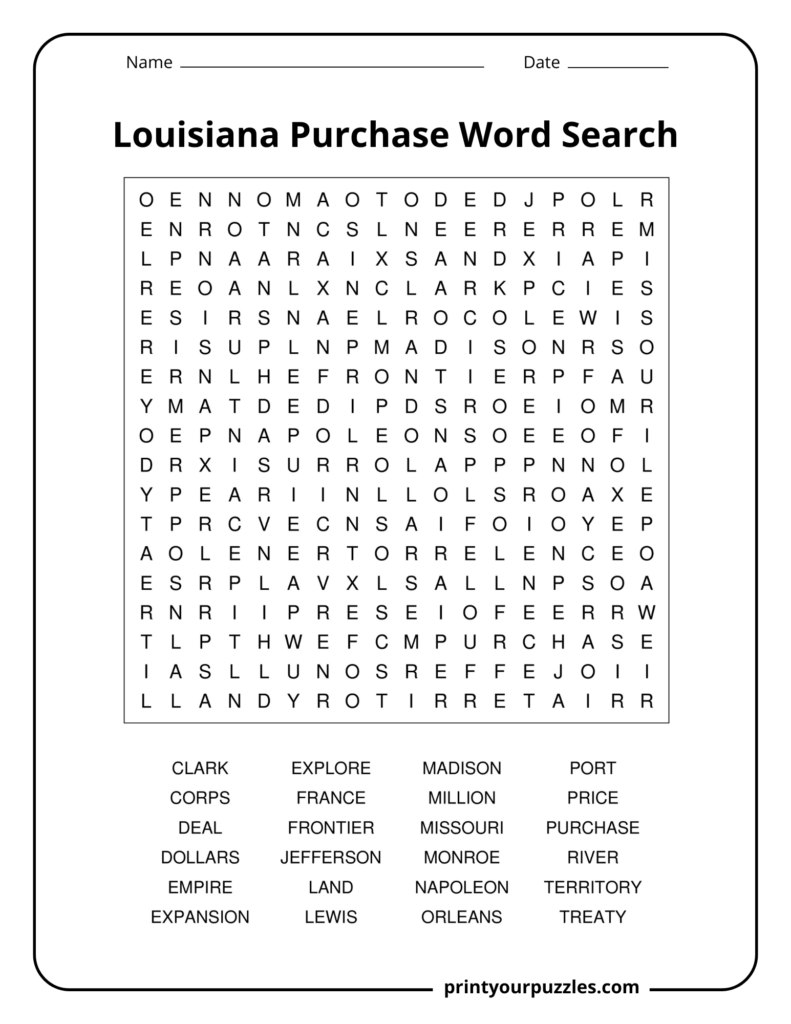
Students can use this Louisiana Purchase word search to review important terms such as Jefferson, Napoleon, France, territory, Mississippi River, New Orleans, Lewis and Clark, expansion, treaty, exploration, and Native American history. By working with a Louisiana Purchase word search, learners can connect the people, places, decisions, and consequences that made this land deal such an important moment in United States history.
Related Word Searches:
Lewis and Clark | Thomas Jefferson | Westward Expansion | Manifest Destiny | Oregon Trail | Native Americans
Medium Difficulty Word Search
Words to Find
CLARK, CORPS, DEAL, DOLLARS, EMPIRE, EXPANSION, EXPLORE, FRANCE, FRONTIER, JEFFERSON, LAND, LEWIS, MADISON, MILLION, MISSOURI, MONROE, NAPOLEON, ORLEANS, PORT, PRICE, PURCHASE, RIVER, TERRITORY, TREATY
All Words Defined
CLARK – William Clark co-led the Corps of Discovery expedition with Meriwether Lewis, mapping and exploring the newly acquired Louisiana Territory from 1804 to 1806.
CORPS – The Corps of Discovery was the exploration team led by Lewis and Clark that surveyed the Louisiana Territory, documenting geography, wildlife, and native peoples.
DEAL – The Louisiana Purchase deal was a land transaction negotiated between the United States and France, doubling America’s size for approximately fifteen million dollars in 1803.
DOLLARS – Fifteen million dollars was paid for the Louisiana Territory, equating to roughly three cents per acre, making it one of history’s greatest real estate bargains.
EMPIRE – Napoleon’s French Empire controlled Louisiana briefly before selling it to fund European wars, ending France’s colonial ambitions in mainland North America forever.
EXPANSION – The Louisiana Purchase enabled westward expansion of the United States, doubling the nation’s territory and providing vast lands for settlement, agriculture, and future statehood.
EXPLORE – President Jefferson commissioned Lewis and Clark to explore the Louisiana Territory, seeking routes to the Pacific and documenting the region’s resources and inhabitants.
FRANCE – France sold Louisiana to the United States in 1803 under Napoleon Bonaparte, who needed funds for European military campaigns and couldn’t defend distant territories.
FRONTIER – The Louisiana Purchase pushed America’s frontier dramatically westward, opening vast new lands beyond the Mississippi River for exploration, settlement, and economic development opportunities.
JEFFERSON – President Thomas Jefferson orchestrated the Louisiana Purchase in 1803, despite constitutional concerns, believing the acquisition essential for America’s agricultural future and security.
LAND – The Louisiana Purchase encompassed approximately 828,000 square miles of land, stretching from the Mississippi River to the Rocky Mountains, doubling United States territory overnight.
LEWIS – Meriwether Lewis, Jefferson’s personal secretary, led the Corps of Discovery expedition alongside William Clark, exploring and mapping the vast Louisiana Territory comprehensively.
MADISON – James Madison served as Secretary of State under Jefferson, helping negotiate the Louisiana Purchase and later becoming the fourth President of the United States.
MILLION – The United States paid fifteen million dollars total for the Louisiana Territory, with eleven million going to France and four million settling American claims.
MISSOURI – The Missouri River was a major waterway explored by Lewis and Clark, serving as a crucial route through the Louisiana Territory toward the Pacific.
MONROE – James Monroe, as minister to France, helped negotiate the Louisiana Purchase alongside Robert Livingston, securing the transformative 1803 agreement with Napoleon’s government.
NAPOLEON – Napoleon Bonaparte sold Louisiana to fund his European wars and prevent British seizure of the territory, dramatically altering North American history forever.
ORLEANS – New Orleans was a strategic port city controlling Mississippi River access, making its acquisition vital for American commerce and westward expansion efforts.
PORT – Control of port access along the Mississippi River, especially New Orleans, was crucial for American farmers shipping goods, motivating the Louisiana Purchase negotiations.
PRICE – The purchase price of fifteen million dollars seemed enormous in 1803 but proved extraordinarily economical, costing approximately three cents per acre of land.
PURCHASE – The Louisiana Purchase was the 1803 acquisition of French territory by the United States, doubling the nation’s size and reshaping America’s continental destiny.
RIVER – The Mississippi River formed the eastern boundary of the Louisiana Territory, serving as a vital commercial waterway connecting interior settlements to ocean ports.
TERRITORY – The Louisiana Territory comprised land from the Mississippi River to the Rocky Mountains, eventually forming multiple states including Louisiana, Arkansas, Missouri, and others.
TREATY – The treaty finalizing the Louisiana Purchase was signed in 1803, officially transferring French territorial claims to the United States for fifteen million dollars.
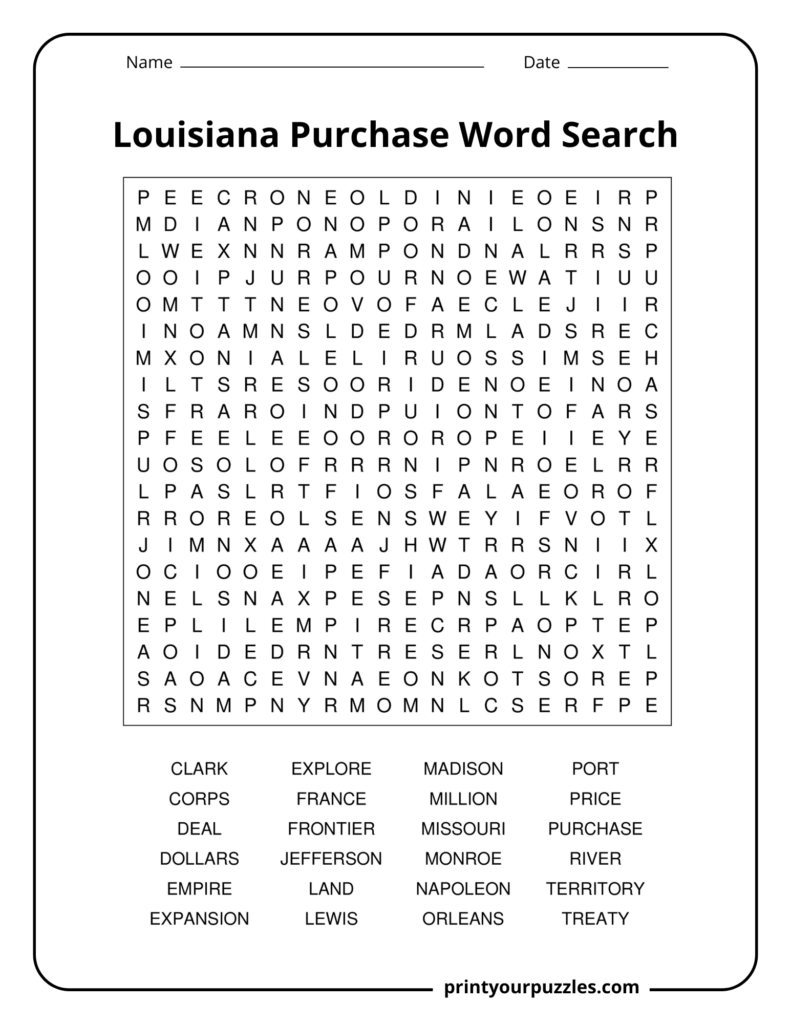
Hard Difficulty Word Search
Words to Find
CLARK, CORPS, DEAL, DOLLARS, EMPIRE, EXPANSION, EXPLORE, FRANCE, FRONTIER, JEFFERSON, LAND, LEWIS, MADISON, MILLION, MISSOURI, MONROE, NAPOLEON, ORLEANS, PORT, PRICE, PURCHASE, RIVER, TERRITORY, TREATY
5 Key FAQs About the Louisiana Purchase
5 Curious "Did You Know?" Facts About the Louisiana Purchase