- The main differences between solar and lunar eclipses.
- How the Sun, Earth, and Moon align to create an eclipse.
- Why total, partial, annular, and penumbral eclipses occur.
- How to observe a solar eclipse safely without damaging your eyes.

An eclipse is one of nature’s most impressive celestial events. It happens when one object in space moves into the shadow of another or temporarily blocks its light. From Earth, the best-known eclipses involve the Sun, the Moon, and our planet. Although people once viewed eclipses with fear or confusion, scientists can now predict them with remarkable accuracy.
A solar eclipse occurs when the Moon passes between Earth and the Sun. For a brief time, the Moon covers part or all of the Sun’s visible surface. During a total solar eclipse, daylight may fade, temperatures can drop, and bright stars or planets may become visible. The Sun’s outer atmosphere, called the corona, can also appear around the dark shape of the Moon. Because looking directly at the Sun can seriously damage the eyes, observers must use certified eclipse glasses or other approved viewing methods.
A lunar eclipse takes place when Earth moves between the Sun and the Moon. Earth’s shadow then falls across the lunar surface. During a total lunar eclipse, the Moon often appears red or orange. This happens because sunlight passes through Earth’s atmosphere, which filters and bends warmer colors toward the Moon. For this reason, a total lunar eclipse is sometimes called a “blood moon.” Unlike a solar eclipse, a lunar eclipse is safe to watch without special eye protection.
Eclipses do not happen every month because the Moon’s orbit is slightly tilted in relation to Earth’s path around the Sun. The Sun, Earth, and Moon must be correctly aligned near specific points in the Moon’s orbit. Their shadows also create different types of eclipses, including total, partial, annular, and penumbral events.
Studying eclipses has helped scientists learn more about the movement of celestial bodies, the Sun’s atmosphere, and the shape and size of Earth. Eclipses have also influenced mythology, calendars, art, and historical records in cultures around the world.
An eclipse word search offers an enjoyable way to become familiar with important vocabulary connected to these extraordinary events. As you find terms related to shadows, orbits, phases, and astronomy, you can explore how the Sun, Earth, and Moon combine to create one of the sky’s most unforgettable sights.
Related Word Searches:
Astronomy | Moon Phases | Solar System | Gravity | Physics | Visible Stars
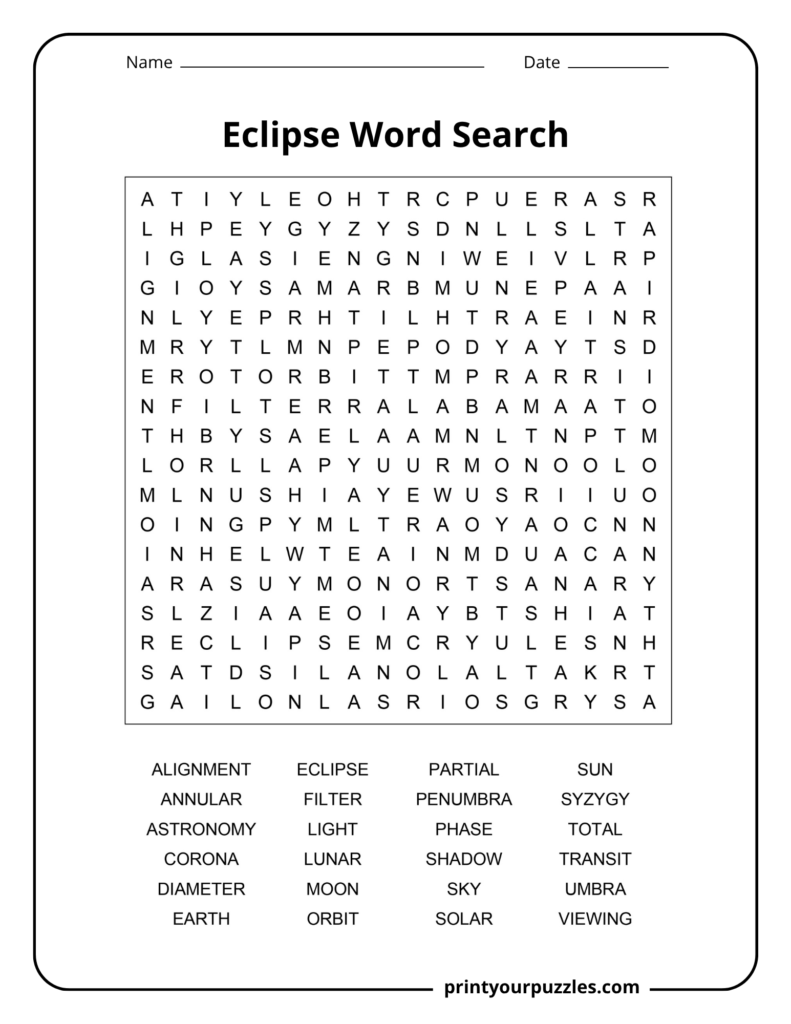
ALIGNMENT, ANNULAR, ASTRONOMY, CORONA, DIAMETER, EARTH, ECLIPSE, FILTER, LIGHT, LUNAR, MOON, ORBIT, PARTIAL, PENUMBRA, PHASE, SHADOW, SKY, SOLAR, SUN, SYZYGY, TOTAL, TRANSIT, UMBRA, VIEWING
ALIGNMENT – The positioning of the Sun, Moon, and Earth in a nearly straight line, allowing one body to block another’s light and create an observable eclipse.
ANNULAR – A solar eclipse in which the Moon covers the Sun’s center but leaves a bright outer ring visible because the Moon appears slightly smaller from Earth.
ASTRONOMY – The scientific study of stars, planets, moons, galaxies, eclipses, and other objects and events found throughout the vast universe beyond our home planet Earth today.
CORONA – The Sun’s extremely hot outer atmosphere, normally hidden by brilliant sunlight but visible as a glowing halo during the total phase of a solar eclipse.
DIAMETER – The distance across a circular object through its center, helping explain why the Sun and Moon can appear nearly equal in size from Earth’s surface.
EARTH – The planet where eclipses are observed, moving around the Sun while the Moon orbits it and occasionally creates precisely aligned shadows across its visible surface.
ECLIPSE – An astronomical event occurring when one celestial body blocks another body’s light or moves into its shadow, producing a temporary and noticeable darkening in the sky.
FILTER – A protective viewing material designed to block dangerous sunlight, allowing people to observe a solar eclipse without seriously damaging their eyes or their long-term vision.
LIGHT – Electromagnetic energy traveling from the Sun that can be blocked, bent, scattered, or filtered during different stages and types of solar and lunar eclipses in space.
LUNAR – Relating to the Moon, especially an eclipse that happens when Earth’s shadow falls across the Moon’s surface during the full moon phase in outer space.
MOON – Earth’s natural satellite, whose orbit sometimes carries it between Earth and the Sun or through Earth’s shadow, producing different types of spectacular celestial eclipses overhead.
ORBIT – The curved path followed by one celestial object around another, such as the Moon around Earth or Earth traveling around the Sun each complete year.
PARTIAL – An eclipse in which only part of the Sun or Moon is covered because the three celestial bodies are not perfectly aligned with one another.
PENUMBRA – The lighter outer part of a shadow, where sunlight is only partly blocked and a less dramatic partial eclipse may be observed from Earth below.
PHASE – A particular stage in the Moon’s changing appearance, with solar eclipses occurring at new moon and lunar eclipses occurring during the complete full moon phase.
SHADOW – A dark area formed when an object blocks light, including the umbra and penumbra created during solar and lunar eclipse alignments in distant outer space.
SKY – The space visible above Earth, where observers can watch eclipses, planets, stars, clouds, and changing light conditions during remarkable celestial events and natural displays worldwide.
SOLAR – Relating to the Sun, especially an eclipse caused when the Moon moves between Earth and the Sun and blocks its bright visible disk from view.
SUN – The star at the center of our solar system, providing the light that is blocked or shadowed during both solar and lunar eclipses seen from Earth.
SYZYGY – The alignment of three celestial bodies in a straight or nearly straight line, a necessary arrangement for both solar and lunar eclipses to occur naturally.
TOTAL – An eclipse stage in which the Sun is completely covered by the Moon or the Moon is fully inside Earth’s darkest central shadow for a time.
TRANSIT – The passage of one celestial object across the visible face of another, similar to an eclipse but usually involving a much smaller distant object in space.
UMBRA – The darkest central part of a shadow, where the light source is completely blocked and a total eclipse can be experienced by observers on Earth.
VIEWING – The act of observing an eclipse safely, using approved solar glasses or indirect methods when watching the Sun to prevent permanent and serious eye injury.
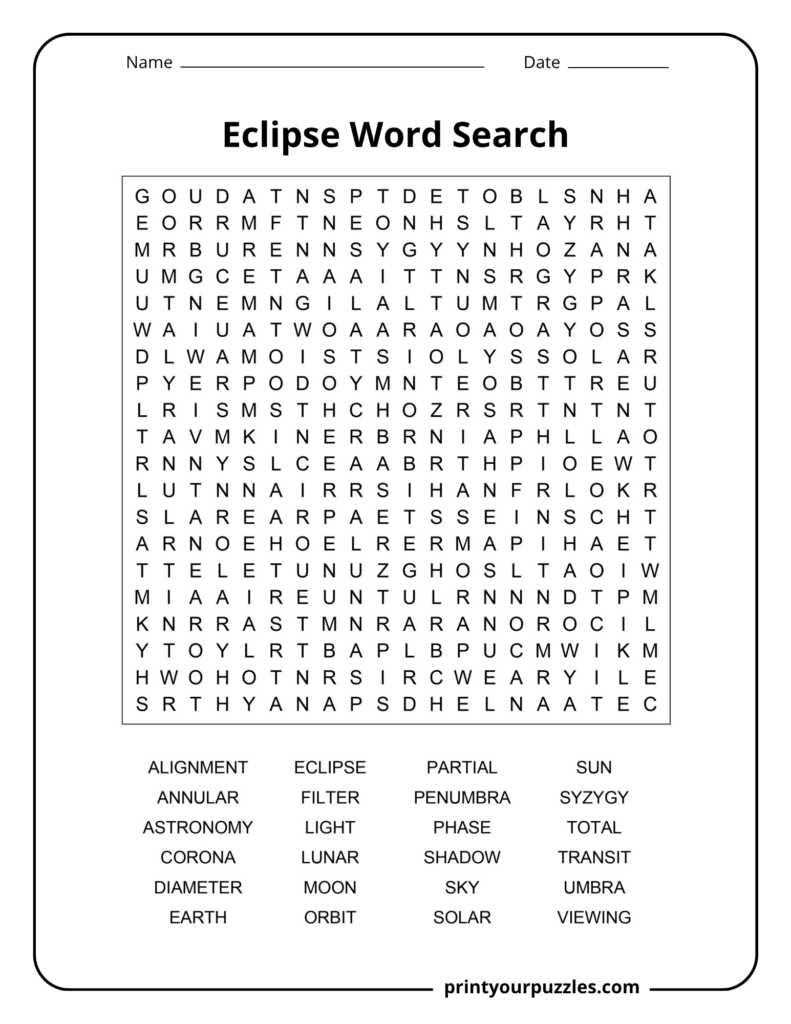
ALIGNMENT, ANNULAR, ASTRONOMY, CORONA, DIAMETER, EARTH, ECLIPSE, FILTER, LIGHT, LUNAR, MOON, ORBIT, PARTIAL, PENUMBRA, PHASE, SHADOW, SKY, SOLAR, SUN, SYZYGY, TOTAL, TRANSIT, UMBRA, VIEWING
An eclipse happens when one celestial body blocks another’s light or moves into its shadow, creating a temporary darkening visible from certain locations.
A solar eclipse occurs when the Moon blocks the Sun, while a lunar eclipse happens when Earth’s shadow falls across the Moon.
Eclipses do not occur monthly because the Moon’s orbit is tilted, so the Sun, Earth, and Moon are usually not perfectly aligned.
Looking directly at a solar eclipse is unsafe without certified eclipse glasses, because intense sunlight can permanently damage the eyes without causing immediate pain.
Earth’s atmosphere filters and bends sunlight, allowing mostly red and orange wavelengths to reach the Moon and create its copper-colored appearance.
As the Moon completely covers the Sun, the sky darkens, temperatures may fall, and bright stars or planets can briefly become visible.
Earth’s atmosphere scatters shorter blue wavelengths while bending red and orange light toward the Moon, creating its dramatic copper-colored appearance.
The Moon’s darkest shadow covers a limited area of Earth, while people outside that path may observe only a partial eclipse.
Historical eclipse records have helped modern scientists study calendars, confirm dates, and understand changes in Earth’s rotation across many centuries.
The Sun is much larger but also far more distant, allowing the Moon to cover it almost perfectly during a total solar eclipse.
1. What happens during a solar eclipse?
A. Earth moves between the Sun and the Moon
B. The Moon moves between Earth and the Sun
C. The Sun moves behind Earth
2. Why does the Moon sometimes appear red during a total lunar eclipse?
A. The Moon produces red light
B. Earth’s atmosphere filters and bends sunlight
C. The Sun becomes cooler
3. What is the darkest central part of an eclipse shadow called?
A. Corona
B. Penumbra
C. Umbra
4. Why do eclipses not occur every month?
A. The Moon’s orbit is slightly tilted
B. Earth stops moving temporarily
C. The Sun changes its orbit
5. What should people use to watch a solar eclipse safely?
A. Ordinary sunglasses
B. Certified eclipse glasses
C. A clear glass window
Answers
1. B. The Moon moves between Earth and the Sun. The Moon blocks part or all of the Sun’s visible surface, casting its shadow onto certain areas of Earth.
2. B. Earth’s atmosphere filters and bends sunlight. Earth’s atmosphere scatters blue light while allowing red and orange wavelengths to reach and illuminate the Moon.
3. C. Umbra. The umbra is the region where the light source is completely blocked, allowing observers to experience a total eclipse.
4. A. The Moon’s orbit is slightly tilted. The Sun, Earth, and Moon are usually not perfectly aligned because the Moon’s orbital path is tilted relative to Earth’s orbit.
5. B. Certified eclipse glasses. Certified eclipse glasses block harmful solar radiation and help prevent permanent eye damage while observing the Sun.