
Visible stars are the stars that people can see from Earth without using a telescope. On a clear, dark night, thousands of stars may appear across the sky, although only a portion of them can be seen from one place at one time. The exact number depends on the observer’s location, the season, weather conditions, and the amount of artificial light nearby.
Stars are enormous spheres of hot gas that produce energy through nuclear fusion. They may look like tiny points of light because they are extremely far away. Even the closest star to Earth, apart from the Sun, is more than four light-years away. A light-year is the distance light travels in one year, so this measurement helps scientists describe the huge distances between objects in space.
Some visible stars appear brighter than others. A star’s apparent brightness depends on its actual size, temperature, and distance from Earth. A very powerful star may look faint because it is far away, while a less powerful but closer star may appear much brighter. Sirius, found in the constellation Canis Major, is the brightest star in Earth’s night sky.
Stars also appear in different colors. Hotter stars may look blue or white, while cooler stars can appear yellow, orange, or red. However, these colors are often difficult to notice with the naked eye because stars appear so small. Betelgeuse, for example, has a reddish-orange appearance, while Rigel looks blue-white.
People have grouped visible stars into constellations for thousands of years. Constellations are recognizable patterns that helped ancient cultures tell stories, track the seasons, and navigate across land and sea. Well-known examples include Orion, Ursa Major, Cassiopeia, and Leo. The stars in a constellation may appear close together, but they are often located at very different distances from Earth.
The stars visible during the night change throughout the year because Earth moves around the Sun. Some constellations are easier to see in winter, while others dominate the summer sky. A visible stars word search can introduce useful vocabulary such as constellation, brightness, telescope, Sirius, color, distance, and light-year. Learning these terms helps students understand why stars look different and how people observe and organize the night sky.
Related Word Searches:
Astronomy | Solar System | Dark Matter | Gravity | Physics | Moon Phases
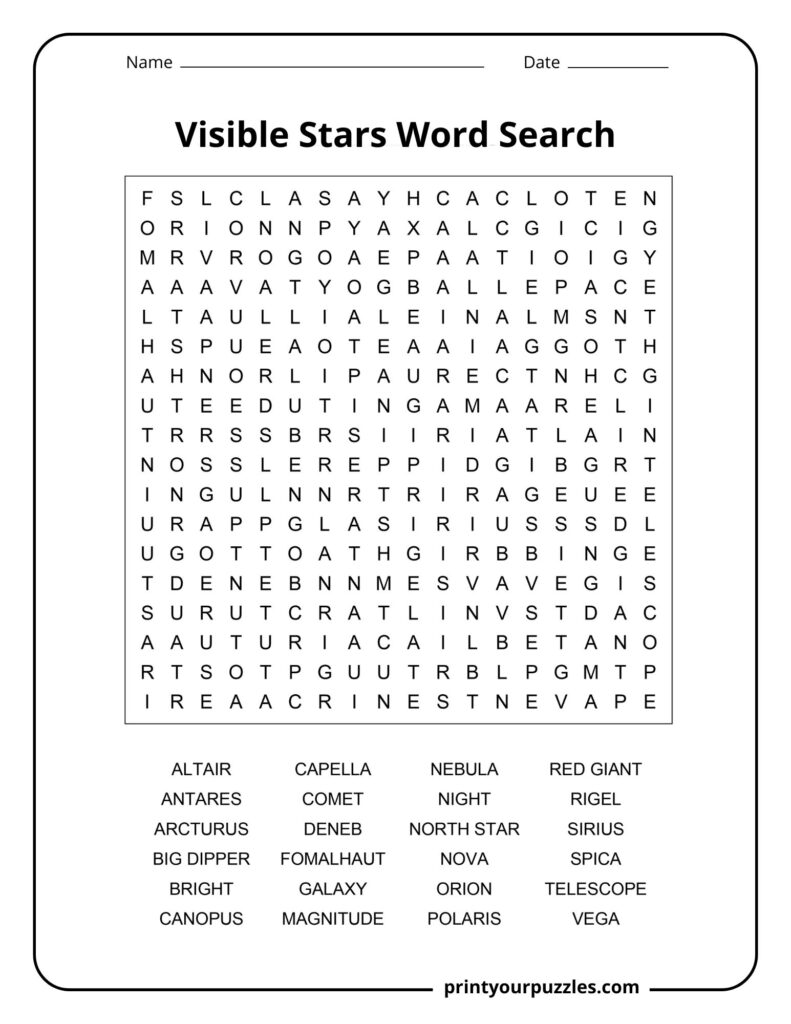
ALTAIR, ANTARES, ARCTURUS, BIG DIPPER, BRIGHT, CANOPUS, CAPELLA, COMET, DENEB, FOMALHAUT, GALAXY, MAGNITUDE, NEBULA, NIGHT, NORTH STAR, NOVA, ORION, POLARIS, RED GIANT, RIGEL, SIRIUS, SPICA, TELESCOPE, VEGA
ALTAIR – A bright white star in the constellation Aquila, located approximately sixteen light-years from Earth. It’s one of the closest naked-eye visible stars to our planet.
ANTARES – A brilliant red supergiant star in the constellation Scorpius. Its distinctive reddish color rivals Mars, which is how it earned its name meaning “rival of Mars.”
ARCTURUS – The brightest star in the northern celestial hemisphere, located in the constellation Boötes. This orange giant is approximately thirty-seven light-years away from Earth and highly luminous.
BIG DIPPER – A prominent asterism of seven bright stars forming part of Ursa Major constellation. Its distinctive saucepan shape helps stargazers locate Polaris and navigate the night sky easily.
BRIGHT – Describes stars emitting significant amounts of visible light, making them easily observable from Earth. Brightness depends on both a star’s luminosity and its distance from us.
CANOPUS – The second brightest star in the night sky after Sirius, located in the constellation Carina. This white supergiant is visible primarily from the Southern Hemisphere’s skies.
CAPELLA – A bright yellowish star system in the constellation Auriga, consisting of four stars. It’s the sixth brightest star visible from Earth and prominent in northern winter skies.
COMET – An icy celestial body that releases gas and dust, creating a glowing tail when approaching the Sun. Comets orbit our solar system and become visible periodically.
DENEB – One of the brightest stars visible from Earth, located in the constellation Cygnus. This blue-white supergiant forms part of the prominent Summer Triangle asterism pattern.
FOMALHAUT – A bright white star in the constellation Piscis Austrinus, sometimes called the “Autumn Star.” It’s relatively nearby at just twenty-five light-years from Earth and quite luminous.
GALAXY – A massive system containing billions of stars, gas, dust, and dark matter bound together by gravity. Our solar system resides within the Milky Way galaxy structure.
MAGNITUDE – A measurement system indicating a celestial object’s brightness as observed from Earth. Lower numbers represent brighter objects, while higher numbers indicate dimmer ones in the sky.
NEBULA – A vast cloud of gas and dust in space where stars are born or remnants of dying stars exist. Nebulae appear as glowing patches in telescopes.
NIGHT – The period when Earth’s rotation places your location away from the Sun, allowing darkness. This is when stars, planets, and other celestial objects become visible overhead.
NORTH STAR – Another name for Polaris, the star marking Earth’s northern celestial pole. Navigators have used it for centuries because it appears stationary while other stars rotate around.
NOVA – A sudden, dramatic increase in a star’s brightness caused by thermonuclear explosions on a white dwarf’s surface. The star appears as a “new” temporary bright object.
ORION – A prominent constellation visible worldwide, named after a mythological hunter. It contains many bright stars including Betelgeuse, Rigel, and the distinctive three-star belt
formation.
POLARIS – The current North Star located nearly aligned with Earth’s rotational axis. This yellow supergiant helps navigators determine direction and latitude in the Northern Hemisphere.
RED GIANT – A large, luminous star in a late evolutionary stage that has expanded and cooled, giving it a reddish appearance. Eventually, it will shed outer layers.
RIGEL – A brilliant blue supergiant star forming Orion’s left foot, one of the brightest stars visible from Earth. It’s approximately eight hundred light-years distant and extremely luminous.
SIRIUS – The brightest star in Earth’s night sky, located in Canis Major constellation. Also called the “Dog Star,” it’s a binary system just eight light-years away.
SPICA – The brightest star in Virgo constellation, appearing as a blue-white point of light. This binary star system is approximately two hundred fifty light-years from Earth.
TELESCOPE – An optical instrument using lenses or mirrors to collect and magnify light from distant celestial objects, allowing astronomers to observe stars, planets, and galaxies more clearly.
VEGA – A bright blue-white star in the constellation Lyra, one of the most luminous stars near Earth. It forms part of the Summer Triangle asterism pattern.
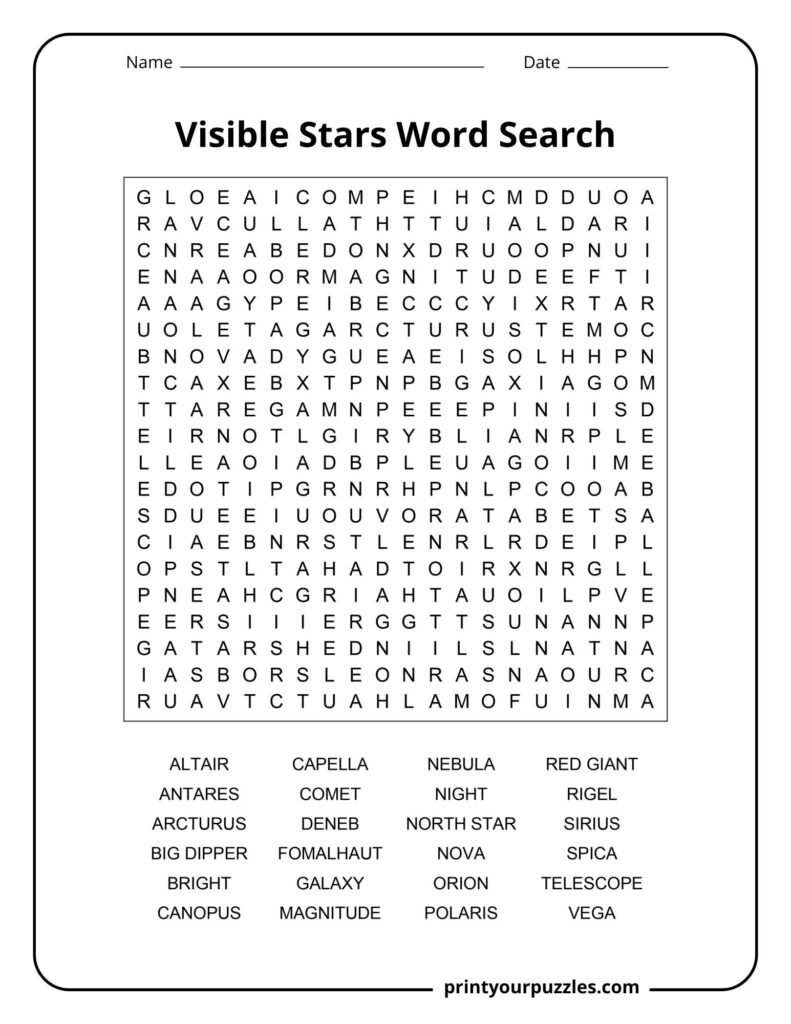
ALTAIR, ANTARES, ARCTURUS, BIG DIPPER, BRIGHT, CANOPUS, CAPELLA, COMET, DENEB, FOMALHAUT, GALAXY, MAGNITUDE, NEBULA, NIGHT, NORTH STAR, NOVA, ORION, POLARIS, RED GIANT, RIGEL, SIRIUS, SPICA, TELESCOPE, VEGA
Under optimal dark-sky conditions away from light pollution, the average human eye can observe approximately two thousand to three thousand stars at any given time from one location on Earth.
Star brightness depends on two factors: the star’s actual luminosity or energy output, and its distance from Earth. Closer or more luminous stars appear brighter in our sky.
Sirius, located in the constellation Canis Major, is the brightest star in our night sky. This brilliant blue-white star is approximately eight light-years away from our planet.
Stars twinkle due to Earth’s atmospheric turbulence. As starlight passes through moving pockets of air with varying temperatures and densities, it bends and shifts, creating the twinkling effect.
No, visible stars vary by location and hemisphere. Northern observers see different constellations than southern observers, though some stars near the celestial equator are visible from both hemispheres seasonally.
Many visible stars are so distant that their light takes thousands of years to reach Earth. Some may have already exhausted their fuel and died long ago.
Due to Earth’s axial precession, different stars become the North Star over time. In ancient Egyptian times, Thuban held this position. Vega will become our North Star eventually.
Our Sun is actually a medium-sized yellow dwarf star. Its proximity makes it appear extraordinarily bright, completely overwhelming the light from all other distant visible stars.
The Andromeda Galaxy appears as a faint smudge resembling a star to the naked eye, yet it contains over one trillion stars and is our Milky Way’s closest galactic neighbor.
Blue stars like Rigel are the hottest, exceeding thirty thousand degrees. Red stars like Betelgeuse are cooler. Our yellow Sun sits comfortably at a moderate ten thousand degrees Fahrenheit.