
The water cycle is the continuous movement of water between Earth’s surface and the atmosphere. It is powered mainly by the Sun and plays an essential role in weather, climate, ecosystems, and everyday life. Although water changes location and form during the cycle, the total amount of water on Earth remains nearly constant.
The cycle begins with evaporation. When sunlight heats water in oceans, lakes, rivers, and other bodies of water, some of it changes from liquid into water vapor and rises into the atmosphere. Plants also release water vapor through a process called transpiration. Together, evaporation and transpiration transfer large amounts of water from the land and oceans into the air.
As water vapor rises, it reaches cooler parts of the atmosphere. The vapor cools and changes into tiny droplets of liquid water through condensation. These droplets gather around small particles in the air, forming clouds. When enough droplets collect, they may combine and become too heavy to remain suspended.
Water then returns to Earth through precipitation. Depending on the temperature, precipitation can fall as rain, snow, sleet, or hail. Some of this water flows across the land as runoff, entering streams, rivers, lakes, and oceans. Snow and ice may remain frozen for months or years before melting and continuing through the cycle.
Other water soaks into the ground through infiltration. It may collect underground as groundwater, which can supply wells, springs, rivers, and plant roots. Some groundwater remains below the surface for long periods, while some slowly moves back toward lakes and oceans.
Collection occurs when water gathers in oceans, rivers, lakes, glaciers, soil, and underground areas. From these locations, sunlight can cause evaporation again, beginning another journey through the cycle. Water molecules may repeat this process many times and travel through different parts of the planet.
A water cycle word search can introduce important vocabulary such as evaporation, condensation, precipitation, runoff, groundwater, and transpiration. Understanding these terms helps students follow how water moves, changes form, supports living things, and shapes weather. The water cycle connects the atmosphere, land, oceans, plants, animals, and people in one constantly moving natural system.
Related Word Searches:
Weather | States of Matter | Energy | Ecology | Ecosystem | Erosion
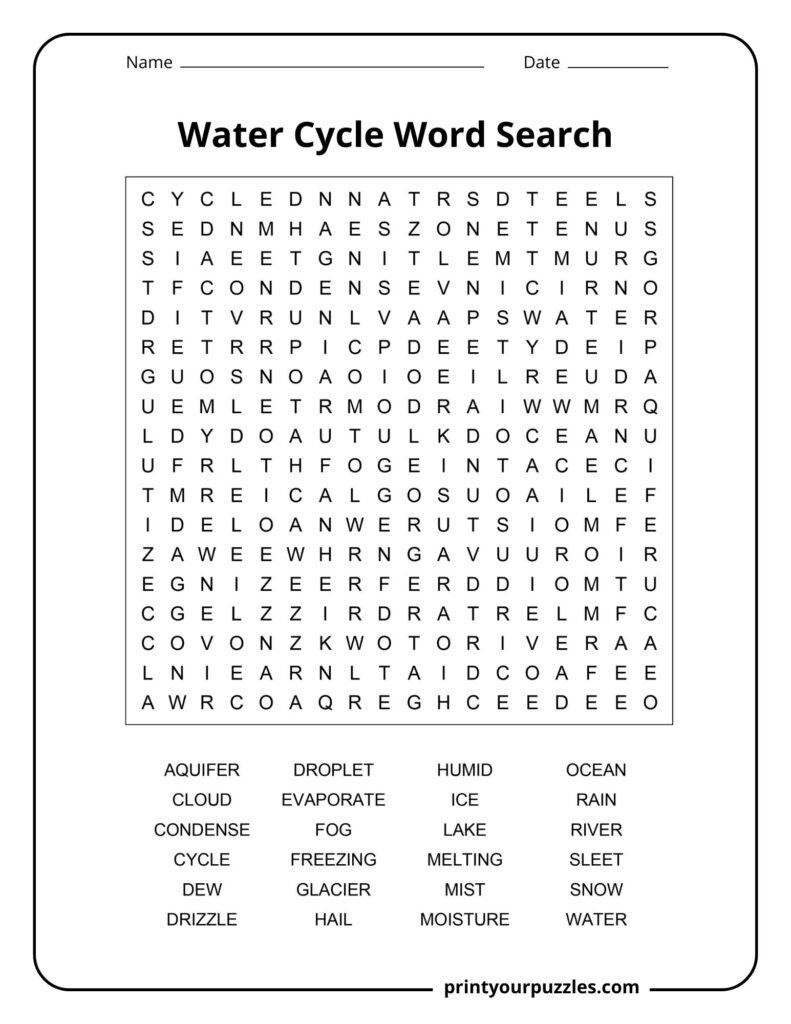
AQUIFER, CLOUD, CONDENSE, CYCLE, DEW, DRIZZLE, DROPLET, EVAPORATE, FOG, FREEZING, GLACIER, HAIL, HUMID, ICE, LAKE, MELTING, MIST, MOISTURE, OCEAN, RAIN, RIVER, SLEET, SNOW, WATER
AQUIFER – An underground layer of permeable rock, sediment, or soil that holds and transmits groundwater, serving as a natural storage reservoir for freshwater beneath Earth’s surface.
CLOUD – A visible mass of water droplets or ice crystals suspended in the atmosphere, formed when water vapor condenses at higher altitudes due to cooling temperatures.
CONDENSE – The process by which water vapor cools and transforms from a gaseous state into liquid water, forming droplets on surfaces or creating clouds in the atmosphere.
CYCLE – The continuous movement of water through Earth’s systems, including evaporation, condensation, precipitation, and collection, repeating endlessly through various states and locations across the planet.
DEW – Water droplets that form on cool surfaces during night or early morning when water vapor in the air condenses due to temperature drops below the dew point.
DRIZZLE – Light, fine precipitation consisting of very small water droplets falling steadily from low clouds, typically measuring less than half a millimeter in diameter upon reaching the ground.
DROPLET – A tiny spherical particle of liquid water, often found in clouds, fog, or mist, formed through condensation or when larger water masses break into smaller pieces.
EVAPORATE – The transformation of liquid water into water vapor gas when heat energy causes molecules to escape from the surface into the atmosphere, occurring in oceans, lakes, and soil.
FOG – A thick cloud of water droplets suspended near ground level that reduces visibility, formed when air temperature drops to the dew point and water vapor condenses.
FREEZING – The phase transition when liquid water turns into solid ice at zero degrees Celsius or thirty-two degrees Fahrenheit, releasing heat energy during the crystallization process.
GLACIER – A massive, slow-moving body of dense ice formed from accumulated and compacted snow over many years, typically found in polar regions or high mountain areas worldwide.
HAIL – Solid precipitation consisting of balls or irregular lumps of ice that form in strong thunderstorm updrafts, growing larger through repeated freezing before falling to the ground.
HUMID – An atmospheric condition characterized by high moisture content or water vapor concentration in the air, making the environment feel damp, sticky, or muggy to living organisms.
ICE – The solid crystalline form of water that exists below zero degrees Celsius, appearing in nature as snow, frost, glaciers, or frozen bodies of water across Earth.
LAKE – A large inland body of standing freshwater or saltwater, typically fed by rivers, streams, or underground springs, serving as important water storage within the water cycle.
MELTING – The phase change when solid ice transforms into liquid water as temperature rises above freezing point, absorbing heat energy to break molecular bonds within the crystalline structure.
MIST – Very fine water droplets suspended in the air near the ground, creating a thin fog that slightly reduces visibility but remains less dense than typical fog.
MOISTURE – Water present in liquid, vapor, or solid form within the atmosphere, soil, or other materials, representing an essential component of Earth’s water cycle and ecosystem health.
OCEAN – A vast body of saltwater covering approximately seventy-one percent of Earth’s surface, serving as the primary source of evaporation and the largest reservoir in the water cycle.
RAIN – Liquid precipitation that falls from clouds when water droplets combine and grow heavy enough to overcome air resistance, providing essential freshwater to Earth’s surface and ecosystems.
RIVER – A natural flowing watercourse moving freshwater from higher elevations toward lower areas, eventually emptying into oceans, lakes, or other rivers, transporting water across landscapes continuously.
SLEET – Frozen precipitation consisting of ice pellets that form when raindrops freeze while falling through a cold atmospheric layer before reaching the ground as small, bouncing ice balls.
SNOW – Frozen precipitation composed of ice crystals that form in clouds when water vapor freezes directly into delicate, hexagonal crystalline structures, falling gently to accumulate on surfaces.
WATER – A transparent, tasteless, odorless liquid compound of hydrogen and oxygen molecules, essential for all known life forms, existing in solid, liquid, and gaseous states throughout Earth.
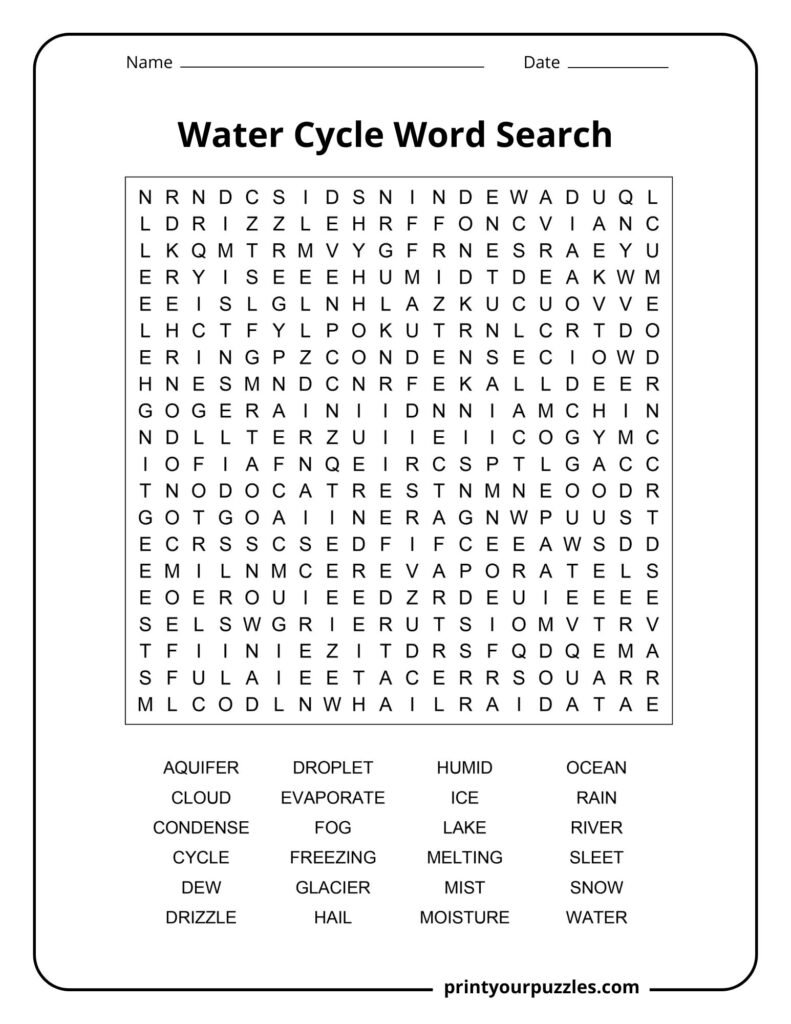
AQUIFER, CLOUD, CONDENSE, CYCLE, DEW, DRIZZLE, DROPLET, EVAPORATE, FOG, FREEZING, GLACIER, HAIL, HUMID, ICE, LAKE, MELTING, MIST, MOISTURE, OCEAN, RAIN, RIVER, SLEET, SNOW, WATER
The water cycle is the continuous movement of water on, above, and below Earth’s surface, involving evaporation, condensation, precipitation, and collection through various natural processes and states.
The four main stages are evaporation (water becoming vapor), condensation (vapor forming clouds), precipitation (rain, snow, or hail falling), and collection (water gathering in oceans, rivers, and lakes).
The water cycle has no fixed duration; a single water molecule might cycle through in days or remain trapped in glaciers for thousands of years, varying greatly.
The water cycle distributes freshwater across Earth, regulates climate and temperature, supports all living organisms, replenishes water sources, and maintains ecological balance essential for planetary health and survival.
No, the water cycle cannot stop as long as the sun provides energy for evaporation and Earth maintains its atmosphere, making it a perpetual natural process essential for life.
Earth’s water constantly recycles through the water cycle but never leaves the planet, meaning water molecules are perpetually reused throughout history and shared across all life forms.
Oceans contribute the vast majority of evaporation into the atmosphere, while only 10% comes from lakes, rivers, and other freshwater sources combined, making oceans the cycle’s primary engine.
This process, called transpiration, contributes roughly 10% of all atmospheric moisture in some regions, making vegetation an important but often overlooked component of the water cycle’s functioning.
Despite appearing light and fluffy while floating in the sky, clouds contain massive amounts of tiny water droplets suspended in air, collectively weighing more than you’d imagine.
At any given time, this tiny atmospheric fraction is crucial for distributing freshwater worldwide through precipitation, demonstrating how even small amounts create significant impacts on life.