
The Mississippi River gives Baton Rouge much of its character. Broad, powerful, and historically essential to trade, the river has helped shape Louisiana’s capital into a center of government, industry, education, and culture. Baton Rouge feels distinctly Southern, yet its identity also reflects French, Spanish, African, Caribbean, and Acadian influences that have developed across Louisiana over centuries.
The city’s name comes from the French expression Bâton Rouge, meaning “red stick.” French explorers used the term after seeing a red-painted pole that marked a boundary between Indigenous communities. European control of the region changed several times before Louisiana became part of the United States through the Louisiana Purchase in 1803. Baton Rouge later became the state capital, replacing New Orleans.
One of the most interesting places to visit is the Louisiana State Capitol, an Art Deco skyscraper that stands dramatically above the city. At 34 stories, it is the tallest state capitol building in the United States. Visitors can explore its grounds and observation area while learning about Louisiana political history. A very different experience awaits at the Old State Capitol, a Gothic Revival building overlooking the Mississippi River that now serves as a museum.
Baton Rouge also has a strong artistic and educational side. Louisiana State University brings museums, performances, sports, and cultural events to the city, while galleries and music venues reflect the broader traditions of Louisiana. Blues, jazz, zydeco, and other musical styles are closely associated with the region and contribute to the capital’s lively cultural identity.
Food is impossible to separate from life in Baton Rouge. Cajun and Creole influences appear in dishes such as gumbo, jambalaya, crawfish étouffée, red beans and rice, and po’boys. Seafood from the Gulf Coast and nearby waterways also plays an important role, making local restaurants an excellent way to explore Louisiana culture.
Visitors can walk along the Mississippi Riverfront, tour the state capitol buildings, or explore museums devoted to history and art. A printable Baton Rouge word search can introduce readers to vocabulary connected with the river, politics, cuisine, music, and Louisiana heritage. Few capitals combine government, food, history, and regional culture with such a strong sense of place.
Related Word Searches:
Louisiana | Jackson | Little Rock | Austin | Montgomery
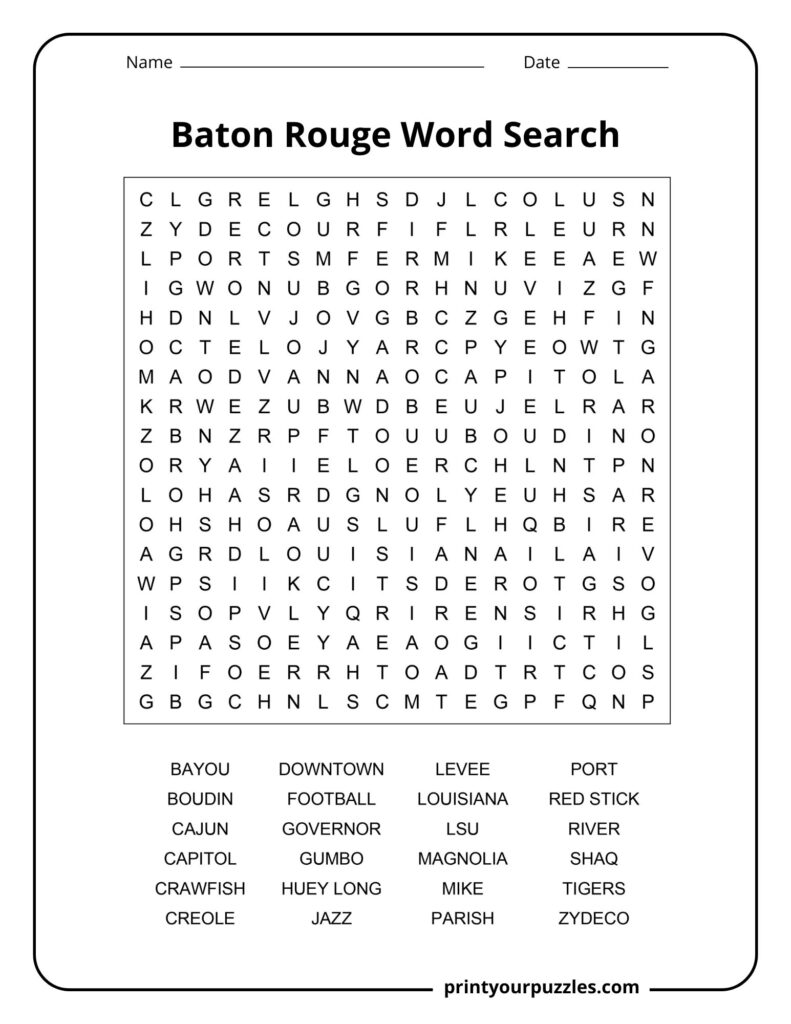
BAYOU, BOUDIN, CAJUN, CAPITOL, CRAWFISH, CREOLE, DOWNTOWN, FOOTBALL, GOVERNOR, GUMBO, HUEY LONG, JAZZ, LEVEE, LOUISIANA, LSU, MAGNOLIA, MIKE, PARISH, PORT, RED STICK, RIVER, SHAQ, TIGERS, ZYDECO
BAYOU – A slow-moving, marshy waterway common in Louisiana’s wetlands. These bodies of water are essential to the region’s ecosystem and cultural identity.
BOUDIN – A traditional Cajun sausage made with pork, rice, and spices. This beloved Louisiana specialty is a staple at local markets and restaurants throughout Baton Rouge.
CAJUN – French-speaking Acadian descendants who settled in Louisiana. Their culture, cuisine, and traditions deeply influence Baton Rouge’s identity, music, and culinary scene across the region.
CAPITOL – Louisiana’s State Capitol building in Baton Rouge, the tallest state capitol in the United States at 450 feet, completed in 1932 during Huey Long’s governorship.
CRAWFISH – Small freshwater crustaceans, also called crayfish or mudbugs. Louisiana produces ninety percent of America’s crawfish, making them central to local cuisine and culture.
CREOLE – A distinct Louisiana culture blending French, Spanish, African, and Native American influences. Creole cuisine and traditions are fundamental to Baton Rouge’s cultural heritage and identity.
DOWNTOWN – Baton Rouge’s urban core along the Mississippi River, featuring government buildings, businesses, entertainment venues, and the historic Spanish Town neighborhood with diverse cultural attractions.
FOOTBALL – LSU Tigers football is a dominant cultural force in Baton Rouge. Game days at Tiger Stadium create electric atmospheres with over 100,000 passionate fans.
GOVERNOR – Louisiana’s chief executive officer works from Baton Rouge, the state capital. The governor’s mansion and Capitol are prominent landmarks in the city’s landscape.
GUMBO – A thick, flavorful stew combining seafood or meat with okra, the “holy trinity” of vegetables, and roux. This iconic Louisiana dish represents the region’s culinary heritage.
HUEY LONG – Controversial Louisiana governor and senator from 1928-1935 who modernized infrastructure and built the State Capitol. Assassinated in the Capitol building in nineteen thirty-five.
JAZZ – An American music genre born in Louisiana, featuring improvisation and syncopated rhythms. Jazz culture thrives in Baton Rouge through festivals, clubs, and street performances.
LEVEE – Earthen embankments built along the Mississippi River to prevent flooding. These structures protect Baton Rouge from the river’s powerful seasonal floods and rising waters.
LOUISIANA – The eighteenth state, admitted in 1812, with Baton Rouge as its capital since 1849. Known for unique French-Spanish legal codes and vibrant multicultural heritage.
LSU – Louisiana State University, founded in 1860, is a major research institution. The university’s 2,000-acre campus defines Baton Rouge’s culture, economy, and community identity.
MAGNOLIA – Louisiana’s state flower, the magnolia blossom represents southern beauty and heritage. These fragrant white flowers bloom on trees throughout Baton Rouge’s neighborhoods and landscapes.
MIKE – LSU’s live Bengal tiger mascot, residing on campus since 1936. The current Mike VII lives in a state-of-the-art habitat near Tiger Stadium.
PARISH – Louisiana’s equivalent of counties, a unique designation reflecting the state’s French and Spanish Catholic heritage. Baton Rouge is in East Baton Rouge Parish.
PORT – The Port of Greater Baton Rouge is a major Mississippi River shipping hub, serving petroleum, chemicals, and agricultural products, vital to the regional economy.
RED STICK – English translation of “Baton Rouge,” referring to a red cypress pole that marked territorial boundaries between Native American tribes along the Mississippi River.
RIVER – The mighty Mississippi River defines Baton Rouge’s geography and economy. The river provides transportation, commerce, and recreation while shaping the city’s historical development.
SHAQ – Shaquille O’Neal, NBA Hall of Famer and four-time champion, was born in Newark but raised in Baton Rouge, where he became a basketball legend.
TIGERS – LSU’s athletic teams mascot, representing strength and Louisiana pride. The purple and gold Tigers compete in the Southeastern Conference across multiple sports.
ZYDECO – Energetic Creole music genre featuring accordions and washboards. This distinctive Louisiana sound blends blues, rhythm, and Cajun influences, celebrated at local festivals.
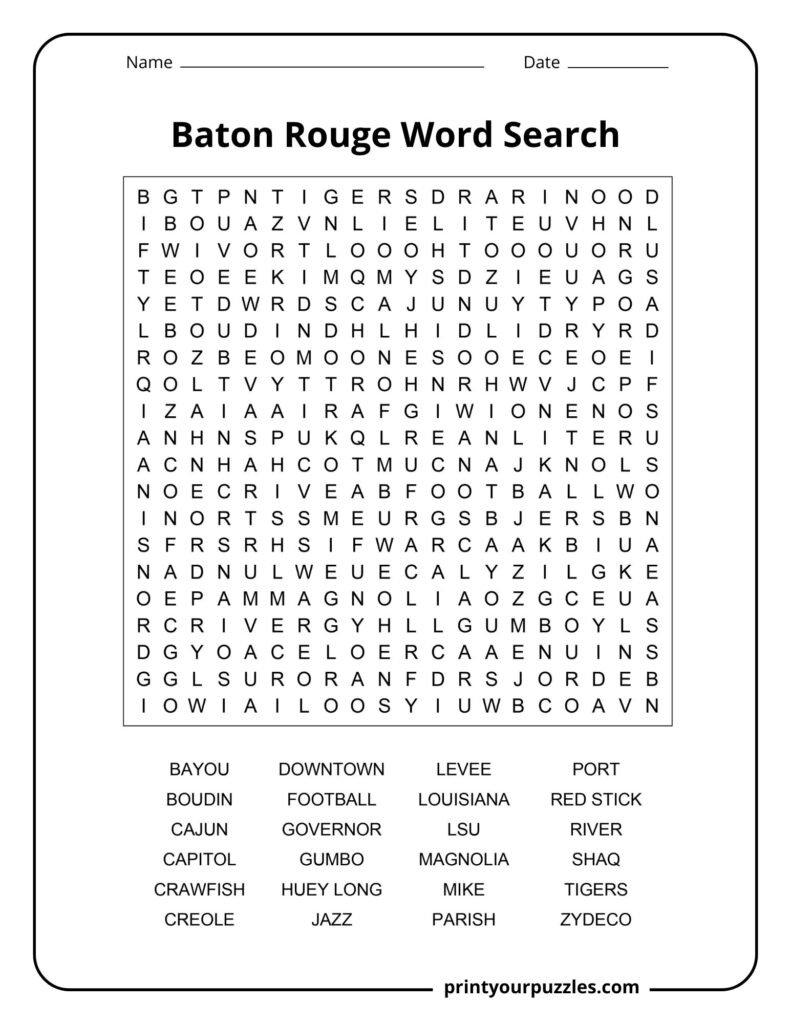
BAYOU, BOUDIN, CAJUN, CAPITOL, CRAWFISH, CREOLE, DOWNTOWN, FOOTBALL, GOVERNOR, GUMBO, HUEY LONG, JAZZ, LEVEE, LOUISIANA, LSU, MAGNOLIA, MIKE, PARISH, PORT, RED STICK, RIVER, SHAQ, TIGERS, ZYDECO
The name means “red stick” in French, referring to a red cypress pole that marked territorial boundaries between Native American tribes along the Mississippi River.
Baton Rouge is famous for being Louisiana’s capital, home to LSU Tigers football, vibrant Cajun and Creole cuisine, petrochemical industries, and its location on the Mississippi River.
Must-see attractions include the Louisiana State Capitol, LSU’s Tiger Stadium and campus, USS Kidd naval museum, Louisiana Art and Science Museum, and the historic Spanish Town neighborhood.
Baton Rouge has a humid subtropical climate with hot, humid summers averaging 90°F, mild winters, and frequent rainfall. Hurricane season runs from June through November annually.
Essential dishes include crawfish boils, gumbo, jambalaya, boudin sausage, po’boy sandwiches, étouffée, beignets, and red beans with rice—all authentic Louisiana Cajun and Creole specialties.
For official city information, government updates, and public services, visit the City of Baton Rouge website. If you are planning a trip, check out the official tourism portal, Visit Baton Rouge.
Louisiana’s State Capitol stands 450 feet tall with 34 floors, surpassing all other state capitols. Built in 1932, it towers over the Mississippi River skyline majestically.
The stadium holds over 102,000 fans who create deafening noise levels exceeding 130 decibels, making it an intimidating venue for visiting teams on game days.
The controversial Louisiana governor was shot in the Capitol’s hallway. Bullet holes remain visible in the marble walls, marking this tragic moment in history.
The Horace Wilkinson Bridge, spanning the Mississippi River, stretches 17,500 feet. This impressive structure connects Baton Rouge’s east and west sides for commuters daily.
LSU’s live Bengal tiger mascot resides in a 15,000-square-foot enclosure featuring a waterfall, pool, and lush vegetation, making it one of collegiate sports’ finest facilities.