
Montpelier proves that a state capital does not need to be large to be memorable. Vermont’s capital is the smallest state capital in the United States by population, yet it offers a rich combination of historic streets, independent shops, local food, art, nearby trails, and the relaxed character associated with northern New England.
The city developed along the Winooski River during the late eighteenth and early nineteenth centuries. Its central location within Vermont helped it become the permanent capital in 1805, and government gradually shaped the community without overwhelming its small-town atmosphere. Today, Montpelier remains compact and walkable, with many of its most interesting places close together.
One of the pleasures of visiting Montpelier is simply exploring downtown on foot. Independent bookstores, cafés, galleries, restaurants, and locally owned shops line the streets, creating a strong sense of community. The Vermont Historical Society Museum offers a deeper look at the state’s past, with exhibits on settlement, politics, industry, agriculture, and everyday life.
Art and creativity are easy to find throughout the city. Local galleries, craft traditions, music, theater, and community events reflect Vermont’s strong support for independent makers and cultural organizations. Nearby institutions and studios also connect Montpelier with the broader artistic life of central Vermont.
Food is another important part of the experience. Maple syrup is one of the state’s best-known products, but local menus also highlight Vermont cheeses, baked goods, apples, farm-raised meats, seasonal vegetables, and dishes prepared with ingredients from nearby farms. Farmers markets and small food producers reinforce the close connection between the capital and the surrounding countryside.
For outdoor time, visitors can hike in Hubbard Park, where wooded trails lead to a stone observation tower with views over Montpelier and the surrounding hills. The Winooski River and nearby rural roads offer more opportunities to enjoy Vermont’s scenery, especially during the colorful fall season.
A Montpelier word search can introduce readers to vocabulary connected with Vermont history, maple traditions, art, local food, forests, and small-town life. Compact, creative, and surrounded by nature, Montpelier offers a capital experience that feels unusually personal and distinctly New England.
Related Word Searches:
Vermont | Concord | Albany | Boston | Augusta
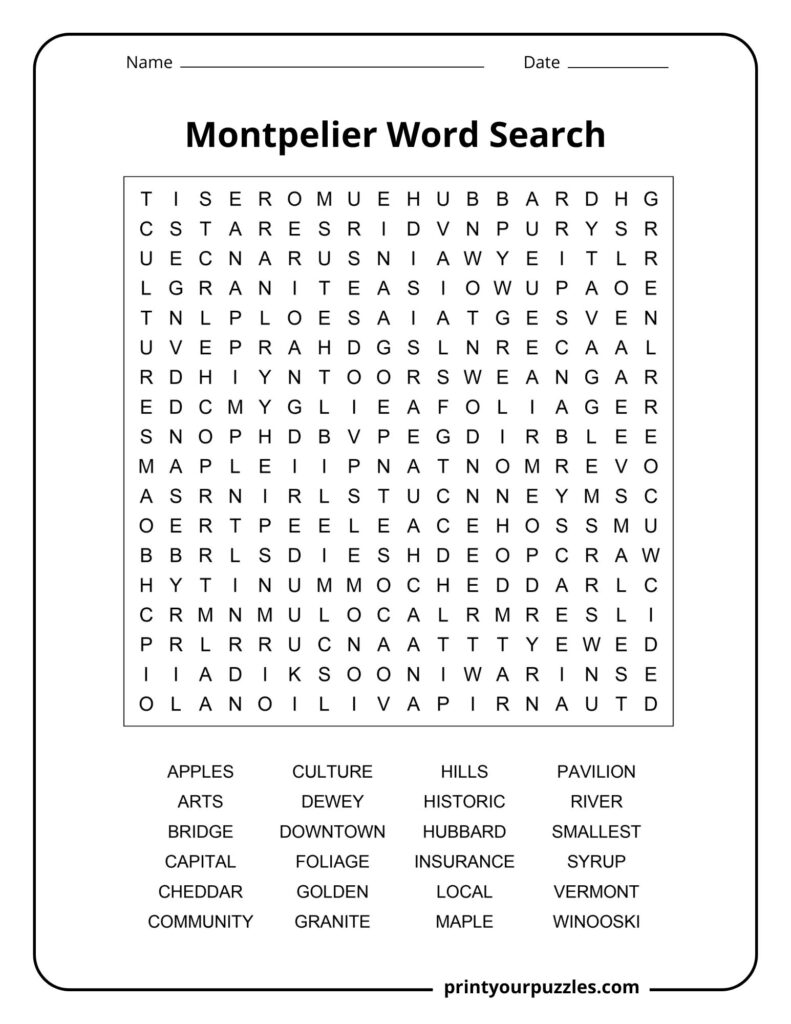
APPLES, ARTS, BRIDGE, CAPITAL, CHEDDAR, COMMUNITY, CULTURE, DEWEY, DOWNTOWN, FOLIAGE, GOLDEN, GRANITE, HILLS, HISTORIC, HUBBARD, INSURANCE, LOCAL, MAPLE, PAVILION, RIVER, SMALLEST, SYRUP, VERMONT, WINOOSKI
APPLES – Vermont is known for apple orchards, with many farms near Montpelier producing heirloom varieties. Apple cider and fresh apples are autumn staples in the region.
ARTS – Montpelier boasts a vibrant arts community with galleries, theaters like Lost Nation Theater, and the Vermont College of Fine Arts attracting creative professionals and students.
BRIDGE – Several historic covered bridges span waterways near Montpelier, representing Vermont’s iconic architecture and serving as popular tourist attractions and community landmarks throughout the region.
CAPITAL – Montpelier serves as Vermont’s state capital since 1805, hosting the State House with its distinctive golden dome and serving as the political center of Vermont.
CHEDDAR – Vermont’s signature sharp cheddar cheese, produced by local dairies and cheesemakers, represents the state’s strong agricultural heritage and artisanal food culture throughout the Montpelier area.
COMMUNITY – Montpelier’s tight-knit community emphasizes local engagement, farmer’s markets, town meetings, and collaborative spirit that defines small-city Vermont life and participatory democracy at its finest.
CULTURE – The city’s rich cultural scene includes independent bookstores, farm-to-table restaurants, music venues, festivals, and progressive values that shape Montpelier’s unique character and appeal.
DEWEY – Admiral George Dewey, Spanish-American War hero, was born in Montpelier. His childhood home still stands, commemorating this nationally significant military figure from Vermont.
DOWNTOWN – Montpelier’s walkable downtown features State Street lined with independent shops, cafes, restaurants, and historic buildings, creating a charming New England urban center atmosphere.
FOLIAGE – Each autumn, Montpelier’s surrounding hills explode with brilliant red, orange, and yellow leaves, attracting tourists worldwide to witness Vermont’s spectacular fall foliage displays.
GOLDEN – The Vermont State House features a brilliant golden dome topped with a statue of Ceres, goddess of agriculture, visible throughout Montpelier and symbolizing prosperity.
GRANITE – Vermont’s granite industry historically shaped Montpelier’s economy. Granite from Barre quarries nearby built many of the city’s beautiful, enduring historic structures and monuments.
HILLS – Montpelier nestles in a valley surrounded by rolling green
hills, creating scenic vistas and defining the city’s picturesque geography within Vermont’s Green Mountains region.
HISTORIC – Montpelier preserves numerous 18th and 19th-century buildings, including the State House, creating a living museum of Vermont’s architectural and political history throughout downtown.
HUBBARD – Hubbard Park offers 185 acres of hiking trails, a stone observation tower, and recreational space overlooking Montpelier, serving as the city’s beloved natural retreat.
INSURANCE – National Life Group and other insurance companies have maintained significant presence in Montpelier, making insurance a major employer and economic driver for the capital.
LOCAL – Montpelier emphasizes supporting local businesses, farmers, artisans, and producers, fostering a sustainable economy and strong sense of community pride and self-reliance throughout the region.
MAPLE – Sugar maple trees blanket Vermont’s landscape. Montpelier celebrates maple syrup production, with local sugarhouses offering tours during spring’s sweet maple sugaring season.
PAVILION – The Montpelier City Hall Arts Center features a pavilion-style architecture, hosting community events, performances, and gatherings that bring residents together throughout the year.
RIVER – The Winooski River flows through Montpelier, powering early mills, shaping the city’s development, and providing recreation while occasionally threatening the downtown with significant flooding.
SMALLEST – Montpelier holds the distinction of being America’s smallest state capital by population, with approximately 8,000 residents, yet serving fully as Vermont’s governmental center.
SYRUP – Pure Vermont maple syrup, produced from sugar
maples each spring, represents the state’s agricultural tradition and remains a prized local product near Montpelier.
VERMONT – The Green Mountain State is characterized by progressive politics, environmental consciousness, rural beauty, and fierce independence, all embodied in its capital city
Montpelier.
WINOOSKI – The Winooski River runs through Montpelier, providing scenic beauty, recreational opportunities, and historical significance as the waterway that powered the city’s early industrial development.
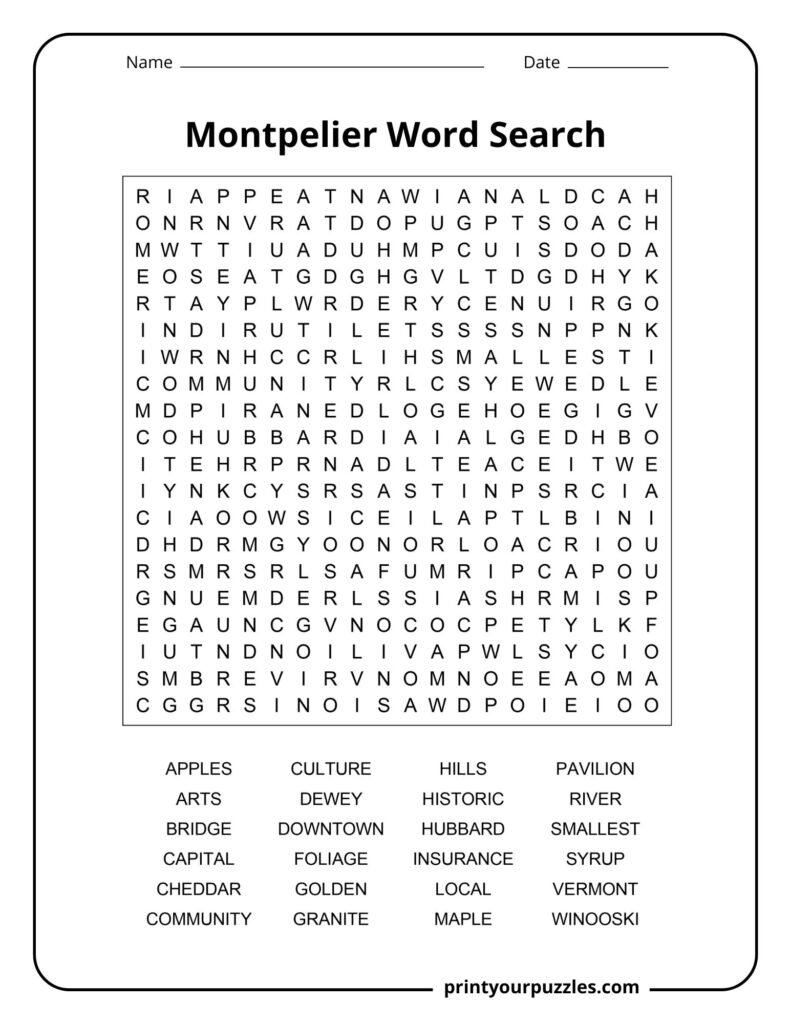
APPLES, ARTS, BRIDGE, CAPITAL, CHEDDAR, COMMUNITY, CULTURE, DEWEY, DOWNTOWN, FOLIAGE, GOLDEN, GRANITE, HILLS, HISTORIC, HUBBARD, INSURANCE, LOCAL, MAPLE, PAVILION, RIVER, SMALLEST, SYRUP, VERMONT, WINOOSKI
Montpelier is the smallest state capital in the United States by population, with approximately 8,000 residents. It’s also the only state capital without a McDonald’s restaurant.
The Vermont State House features a stunning golden dome topped with a statue of Ceres, the Roman goddess of agriculture. This Greek Revival building has served Vermont since 1859.
Visit the State House, explore Hubbard Park’s hiking trails, stroll downtown’s independent shops and restaurants, tour the Vermont History Museum, and enjoy seasonal events like farmers’ markets.
Fall offers spectacular foliage displays with vibrant autumn colors. Spring features maple sugaring season, while summer provides warm weather for outdoor activities and winter offers skiing nearby.
Government employment dominates as the state capital. Insurance companies like National Life Group provide significant jobs. Tourism, education, healthcare, and local artisanal businesses also contribute substantially.
For official city information, government updates, and public services, visit the City of Montpelier website. If you are planning a trip, check out the official tourism portal, Montpelier Alive.
The city has deliberately maintained its independent, local business character, resisting chain restaurants. This reflects Montpelier’s commitment to supporting small businesses and preserving its unique community identity.
Dewey achieved fame commanding the U.S. fleet at Manila Bay in 1898. His Montpelier birthplace still stands today, commemorating Vermont’s connection to this celebrated naval officer.
The Winooski River has flooded downtown multiple times, most notably in 1927 and 1992. Tropical Storm Irene in 2011 caused massive damage, submerging State Street underwater.
The iconic golden dome requires periodic restoration using approximately 3,300 sheets of 23-karat gold leaf. This gleaming landmark symbolizes Vermont’s prosperity and remains visible throughout the city.
Until recently, Montpelier was one of few state capitals managing traffic flow without signals, relying on stop signs. This reflected the city’s small size and commitment to simpler living.