
Some presidencies are remembered because they solved problems. Others are remembered because the problems grew worse. Franklin Pierce (1853–1857) entered the White House hoping to reduce sectional conflict, but his time in office helped push the United States closer to civil war. His presidency shows how one law, one political decision, or one failed compromise can change the direction of a country. The Franklin Pierce word search gives students a way to explore a difficult but important chapter in American history.
Pierce came from New Hampshire and built his career as a lawyer, congressman, senator, and military officer during the Mexican-American War. In 1852, the Democratic Party chose him partly because he seemed acceptable to different wings of the party. Many Americans wanted to believe that the Compromise of 1850 had settled the slavery debate, at least for a while. Pierce’s presidency revealed that this hope was fragile.
The most important and controversial event of his administration was the Kansas-Nebraska Act of 1854. This law allowed settlers in Kansas and Nebraska to decide for themselves whether slavery would be permitted, a principle known as popular sovereignty. It also effectively overturned the Missouri Compromise line, which had limited slavery in part of the western territories for decades.
Instead of calming the country, the Kansas-Nebraska Act inflamed it. Pro-slavery and anti-slavery settlers rushed into Kansas, leading to violence known as “Bleeding Kansas.” The conflict became a warning sign of the larger war that would later divide the nation. The law also helped destroy the Whig Party and encouraged the rise of the Republican Party, which opposed the expansion of slavery into new territories.
Foreign policy during Pierce’s presidency reflected expansionist ambitions. The Gadsden Purchase added land in the Southwest, later important for a possible southern railroad route. Other ideas, including interest in Cuba, showed that many leaders still imagined the United States growing in size and influence. But domestic conflict over slavery overshadowed much of his administration.
This Franklin Pierce word search examines popular sovereignty, the Kansas-Nebraska Act, Bleeding Kansas, expansion, party division, and the growing crisis before the Civil War. Pierce wanted to preserve national unity, but his presidency demonstrates how avoiding the deepest issue of the age made division even more dangerous.
Keep exploring the presidents before the Civil War with our Millard Fillmore word search, James Buchanan word search, Andrew Johnson word search, and the full US Presidents Word Searches collection.
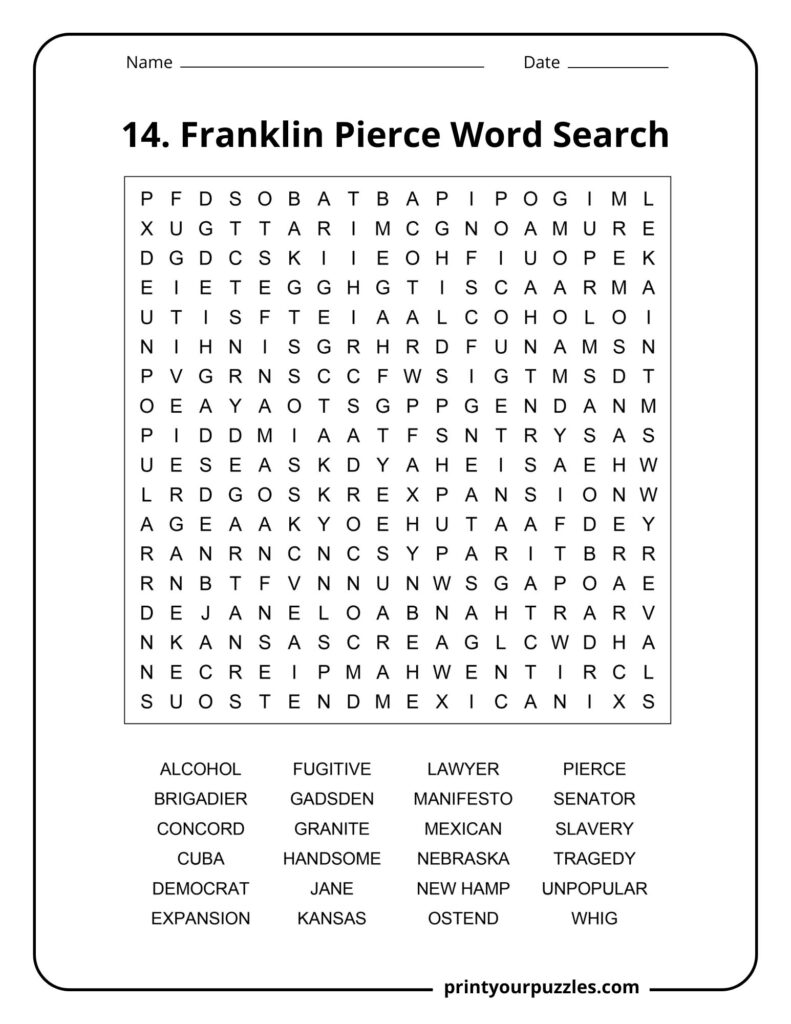
ALCOHOL, BRIGADIER, CONCORD, CUBA, DEMOCRAT, EXPANSION, FUGITIVE, GADSDEN, GRANITE, HANDSOME, JANE, KANSAS, LAWYER, MANIFESTO, MEXICAN, NEBRASKA, NEW, HAMP, OSTEND, PIERCE, SENATOR, SLAVERY, TRAGEDY, UNPOPULAR, WHIG
ALCOHOL – Pierce struggled with alcoholism throughout his life, which worsened after personal tragedies. His drinking affected his presidency and contributed to his reputation as an ineffective leader.
BRIGADIER – Pierce served as a brigadier general during the Mexican-American War, though his military service was marked by controversy and injuries. This rank boosted his political profile.
CONCORD – New Hampshire’s capital city where Pierce lived and practiced law. He served as a prominent political figure in Concord before becoming president in 1853.
CUBA – Pierce’s administration aggressively pursued acquiring Cuba from Spain, reflecting his expansionist goals. The controversial Ostend Manifesto proposed purchasing or seizing the island to extend slavery.
DEMOCRAT – Pierce was a loyal member of the Democratic Party, serving as a compromise candidate in 1852. He represented the party’s pro-slavery Northern wing during divisive times.
EXPANSION – Pierce strongly supported territorial expansion, particularly into Latin America and the Caribbean. His administration completed the Gadsden Purchase and pursued additional acquisitions to extend American influence.
FUGITIVE – Pierce strictly enforced the Fugitive Slave Act of 1850, requiring Northern states to return escaped slaves. This enforcement deeply angered abolitionists and increased sectional tensions.
GADSDEN – The Gadsden Purchase of 1854 acquired land from Mexico for a southern transcontinental railroad route. This was Pierce’s most successful territorial acquisition, adding portions of Arizona and New Mexico.
GRANITE – New Hampshire’s nickname is the Granite State, referring to Pierce’s home state’s extensive granite formations and quarries. Pierce embodied this connection to his native New Hampshire.
HANDSOME – Pierce was considered the most handsome president of his era, with striking features and an impressive physical presence. His appearance initially helped his political appeal.
JANE – Jane Means Appleton Pierce was Franklin’s wife, a deeply religious woman who opposed his political career. Their marriage was marked by profound grief and personal tragedy.
KANSAS – The Kansas-Nebraska Act of 1854, which Pierce
championed, allowed territories to decide on slavery through popular sovereignty. This led to violent conflict known as “Bleeding Kansas.”
LAWYER – Pierce practiced law in New Hampshire before entering politics, establishing a successful legal career. His legal background prepared him for legislative and executive service in government.
MANIFESTO – The Ostend Manifesto of 1854 was a secret diplomatic memo proposing the United States purchase or forcibly take Cuba from Spain to expand slavery’s reach southward.
MEXICAN – Pierce served in the Mexican-American War as a brigadier general under Winfield Scott. His military experience, though controversial, helped launch his path to the presidency.
NEBRASKA – The Kansas-Nebraska Act organized Nebraska
Territory and repealed the Missouri Compromise, allowing popular sovereignty on slavery. This legislation proved disastrous for Pierce’s legacy and national unity.
NEW HAMP – New Hampshire was Pierce’s home state, where he built his political career serving as state legislator, congressman, and senator before becoming America’s fourteenth president.
OSTEND – The Ostend Manifesto was drafted in Ostend, Belgium, by American diplomats advocating Cuba’s annexation. When leaked publicly, it embarrassed Pierce’s administration and sparked Northern outrage.
PIERCE – Franklin Pierce served as the fourteenth president from 1853 to 1857. His presidency is considered one of America’s worst due to policies that accelerated the path toward Civil War.
SENATOR – Pierce served as United States Senator from New Hampshire from 1837 to 1842. He resigned from the Senate, claiming to focus on family and his law practice.
SLAVERY – Slavery dominated Pierce’s presidency as he supported pro-slavery policies, enforced the Fugitive Slave Act, and backed territorial expansion to extend the institution westward and southward.
TRAGEDY – Pierce endured devastating personal losses: all three children died young, including his son Benjamin killed in a train accident shortly before his presidential inauguration in 1853.
UNPOPULAR – Pierce became deeply unpopular during his
presidency due to pro-slavery policies and sectional violence. His own party denied him renomination, making him a one-term president.
WHIG – The Whig Party opposed Pierce and the Democrats, though it collapsed during Pierce’s presidency over slavery divisions. Former Whigs later formed the anti-slavery Republican Party.
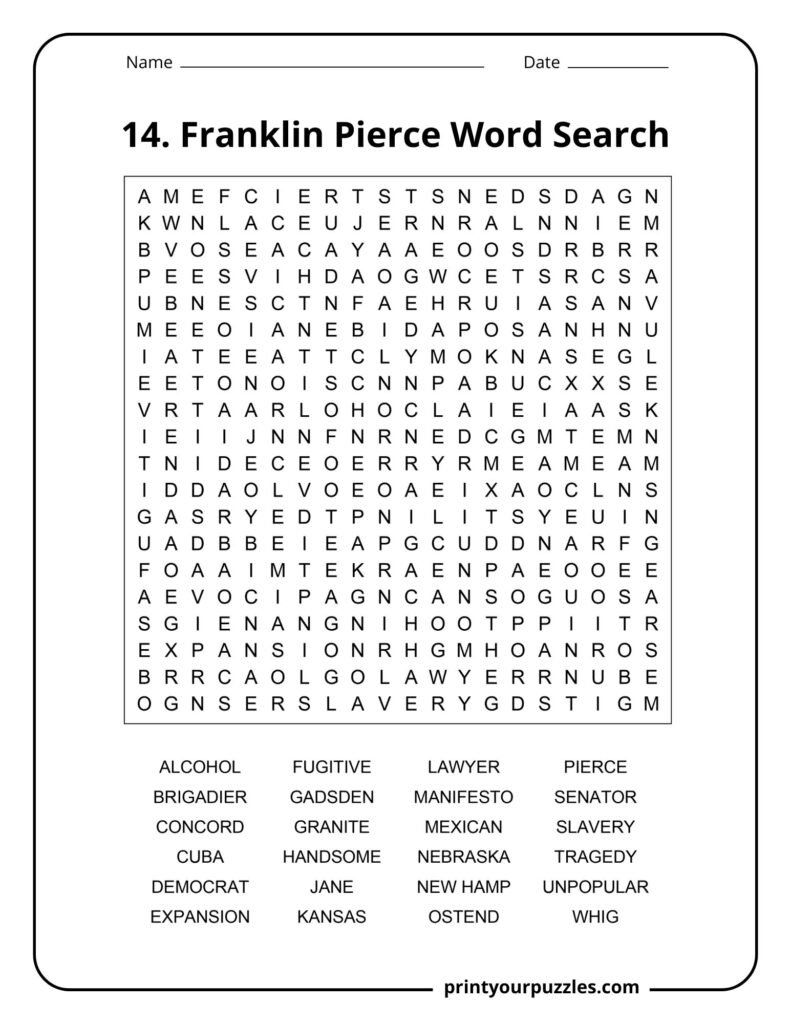
ALCOHOL, BRIGADIER, CONCORD, CUBA, DEMOCRAT, EXPANSION, FUGITIVE, GADSDEN, GRANITE, HANDSOME, JANE, KANSAS, LAWYER, MANIFESTO, MEXICAN, NEBRASKA, NEW, HAMP, OSTEND, PIERCE, SENATOR, SLAVERY, TRAGEDY, UNPOPULAR, WHIG
Pierce’s pro-slavery policies, support for the Kansas-Nebraska Act, and enforcement of the Fugitive Slave Act intensified sectional divisions, accelerating the nation toward Civil War and earning him lasting historical condemnation.
All three of Pierce’s children died young. Most devastating was eleven-year-old Benjamin’s death in a train accident just weeks before Pierce’s presidential inauguration, which traumatized both Franklin and Jane.
Pierce’s signature legislation allowed Kansas and Nebraska territories to decide slavery through popular sovereignty, repealing the Missouri Compromise. This triggered violent conflict called “Bleeding Kansas” and destroyed sectional peace.
Though from New Hampshire, Pierce strongly supported slavery and Southern interests. He enforced the Fugitive Slave Act, backed slavery’s territorial expansion, and believed Northern abolitionists threatened national unity and constitutional order.
Pierce’s Democratic Party denied him renomination in 1856. He retired to New Hampshire, where alcoholism worsened and he became increasingly isolated. He died in 1869, largely forgotten and unappreciated.
For official administration records and historical biography, visit the Franklin Pierce page in the White House Archives. If you are planning a trip, visit the official Pierce Manse.
Franklin Pierce: New Hampshire’s Favorite Son by Peter A. Wallner. A sympathetic two-volume work exploring a tragic figure devastated by personal loss, whose presidency accelerated the nation toward civil war.
Pierce memorized his 3,319-word inaugural speech without using notes, the longest address delivered entirely from memory. This impressive feat demonstrated his oratorical skills and mental preparation.
Pierce and Nathaniel Hawthorne became lifelong friends at Bowdoin College. Hawthorne later wrote Pierce’s campaign biography, and Pierce appointed him as consul to Liverpool, England during his presidency.
While president, Pierce accidentally struck a woman with his horse in Washington DC. He was briefly arrested but charges were dropped. The incident added to his troubled presidency’s controversies.
Jane Pierce despised politics and hoped her husband would lose. When she learned of his nomination and victory, she fainted from shock and remained depressed throughout his presidency.
After leaving office, Pierce criticized President Lincoln’s policies and defended states’ rights to secede. His Confederate sympathies made him extremely unpopular in the North during wartime.