
Chester A. Arthur (1881–1885) surprised many Americans. Before becoming president, he was closely connected to New York political machines and the spoils system, where government jobs were often given as rewards for party loyalty. Few people expected him to become a serious reformer. Yet after the assassination of James A. Garfield, Arthur entered the White House and helped support one of the most important changes in federal employment. The Chester A. Arthur word search gives students a chance to study a president whose reputation changed while he was in office.
Arthur’s rise to national leadership came through party politics. He worked as a lawyer, supported the Union during the Civil War, and became an important Republican figure in New York. For years, he was associated with Senator Roscoe Conkling and the Stalwart faction of the Republican Party, which defended the traditional system of political appointments. When Arthur became vice president in 1881, many reformers viewed him with suspicion.
Everything changed after Garfield was shot by Charles Guiteau, a disappointed office seeker who believed he deserved a government position. Garfield’s death made the spoils system look dangerous and outdated. Arthur, who had benefited from that political world, now faced pressure to support reform. To the surprise of many critics, he signed the Pendleton Civil Service Reform Act in 1883. This law created a merit-based system for some federal jobs and helped reduce the influence of political favoritism.
Arthur’s presidency also included other important issues. His administration worked to modernize the U.S. Navy, supported tariff discussions, and tried to manage the growing responsibilities of the federal government during the Gilded Age. These topics showed that the United States was becoming more industrial, more connected, and more demanding to govern.
His record on immigration was more troubling. Arthur signed the Chinese Exclusion Act, which severely restricted Chinese immigration and reflected the prejudice and discrimination of the period. This law remains a controversial part of his legacy and an important reminder that reform in one area did not mean justice in all areas.
Although Arthur was not nominated for another term, he left office with more respect than many expected. This Chester A. Arthur word search looks at political machines, civil service reform, immigration, the navy, tariffs, and the changing federal government. Arthur’s presidency shows that historical reputations can shift when leaders respond differently than people expect.
Keep learning about the Gilded Age and Progressive Era Presidents with our James A. Garfield word search, Grover Cleveland 22nd President word search, Benjamin Harrison word search, and the full US Presidents Word Searches collection.
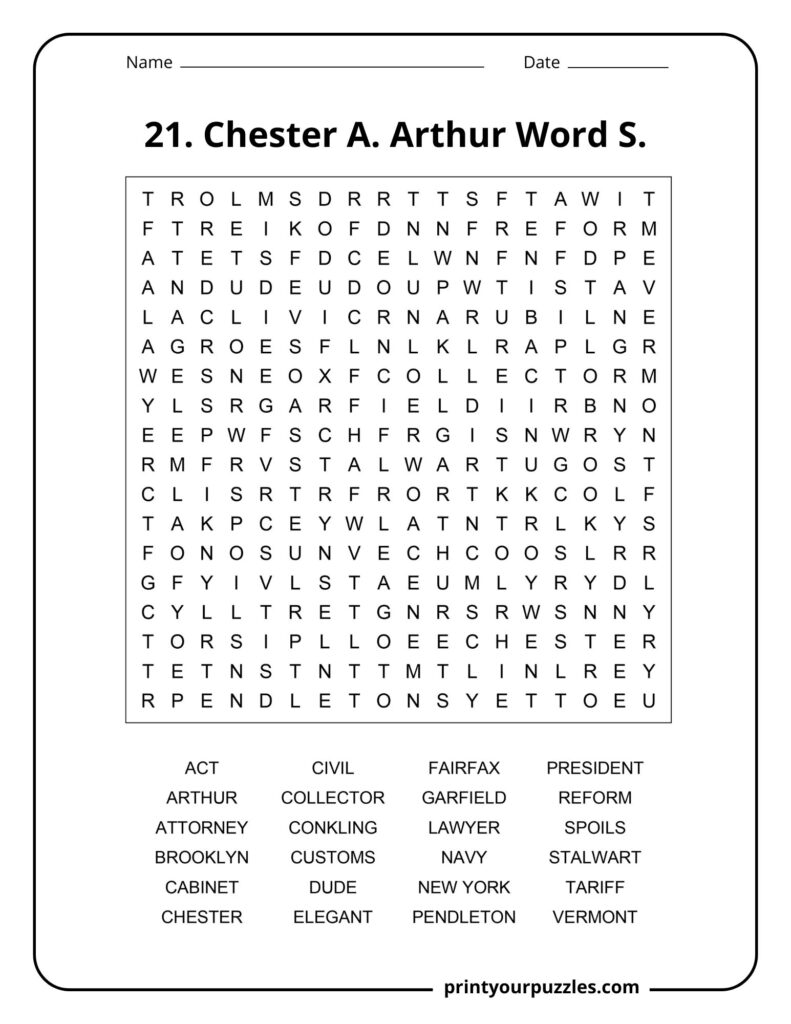
ACT, ARTHUR, ATTORNEY, BROOKLYN, CABINET, CHESTER, CIVIL, COLLECTOR, CONKLING, CUSTOMS, DUDE, ELEGANT, FAIRFAX, GARFIELD, LAWYER, NAVY, NEW YORK, PENDLETON, PRESIDENT, REFORM, SPOILS, STALWART, TARIFF, VERMONT
ACT – Refers to the Pendleton Civil Service Reform Act of 1883, landmark legislation signed by Arthur that established merit-based federal employment, ending the spoils system.
ARTHUR – Chester Alan Arthur, 21st President of the United States (1881-1885), who assumed office after President Garfield’s assassination and championed civil service reform.
ATTORNEY – Arthur’s original profession; he practiced law in New York City, notably defending Elizabeth Jennings in an early civil rights case involving streetcar segregation.
BROOKLYN – New York borough where Arthur lived and practiced law before his political career, establishing himself as a prominent Republican attorney and community member.
CABINET – Arthur’s presidential advisory group; he inherited Garfield’s cabinet initially but eventually appointed his own trusted advisors to guide his administration’s policies.
CHESTER – Arthur’s first name, given at birth in Vermont; he was named Chester Alan Arthur and often went by his full name throughout life.
CIVIL – Refers to civil service reform, Arthur’s greatest presidential achievement, transforming federal employment from political patronage to merit-based selection through examination.
COLLECTOR – Arthur served as Collector of the New York Customs House, a powerful patronage position controlling thousands of jobs before President Hayes removed him.
CONKLING – Roscoe Conkling, powerful New York Senator and Arthur’s political mentor who led the Stalwart faction favoring patronage; their relationship cooled during Arthur’s presidency.
CUSTOMS – The New York Customs House, where Arthur served as collector, was the nation’s largest federal revenue source and center of political patronage operations.
DUDE – Arthur earned the nickname “Dude President” for his fashionable wardrobe, elegant appearance, and refined tastes, owning over eighty pairs of trousers.
ELEGANT – Describes Arthur’s refined personal style and taste; he was known for sophisticated entertaining, fine clothing, and renovating the White House with Tiffany designs.
FAIRFAX – Arthur’s middle name, though officially his middle initial was “A”; there’s historical debate about whether it stood for Alan, Alban, or Almerin.
GARFIELD – James A. Garfield, 20th President, whose assassination by Charles Guiteau in 1881 elevated Vice President Arthur to the presidency unexpectedly.
LAWYER – Arthur’s primary profession before politics; he practiced in New York, handling commercial cases and civil rights matters, establishing his professional reputation.
NAVY – Arthur modernized the U.S. Navy during his presidency, authorizing construction of steel warships that began transforming America into a modern naval power.
NEW YORK – Arthur’s home state and political base; he rose through New York Republican ranks, serving in state positions before becoming vice president.
PENDLETON – The Pendleton Civil Service Reform Act of 1883, Arthur’s signature achievement, establishing competitive examinations for federal jobs and reducing political patronage.
PRESIDENT – Arthur served as the 21st President from 1881 to 1885, assuming office after Garfield’s assassination and surprising critics by governing independently and honorably.
REFORM – Arthur championed civil service reform despite his patronage background, signing the Pendleton Act and pursuing tariff reform, defying his Stalwart political allies.
SPOILS – The spoils system distributed government jobs based on political loyalty rather than merit; Arthur helped dismantle this through civil service reform legislation.
STALWART – Faction of the Republican Party led by Conkling favoring patronage; Arthur was initially a Stalwart but governed more independently as president.
TARIFF – Arthur attempted tariff reform to reduce excessive rates, though Congress only made modest reductions; protective tariffs remained controversial throughout his presidency.
VERMONT – Arthur’s birthplace; he was born in Fairfield, Vermont in 1829, though he spent most of his adult life in New York City.
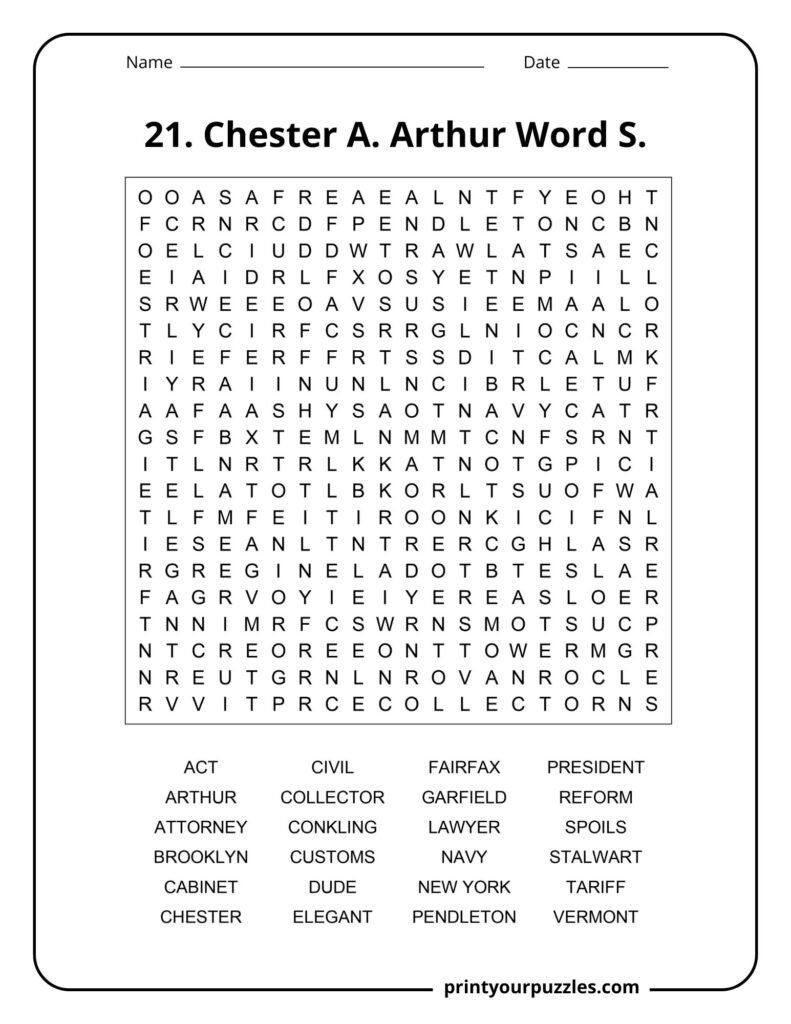
ACT, ARTHUR, ATTORNEY, BROOKLYN, CABINET, CHESTER, CIVIL, COLLECTOR, CONKLING, CUSTOMS, DUDE, ELEGANT, FAIRFAX, GARFIELD, LAWYER, NAVY, NEW YORK, PENDLETON, PRESIDENT, REFORM, SPOILS, STALWART, TARIFF, VERMONT
Arthur became president after James Garfield’s assassination in 1881. As vice president, he assumed office on September 19, 1881, when Garfield died from gunshot wounds.
Arthur’s signature achievement was signing the Pendleton Civil Service Reform Act in 1883, which established merit-based federal employment and ended the corrupt spoils system of political patronage.
Arthur earned this nickname for his impeccable fashion sense and elegant lifestyle. He owned over eighty pairs of trousers and was considered the most stylish president of his era.
Arthur served as Collector of the New York Customs House and was a leader in New York’s Republican political machine, allied with Senator Roscoe Conkling’s Stalwart faction.
Arthur wanted the Republican nomination but lost to James G. Blaine. He was suffering from fatal kidney disease, kept secret from the public, and died in 1886.
For official administration records and historical biography, visit the Chester A. Arthur page in the White House Archives. For historical information, check out the Chester Arthur State Historic Site.
The Unexpected President: The Life and Times of Chester A. Arthur by Scott S. Greenberger. Reveals how a corrupt political operative transformed himself into a reform-minded president who surprised everyone, including his own party.
Arthur ordered nearly all his personal and official papers destroyed, leaving historians with limited documentation about his private thoughts, motivations, and behind-the-scenes presidential decisions.
Arthur considered the White House furnishings outdated and shabby. He held a public auction selling twenty-four wagonloads of furniture before hiring Louis Comfort Tiffany to redecorate lavishly.
As a young lawyer in 1854, Arthur represented Elizabeth Jennings, who was forcibly removed from a New York streetcar, winning her case and helping desegregate the city’s transportation.
Arthur suffered from Bright’s disease but concealed his declining health from the public. He knew he was dying, which influenced his decision not to campaign vigorously for re-election.
Arthur kept unconventional hours, often working until 2 or 3 a.m., then sleeping late into the morning. He preferred entertaining guests with elegant late-night dinners and conversations.