Introduction to the John F. Kennedy Word Search
John F. Kennedy (1961–1963) brought a sense of youth, style, and possibility to the presidency. When he took office in 1961, he became the youngest person ever elected president of the United States, and many Americans saw him as the face of a new generation. His speeches spoke of service, courage, science, and national purpose. Yet behind that hopeful image, Kennedy’s presidency unfolded during one of the most dangerous periods of the Cold War. The John F. Kennedy word search gives students a way to explore both the promise and pressure of the early 1960s.
Kennedy came from a wealthy and powerful Massachusetts family with deep political connections. He served in the U.S. Navy during World War II and became known for his leadership after his patrol boat, PT-109, was sunk in the Pacific. Later, he represented Massachusetts in Congress and the Senate before narrowly defeating Richard Nixon in the election of 1960. That campaign, shaped by television debates and Cold War concerns, helped modernize presidential politics.
Foreign policy quickly tested Kennedy. The failed Bay of Pigs invasion in Cuba damaged his administration early, but the Cuban Missile Crisis in 1962 became the defining moment of his presidency. For thirteen tense days, the United States and the Soviet Union came dangerously close to nuclear war after Soviet missiles were discovered in Cuba. Kennedy’s careful response helped avoid catastrophe, while also showing the terrifying risks of Cold War confrontation.
At home, Kennedy promoted a program he called the New Frontier. He supported tax cuts, space exploration, civil rights, and economic growth. His famous goal of landing an American on the Moon helped inspire the space race, even though the achievement came after his death. The Peace Corps, created during his presidency, also reflected his call for service and international cooperation.
On civil rights, Kennedy gradually moved toward stronger federal support, especially as protests and violence revealed the urgency of racial injustice. His administration faced pressure from activists who wanted faster action, and the civil rights bill he supported would later become law under Lyndon B. Johnson.
Kennedy was assassinated in Dallas, Texas, on November 22, 1963. His death shocked the world and left many of his goals unfinished. This John F. Kennedy word search examines television politics, the Cold War, Cuba, space exploration, civil rights, public service, and the difficult balance between hope and danger in modern American history.
Continue into the Civil Rights, Vietnam, and Watergate Presidents with our Lyndon B. Johnson word search, Richard Nixon word search, Gerald Ford word search, and the full US Presidents Word Searches collection.
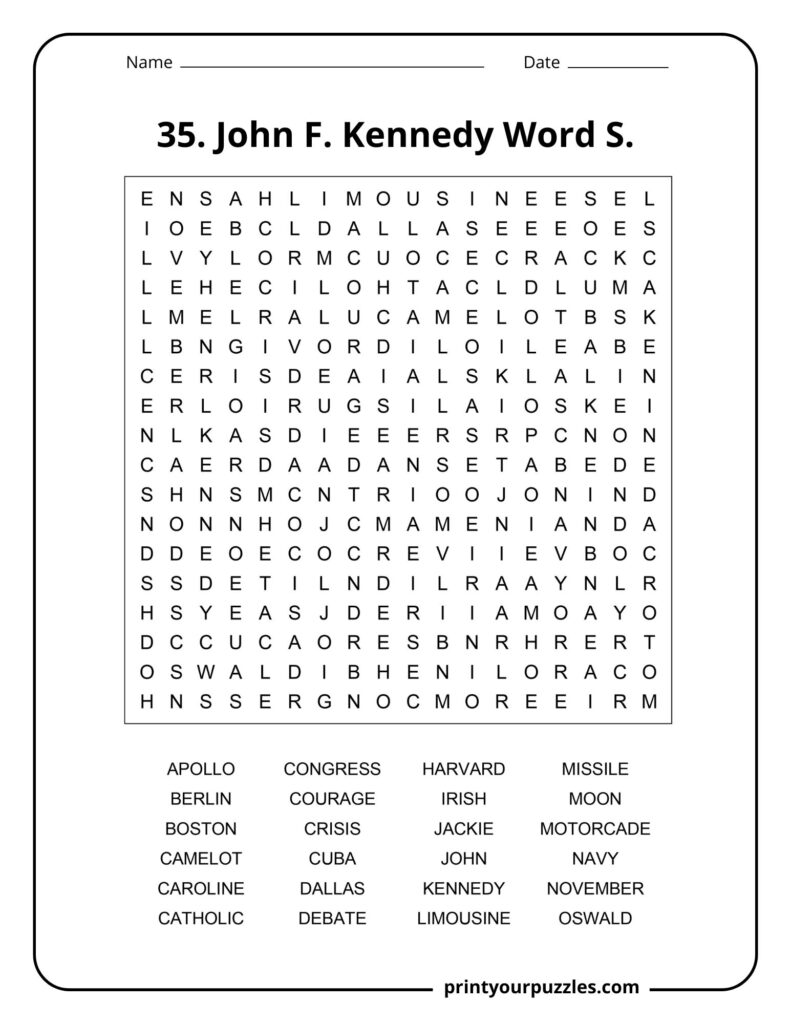
Medium Difficulty Word Search
Words to Find:
APOLLO, BERLIN, BOSTON, CAMELOT, CAROLINE, CATHOLIC, CONGRESS, COURAGE, CRISIS, CUBA, DALLAS, DEBATE, HARVARD, IRISH, JACKIE, JOHN, KENNEDY, LIMOUSINE, MISSILE, MOON, MOTORCADE, NAVY, NOVEMBER, OSWALD
All Words Defined
APOLLO – NASA’s space program that aimed to land humans on the moon, initiated under Kennedy’s administration with his famous 1961 commitment to lunar exploration.
BERLIN – German city where Kennedy delivered his famous “Ich bin ein Berliner” speech in 1963, expressing solidarity with West Berliners during the Cold War.
BOSTON – Massachusetts city where Kennedy was born in 1917 and launched his political career, representing the state in Congress and Senate before his presidency.
CAMELOT – Mythical kingdom used to describe Kennedy’s presidency, symbolizing an idealized era of elegance, culture, and optimism in American politics and society.
CAROLINE – Kennedy’s daughter, born in 1957, who became the first young child to live in the White House since Theodore Roosevelt’s administration.
CATHOLIC – Kennedy was the first Roman Catholic president, facing religious prejudice during his campaign but ultimately breaking this significant barrier in American politics.
CONGRESS – Legislative body where Kennedy served as Representative (1947-1953) and Senator (1953-1961) from Massachusetts before becoming president in 1961.
COURAGE – Reference to Kennedy’s Pulitzer Prize-winning book “Profiles in Courage,” published in 1956, examining senators who showed integrity under political pressure.
CRISIS – Term associated with Kennedy’s presidency, particularly the Cuban Missile Crisis of 1962, when nuclear war with the Soviet Union was narrowly averted.
CUBA – Caribbean island nation central to Kennedy’s presidency, including the Bay of Pigs invasion failure and the tense Cuban Missile Crisis standoff.
DALLAS – Texas city where President Kennedy was assassinated on November 22, 1963, while riding in a motorcade through Dealey Plaza with Governor Connally.
DEBATE – Reference to the groundbreaking televised presidential debates in 1960 against Richard Nixon, which significantly influenced Kennedy’s electoral victory and modern campaigning.
HARVARD – Prestigious university Kennedy attended, graduating in 1940 with a thesis on British appeasement that later became the book “Why England Slept.”
IRISH – Kennedy’s ancestral heritage; he was of Irish-Catholic descent, with great-grandparents who emigrated from Ireland during the 1840s famine era.
JACKIE – Jacqueline Kennedy, his elegant and cultured wife who became a beloved First Lady, known for restoring the White House and championing arts.
JOHN – Kennedy’s first name, often abbreviated as JFK; he was named John Fitzgerald Kennedy after his maternal grandfather, Boston Mayor John Fitzgerald.
KENNEDY – The prominent Irish-American political family dynasty, including President John F. Kennedy, his brothers Robert and Edward, and subsequent generations in public service.
LIMOUSINE – The presidential Lincoln Continental convertible in which Kennedy was riding when assassinated, a vehicle that became tragically iconic in American history.
MISSILE – Refers to the Cuban Missile Crisis of October 1962, when Soviet nuclear missiles discovered in Cuba brought the world closest to nuclear war.
MOON – Kennedy’s ambitious goal, announced in 1961, to land Americans on the moon before decade’s end, achieved by Apollo 11 in 1969.
MOTORCADE – Presidential procession of vehicles traveling through Dallas on November 22, 1963, during which Kennedy was fatally shot while greeting crowds.
NAVY – Military branch where Kennedy served heroically during World War II, commanding PT-109 and saving crew members after a Japanese destroyer collision.
NOVEMBER – Month of Kennedy’s assassination in 1963; he was shot on November 22nd in Dallas, shocking the nation and world profoundly.
OSWALD – Lee Harvey Oswald, the man arrested for assassinating President Kennedy; he was himself killed by Jack Ruby two days later.
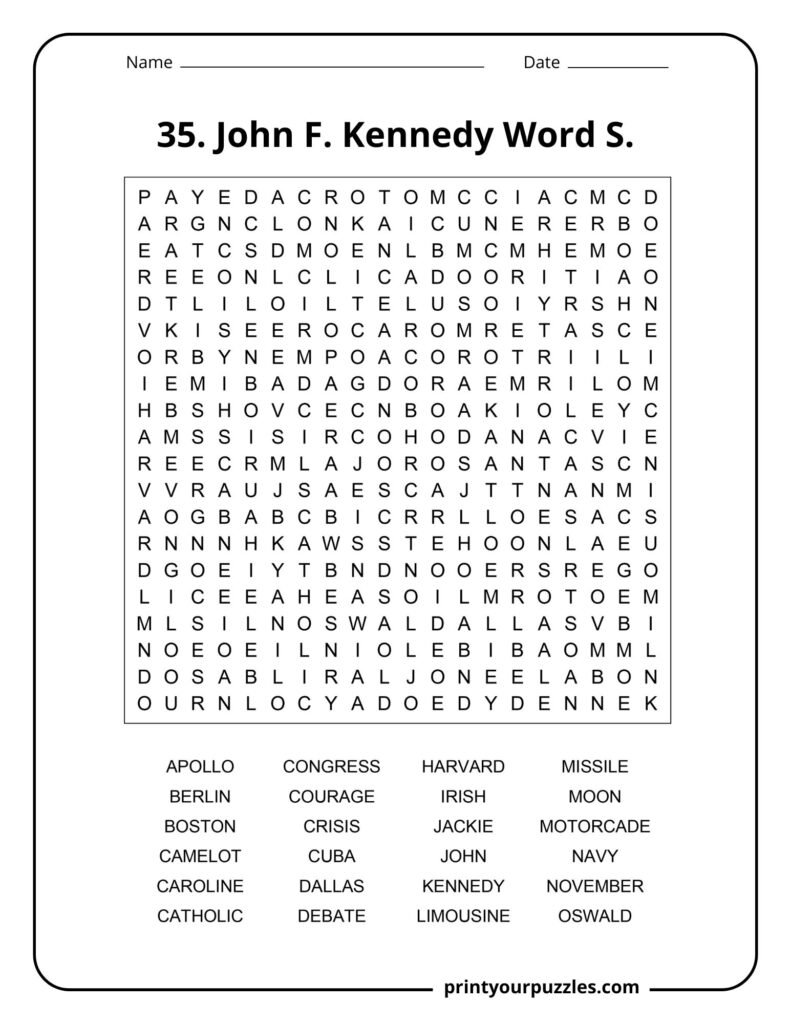
Hard Difficulty Word Search
Words to Find:
APOLLO, BERLIN, BOSTON, CAMELOT, CAROLINE, CATHOLIC, CONGRESS, COURAGE, CRISIS, CUBA, DALLAS, DEBATE, HARVARD, IRISH, JACKIE, JOHN, KENNEDY, LIMOUSINE, MISSILE, MOON, MOTORCADE, NAVY, NOVEMBER, OSWALD
7 Key FAQs About John F. Kennedy
5 Curious "Did You Know?" Facts About John F. Kennedy