
This Civil War Battles word search takes you back to one of the most defining conflicts in American history. Fought between 1861 and 1865, the Civil War divided the United States into two opposing forces: the Union in the North and the Confederacy in the South. The conflict erupted over deep disagreements about slavery, states’ rights, and the future direction of the nation.
Battles raged across vast territories, from Virginia and Pennsylvania in the eastern theater to Tennessee, Mississippi, and Arkansas in the west. Iconic engagements like Antietam, Shiloh, and Vicksburg shaped the course of the war, while advances in weaponry and tactics made combat deadlier than anything previously witnessed on American soil. Millions of soldiers fought, and over 600,000 lost their lives before the Confederacy finally surrendered in 1865.
This Civil War Battles word search features 24 carefully selected words, including famous battle sites, military terms, and key vocabulary from the conflict. Each word connects you to a pivotal moment or concept from this transformative era.
To make this word search printable resource more educational, you will also find detailed definitions for all 24 words, five frequently asked questions covering essential facts, and a fascinating Did You Know? section. For instance, did you know that the Battle of Gettysburg reportedly started over a search for shoes?
Whether you are a student, a history enthusiast, or a teacher looking for a Civil War Battles word search printable, this puzzle offers an engaging and informative way to explore the battles that reshaped a nation.
This is the third in our series of 6 word searches about the Civil War. Also explore Civil War, Civil War Causes, Civil War Generals, Civil War Women, and Reconstruction Era!
Related Word Searches:
Civil War | Abraham Lincoln | Emancipation Proclamation | Reconstruction Era | Harriet Tubman | Ulysses S. Grant
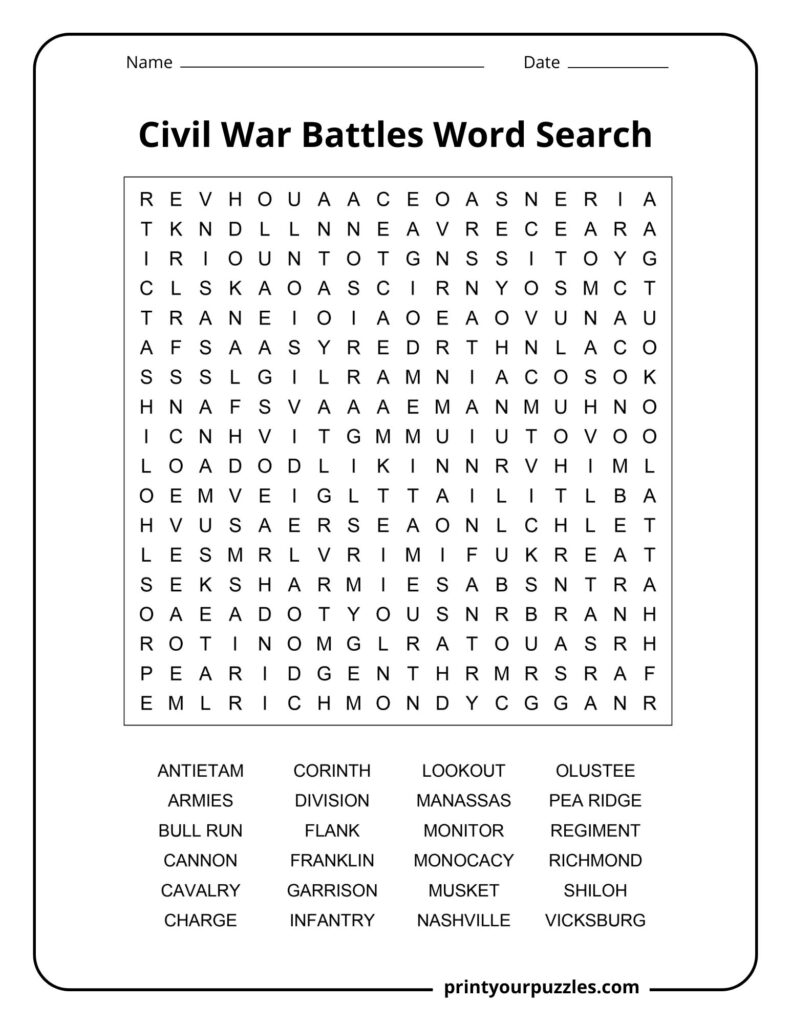
ANTIETAM, ARMIES, BULL RUN, CANNON, CAVALRY, CHARGE, CORINTH, DIVISION, FLANK, FRANKLIN, GARRISON, INFANTRY, LOOKOUT, MANASSAS, MONITOR, MONOCACY, MUSKET, NASHVILLE, OLUSTEE, PEA RIDGE, REGIMENT, RICHMOND, SHILOH, VICKSBURG
ANTIETAM – Battle fought on September 17, 1862, near Sharpsburg, Maryland. It was the bloodiest single-day battle in American history, resulting in a strategic Union victory.
ARMIES – Large organized military forces composed of infantry, cavalry, and artillery divisions. Both the Union and Confederate sides fielded multiple armies throughout the war.
BULL RUN – Site of two major battles in Virginia in 1861 and 1862. The First Battle of Bull Run was the first large-scale engagement of the Civil War.
CANNON – Heavy artillery weapon used extensively during the Civil War. Cannons fired solid shot, explosive shells, and canister rounds, causing devastating casualties on battlefields.
CAVALRY – Mounted soldiers on horseback used for scouting, raiding, and flanking maneuvers. Famous cavalry leaders included J.E.B. Stuart for the Confederacy and Philip Sheridan for the Union.
CHARGE – An aggressive forward assault by troops against enemy positions. Pickett’s Charge at Gettysburg in 1863 remains one of the most famous and costly charges in history.
CORINTH – Strategic railroad crossroads town in Mississippi. The Battles of Corinth in 1862 were important Union victories that secured control of vital transportation routes in the Western Theater.
DIVISION – A military unit typically composed of several brigades, numbering thousands of soldiers. Divisions were key organizational elements within both Union and Confederate army structures during campaigns.
FLANK – The side of a military formation, often vulnerable to attack. Flanking maneuvers were a common tactic, most famously executed by Stonewall Jackson at Chancellorsville in 1863.
FRANKLIN – Battle fought on November 30, 1864, in Tennessee. A devastating Confederate frontal assault resulted in enormous casualties, including six Confederate generals killed in action.
GARRISON – A body of troops stationed at a military post, fort, or town for defensive purposes. Many garrisons held strategic forts and cities throughout the duration of the war.
INFANTRY – Foot soldiers forming the backbone of both armies. Armed primarily with rifled muskets, infantry units bore the heaviest casualties and fought in most major engagements of the conflict.
LOOKOUT – Refers to the Battle of Lookout Mountain, fought on November 24, 1863, near Chattanooga, Tennessee. Known as the “Battle Above the Clouds” due to heavy fog during combat.
MANASSAS – Confederate name for the battles also known as Bull Run, fought near Manassas Junction, Virginia. This vital railroad hub made the area strategically important for both sides.
MONITOR – Union ironclad warship that fought the CSS Virginia at Hampton Roads in March 1862. This historic naval engagement revolutionized warship design and marked the end of wooden navies.
MONOCACY – Battle fought on July 9, 1864, in Maryland. Although a Confederate tactical victory, the Union delay of Confederate forces saved Washington, D.C. from potential capture by Jubal Early.
MUSKET – Primary firearm carried by infantry soldiers during the Civil War. The transition from smoothbore to rifled muskets greatly increased accuracy and range, transforming battlefield tactics significantly.
NASHVILLE – Battle fought on December 15–16, 1864, in Tennessee. Union General George Thomas decisively defeated Confederate General John Bell Hood’s army, effectively ending the Confederate threat in the west.
OLUSTEE – Battle fought on February 20, 1864, in Florida. It was the largest Civil War engagement in the state, resulting in a Confederate victory that halted the Union advance inland.
PEA RIDGE – Battle fought on March 7–8, 1862, in Arkansas. This decisive Union victory secured Missouri for the Union and was one of the most significant engagements west of the Mississippi.
REGIMENT – A military unit typically consisting of around one thousand soldiers, commanded by a colonel. Regiments were the primary building blocks of both Union and Confederate armies throughout the war.
RICHMOND – Capital of the Confederate States of America, located in Virginia. Its capture was a primary Union objective throughout the war, and it finally fell in April 1865 before Lee’s surrender.
SHILOH – Battle fought on April 6–7, 1862, in Tennessee. One of the war’s bloodiest early battles, it shocked both sides with its enormous casualties and demonstrated the war’s brutal nature.
VICKSBURG – Confederate fortress city on the Mississippi River in Mississippi. After a prolonged siege, it surrendered on July 4, 1863, giving the Union complete control of the Mississippi River.
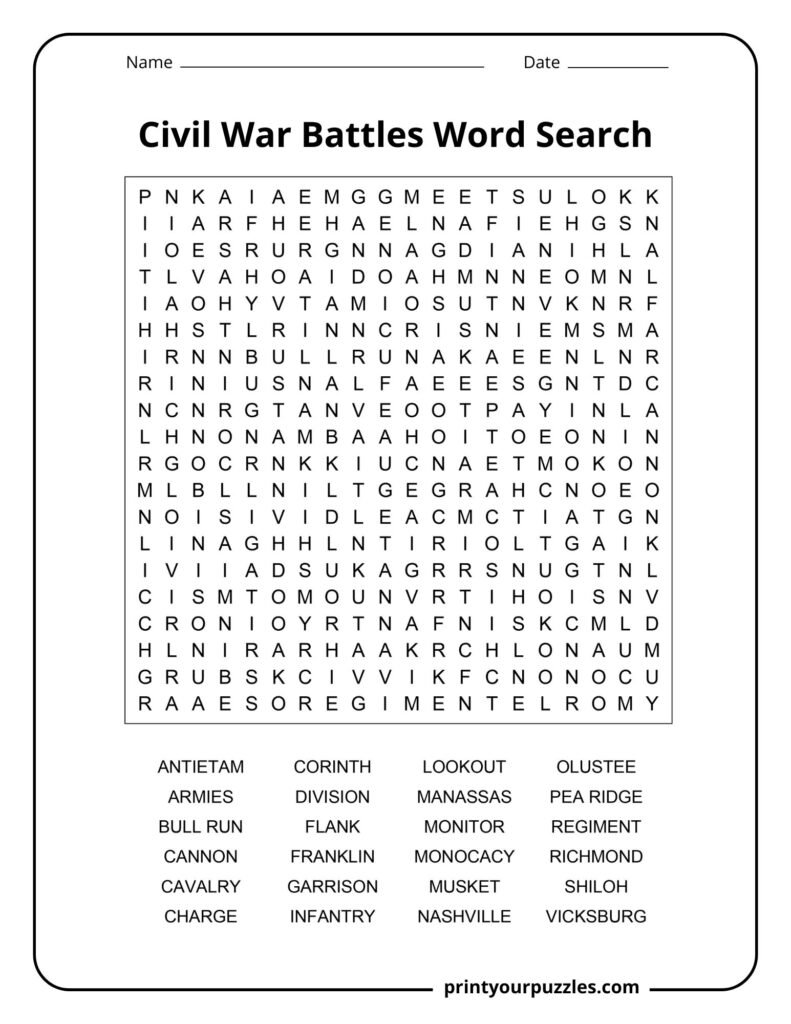
ANTIETAM, ARMIES, BULL RUN, CANNON, CAVALRY, CHARGE, CORINTH, DIVISION, FLANK, FRANKLIN, GARRISON, INFANTRY, LOOKOUT, MANASSAS, MONITOR, MONOCACY, MUSKET, NASHVILLE, OLUSTEE, PEA RIDGE, REGIMENT, RICHMOND, SHILOH, VICKSBURG
The Battle of Gettysburg, fought July 1–3, 1863, in Pennsylvania, was the bloodiest with approximately 51,000 total casualties. It marked a turning point against the Confederacy.
The First Battle of Bull Run, fought on July 21, 1861, near Manassas, Virginia, was the first significant engagement. It shocked the Union with an unexpected Confederate victory.
The war spanned a vast territory. Eastern battles focused on capturing Richmond, while western campaigns aimed to control the Mississippi River and split the Confederacy in two.
Rifled muskets, ironclad warships, railroads, and telegraph communications transformed warfare. These innovations increased firepower and casualties dramatically, making traditional frontal assaults far more deadly than before.
The Battle of Palmito Ranch, fought on May 13, 1865, in Texas, is considered the final significant land engagement. Ironically, it ended as a Confederate tactical victory after Lee’s surrender.
The Killer Angels by Michael Shaara. Technically a historical novel, but it’s so meticulously researched and so influential that historians regularly recommend it alongside nonfiction. It covers Gettysburg from multiple perspectives and remains one of the most immersive depictions of combat ever written. Won the Pulitzer Prize for Fiction.
Gettysburg: The Last Invasion by Allen C. Guelzo. If you want the nonfiction counterpart to Shaara, this is it. Guelzo combines granular tactical detail with larger strategic and political context, and his prose is sharp and authoritative without being academic.
Shiloh: The Battle That Changed the Civil War by Larry J. Daniel. Considered the definitive account of Shiloh. Daniel reconstructs the battle in vivid detail using soldier accounts and official records, making a chaotic two-day fight genuinely comprehensible.
Wilmer McLean’s home was damaged at Bull Run in 1861. He moved to Appomattox, where Lee surrendered inside his house in 1865, bookending the entire war.
Several battles featured brothers on opposing sides. Senator John Crittenden of Kentucky had two sons who became generals, one for the Union and one for the Confederacy.
Confederate troops reportedly marched toward Gettysburg seeking a supply of shoes. They unexpectedly encountered Union cavalry, triggering what became the war’s largest and deadliest battle.
The Union Army Balloon Corps used hydrogen-filled balloons to observe Confederate positions from the sky. Professor Thaddeus Lowe pioneered this early form of aerial military intelligence.
During the Battle of the Crater in 1864 at Petersburg, Union soldiers detonated explosives in a tunnel beneath Confederate lines, creating a huge crater that became a deadly trap.