
Discover the hidden heroines of the American Civil War with this Civil War Women word search, which explores the remarkable contributions of women who shaped the course of the conflict between 1861 and 1865. From battlefields and hospitals to secret intelligence networks, women on both sides defied societal expectations and played vital roles that history often overlooked.
Union and Confederate women served as nurses, spies, soldiers, abolitionists, and organizers across the nation. Figures like Clara Barton, Harriet Tubman, and Dorothea Dix transformed military medicine, while daring spies such as Belle Boyd, Rose Greenhow, and Mary Bowser risked their lives gathering intelligence behind enemy lines. Some women even disguised themselves as men to fight alongside soldiers, hiding their identities for years.
Their courage and sacrifice challenged traditional gender roles and helped pave the way for the women’s suffrage movement in the decades that followed. Did you know that Harriet Tubman became the first American woman to lead an armed military expedition when she guided the Combahee River Raid in 1863?
This Civil War Women word search printable is designed to be both entertaining and educational. Alongside the puzzle, you will find a FAQ section answering key questions, a Did You Know? feature with surprising historical facts, and detailed definitions for all 24 words to deepen your understanding of these extraordinary women.
Whether you are a history enthusiast, a student, or a teacher looking for engaging classroom material, this word search printable offers a fun and meaningful way to discover the hidden heroines of the Civil War.
This is the fifth and final in our series of 6 word searches about the Civil War. Also explore Civil War, Civil War Causes, Civil War Battles, Civil War Generals, and Reconstruction Era!
Related Word Searches:
Civil War | Harriet Tubman | Civil War Battles | Civil War Causes | Emancipation Proclamation | Reconstruction Era
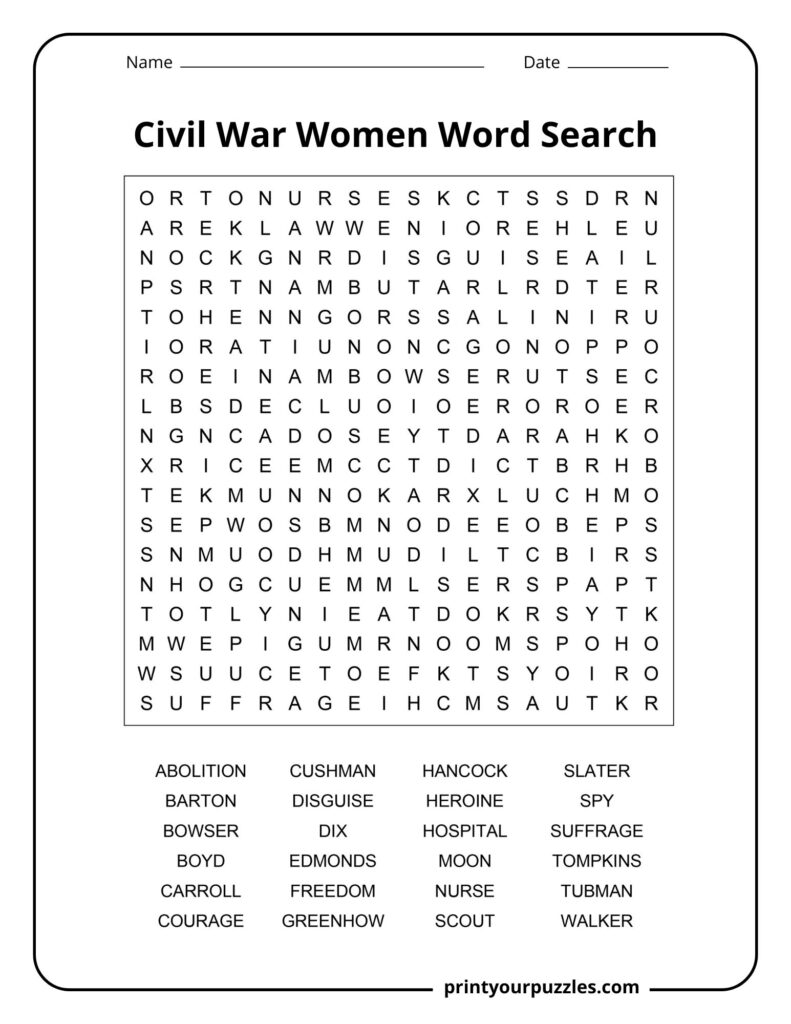
ABOLITION, BARTON, BOWSER, BOYD, CARROLL, COURAGE, CUSHMAN, DISGUISE, DIX, EDMONDS, FREEDOM, GREENHOW, HANCOCK, HEROINE, HOSPITAL, MOON, NURSE, SCOUT, SLATER, SPY, SUFFRAGE, TOMPKINS, TUBMAN, WALKER
ABOLITION – The movement to end slavery in the United States. Many Civil War women were fierce abolitionists who fought tirelessly for emancipation through speeches, writings, and direct action like the Underground Railroad.
BARTON – Clara Barton, known as the “Angel of the Battlefield,” nursed wounded soldiers during the Civil War. She later founded the American Red Cross in 1881, leaving a lasting humanitarian legacy.
BOWSER – Mary Bowser, a freed African American woman, worked as a Union spy inside the Confederate White House. She gathered critical intelligence while posing as a servant to Jefferson Davis’s family.
BOYD – Belle Boyd, a famous Confederate spy, began her espionage career as a teenager. She passed military intelligence to Stonewall Jackson’s forces and was arrested multiple times for her daring activities.
CARROLL – Anna Ella Carroll, a Maryland political writer and strategist, advised President Lincoln on military strategy. She advocated the Tennessee River campaign plan and wrote influential pro-Union pamphlets during the war.
COURAGE – A defining quality of Civil War women who risked imprisonment, injury, and death. They served as spies, soldiers in disguise, nurses, and activists, breaking social barriers with extraordinary bravery.
CUSHMAN – Pauline Cushman, a Union spy and actress, gathered Confederate intelligence while posing as a Southern sympathizer. Captured and sentenced to death, she was rescued by advancing Union troops just in time.
DISGUISE – Many women disguised themselves as men to fight in the Civil War. They cut their hair, adopted male names, and enlisted as soldiers, hiding their identities sometimes for years throughout the conflict.
DIX – Dorothea Dix served as Superintendent of Army Nurses for the Union. A mental health reformer, she organized and recruited thousands of female nurses, establishing strict standards for military nursing during the war.
EDMONDS – Sarah Emma Edmonds enlisted in the Union Army disguised as a man named Franklin Thompson. She served as a soldier, nurse, and spy, participating in several major battles before deserting to avoid discovery.
FREEDOM – The central cause motivating many Civil War women, especially African American women who fought for liberation from slavery. Their efforts as activists, spies, and nurses helped advance the cause of human liberty.
GREENHOW – Rose O’Neal Greenhow, a prominent Confederate spy in Washington, passed crucial intelligence before the First Battle of Bull Run. Imprisoned and later exiled, she drowned in 1864 while running a Union blockade.
HANCOCK – Cornelia Hancock, a young Union nurse, arrived at Gettysburg to tend the wounded despite having no formal training. She served throughout the war and later dedicated her life to education and social reform.
HEROINE – A term describing the countless brave women of the Civil War era. Whether serving as nurses, spies, soldiers, or abolitionists, these women displayed remarkable heroism and challenged traditional gender roles of their time.
HOSPITAL – Civil War hospitals were vital settings where women proved their capability as caregivers. Women organized field hospitals, treated horrific wounds, battled disease, and transformed military medicine through their dedication and competence.
MOON – Ginnie and Lottie Moon were Confederate spy sisters from Virginia. They used charm and cunning to smuggle information and supplies across enemy lines, becoming two of the war’s most resourceful female operatives.
NURSE – Thousands of women served as nurses during the Civil War, revolutionizing the profession. They overcame prejudice and resistance to care for wounded soldiers, establishing nursing as a respected and essential vocation for women.
SCOUT – Some women served as scouts, gathering intelligence behind enemy lines. Harriet Tubman notably led scouting missions for the Union Army in South Carolina, becoming the first woman to command an armed military operation.
SLATER – Sarah Slater, a mysterious Confederate courier, carried secret dispatches between Richmond and Montreal. Her espionage missions were highly dangerous, and she disappeared after the war, her fate remaining an unsolved historical mystery.
SPY – Women on both sides served as spies during the Civil War. Their gender often allowed them to move freely and avoid suspicion, making them remarkably effective intelligence agents for both Union and Confederate forces.
SUFFRAGE – The women’s suffrage movement gained momentum partly through Civil War service. Women who proved their patriotism and competence during the war increasingly demanded voting rights, laying groundwork for the Nineteenth Amendment decades later.
TOMPKINS – Sally Louisa Tompkins established a private hospital in Richmond for wounded Confederate soldiers. President Jefferson Davis commissioned her as a captain of cavalry, making her the only woman officially commissioned in the Confederate Army.
TUBMAN – Harriet Tubman, a formerly enslaved woman, served the Union as a spy, scout, and nurse. Already famous for leading hundreds to freedom via the Underground Railroad, she became a legendary figure of courage and resistance.
WALKER – Mary Edwards Walker, a Union surgeon, is the only woman to have received the Medal of Honor. She served on the front lines, was captured as a prisoner of war, and championed women’s rights throughout her life.
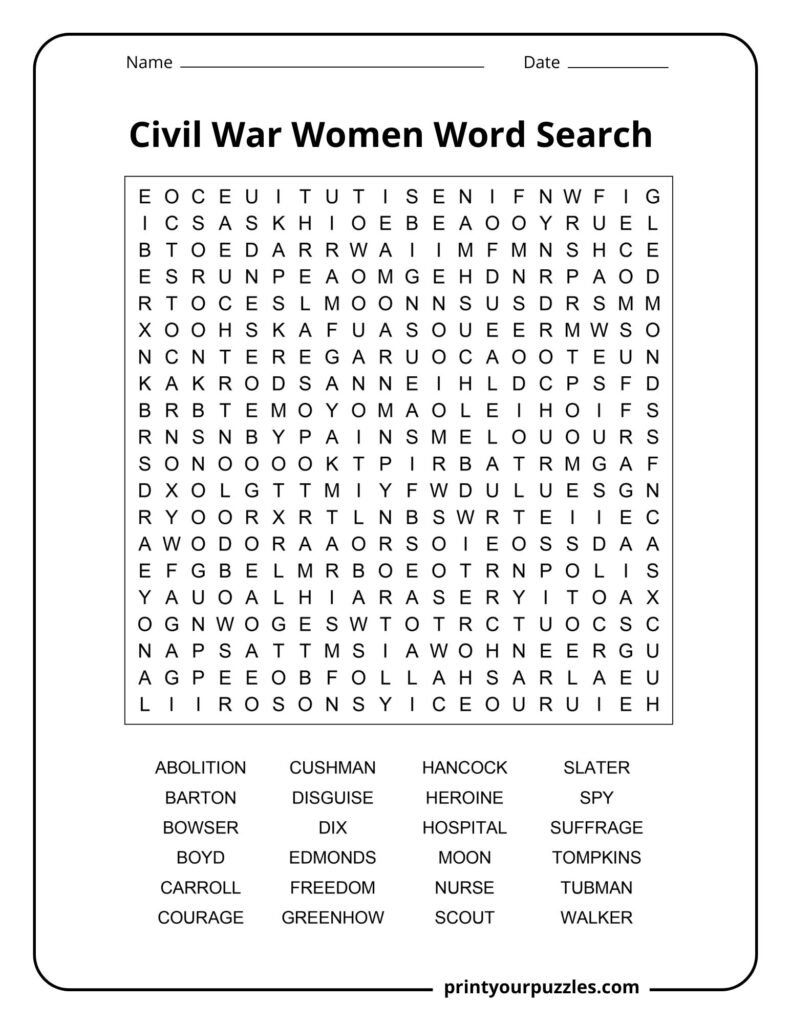
ABOLITION, BARTON, BOWSER, BOYD, CARROLL, COURAGE, CUSHMAN, DISGUISE, DIX, EDMONDS, FREEDOM, GREENHOW, HANCOCK, HEROINE, HOSPITAL, MOON, NURSE, SCOUT, SLATER, SPY, SUFFRAGE, TOMPKINS, TUBMAN, WALKER
Women served as nurses, spies, soldiers in disguise, abolitionists, couriers, and organizers. They challenged gender norms and proved essential to both Union and Confederate war efforts.
Women cut their hair, bound their chests, adopted male names, and disguised themselves as men. Poor sanitation and limited medical exams made it easier to conceal their identities for years.
Society considered women harmless and apolitical, allowing them to move freely across enemy lines. They hid messages in clothing, hairstyles, and personal belongings without raising suspicion.
Women’s wartime contributions proved their competence and patriotism, fueling demands for equality. Their service strengthened the suffrage movement and helped establish nursing and medicine as female professions.
Yes, significantly. Harriet Tubman served as spy and scout, Mary Bowser gathered intelligence inside the Confederate White House, and thousands of freed women worked as nurses, cooks, and laundresses.
This Republic of Suffering by Drew Gilpin Faust. While not exclusively about women, Faust places women at the center of the story of how Americans confronted mass death. Their roles as mourners, nurses, and keepers of memory are woven throughout. Faust’s writing is elegant and emotionally resonant.
Women’s War by Stephanie McCurry. A groundbreaking work examining how women — enslaved women, soldiers’ wives, and female refugees — shaped the political and military course of the war in ways rarely acknowledged. McCurry is a rigorous historian who writes with real narrative drive.
Liar, Temptress, Soldier, Spy by Karen Abbott. Follows four women on both sides of the conflict: a socialite spy for the Confederacy, a Union spy in Richmond, a soldier who disguised herself as a man, and an abolitionist operative. Abbott is a narrative nonfiction writer, so the book reads almost like a thriller while staying grounded in primary sources.
In 1863, she guided the Combahee River Raid in South Carolina, freeing over 700 enslaved people. She became the first American woman to lead an armed military expedition.
Dr. Mary Edwards Walker remains the only woman ever awarded the Medal of Honor. She served as a Union surgeon, was captured, and endured months in a Confederate prison.
Mary Bowser, a freed African American woman, worked as a servant in the Confederate White House. She memorized documents and passed vital military secrets directly to Union intelligence officers.
Hundreds of women fought disguised as men. Their true identities were often revealed only on the battlefield when they received medical treatment or were prepared for burial.
Sally Tompkins operated a private hospital in Richmond with remarkably low death rates. President Jefferson Davis commissioned her as a cavalry captain, making her the Confederacy’s only female officer.