
Bill Clinton’s (1993–2001) presidency belonged to the 1990s, a decade often remembered for economic growth, new technology, political debate, and the first years of the internet age. He entered the White House as a younger leader who promised to move beyond older political divisions and focus on the concerns of the middle class. The Bill Clinton word search gives students a way to explore a president whose time in office mixed prosperity, policy change, global challenges, and personal scandal.
Clinton came from Arkansas and built his political career far from Washington, D.C. He studied law, became attorney general of Arkansas, and later served as governor. In the election of 1992, he defeated President George H. W. Bush in a campaign shaped by economic worries and a desire for generational change. His message focused on jobs, opportunity, education, health care, and a government that could be active but also more efficient.
The economy became one of the strongest parts of Clinton’s presidency. During his years in office, the United States experienced low unemployment, strong growth, rising technology investment, and budget surpluses near the end of the decade. Computers, the internet, and new forms of communication were changing business, schools, and daily life. Clinton often connected this economic optimism with education, trade, and preparation for a global future.
His domestic record included both success and controversy. He supported deficit reduction, signed the North American Free Trade Agreement, and approved welfare reform, which changed how federal assistance worked for many families. Supporters praised these policies as practical and modern. Critics argued that some decisions weakened protections for workers or made life harder for vulnerable people. His attempt to create a major health care reform plan failed, showing the difficulty of changing such a large system.
Foreign policy after the Cold War brought new responsibilities. Clinton’s administration was involved in Bosnia and Kosovo, supported peace efforts in the Middle East and Northern Ireland, and responded to growing concerns about terrorism. These issues showed that even without the old Cold War structure, the world still contained serious dangers.
Clinton’s presidency was also marked by impeachment in 1998 after investigations related to his personal conduct and statements under oath. The Senate acquitted him, but the scandal became a major part of his legacy. This Bill Clinton word search examines the economy, technology, trade, welfare reform, impeachment, and America’s changing role after the Cold War.
Continue your Modern America Presidents journey with our George H. W. Bush word search, George W. Bush word search, Barack Obama word search, and the full US Presidents Word Searches collection.
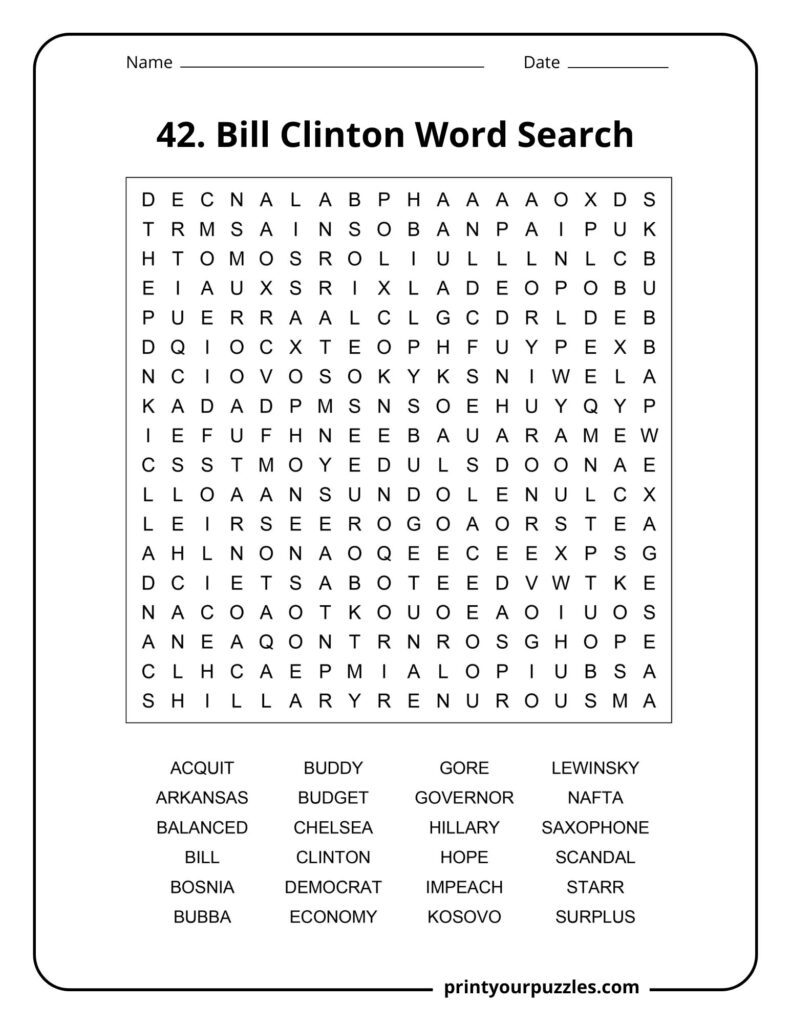
ACQUIT, ARKANSAS, BALANCED, BILL, BOSNIA, BUBBA, BUDDY, BUDGET, CHELSEA, CLINTON, DEMOCRAT, ECONOMY, GORE, GOVERNOR, HILLARY, HOPE, IMPEACH, KOSOVO, LEWINSKY, NAFTA, SAXOPHONE, SCANDAL, STARR, SURPLUS
ACQUIT – The Senate voted to acquit Clinton in 1999 on impeachment charges of perjury and obstruction of justice, allowing him to complete his second presidential term.
ARKANSAS – Clinton’s home state where he served five terms as governor before becoming president. He launched his presidential campaign from Little Rock in 1991.
BALANCED – Clinton achieved a balanced federal budget in 1998, the first in decades, through spending cuts and tax increases, creating budget surpluses for his remaining years.
BILL – Clinton’s first name, short for William Jefferson Clinton. He was born William Jefferson Blythe III but took his stepfather’s surname during childhood in Arkansas.
BOSNIA – Clinton authorized NATO military intervention in Bosnia-Herzegovina in 1995, helping end the Bosnian War and negotiating the Dayton Peace Accords to establish regional stability.
BUBBA – A Southern nickname given to Clinton, reflecting his folksy charm and ability to connect with ordinary Americans. It emphasized his down-to-earth, approachable personality style.
BUDDY – Clinton’s chocolate Labrador Retriever who became famous as the First Dog. Buddy joined the Clinton family in 1997 and frequently appeared in White House photos.
BUDGET – Clinton focused heavily on fiscal responsibility, cutting the deficit significantly through the 1993 Budget Act and eventually achieving surplus years during his second presidential term.
CHELSEA – Clinton’s only daughter with Hillary, born in 1980. She lived in the White House as a teenager and was largely shielded from media attention.
CLINTON – The 42nd President of the United States who served from 1993 to 2001, presiding over peace and prosperity but marred by scandal and impeachment.
DEMOCRAT – Clinton’s political party affiliation. He represented a “New Democrat” approach, combining traditional liberal values with centrist economic policies and welfare reform initiatives.
ECONOMY – The U.S. economy thrived during Clinton’s presidency with low unemployment, strong growth, reduced deficit, technological boom, and rising wages creating widespread
prosperity nationwide.
GORE – Al Gore served as Clinton’s Vice President for both terms. He was an influential partner, focusing on environmental issues and technology before running unsuccessfully in 2000.
GOVERNOR – Clinton served as Arkansas Governor for five terms between 1979 and 1992, implementing education reform and establishing his reputation as a policy-focused, moderate leader.
HILLARY – Hillary Rodham Clinton, Bill’s wife and political partner. As First Lady, she championed healthcare reform, later becoming Senator, Secretary of State, and presidential candidate.
HOPE – Clinton’s birthplace in Arkansas. Hope became symbolic of his campaign theme and humble origins, representing optimism and the American Dream in political messaging.
IMPEACH – Clinton was impeached by the House of Representatives in December 1998 on charges of perjury and obstruction related to the Monica Lewinsky scandal.
KOSOVO – Clinton led NATO bombing campaign against Yugoslavia in 1999 to stop ethnic cleansing in Kosovo, intervening militarily for humanitarian reasons without UN authorization.
LEWINSKY – Monica Lewinsky, the White House intern whose relationship with Clinton became public in 1998, triggering impeachment proceedings and dominating his second term’s legacy.
NAFTA – North American Free Trade Agreement, signed by Clinton in 1993. It eliminated trade barriers between the U.S., Canada, and Mexico, sparking ongoing economic debate.
SAXOPHONE – Clinton famously played the tenor saxophone, performing on television shows including a memorable 1992 appearance on The Arsenio Hall Show wearing sunglasses during his campaign.
SCANDAL – Clinton’s presidency faced multiple controversies including Whitewater, Travelgate, and the Monica Lewinsky affair, which led to his impeachment though he remained personally popular.
STARR – Kenneth Starr, the independent counsel who investigated Clinton’s Whitewater dealings and later the Lewinsky affair, producing a detailed report that led to impeachment proceedings.
SURPLUS – Clinton achieved federal budget surpluses in his final years as president, reversing decades of deficits through fiscal discipline, economic growth, and a booming technology sector.
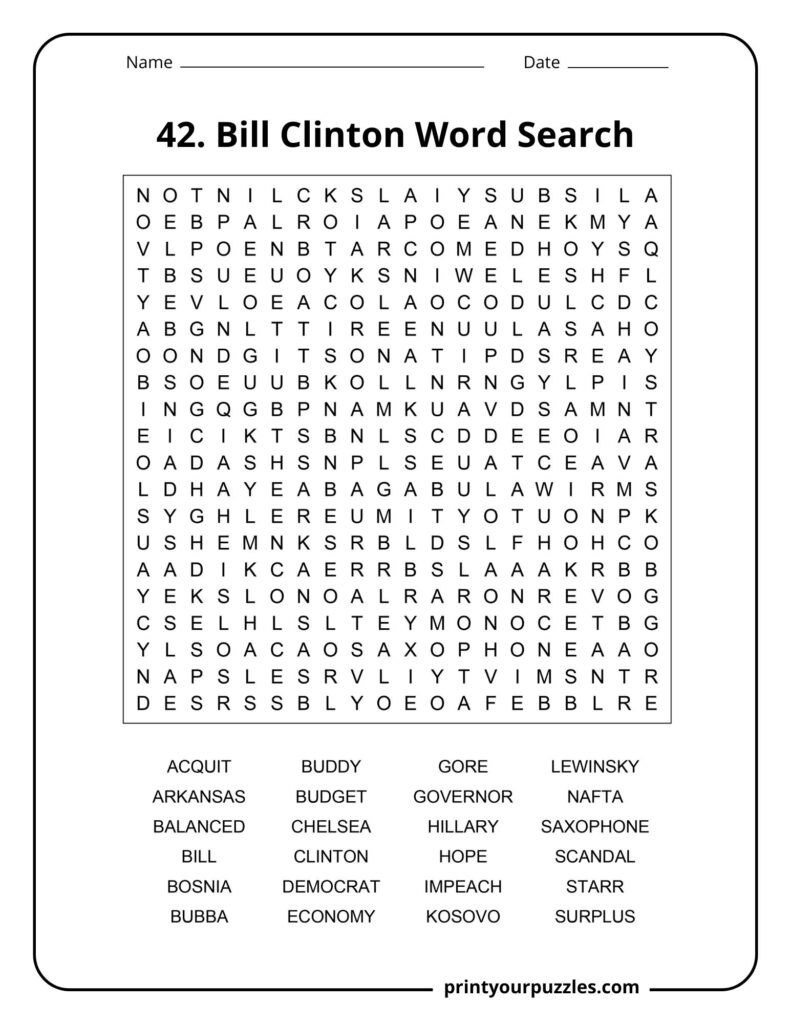
ACQUIT, ARKANSAS, BALANCED, BILL, BOSNIA, BUBBA, BUDDY, BUDGET, CHELSEA, CLINTON, DEMOCRAT, ECONOMY, GORE, GOVERNOR, HILLARY, HOPE, IMPEACH, KOSOVO, LEWINSKY, NAFTA, SAXOPHONE, SCANDAL, STARR, SURPLUS
Bill Clinton served as the 42nd President from January 20, 1993, to January 20, 2001, completing two full terms in office during a period of economic prosperity.
Clinton was impeached by the House in December 1998 for perjury and obstruction of justice related to the Monica Lewinsky scandal. The Senate acquitted him in February 1999.
Clinton achieved a balanced federal budget, created budget surpluses, presided over strong economic growth, low unemployment, signed NAFTA, expanded healthcare access, and promoted peace in Bosnia and Kosovo.
Clinton served as Arkansas Attorney General and five-term Arkansas Governor. He graduated from Georgetown University, was a Rhodes Scholar at Oxford, and earned his law degree from Yale.
Al Gore served as Vice President throughout both Clinton terms. Hillary Rodham Clinton, his wife since 1975, served as First Lady and later became Senator and Secretary of State.
For official administration records and historical biography, visit the William J. Clinton page in the White House Archives. If you are planning a trip, check out the official Clinton Presidential Library.
First in His Class: A Biography of Bill Clinton by David Maraniss. A Pulitzer-winning journalist’s deep character study of Clinton’s rise, capturing the brilliance, ambition, and contradictions that defined him.
In 1963, 16-year-old Clinton attended Boys Nation in Washington D.C. and shook hands with JFK in the Rose Garden, inspiring his political career aspirations.
Clinton joins a remarkable group of left-handed presidents including Gerald Ford, George H.W. Bush, and Barack Obama. Left-handed people comprise only about 10 percent of the population.
Clinton once joked that he’d achieved peace in the Middle East but couldn’t broker peace between his cat and dog, who had to be kept separated.
His biological father died in a car accident before he was born. Clinton later took his stepfather Roger Clinton’s surname when he was a teenager in Arkansas.
Following quadruple bypass surgery and additional procedures, Clinton adopted a plant-based diet to improve his heart health, losing significant weight and crediting the lifestyle change publicly.