
Ancient Japan created one of Asia’s most distinctive and enduring cultures. Over many centuries, its people developed important traditions in government, religion, literature, art, architecture, and craftsmanship. Japan absorbed ideas from neighboring civilizations, especially China and Korea, but transformed them into uniquely Japanese forms. Many traditions established in ancient times—including the imperial institution, Shinto beliefs, kana writing, refined court literature, and respect for nature—remain important parts of Japanese identity today.
Japan developed across a chain of islands in East Asia, where mountains, forests, rivers, fertile plains, and surrounding seas shaped settlement and daily life. Coastal waters provided food and transportation, while valleys and plains supported agriculture. Although the islands offered some natural protection, Japan was never completely isolated. Sea routes connected its communities with Korea, China, and other parts of Asia, bringing new technologies, beliefs, writing systems, and artistic influences.
The earliest well-known inhabitants belonged to the Jōmon culture, which began thousands of years ago. Jōmon communities relied on hunting, fishing, gathering, and small-scale farming. They are especially famous for producing some of the world’s earliest known pottery, often decorated with cord-like patterns. During the Yayoi period, wet-rice farming, metalworking, weaving, bronze objects, and more organized villages transformed society and supported larger populations.
As communities expanded, powerful clans competed for land and authority. The Yamato clan gradually became dominant and helped establish an early centralized state. Yamato rulers claimed descent from Amaterasu, the sun goddess, giving the imperial family sacred importance. The emperor became a lasting symbol of unity, although noble families, court officials, and regional leaders often exercised much of the practical political power.
Contact with China and Korea greatly influenced Japan’s development. Chinese characters, Buddhism, Confucian ideas, government systems, architecture, and artistic techniques were introduced and adapted to Japanese society. Buddhism arrived during the sixth century and existed alongside Shinto, Japan’s native spiritual tradition. Shinto centered on kami, sacred presences associated with nature, ancestors, communities, and particular places.
The Nara period strengthened centralized government and established a permanent capital modeled partly on Chinese cities. In 794, the capital moved to Heian-kyō, now Kyoto. The Heian court became celebrated for poetry, painting, music, ceremony, elegant clothing, and sophisticated palace life. Writers such as Murasaki Shikibu produced enduring literature, including The Tale of Genji, often described as one of the world’s earliest great novels.
Ancient Japanese achievements continue to influence life today. Hiragana and katakana developed from Chinese characters and remain essential to modern Japanese writing. Japanese artisans also refined pottery, papermaking, lacquerware, silk weaving, calligraphy, wooden architecture, garden design, and construction methods suited to an earthquake-prone land.
Through this Ancient Japan word search, students can explore the people, beliefs, inventions, artistic traditions, and political changes that helped shape one of the world’s most influential cultures.
Related Word Searches:
Ancient China | Silk Road | Viking Age | Feudalism | Ancient Rome | Ancient Greece
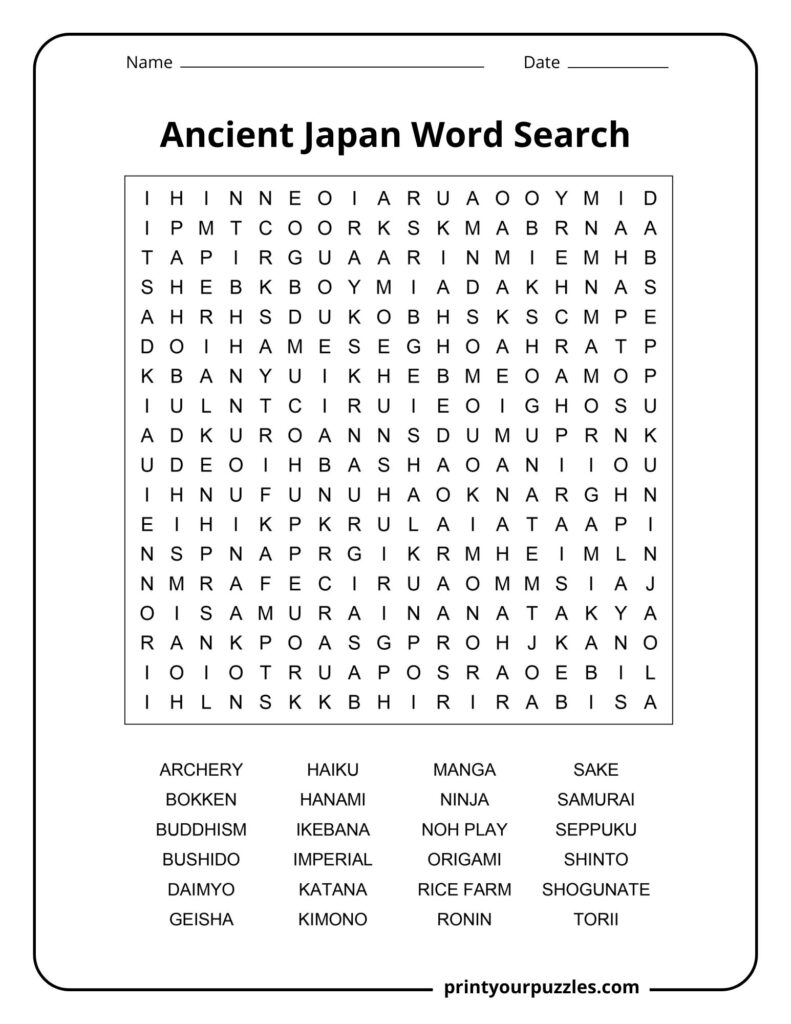
ARCHERY, BOKKEN, BUDDHISM, BUSHIDO, DAIMYO, GEISHA, HAIKU, HANAMI, IKEBANA, IMPERIAL, KATANA, KIMONO, MANGA, NINJA, NOH PLAY, ORIGAMI, RICE FARM, RONIN, SAKE, SAMURAI, SEPPUKU, SHINTO, SHOGUNATE, TORII
ARCHERY – The ancient Japanese practice of shooting arrows with a bow, known as Kyudo, considered a spiritual discipline and martial art requiring precision, focus, and mental balance.
BOKKEN – A wooden sword used in Japanese martial arts training, shaped like a katana and employed by samurai to practice combat techniques safely without risking injury with real blades.
BUDDHISM – A major religion introduced to Japan around the 6th century, teaching the path to enlightenment through meditation, ethical conduct, and wisdom, deeply influencing Japanese culture and art.
BUSHIDO – The strict samurai code of honor emphasizing loyalty, courage, discipline, and moral conduct. It guided every aspect of a warrior’s life, including how to face death with dignity.
DAIMYO – Powerful feudal lords in ancient Japan who controlled vast territories and commanded armies of samurai. They owed loyalty to the shogun while governing their domains with great autonomy.
GEISHA – Highly skilled female entertainers trained in traditional Japanese arts including music, dance, and conversation. Geisha were cultured artists who provided sophisticated companionship in exclusive social gatherings.
HAIKU – A traditional Japanese poetic form composed of three lines with a five-seven-five syllable structure. Haiku capture fleeting moments in nature with simplicity, depth, and quiet contemplation.
HANAMI – The beloved Japanese tradition of gathering beneath blooming cherry trees to celebrate spring’s arrival. This centuries-old custom symbolizes the beauty and transience of life through nature’s seasonal cycles.
IKEBANA – The refined Japanese art of flower arrangement, far beyond simple decoration. It follows strict principles of harmony, balance, and minimalism, expressing a deep philosophical connection between humans and nature.
IMPERIAL – Relating to Japan’s ancient imperial system, centered on the Emperor, believed to be descended from the sun goddess Amaterasu. The imperial institution shaped Japanese politics, religion, and national identity for centuries.
KATANA – The iconic curved single-edged sword of the Japanese samurai, masterfully crafted by skilled swordsmiths. Renowned for its exceptional sharpness and strength, it was considered the soul of the warrior.
KIMONO – A traditional Japanese garment characterized by its T-shaped silhouette, wide sleeves, and elegant fabrics. Worn for centuries across all social classes, each kimono’s colors and patterns carried deep cultural meaning.
MANGA – A form of Japanese visual storytelling with roots in ancient picture scrolls and woodblock prints. These illustrated narratives depicted myths, daily life, and satire, laying the foundation for modern Japanese comics.
NINJA – Covert agents in feudal Japan specializing in espionage, sabotage, and assassination. Operating in secrecy, ninjas used unconventional tactics, disguises, and special weapons to carry out missions for their employers.
NOH PLAY – A classical form of Japanese musical theater dating back to the 14th century, combining masked performance, slow movement, poetry, and music to portray supernatural tales with profound spiritual and emotional depth.
ORIGAMI – The traditional Japanese art of paper folding, transforming flat sheets into intricate sculptural forms without cutting or gluing. Origami holds deep cultural significance, with the crane symbolizing longevity and good fortune.
RICE FARM – The foundation of ancient Japanese civilization and economy. Wet rice cultivation shaped rural landscapes, community cooperation, and religious rituals, as rice was considered sacred and essential to both survival and ceremony.
RONIN – A samurai who had lost his master through death or disgrace, left to wander without purpose or allegiance. Ronin occupied an ambiguous social position, sometimes becoming mercenaries, criminals, or legendary heroic figures.
SAKE – A traditional Japanese alcoholic beverage brewed from fermented rice, deeply woven into religious ceremonies, royal banquets, and everyday social life. Its production dates back over two thousand years in Japanese history.
SAMURAI – The elite warrior class of feudal Japan, bound by Bushido and skilled in combat, strategy, and cultural arts. Samurai served powerful lords and embodied the ideals of honor, loyalty, and self-discipline.
SEPPUKU – A ritualistic form of suicide by self-disembowelment practiced by samurai to die with honor rather than face defeat, capture, or disgrace. It was considered the ultimate expression of a warrior’s dignity and courage.
SHINTO – Japan’s indigenous religion centered on the worship of kami, divine spirits inhabiting nature, ancestors, and sacred places. Shinto rituals and shrines remain deeply embedded in Japanese culture, identity, and daily spiritual practice.
SHOGUNATE – The military government of feudal Japan ruled by the shogun, a supreme military commander who held actual political power while the Emperor remained a symbolic figurehead. Several shogunates shaped centuries of Japanese history.
TORII – A traditional Japanese gate marking the sacred entrance to Shinto shrines, symbolizing the boundary between the ordinary human world and the divine spiritual realm. Often painted vivid red, torii are iconic cultural symbols.
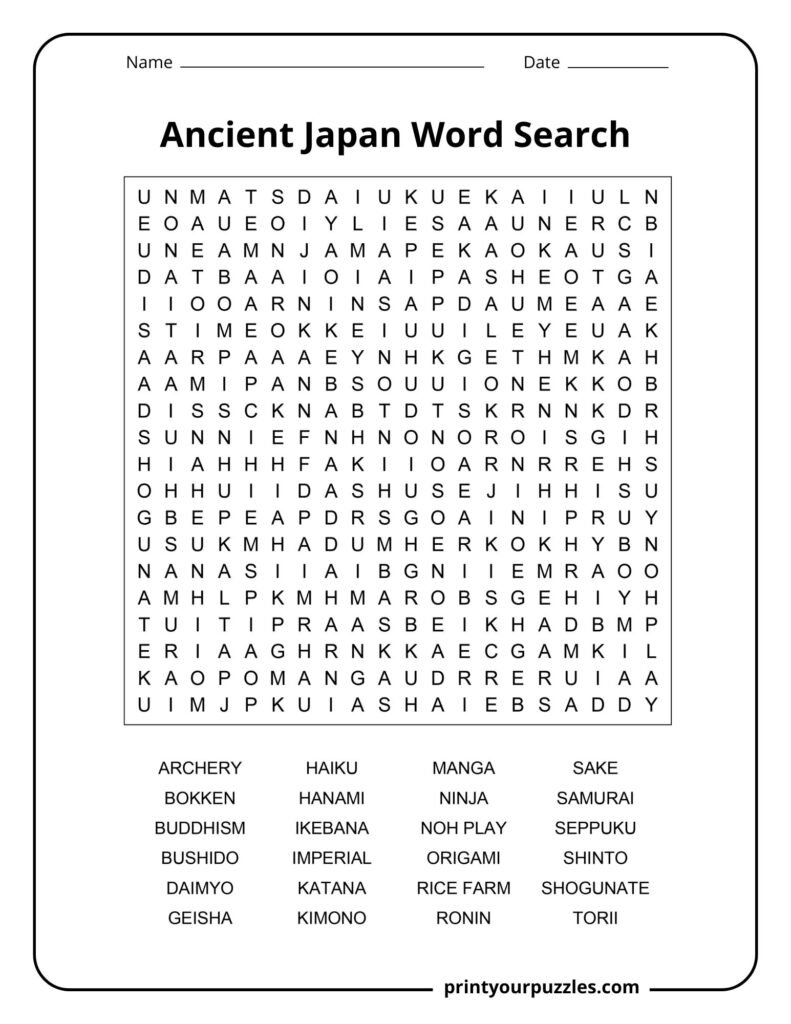
ARCHERY, BOKKEN, BUDDHISM, BUSHIDO, DAIMYO, GEISHA, HAIKU, HANAMI, IKEBANA, IMPERIAL, KATANA, KIMONO, MANGA, NINJA, NOH PLAY, ORIGAMI, RICE FARM, RONIN, SAKE, SAMURAI, SEPPUKU, SHINTO, SHOGUNATE, TORII
The Emperor was considered a divine figurehead descended from the sun goddess Amaterasu, holding sacred religious authority while actual political and military power was often exercised by shoguns or powerful clans.
Samurai were elite warriors serving feudal lords under a strict code of honor called Bushido. They provided military protection, maintained order, and represented the highest ideals of loyalty, courage, and discipline.
Shinto and Buddhism deeply influenced Japanese laws, arts, architecture, and daily rituals. Both religions coexisted, shaping moral values, funeral practices, seasonal celebrations, and the spiritual relationship between humans and nature.
Ancient Japan operated under a strict hierarchy with the Emperor at the top, followed by shoguns, daimyo, samurai, farmers, artisans, and merchants, each class holding defined roles, rights, and social responsibilities.
Ancient Japan produced remarkable achievements including Noh theater, haiku poetry, ikebana, origami, Zen Buddhism, landscape gardening, and exquisite sword-making, all reflecting a civilization that deeply valued beauty, discipline, and spiritual harmony.
The World of the Shining Prince: Court Life in Ancient Japan by Ivan Morris. Columbia scholar Morris weaves rigorous Japanese literary and historical scholarship into an utterly captivating portrait of Heian court life — its beauty, politics, superstitions, and remarkable women — making ancient Japan feel luminously alive.
Beyond battlefield skills, samurai were expected to master calligraphy, poetry, and tea ceremony, reflecting Bushido’s belief that true warriors must cultivate both fierce combat ability and refined cultural sensitivity.
Female warriors called Onna-bugeisha were trained in martial arts and weapons, particularly the naginata spear, defending their homes and communities with remarkable courage equal to their male counterparts.
Known as Burakumin, these people performed jobs deemed spiritually impure, such as butchering animals or handling the dead, placing them completely outside Japan’s rigid four-tier feudal social structure.
Paper was extremely valuable in Ancient Japan, making origami a sacred practice used in Shinto rituals and formal ceremonies long before it became a widespread artistic and recreational tradition.
Early Japanese emperors frequently relocated the capital upon each new reign, believing a ruler’s death spiritually contaminated the city, until Nara and later Kyoto became permanent imperial centers.