
Decolonization was the process through which colonies gained independence from European empires and other imperial powers. Although resistance to colonial rule had existed for centuries, the movement accelerated after World War II, especially from the 1940s through the 1970s. During these decades, dozens of new nations emerged across Asia, Africa, the Caribbean, and the Pacific, transforming the political map of the world.
Before decolonization, powers such as Britain, France, Belgium, the Netherlands, Portugal, and Spain controlled large overseas territories. Colonial governments often shaped land ownership, labor systems, education, trade, and political institutions to serve imperial interests. In many places, local people had limited power over their own economies, governments, and natural resources.
World War II weakened the European empires financially and militarily. Millions of people from colonized societies had served in the war, and many returned with stronger expectations of equality, rights, and self-government. Nationalist leaders, political parties, labor unions, students, veterans, and community organizations began demanding independence through negotiations, strikes, demonstrations, and, in some cases, armed resistance.
Decolonization followed different paths in different regions. India and Pakistan gained independence from Britain in 1947, although partition caused enormous violence and displacement. Indonesia fought to end Dutch rule, while Vietnam struggled against France. Across Africa, Ghana became the first sub-Saharan colony to gain independence in 1957, followed by many others during the 1960s. Algeria, Kenya, Congo, and the Portuguese colonies experienced especially difficult or violent transitions.
The Cold War also shaped the process. The United States and Soviet Union competed for influence among newly independent nations, offering military, political, or economic support. Some governments joined one side, while others helped create the Non-Aligned Movement to avoid domination by either superpower. Radio, newspapers, political pamphlets, photography, cinema, telephones, railways, and international broadcasting helped independence movements spread ideas, organize supporters, and document repression. These tools played a role similar to digital media in modern political campaigns.
Independence did not solve every problem. Many new countries inherited colonial borders, weak institutions, unequal land ownership, limited infrastructure, and economies dependent on foreign trade. Some experienced coups, civil wars, ethnic tensions, or continued outside influence. Even so, decolonization expanded ideas of sovereignty and self-determination and greatly increased the number of independent states represented in the United Nations.
The Decolonization word search introduces students to key ideas, regions, and movements that transformed the modern world. By exploring terms such as empire, nationalism, sovereignty, partition, liberation, Africa, Asia, and the Non-Aligned Movement, learners can better understand how independence struggles weakened colonial rule and changed international politics, national identity, and ideas about freedom and justice.
Related Word Searches:
Arab Spring | Cuban Revolution | Iranian Revolution | Chinese Revolution | Korean War | Truman Doctrine
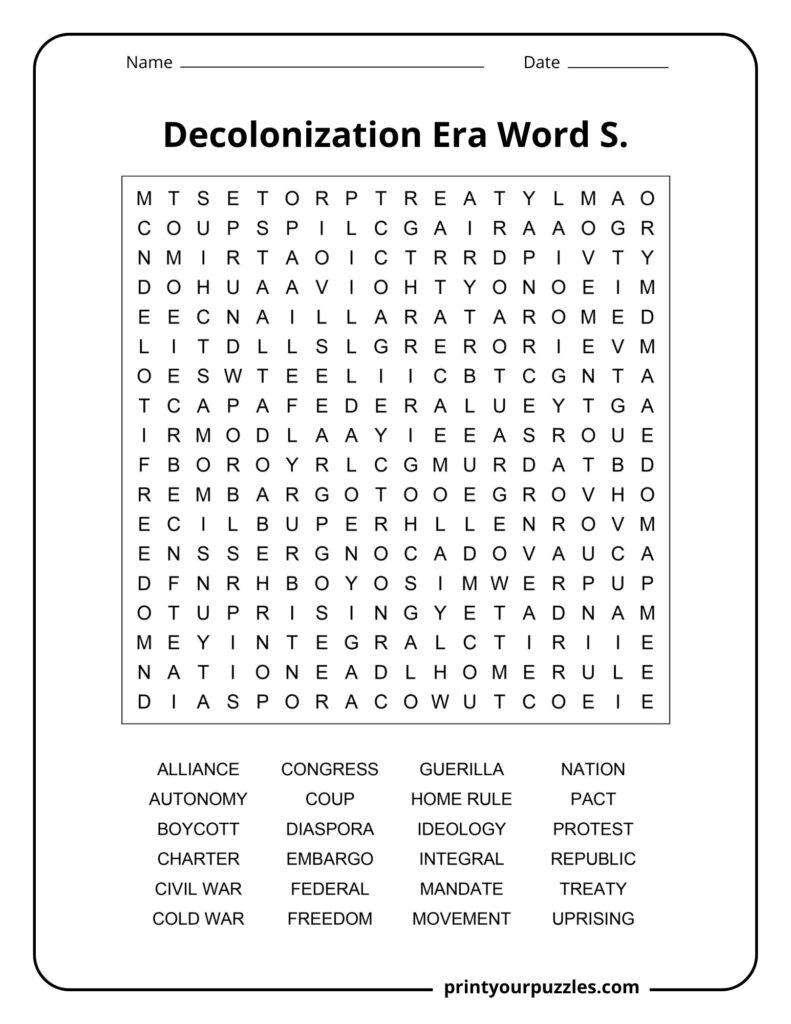
ALLIANCE, AUTONOMY, BOYCOTT, CHARTER, CIVIL WAR, COLD WAR, CONGRESS, COUP, DIASPORA, EMBARGO, FEDERAL, FREEDOM, GUERILLA, HOME RULE, IDEOLOGY, INTEGRAL, MANDATE, MOVEMENT, NATION, PACT, PROTEST, REPUBLIC, TREATY, UPRISING
ALLIANCE – A formal agreement between two or more nations or groups to cooperate for mutual benefit, especially in pursuing independence or resisting colonial powers during the decolonization era.
AUTONOMY – The right of a people or territory to govern itself independently, making its own political and administrative decisions without interference from a colonial or foreign authority.
BOYCOTT – A deliberate refusal to buy goods, use services, or cooperate with a colonial power or institution, used as a nonviolent tool of political and economic pressure to force change.
CHARTER – An official written document issued by a government or international body granting rights, defining freedoms, or establishing the terms of governance for a nation or organization.
CIVIL WAR – An armed conflict between opposing groups within the same country, often triggered by power struggles following independence when colonial borders left rival ethnic or political factions together.
COLD WAR – The geopolitical rivalry between the United States and the Soviet Union from 1947 to 1991, during which both superpowers competed for influence over newly independent decolonizing nations worldwide.
CONGRESS – A formal assembly or political organization of representatives working toward national goals, such as the Indian National Congress, which led independence movements against British colonial rule.
COUP – A sudden, often violent seizure of power from an existing government, frequently occurring in newly independent states where political institutions were still fragile after colonial withdrawal.
DIASPORA – The dispersal of a people from their original homeland to other regions or countries, often resulting from colonial displacement, forced migration, slavery, or the search for better opportunities.
EMBARGO – An official ban on trade or other commercial activity imposed on a country, used by colonial or global powers as an economic weapon to influence political behavior or punish nations.
FEDERAL – A system of government in which power is divided between a central authority and regional units, often adopted by newly independent nations managing diverse ethnic or cultural populations.
FREEDOM – The state of being liberated from colonial rule, oppression, or foreign domination, representing the core goal of independence movements across Africa, Asia, and the Caribbean during the 20th century.
GUERILLA – A member of an irregular armed force using unconventional tactics such as ambushes and sabotage to fight against a colonial or occupying military power in pursuit of independence.
HOME RULE – A political arrangement allowing a colony or territory to govern its own internal affairs while remaining under the broader authority of a colonial power, often seen as a step toward full independence.
IDEOLOGY – A structured set of political beliefs and values, such as nationalism, socialism, or pan-Africanism, that guided independence leaders and shaped the political systems of newly decolonized states.
INTEGRAL – Describing something essential and inseparable from a whole, often used in colonial contexts when powers argued that overseas territories were an integral part of the metropolitan nation itself.
MANDATE – A territory placed under the administration of another nation by the League of Nations after World War I, theoretically to be guided toward self-governance rather than outright annexed as a colony.
MOVEMENT – An organized collective effort by a group of people working together toward a shared political goal, such as national independence, civil rights, or the end of colonial rule in their territory.
NATION – A large group of people united by common history, culture, language, or territory who seek or possess their own sovereign state, a concept central to anti-colonial independence movements worldwide.
PACT – A binding agreement or treaty between nations or political groups, establishing mutual obligations, defense commitments, or cooperative terms, often signed following independence negotiations or regional alliances.
PROTEST – A public expression of opposition or disapproval toward colonial policies or authorities, taking forms such as marches, strikes, or demonstrations to demand political rights and national independence.
REPUBLIC – A form of government in which the country is considered a public matter and leaders are elected representatives of the citizens, adopted by many nations following independence from colonial monarchies.
TREATY – A formally concluded and ratified agreement between sovereign states, used to recognize independence, establish borders, or settle conflicts arising from the withdrawal of colonial powers from territories.
UPRISING – A rebellion or revolt by a population against colonial rulers or an oppressive government, often marking a turning point in independence struggles by forcing political negotiations or military confrontation.
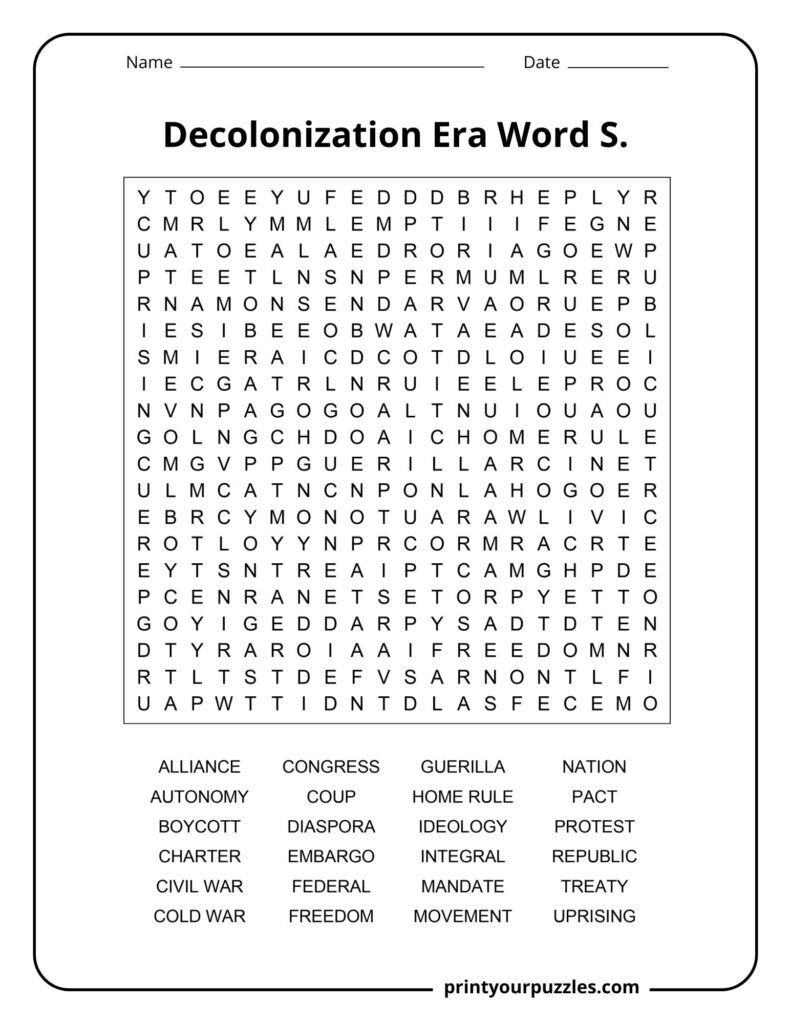
ALLIANCE, AUTONOMY, BOYCOTT, CHARTER, CIVIL WAR, COLD WAR, CONGRESS, COUP, DIASPORA, EMBARGO, FEDERAL, FREEDOM, GUERILLA, HOME RULE, IDEOLOGY, INTEGRAL, MANDATE, MOVEMENT, NATION, PACT, PROTEST, REPUBLIC, TREATY, UPRISING
The Decolonization Era refers to the period between 1945 and 1975 when dozens of nations in Africa, Asia, and the Caribbean gained independence from European colonial powers.
Key causes included the weakening of European powers after World War II, the rise of nationalist movements, Cold War pressures, and growing international support for self-determination and human rights.
Sub-Saharan Africa, South and Southeast Asia, the Middle East, and the Caribbean were most affected, with over 80 new independent nations emerging between 1945 and 1980.
No. While some nations gained independence through negotiation, many others — such as Algeria, Kenya, and Vietnam — endured violent armed conflicts and prolonged wars against colonial powers resisting independence.
Decolonization left complex legacies including unstable borders, economic dependency, political fragility, and cultural tensions, while also inspiring global movements for civil rights, equality, and national self-determination.
The Fate of Africa: A History of the Continent Since Independence by Martin Meredith. Oxford-based historian Meredith, drawing on four decades in Africa, transforms the entire continent’s decolonization era into a sweeping, dispassionately brilliant narrative — riveting as a novel, authoritative as scholarship.
The 1960s, known as the “Year of Africa,” saw 17 countries alone achieve independence in 1960, transforming the continent’s political map forever.
The UN’s 1960 Declaration on the Granting of Independence formally condemned colonialism, pressuring European powers to relinquish their overseas territories more rapidly.
Several European nations staged flawed votes in their territories, offering limited options designed to maintain economic and political control even after formal independence was granted.
Both the United States and Soviet Union supplied money, weapons, and training to rival independence factions, turning decolonizing nations into battlegrounds for global ideological competition.
European powers at the 1884 Berlin Conference divided Africa using straight lines on maps, splitting communities and planting seeds for future civil conflicts.