
The Renaissance was a major period of cultural, artistic, scientific, and intellectual change that began in Italy during the fourteenth century. It later spread across Europe and continued into the sixteenth and early seventeenth centuries. The word Renaissance means “rebirth,” referring to the renewed interest in the art, literature, philosophy, and ideas of Ancient Greece and Ancient Rome.
The movement first flourished in wealthy Italian cities such as Florence, Venice, Milan, and Rome. Trade, banking, and political competition created fortunes that could support artists, architects, writers, and scholars. Powerful families, merchants, rulers, and popes acted as patrons, paying for paintings, sculptures, buildings, books, and public monuments. The Medici family of Florence became one of the most famous examples.
Humanism was one of the central ideas of the Renaissance. Humanist scholars studied classical languages, history, philosophy, literature, and politics while emphasizing education, individual ability, and human experience. Religion remained important, but writers and artists also explored ambition, beauty, nature, government, love, and personal achievement.
Renaissance artists developed new techniques that made their work more realistic and expressive. Linear perspective created the illusion of depth, while careful studies of anatomy improved the human figure. Light, shadow, proportion, and detailed landscapes became increasingly important. Leonardo da Vinci, Michelangelo, Raphael, Botticelli, Donatello, and Titian produced works that remain among the most admired in world art.
The Renaissance also encouraged new approaches to science and observation. Scholars such as Copernicus, Galileo, and Vesalius questioned older explanations of the universe and the human body. Advances in astronomy, anatomy, engineering, navigation, and mapmaking helped prepare the way for the Scientific Revolution and European overseas exploration.
Several inventions and developments from this period still influence modern life. Johannes Gutenberg’s movable-type printing press made books cheaper and helped ideas travel more quickly. Improved clocks, eyeglasses, maps, navigational instruments, architectural methods, and technical drawings also became more important. Renaissance perspective remains essential in art and design, while careful observation continues to shape science and engineering.
Renaissance ideas spread beyond Italy to England, France, Germany, and the Low Countries, where artists and writers combined humanism with religious reform and social criticism.
The Renaissance word search helps students discover the people, ideas, places, and artistic techniques that shaped this remarkable period. Terms such as humanism, Florence, the Medici, Leonardo, Michelangelo, perspective, anatomy, printing, Shakespeare, and Galileo reveal how the Renaissance transformed European art, learning, science, and culture.
Related Word Searches:
Ancient Rome | Feudalism | Carolingian Empire | Silk Road | Ancient Greece | Age of Exploration
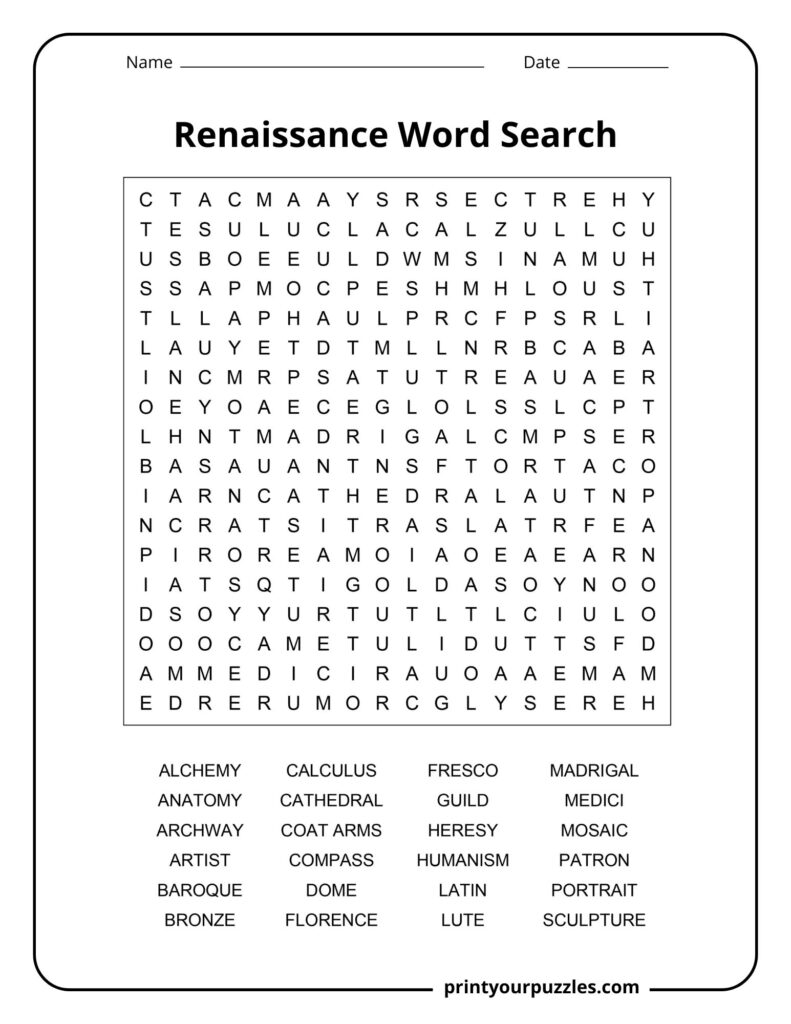
ALCHEMY, ANATOMY, ARCHWAY, ARTIST, BAROQUE, BRONZE, CALCULUS, CATHEDRAL, COAT ARMS, COMPASS, DOME, FLORENCE, FRESCO, GUILD, HERESY, HUMANISM, LATIN, LUTE, MADRIGAL, MEDICI, MOSAIC, PATRON, PORTRAIT, SCULPTURE
ALCHEMY – Ancient practice combining early chemistry and philosophy, seeking to transform base metals into gold and discover the elixir of eternal life, widely studied during the Renaissance period.
ANATOMY – Scientific study of the human body’s structure, revolutionized during the Renaissance by artists and scholars like Leonardo da Vinci through detailed dissections and precise anatomical drawings.
ARCHWAY – Curved architectural structure forming a passage or entrance, commonly used in Renaissance buildings to blend Roman classical influences with new artistic and structural innovations of the era.
ARTIST – Skilled creator of visual works such as paintings and sculptures, elevated during the Renaissance from simple craftsman to intellectual genius celebrated by patrons, courts and the Church.
BAROQUE – Ornate and dramatic artistic style that emerged after the Renaissance, characterized by grandeur, rich detail, bold contrasts of light and shadow, and intense emotional expression in art.
BRONZE – Durable metal alloy of copper and tin widely used by Renaissance sculptors to cast monumental statues, reliefs and commemorative works that celebrated both sacred and secular subjects.
CALCULUS – Branch of mathematics dealing with rates of change and accumulation, whose foundations were developed during the Renaissance era, paving the way for modern science and engineering advances.
CATHEDRAL – Large and majestic Christian church serving as a bishop’s seat, built with soaring architecture, stained glass and artistic decoration that made it the ultimate symbol of Renaissance faith.
COAT ARMS – Hereditary visual design used on shields and banners to identify noble families, guilds and cities, becoming a refined art form and symbol of social status during the Renaissance.
COMPASS – Essential drawing and navigation instrument used by Renaissance architects, artists and explorers to measure distances, draw perfect circles and chart unknown territories across the expanding known world.
DOME – Rounded architectural roof structure perfected during the Renaissance, most famously by Brunelleschi in Florence, symbolizing both technical mastery and the human ambition to reach toward the heavens.
FLORENCE – Wealthy and powerful Italian city widely regarded as the birthplace of the Renaissance, home to the Medici family and brilliant figures like Dante, Botticelli, Michelangelo and Leonardo.
FRESCO – Painting technique executed directly onto fresh wet plaster walls or ceilings, allowing pigments to bond permanently with the surface, used masterfully by Michelangelo and Raphael in iconic works.
GUILD – Organized association of craftsmen or merchants sharing a trade, controlling quality standards and training apprentices, playing a vital economic and cultural role in Renaissance cities and artistic production.
HERESY – Belief or opinion strongly contradicting established Church doctrine, a dangerous accusation during the Renaissance when religious authority clashed with new scientific discoveries and humanist philosophical thinking.
HUMANISM – Intellectual movement placing human beings and their potential at the center of thought, drawing inspiration from classical antiquity and reshaping Renaissance education, art, philosophy and political theory.
LATIN – Classical language of ancient Rome that served as the universal language of scholarship, religion, diplomacy and literature throughout the Renaissance, essential for any educated European person of the time.
LUTE – Plucked stringed musical instrument with a rounded body and fretted neck, enormously popular during the Renaissance as both a solo and accompaniment instrument in courts and noble households.
MADRIGAL – Sophisticated form of secular vocal music composed for multiple voices without instrumental accompaniment, flourishing during the Renaissance in Italy and England with complex harmonies and expressive poetic texts.
MEDICI – Powerful and extraordinarily influential Florentine banking dynasty who became the most important patrons of Renaissance art and culture, supporting artists like Botticelli, Michelangelo and Leonardo da Vinci.
MOSAIC – Art form creating images from small pieces of colored glass, stone or tile, revived and refined during the Renaissance to decorate church interiors, floors and walls with dazzling visual narratives.
PATRON – Wealthy individual or institution providing financial support to artists, musicians and scholars, enabling creative work to flourish throughout the Renaissance in exchange for prestige, loyalty and commemorative artworks.
PORTRAIT – Artistic representation capturing the likeness, personality and status of an individual, transformed during the Renaissance into a powerful genre celebrating human identity, dignity and the individuality of the sitter.
SCULPTURE – Three-dimensional art form using materials like marble, bronze and wood to create figures and reliefs, reaching extraordinary heights of technical and expressive mastery during the Renaissance through artists like Michelangelo.
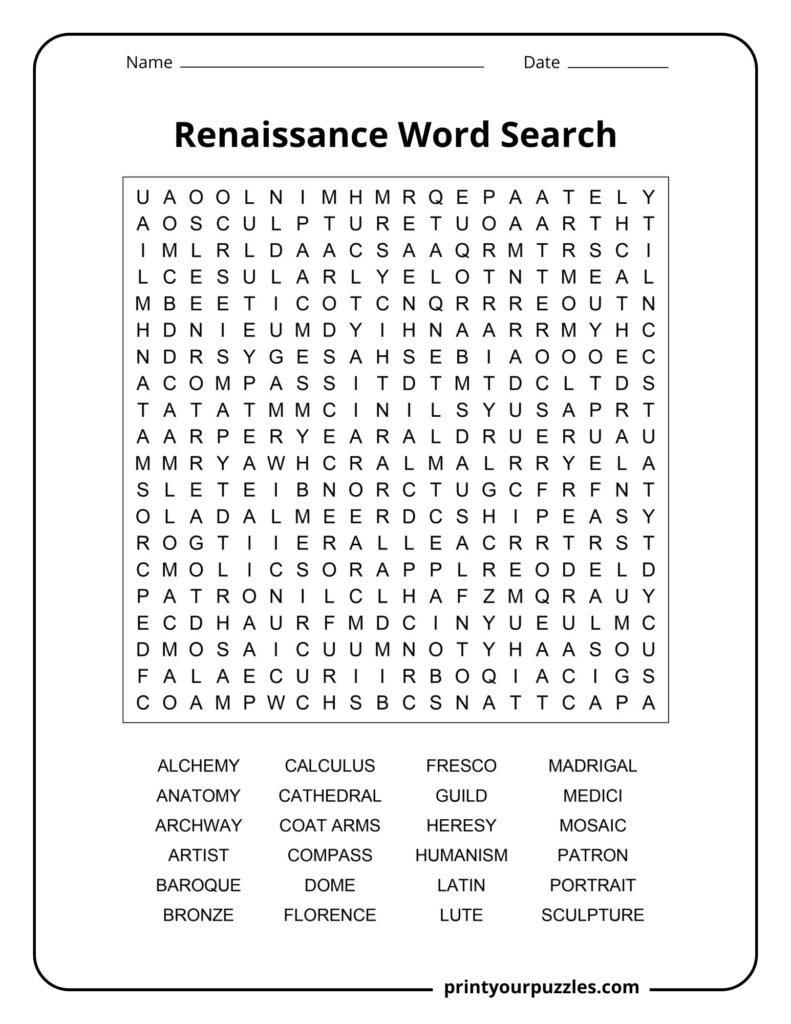
ALCHEMY, ANATOMY, ARCHWAY, ARTIST, BAROQUE, BRONZE, CALCULUS, CATHEDRAL, COAT ARMS, COMPASS, DOME, FLORENCE, FRESCO, GUILD, HERESY, HUMANISM, LATIN, LUTE, MADRIGAL, MEDICI, MOSAIC, PATRON, PORTRAIT, SCULPTURE
A cultural and intellectual rebirth in Europe from the 14th to 17th century, reviving classical Greek and Roman ideals while transforming art, science, philosophy and human understanding.
It originated in Florence, Italy, fueled by wealthy patrons like the Medici family, a thriving merchant economy and an exceptional concentration of artistic and intellectual talent.
Leonardo da Vinci, Michelangelo, Raphael, Galileo, Copernicus and Erasmus stand out as giants who reshaped art, science, astronomy and philosophy with their groundbreaking and enduring contributions.
An intellectual movement that placed human potential, reason and dignity at the center of thought, drawing inspiration from classical antiquity and challenging the strictly religious worldview of the medieval period.
It laid the foundations of the modern world by advancing science, celebrating individual achievement, revolutionizing art and architecture and inspiring a spirit of inquiry that still shapes Western civilization today.
Michelangelo and the Pope’s Ceiling by Ross King. King, a PhD historian turned master storyteller, weaves papal politics, artistic rivalry, and fresco technique into a rigorously sourced, novelistic thriller — making the Renaissance’s greatest creation feel electrifyingly alive.
He wrote backwards from right to left, possibly to keep ideas private or simply because, as a left-handed person, it felt more natural and prevented ink smearing.
This technique, called tempera, made colors dry quickly and remain vivid for centuries. Many masterpieces painted with egg-based pigments still display remarkably bright and well-preserved colors today
Despite the enormous scale of the project, he dismissed most assistants and completed the breathtaking 500 square meter ceiling almost single-handedly over an exhausting four-year period ending in 1512.
Gutenberg’s printing press, invented around 1440, revolutionized knowledge by making books affordable and widely accessible, accelerating the spread of Renaissance ideas across Europe at an unprecedented speed.
Raphael painted major works before turning 25, and Michelangelo completed his breathtaking Pietà sculpture at just 24, proving that extraordinary genius flourished remarkably early during this golden creative era.