
The Mayan civilization was one of the most advanced and influential cultures of the ancient Americas. It developed across a large part of Mesoamerica, including present-day southern Mexico, Guatemala, Belize, Honduras, and El Salvador. Maya history lasted for more than two thousand years, with the Classic Period, from about 250 to 900 CE, marking the height of many great cities, royal dynasties, artistic achievements, and scientific discoveries.
The Maya were not united under one permanent empire. Instead, they lived in independent city-states such as Tikal, Palenque, Copán, Calakmul, and Chichén Itzá. Each city had its own ruler, noble families, temples, army, and political alliances. Kings held both political and religious authority, organizing warfare, ceremonies, trade, building projects, and relationships with neighboring cities.
Religion was closely connected to government, agriculture, and the natural world. The Maya worshipped many gods associated with rain, maize, the sun, death, creation, and fertility. Priests performed rituals, sacrifices, and ceremonies intended to maintain harmony between people, the gods, and nature. Sacred calendars helped determine the proper dates for religious events and royal activities.
Most Maya people worked in agriculture, growing maize, beans, squash, cacao, chili peppers, and other crops. Farmers supported large urban populations, while artisans, merchants, warriors, scribes, priests, and nobles filled specialized roles. Maya cities contained stepped pyramids, temples, palaces, plazas, ball courts, reservoirs, and raised roads that demonstrated advanced planning and engineering.
The Maya created one of the most developed writing systems in the ancient Americas. Scribes used hieroglyphic symbols to record rulers, wars, ceremonies, astronomy, and historical events on monuments, pottery, and books called codices. Maya mathematicians used a base-20 number system and an important symbol for zero. Their calendars tracked ritual cycles, the solar year, and long periods of historical time.
Many Maya achievements still influence life today. Their knowledge of astronomy helped them observe the movements of the sun, moon, Venus, and eclipses with remarkable accuracy. They also developed reservoirs, terraced farming, raised fields, rubber processing, chocolate preparation, and durable pigments such as Maya blue. Maize and cacao, cultivated in Mesoamerica long before European contact, remain important foods throughout the world.
Many southern Maya cities declined after the ninth century because of factors that may have included drought, warfare, environmental pressure, and political instability. However, the Maya did not disappear. Millions of Maya people and many Maya languages survive today.
Related Word Searches:
Inca Empire | Ancient Egypt | Ancient Mesopotamia | Ancient China | Stone Age | Neolithic Revolution
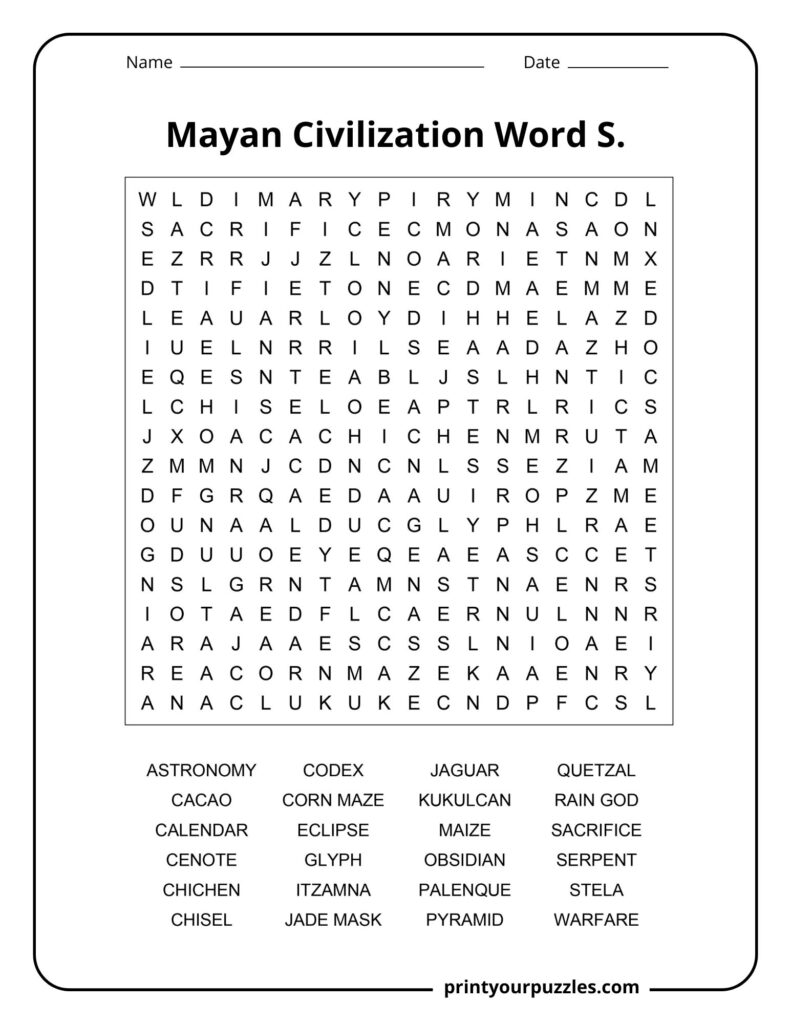
ASTRONOMY, CACAO, CALENDAR, CENOTE, CHICHEN, CHISEL, CODEX, CORN MAZE, ECLIPSE, GLYPH, ITZAMNA, JADE MASK, JAGUAR, KUKULCAN, MAIZE, OBSIDIAN, PALENQUE, PYRAMID, QUETZAL, RAIN GOD, SACRIFICE, SERPENT, STELA, WARFARE
ASTRONOMY – The Maya were expert astronomers who tracked the movements of the sun, moon, planets, and stars to create precise calendars and predict celestial events with remarkable accuracy.
CACAO – Sacred to the Maya, cacao beans were used to make a bitter ceremonial chocolate drink and also served as currency, representing wealth, power, and divine connection in their society.
CALENDAR – The Maya developed two interlocking calendar systems, the 365-day Haab and the 260-day Tzolkin, which combined to create a 52-year cycle governing religious and agricultural life.
CENOTE – Natural sinkholes filled with fresh groundwater, cenotes were considered sacred portals to the underworld by the Maya, used for water supply, rituals, and offerings to the gods.
CHICHEN – Chichen Itza was one of the most powerful and influential Maya cities, located in the Yucatan Peninsula, featuring iconic temples, ball courts, and impressive astronomical monuments.
CHISEL – Maya artisans used stone and bone chisels to carve intricate glyphs, sculptures, and reliefs into limestone monuments, temples, and stelae, leaving behind a rich visual historical record.
CODEX – Folded bark-paper books created by Maya scribes containing astronomical data, religious rituals, prophecies, and historical records, with only four surviving the Spanish conquest and colonial destruction.
CORN MAZE – Maize fields were central to Maya civilization, providing the primary food source. Corn was also spiritually significant, as Maya mythology taught that humans were literally created from maize dough.
ECLIPSE – Maya astronomers carefully recorded and predicted solar and lunar eclipses using observation and mathematical calculations, believing these events were powerful omens requiring special ceremonies and sacrificial offerings.
GLYPH – Maya glyphs were a sophisticated writing system combining logographic and syllabic elements, carved or painted to record history, mythology, royal lineages, dates, and religious texts across monuments and codices.
ITZAMNA – The supreme deity of the Maya pantheon, Itzamna was the god of creation, writing, and wisdom, believed to have given humanity the gifts of knowledge, medicine, and the calendar system.
JADE MASK – Jade was the most precious material in Maya culture, and elaborately crafted jade masks were placed over the faces of deceased rulers during burial to ensure their divine transformation and afterlife journey.
JAGUAR – The jaguar was the most powerful animal symbol in Maya culture, representing strength, the night, and the underworld. Rulers wore jaguar pelts and took jaguar names to embody divine authority.
KUKULCAN – The feathered serpent deity worshipped across Mesoamerica, Kukulcan was central to Maya religion at Chichen Itza, where the famous El Castillo pyramid was built to honor and channel his power.
MAIZE – The foundation of Maya civilization, maize sustained entire populations and held deep spiritual meaning. The Maize God was one of their most important deities, symbolizing life, death, and resurrection.
OBSIDIAN – A naturally occurring volcanic glass, obsidian was highly valued by the Maya for crafting sharp blades, tools, and weapons. It was also traded extensively across Mesoamerica as a luxury commodity.
PALENQUE – An extraordinary Maya city in modern Chiapas, Mexico, Palenque is renowned for its refined architecture, detailed sculptural reliefs, and the elaborate tomb of the great ruler Pakal the Great.
PYRAMID – Maya pyramids were stepped temple structures serving as religious centers, royal tombs, and astronomical instruments, with staircases aligned to celestial events and summits housing sacred temple chambers for rituals.
QUETZAL – The brilliantly colored quetzal bird was sacred to the Maya, its long iridescent green tail feathers reserved exclusively for royalty and gods. It symbolized freedom, wealth, and divine favor throughout Mesoamerica.
RAIN GOD – Chaac was the Maya god of rain, lightning, and storms, extremely important in the Yucatan where droughts were frequent. Elaborate ceremonies and offerings were dedicated to ensuring sufficient rainfall for crops.
SACRIFICE – Ritual sacrifice, including both animal and human offerings, was a central Maya religious practice meant to nourish the gods, maintain cosmic balance, and ensure the continuation of life and agricultural fertility.
SERPENT – Serpents held profound symbolic importance in Maya religion, representing fertility, water, time, and divine power. The feathered serpent deity and vision serpents appeared extensively throughout Maya art and ceremonial practice.
STELA – Tall carved stone monuments erected by Maya rulers to commemorate important dates, military victories, and personal achievements, stelae served as public declarations of royal power and historical record-keeping across Maya cities.
WARFARE – Warfare was integral to Maya civilization, conducted to capture noble prisoners for sacrifice, expand political influence, and control trade routes. Elite warriors held high social status and battles were ritualized events.
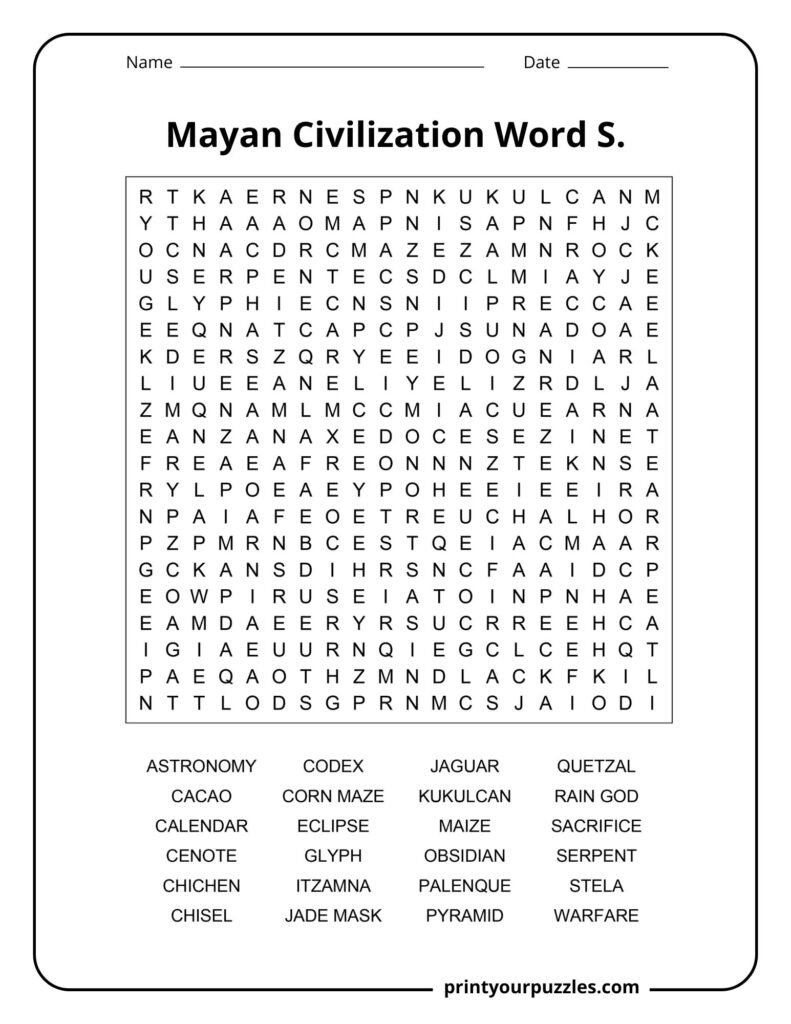
ASTRONOMY, CACAO, CALENDAR, CENOTE, CHICHEN, CHISEL, CODEX, CORN MAZE, ECLIPSE, GLYPH, ITZAMNA, JADE MASK, JAGUAR, KUKULCAN, MAIZE, OBSIDIAN, PALENQUE, PYRAMID, QUETZAL, RAIN GOD, SACRIFICE, SERPENT, STELA, WARFARE
The Maya civilization flourished from approximately 2000 BC, reaching its Classic Period peak between 250 and 900 AD, before gradually declining though Maya people exist today.
Historians believe a combination of prolonged droughts, overpopulation, warfare between city-states, political instability, and environmental degradation led to the dramatic collapse of major Maya cities around 900 AD.
No. The Maya calendar simply completed a major cycle in December 2012, similar to a new century beginning. Maya inscriptions actually reference dates far beyond 2012 without apocalyptic meaning.
The Maya independently developed the concept of zero, used a vigesimal base-20 number system, and performed remarkably accurate astronomical calculations, predicting eclipses and planetary cycles centuries into the future.
Yes. Approximately seven million Maya descendants live today across Mexico, Guatemala, Belize, Honduras, and El Salvador, many still speaking traditional Maya languages and maintaining cultural practices rooted in ancient traditions.
The Maya by Michael D. Coe & Stephen Houston. Yale’s preeminent Mayanist Coe, who helped crack the Maya hieroglyphic code, transforms five millennia of pyramid-building, dynastic warfare, and intellectual achievement into an authoritative yet compulsively readable masterwork — updated across ten editions.
Contrary to popular belief, the Maya civilization never truly vanished. Over seven million Maya descendants live today, preserving languages, traditions, and cultural practices inherited directly from their ancient ancestors.
The Maya played Pok-a-Tok, a ritual ball game where players kept a rubber ball airborne using only hips and knees, and losing players were sometimes sacrificed to honor the gods.
Using pure mathematical observation and careful record-keeping, Maya astronomers accurately predicted solar and lunar eclipses without telescopes, demonstrating scientific sophistication that rivaled and sometimes surpassed contemporary civilizations worldwide.
The Maya were the first known civilization to cultivate cacao and prepare chocolate as a bitter ceremonial drink mixed with water, chili, and spices, consumed during sacred rituals and royal celebrations.
El Castillo pyramid at Chichen Itza was precisely engineered so that during spring and autumn equinoxes, sunlight creates a serpent shadow illusion descending its staircase, functioning as a spectacular astronomical calendar.