

The Neolithic Revolution was one of the most important turning points in human history. Beginning in some regions around 10,000 BCE, it marked the gradual transition from hunting and gathering to farming, animal domestication, and permanent settlement. This change did not happen everywhere at the same time, but over thousands of years it transformed how people found food, organized communities, and interacted with the environment.
Several factors may have encouraged this transition. After the last Ice Age, warmer climates changed landscapes and made some wild plants more abundant. Growing populations also increased the need for reliable food supplies. Through generations of observation and experimentation, people learned when seeds grew best, which animals could be controlled, and how seasonal cycles affected food production.
The Fertile Crescent in Southwest Asia became one of the earliest centers of agriculture, where people cultivated wheat and barley and domesticated sheep and goats. Farming also developed independently in other parts of the world. Rice and millet were grown in China, maize and beans in Mesoamerica, potatoes in the Andes, and different crops in Africa and New Guinea.
Agriculture encouraged people to remain in one place for longer periods. Small settlements grew into permanent villages, including communities such as Jericho and Çatalhöyük. Larger food supplies supported population growth, while houses, storage areas, and shared spaces became more organized. People could store grain and other foods for seasons when fresh resources were limited.
New tools and technologies developed alongside farming. Polished stone axes, sickles, grinding stones, plows, baskets, pottery, weaving, irrigation channels, and stronger houses made food production and daily life more efficient. Many of these innovations still have modern equivalents in agriculture, food storage, textile production, construction, and water management.
Food surpluses also changed society. Not everyone needed to work directly in farming, allowing some people to become artisans, traders, builders, religious leaders, or warriors. Trade in obsidian, shells, pottery, tools, and food connected distant communities. At the same time, differences in land, wealth, and power contributed to growing social inequality.
The Neolithic Revolution brought both advantages and problems. Farming could support larger populations and permanent settlements, but it also led to harder labor, infectious disease, environmental damage, conflict over land, and dependence on a limited number of crops.
With this Neolithic Revolution word search, students can explore vocabulary connected to agriculture, domestication, villages, livestock, pottery, irrigation, surplus, trade, and the beginnings of more complex societies.
Related Word Searches:
Stone Age | Ancient Mesopotamia | Ancient Egypt | Ancient China | Mayan Civilization | Inca Empire
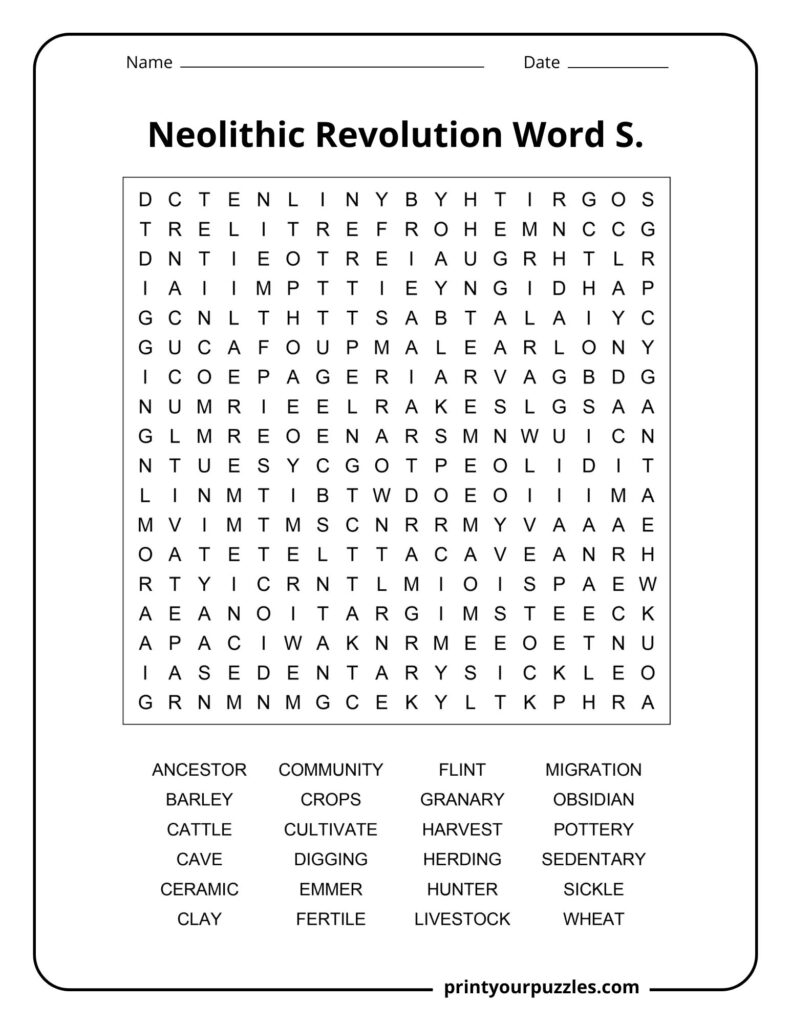
ANCESTOR, BARLEY, CATTLE, CAVE, CERAMIC, CLAY, COMMUNITY, CROPS, CULTIVATE, DIGGING, EMMER, FERTILE, FLINT, GRANARY, HARVEST, HERDING, HUNTER, LIVESTOCK, MIGRATION, OBSIDIAN, POTTERY, SEDENTARY, SICKLE, WHEAT
ANCESTOR – A person from whom one is descended, living in prehistoric times before written records, whose survival and adaptation shaped early human communities and genetic heritage.
BARLEY – One of the first crops domesticated during the Neolithic Revolution, grown in fertile regions and used as food, animal feed, and for producing early fermented beverages.
CATTLE – Large domesticated bovine animals raised during the Neolithic period for meat, milk, leather, and labor, representing a major shift from hunting wild animals to farming.
CAVE – A natural underground shelter used by early humans before permanent settlements, providing protection from predators and harsh weather during the transition to Neolithic life.
CERAMIC – Objects made from fired clay, including pots and storage vessels, developed during the Neolithic Revolution to store food, water, and grain in permanent settlements.
CLAY – A natural earth material used by Neolithic peoples to craft pottery, bricks, and figurines, becoming essential for food storage, construction, and early artistic expression.
COMMUNITY – A group of people living together in early Neolithic villages, sharing resources, labor, and social responsibilities, forming the foundation of organized human civilization and culture.
CROPS – Plants intentionally cultivated for food during the Neolithic Revolution, including wheat, barley, and legumes, allowing communities to produce reliable food supplies and abandon nomadic lifestyles.
CULTIVATE – The deliberate process of preparing soil, planting seeds, and tending to growing plants, a revolutionary practice that transformed human societies from foragers into settled agricultural communities.
DIGGING – The manual labor of breaking and turning soil using stone or bone tools, essential for planting crops, building shelters, and burying the dead in Neolithic communities.
EMMER – An ancient variety of wheat among the earliest crops domesticated in the Fertile Crescent, providing a nutritious grain that sustained early farming communities across the ancient world.
FERTILE – Describing land rich in nutrients capable of supporting abundant crop growth, particularly the Fertile Crescent region where the Neolithic Revolution first emerged around ten thousand years ago.
FLINT – A hard stone widely used by Neolithic people to craft sharp tools and weapons such as blades, arrowheads, and sickles, essential for farming, hunting, and daily survival.
GRANARY – A building or storage structure used by Neolithic communities to store harvested grain, protecting food supplies from moisture and pests and enabling communities to survive through winter.
HARVEST – The seasonal gathering of mature crops from cultivated fields, a critical event in Neolithic farming life that determined a community’s food supply and survival through colder months.
HERDING – The practice of managing and moving groups of domesticated animals such as sheep, goats, and cattle, providing Neolithic communities with reliable sources of meat, milk, and wool.
HUNTER – A person who pursued and killed wild animals for food before and during the Neolithic transition, gradually shifting toward herding and farming as more reliable food sources emerged.
LIVESTOCK – Domesticated animals kept by Neolithic farmers for food, labor, and materials, including cattle, pigs, sheep, and goats, fundamentally changing humanity’s relationship with the natural animal world.
MIGRATION – The movement of human groups across landscapes in search of food, water, and fertile land, spreading Neolithic farming practices and culture from the Middle East across Europe and Asia.
OBSIDIAN – A naturally occurring volcanic glass prized by Neolithic peoples for crafting extremely sharp cutting tools and blades, also traded across long distances as a valuable prehistoric commodity.
POTTERY – Containers and vessels shaped from clay and hardened by fire, invented during the Neolithic period to store, cook, and transport food and water in permanent agricultural settlements.
SEDENTARY – Describing a lifestyle where people remain permanently settled in one location, a defining characteristic of Neolithic communities that built villages and relied on agriculture rather than constant movement.
SICKLE – A curved cutting tool with a sharp flint or stone blade, used by Neolithic farmers to harvest cereal crops efficiently, representing one of the earliest specialized agricultural implements.
WHEAT – One of the most important crops first domesticated during the Neolithic Revolution in the Fertile Crescent, becoming a dietary staple that supported the growth of early human civilizations.
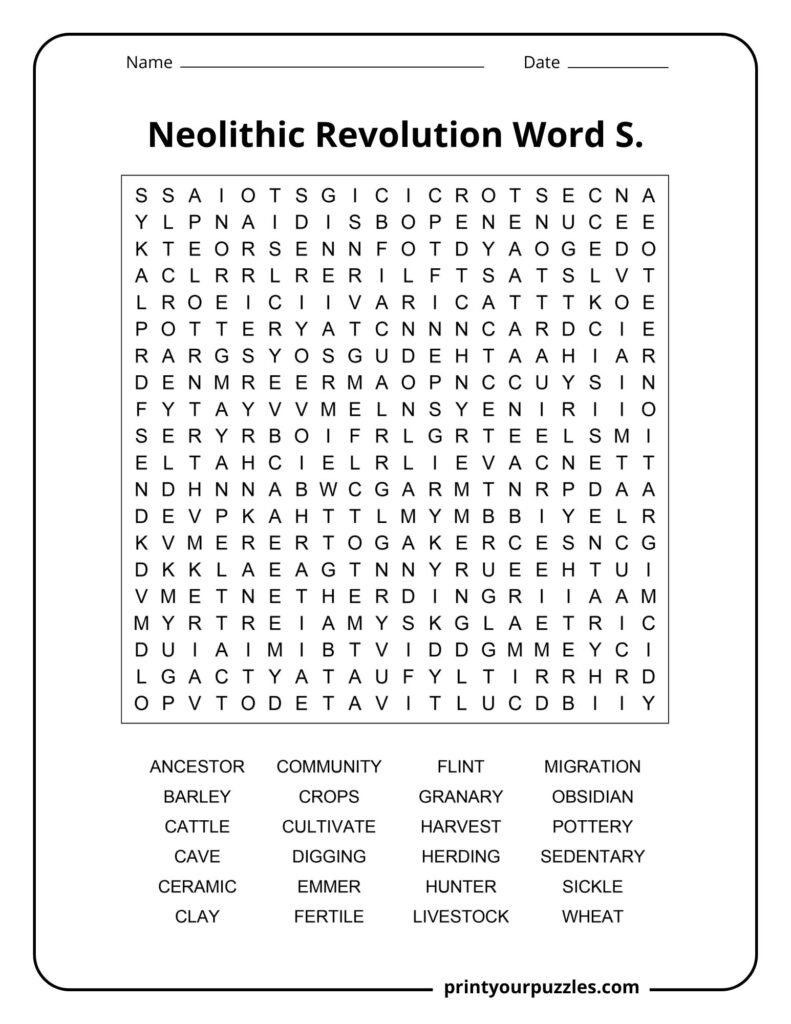
ANCESTOR, BARLEY, CATTLE, CAVE, CERAMIC, CLAY, COMMUNITY, CROPS, CULTIVATE, DIGGING, EMMER, FERTILE, FLINT, GRANARY, HARVEST, HERDING, HUNTER, LIVESTOCK, MIGRATION, OBSIDIAN, POTTERY, SEDENTARY, SICKLE, WHEAT
A major turning point when humans shifted from nomadic hunting and gathering to settled farming and animal domestication, beginning around 10,000 BCE in the Fertile Crescent.
It originated in the Fertile Crescent, a region spanning modern Iraq, Syria, and Turkey, later spreading independently to China, Mesoamerica, and other parts of the world.
Climate changes after the last Ice Age created favorable conditions for plant cultivation, pushing human groups to experiment with agriculture as a more reliable food source.
Goats, sheep, pigs, and cattle were among the earliest domesticated animals, providing communities with steady supplies of meat, milk, wool, and labor for farming.
It led to population growth, permanent villages, social hierarchies, division of labor, and eventually writing and trade, laying the foundations of modern human civilization.
After the Ice: A Global Human History, 20,000–5000 BC by Steven Mithen. University of Reading archaeologist Mithen ingeniously sends a fictional time-traveller across 50 excavation sites worldwide — wrapping rigorous, multi-disciplinary Neolithic scholarship in an irresistibly vivid, globe-spanning human adventure.
Some researchers believe ancient peoples began cultivating barley not primarily for bread, but to produce fermented alcoholic beverages for ritual and social celebrations.
Archaeological evidence shows early farmers had poorer diets, more dental decay, and shorter stature than their hunter-gatherer ancestors due to less dietary variety.
As grain storage attracted rodents, wildcats began following human settlements to hunt them, gradually becoming tolerated and then welcomed companions without any deliberate human intervention.
Çatalhöyük in modern Turkey, one of the earliest known towns, was already thriving around 7,500 BCE, thousands of years before Egypt’s great monuments were built.
Farming was separately invented in the Middle East, China, New Guinea, Mesoamerica, the Andes, West Africa, and eastern North America, with no contact between these cultures.