Introduction to the Lego Word Search
LEGO is one of the most recognizable toy brands in the world, famous for small interlocking bricks that can be combined to create buildings, vehicles, characters, machines, and almost anything a builder can imagine. Its story began in Billund, Denmark, in 1932 with carpenter Ole Kirk Christiansen, who started making wooden toys during a difficult period for his business.
Christiansen had originally worked as a carpenter and furniture maker, but the economic troubles of the early 1930s reduced demand for larger projects. He began producing smaller wooden items and toys, gradually discovering that toys could become the future of the company. In 1934, he chose the name LEGO, based on the Danish phrase “leg godt,” meaning “play well.” The name later proved especially fitting for a company built around creativity and construction.
The business remained a family enterprise. Ole Kirk’s son, Godtfred Kirk Christiansen, became increasingly involved and later played a major role in developing the company’s long-term direction. After World War II, LEGO began experimenting with plastic, a relatively new material for toys at the time. In 1949, the company introduced early plastic building bricks that would eventually evolve into the modern LEGO system.
A crucial breakthrough came in 1958 with the stud-and-tube design. This improved connection made bricks hold together securely while still allowing them to be separated and reused. Even more importantly, it created a system in which pieces from different sets could remain compatible, encouraging children to combine, rebuild, and invent rather than use a toy only one way.
That history gives a Lego word search puzzle plenty of distinctive vocabulary, including Billund, bricks, studs, tubes, wooden toys, minifigures, building, sets, and imagination.
LEGO later expanded into themed worlds involving cities, castles, space, pirates, vehicles, and many other subjects. Minifigures added characters to these creations, while licensed themes connected LEGO with films, superheroes, fantasy stories, and popular entertainment. Theme parks, movies, video games, and products for adult builders broadened the brand even further.
From a small Danish carpentry business to an international symbol of creative play, LEGO grew through family entrepreneurship, clever design, and the simple idea that one set of pieces could be used to build countless new things.
Related Word Searches:
Disney | Sony | Amazon | Apple
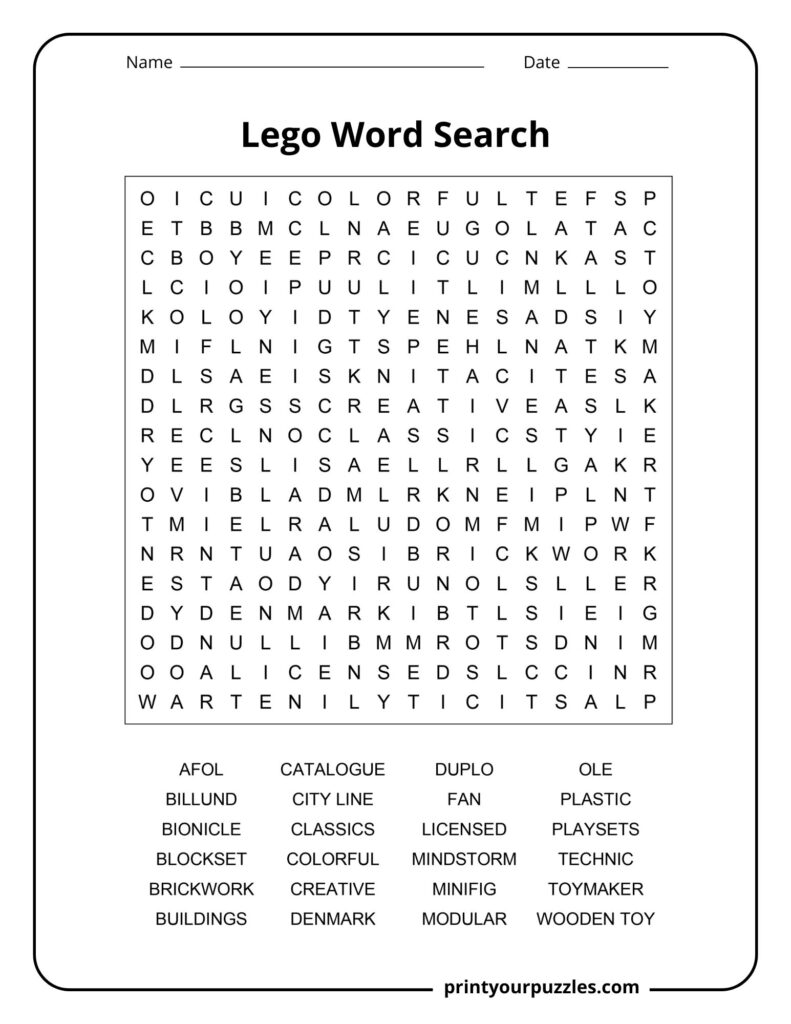
Medium Difficulty Word Search
Words to Find
AFOL, BILLUND, BIONICLE, BLOCKSET, BRICKWORK, BUILDINGS, CATALOGUE, CITY LINE, CLASSICS, COLORFUL, CREATIVE, DENMARK, DUPLO, FAN, LICENSED, MINDSTORM, MINIFIG, MODULAR, OLE, PLASTIC, PLAYSETS, TECHNIC, TOYMAKER, WOODEN TOY
All Words Defined
AFOL – Widely recognized acronym standing for Adult Fan Of LEGO, describing the passionate global community of grown-up enthusiasts who collect, build and celebrate LEGO with the same joy and dedication as children.
BILLUND – Small Danish town and birthplace of the LEGO Group, where Ole Kirk Christiansen founded his carpentry workshop in 1932, later transforming it into the iconic toy brick company we know today.
BIONICLE – Iconic LEGO theme launched in 2001 featuring buildable action figures with rich storylines inspired by Polynesian mythology, becoming one of the most successful and beloved product lines in LEGO history.
BLOCKSET – Complete collection of interlocking plastic bricks and elements packaged together with instructions, allowing builders of all ages to construct specific models or freely create their own original designs.
BRICKWORK – The art and technique of assembling LEGO bricks together in creative and structural ways, forming the fundamental building skill that has defined the LEGO play experience since the earliest sets.
BUILDINGS – Architectural constructions created from LEGO bricks, ranging from simple houses to detailed replicas of famous landmarks, representing one of the most popular and enduring categories in LEGO set history.
CATALOGUE – Iconic printed booklet distributed annually by LEGO showcasing their full range of available sets and themes, eagerly anticipated by children worldwide and serving as a key marketing tool for decades.
CITY LINE – Popular LEGO theme representing everyday urban life with sets including police stations, fire trucks, hospitals and airports, teaching children about community roles through imaginative and relatable play scenarios.
CLASSICS – Foundational LEGO sets celebrating the original open-ended building experience with assorted bricks in multiple colors, encouraging pure creativity without instructions and honoring the brand’s long toy-making heritage.
COLORFUL – Defining visual characteristic of LEGO bricks since their earliest days, with a standardized palette of bright, bold colors that make sets instantly recognizable and stimulate children’s creativity and imagination.
CREATIVE – Core value embedded in LEGO’s philosophy since its founding, encouraging children and adults to imagine, design and build freely, making creativity the central purpose behind every brick ever produced.
DENMARK – Scandinavian country and proud home of the LEGO brand, whose design values, craftsmanship tradition and cultural emphasis on quality play deeply influenced the company’s identity and global success.
DUPLO – LEGO’s beloved product line introduced in 1969 designed for toddlers and young children, featuring bricks twice the size of standard LEGO pieces for safe, easy handling and early developmental play.
FAN – Devoted LEGO enthusiast of any age who passionately collects, builds and celebrates the brand, forming a worldwide community of millions who share creations, attend conventions and keep LEGO culture vibrantly alive.
LICENSED – Refers to LEGO’s highly successful partnerships with major entertainment franchises including Star Wars, Harry Potter and Marvel, producing themed sets that expanded the brand’s appeal enormously across all age groups.
MINDSTORM – Revolutionary LEGO robotics line launched in 1998 combining programmable bricks with motors and sensors, introducing children and adults to coding and engineering through hands-on building and creative technological exploration.
MINIFIG – Affectionate abbreviation for the LEGO minifigure, the small iconic humanoid character introduced in 1978 that transformed LEGO play by adding personality, storytelling and role-play to the building experience.
MODULAR – Advanced LEGO building concept introduced in 2007 featuring highly detailed multi-story buildings with removable floors and interchangeable sections, designed for adult collectors seeking architectural realism and display quality.
OLE – First name of Ole Kirk Christiansen, the humble Danish carpenter and visionary founder of LEGO, whose passion for quality craftsmanship and belief in the power of play created a global toy empire.
PLASTIC – The durable, precision-molded acrylonitrile butadiene styrene material LEGO adopted in 1958 for its iconic bricks, replacing earlier wooden toys and enabling the perfect clutch power that defines every genuine LEGO element.
PLAYSETS – Complete themed LEGO packages combining bricks, minifigures and accessories to recreate specific scenes or environments, providing children with immersive storytelling experiences across hundreds of imaginative themes and worlds.
TECHNIC – Advanced LEGO building system launched in 1977 featuring gears, axles, pins and beams that allow builders to create functional mechanical models with realistic moving parts, targeting older builders and engineering enthusiasts.
TOYMAKER – Honorable title describing Ole Kirk Christiansen and the LEGO company’s core identity, rooted in a deep commitment to crafting meaningful, high-quality playthings that educate, inspire and bring joy to children everywhere.
WOODEN TOY – Reference to LEGO’s earliest products made in Ole Kirk Christiansen’s carpentry workshop during the 1930s, before plastic bricks existed, including wooden ducks, cars and trucks that launched the company’s toy-making journey.
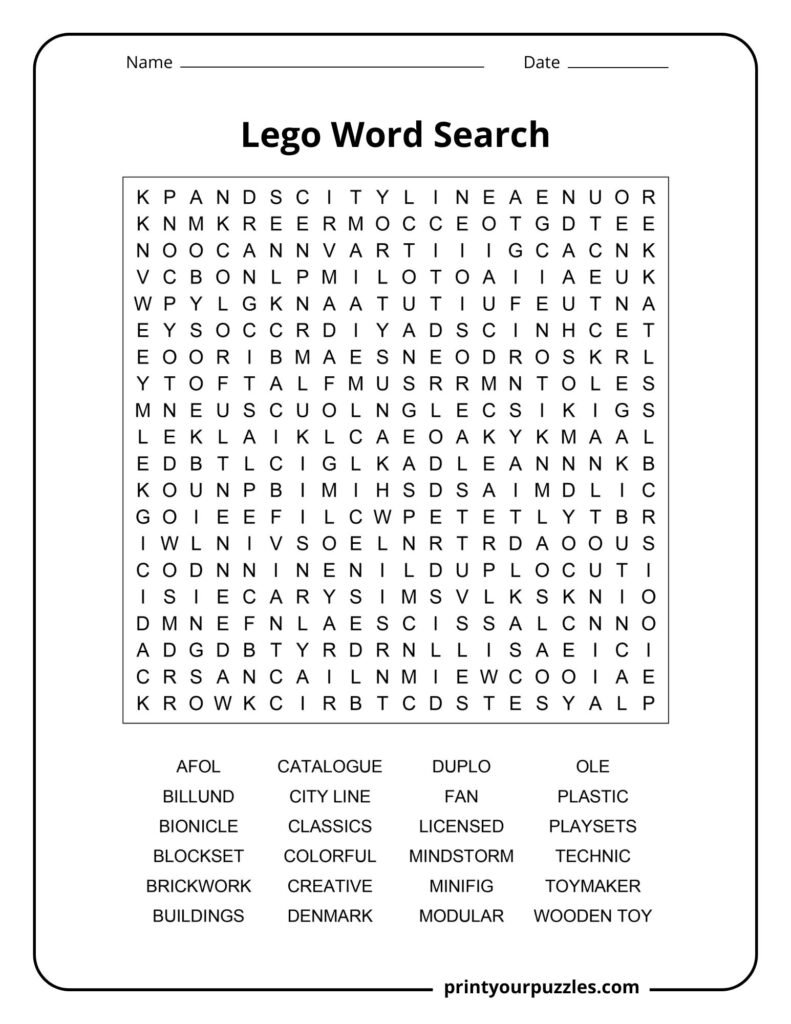
Hard Difficulty Word Search
Words to Find
AFOL, BILLUND, BIONICLE, BLOCKSET, BRICKWORK, BUILDINGS, CATALOGUE, CITY LINE, CLASSICS, COLORFUL, CREATIVE, DENMARK, DUPLO, FAN, LICENSED, MINDSTORM, MINIFIG, MODULAR, OLE, PLASTIC, PLAYSETS, TECHNIC, TOYMAKER, WOODEN TOY
6 Key FAQs About the Lego Brand
5 Curious "Did You Know?" Facts About Lego