
Tesla is one of the most recognizable names in the electric vehicle industry, known for battery-powered cars, software, charging technology, and ambitious ideas about transportation and energy. The company was founded in the United States in 2003 by Martin Eberhard and Marc Tarpenning, who believed electric cars could become practical, attractive, and exciting alternatives to gasoline-powered vehicles.
In its early years, Tesla faced a difficult challenge. Electric cars were often viewed as slow, limited, or impractical, so the company decided to begin with a high-performance sports car rather than a small economy vehicle. The Tesla Roadster, launched in the late 2000s, helped demonstrate that an electric car could offer strong acceleration and useful driving range. Elon Musk, who became an early investor and later the company’s most prominent leader, played a major role in financing, strategy, and the expansion of the business.
Tesla then moved toward larger-scale production. The Model S luxury sedan brought the company much wider attention, followed by the Model X SUV. The Model 3 was especially important because it was designed to reach a broader market, while the Model Y helped Tesla expand further into the popular crossover segment. Building these vehicles required major investments in factories, battery production, manufacturing systems, and global distribution.
The company also developed the Supercharger network, giving Tesla drivers access to fast charging on longer journeys. Software became another distinctive feature, with large touchscreen controls, mobile connectivity, over-the-air updates, and driver-assistance systems helping give the vehicles a technology-focused identity.
A printable Tesla word search puzzle can connect this growth story through terms such as Roadster, Model S, Model 3, batteries, charging, Superchargers, software, electric motors, and energy.
Tesla later expanded beyond cars into battery storage and solar-related products for homes, businesses, and power systems. From a small startup trying to prove the potential of electric vehicles to a major force in the automotive and energy industries, Tesla grew through bold product choices, large-scale investment, technological integration, and a willingness to challenge traditional ideas about how cars should be designed, sold, and powered.
Related Word Searches:
Ford | Michelin | Nvidia | General Electric
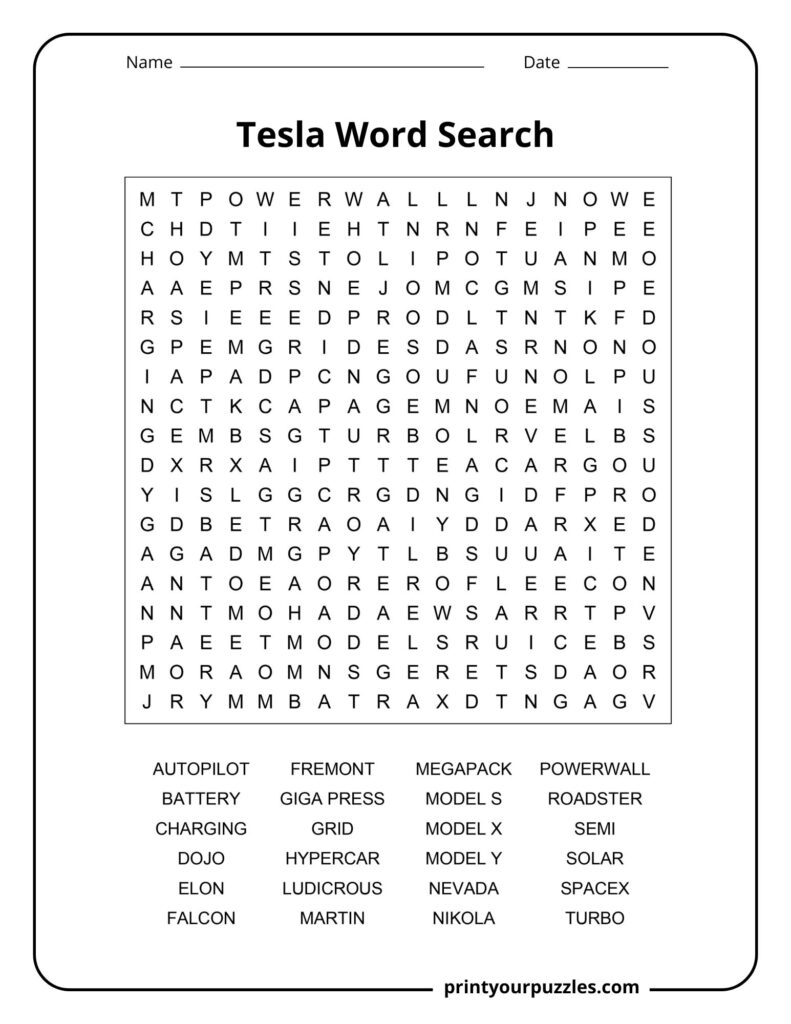
AUTOPILOT, BATTERY, CHARGING, DOJO, ELON, FALCON, FREMONT, GIGA PRESS, GRID, HYPERCAR, LUDICROUS, MARTIN, MEGAPACK, MODEL S, MODEL X, MODEL Y, NEVADA, NIKOLA, POWERWALL, ROADSTER, SEMI, SOLAR, SPACEX, TURBO
AUTOPILOT – Tesla’s advanced driver-assistance system that uses cameras and sensors to steer, accelerate, and brake automatically, helping drivers navigate highways with reduced manual input.
BATTERY – The rechargeable lithium-ion energy pack at the heart of every Tesla vehicle, storing electricity that powers the electric motor and all onboard systems.
CHARGING – The process of replenishing a Tesla’s battery using home outlets, destination chargers, or Tesla’s proprietary Supercharger network spread across the globe.
DOJO – Tesla’s custom-built supercomputer designed to train the neural networks behind Autopilot and Full Self-Driving by processing massive amounts of real-world video data.
ELON – Elon Musk, the entrepreneur who joined Tesla as chairman in 2004, became CEO in 2008, and transformed the company into the world’s leading electric vehicle manufacturer.
FALCON – The name of the distinctive falcon-wing doors on the Tesla Model X SUV, which open upward and outward, allowing easy access even in tight parking spaces.
FREMONT – The city in California where Tesla’s main vehicle assembly plant is located, a former joint GM-Toyota factory that became the backbone of Tesla’s early production.
GIGA PRESS – A massive die-casting machine used in Tesla’s factories to mold large sections of a vehicle’s underbody in a single piece, dramatically simplifying manufacturing and reducing costs.
GRID – The electrical power network that Tesla’s Powerwall, Megapack, and solar products interact with, enabling homes and utilities to store, share, and stabilize renewable energy supply.
HYPERCAR – A term that describes Tesla’s highest-performance vehicles, particularly the next-generation Roadster, which aims to rival and surpass the world’s fastest gasoline-powered supercars.
LUDICROUS – A performance mode introduced by Tesla in 2015 that enables extreme acceleration, allowing the Model S to reach 60 mph in under 3 seconds with remarkable ease.
MARTIN – Martin Eberhard, one of Tesla’s original co-founders, who launched the company in 2003 alongside Marc Tarpenning with a vision to accelerate the world’s transition to electric transport.
MEGAPACK – A large-scale industrial battery system built by Tesla for utilities and energy companies, capable of storing and discharging electricity to stabilize power grids during peak demand periods.
MODEL S – Tesla’s flagship luxury electric sedan, first delivered in 2012, that proved long-range electric vehicles were viable and set new benchmarks for performance, range, and over-the-air software updates.
MODEL X – Tesla’s premium all-electric SUV launched in 2015, known for its distinctive falcon-wing doors, exceptional safety ratings, and the ability to seat up to seven passengers comfortably.
MODEL Y – A compact electric crossover SUV introduced in 2020 that quickly became Tesla’s best-selling vehicle worldwide, praised for its practicality, range, and shared platform with the Model 3.
NEVADA – The US state where Tesla built its first Gigafactory near Reno, a massive facility dedicated to producing battery cells and Model 3 electric motors in partnership with Panasonic.
NIKOLA – Nikola Tesla, the Serbian-American inventor and electrical engineer whose pioneering work on alternating current inspired the company’s founders to name their electric vehicle brand after him.
POWERWALL – A home battery storage unit made by Tesla that stores solar or grid electricity for use during outages or peak hours, giving households greater energy independence and resilience.
ROADSTER – Tesla’s first production car, a two-seat electric sports vehicle launched in 2008, which demonstrated that electric cars could be high-performance and desirable, laying the foundation for the brand.
SEMI – Tesla’s fully electric heavy-duty commercial truck, unveiled in 2017 and delivered from 2022, designed to reduce operating costs for freight companies while eliminating diesel emissions on long hauls.
SOLAR – Tesla’s renewable energy division offering solar panels and the Solar Roof product, which replaces traditional roof tiles with glass cells that generate clean electricity directly for homes.
SPACEX – Elon Musk’s aerospace company that, while separate from Tesla, shares leadership, engineering culture, and manufacturing innovation philosophy, reinforcing Musk’s broader mission of sustainable human civilization.
TURBO – A performance variant designation used on Tesla’s Cybertruck, borrowing the iconic automotive term to brand the truck’s most powerful all-wheel-drive version with maximum towing and acceleration capability.
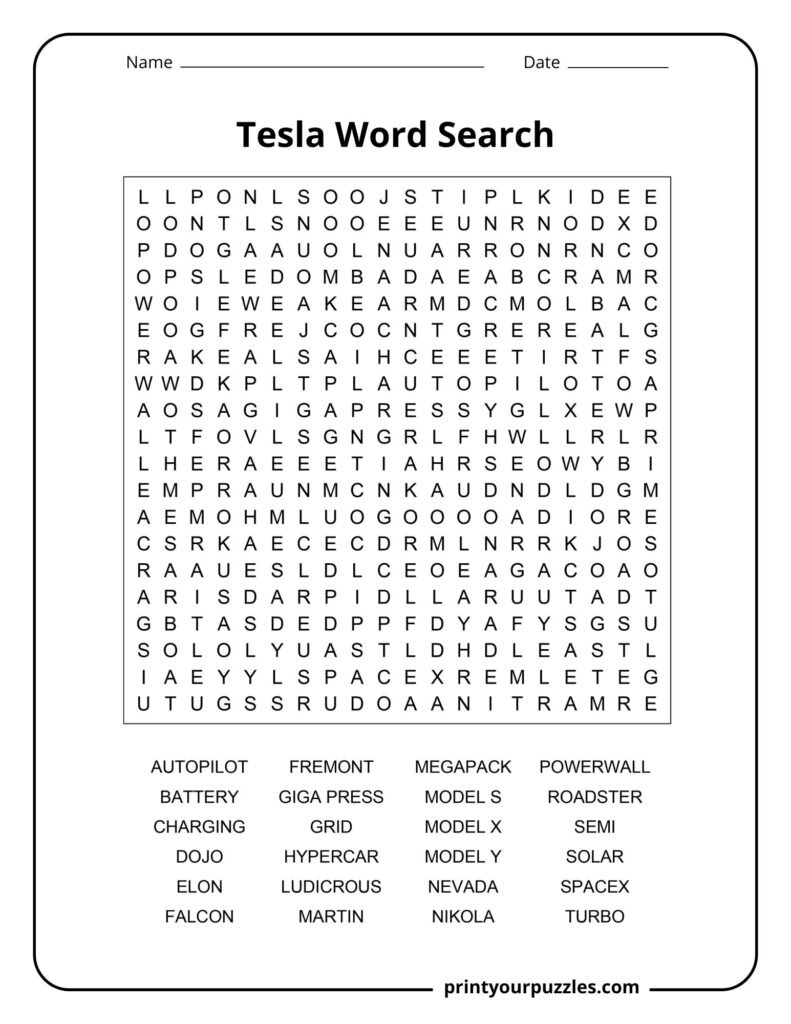
AUTOPILOT, BATTERY, CHARGING, DOJO, ELON, FALCON, FREMONT, GIGA PRESS, GRID, HYPERCAR, LUDICROUS, MARTIN, MEGAPACK, MODEL S, MODEL X, MODEL Y, NEVADA, NIKOLA, POWERWALL, ROADSTER, SEMI, SOLAR, SPACEX, TURBO
Tesla was founded in 2003 by Martin Eberhard and Marc Tarpenning to prove that electric vehicles could outperform gasoline cars while accelerating the world’s shift to sustainable energy.
Elon Musk joined Tesla as chairman and lead investor in 2004, became CEO in 2008, and drove the company’s global expansion into vehicles, energy storage, and solar products.
The 2008 Roadster was Tesla’s debut vehicle, proving electric cars could be fast, stylish, and practical, and establishing the brand’s credibility in the broader automotive industry.
Tesla scaled through the Model S, X, 3, and Y lineup, building Gigafactories worldwide to reduce costs and making electric vehicles mainstream for millions of everyday consumers.
No. Tesla also develops energy products including the Powerwall, Megapack, and Solar Roof, positioning itself as a full clean-energy company beyond just manufacturing electric vehicles.
Power Play: Tesla, Elon Musk, and the Bet of the Century by Tim Higgins. Higgins masterfully reconstructs Tesla’s hellish fifteen-year survival story — near-bankruptcy, meltdowns, and impossible gambles — through relentless front-row reporting that reads like a thriller without ever sacrificing journalistic rigour or balance.
The company honors Nikola Tesla, the Serbian-American genius who invented alternating current, a technology that remains fundamental to how electric motors in every Tesla vehicle work today.
In 2008, during the financial crisis, Tesla nearly collapsed. Musk invested his last personal funds to keep the company alive, just days before it would have shut down permanently.
The Fremont plant was previously the NUMMI factory, a joint venture between General Motors and Toyota — two traditional automakers that once dismissed electric vehicles as commercially unviable.
In 2018, Elon Musk launched his personal red Tesla Roadster aboard a SpaceX Falcon Heavy rocket, sending it into a solar orbit where it still travels through space today.
Tesla pioneered over-the-air software updates, meaning vehicles gain new features, improved performance, and bug fixes overnight while parked — without ever visiting a dealership or service center.