

Sony is one of Japan’s most famous technology and entertainment companies, with a history that began in the difficult years immediately after World War II. In 1946, engineer Masaru Ibuka and businessman Akio Morita founded a small electronics company in Tokyo. Operating with limited resources, the young business experimented with new products and looked for practical ways to bring modern technology into everyday life.
The company was originally called Tokyo Tsushin Kogyo, or Tokyo Telecommunications Engineering Corporation. Its early products included electrical equipment and Japan’s first commercially successful tape recorder. As the business grew, Ibuka and Morita realized they needed a shorter, more international name that would be easy to recognize outside Japan. In 1958, the company officially adopted the name Sony.
Transistor radios became one of Sony’s first major international successes. By making radios smaller and more portable, the company helped people take music and news with them rather than listening only at home. This focus on compact, personal electronics became a recurring theme in Sony’s development.
The company continued expanding into televisions, audio equipment, cameras, and home entertainment. Products such as Trinitron televisions, the Walkman portable cassette player, Discman CD players, Handycam video cameras, and Cyber-shot digital cameras helped make Sony a familiar name in homes around the world.
A printable Sony word search puzzle can connect these different stages through terms such as Tokyo, Walkman, Trinitron, PlayStation, cameras, music, electronics, gaming, and innovation.
Another major turning point came with the launch of the PlayStation in the 1990s. The console established Sony as a major force in video games and opened a new chapter in the company’s growth. At the same time, Sony expanded further into movies and music, building entertainment divisions that connected hardware with films, recording artists, television, and digital content.
From a small postwar workshop in Tokyo to a global technology and entertainment company, Sony grew by repeatedly finding new ways to make electronics more personal, portable, and enjoyable. Its history shows how innovation, design, and entertainment can come together to create a brand that influences the way people listen, watch, play, and create.
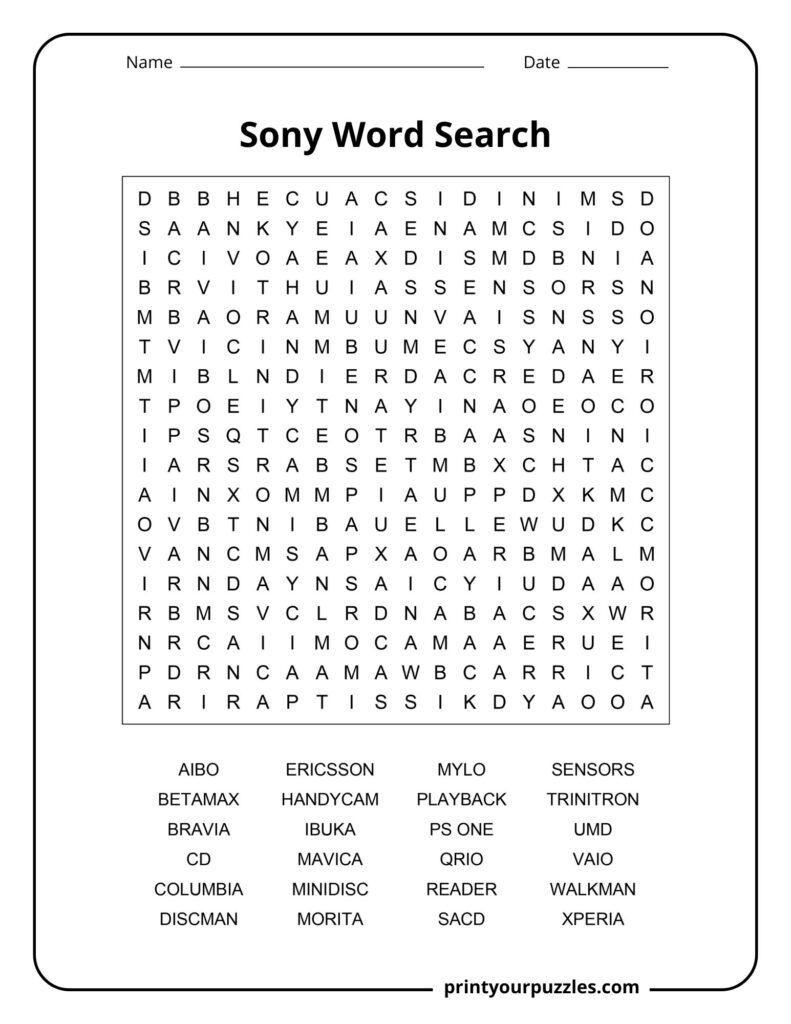
AIBO, BETAMAX, BRAVIA, CD, COLUMBIA, DISCMAN, ERICSSON, HANDYCAM, IBUKA, MAVICA, MINIDISC, MORITA, MYLO, PLAYBACK, PS ONE, QRIO, READER, SACD, SENSORS, TRINITRON, UMD, VAIO, WALKMAN, XPERIA
AIBO – Sony’s robotic dog launched in 1999, one of the world’s first consumer entertainment robots, capable of learning, expressing emotions, and interacting with its environment using sensors and AI.
BETAMAX – Sony’s home video cassette format introduced in 1975, which competed against VHS in the famous “format war” of the late 1970s and ultimately lost despite offering superior video quality.
BRAVIA – Sony’s premium television brand launched in 2005, standing for “Best Resolution Audio Visual Integrated Architecture,” known for exceptional picture quality across LCD and OLED screen technologies.
CD – The Compact Disc, co-developed by Sony and Philips in 1982, revolutionized music consumption worldwide by replacing vinyl records with a digital optical format offering superior sound and durability.
COLUMBIA – Columbia Records, acquired by Sony in 1988, is one of the oldest and most prestigious music labels in history, home to artists like Bob Dylan, Beyoncé, and Bruce Springsteen.
DISCMAN – Sony’s portable CD player introduced in 1984, the natural successor to the Walkman, bringing digital music listening on the go for the first time to mainstream consumers everywhere.
ERICSSON – The Swedish telecommunications giant that partnered with Sony in 2001 to form Sony Ericsson, a mobile phone joint venture that produced popular handsets before Sony acquired full ownership in 2012.
HANDYCAM – Sony’s legendary line of consumer camcorders launched in 1985, which made home video recording accessible to everyday families through compact design, ease of use, and continuously evolving recording technology.
IBUKA – Masaru Ibuka, Sony’s visionary co-founder who established the company in 1946 alongside Akio Morita, driving its early technical innovation and establishing the engineering culture that defined Sony’s identity.
MAVICA – Sony’s groundbreaking electronic still camera line introduced in 1981, among the world’s first digital cameras, storing images on small floppy disks rather than traditional photographic film.
MINIDISC – Sony’s recordable optical disc format launched in 1992, offering a compact and rewritable alternative to cassette tapes and CDs, popular in Japan but never achieving major worldwide commercial success.
MORITA – Akio Morita, Sony’s legendary co-founder and global ambassador, who transformed the company into a worldwide brand and famously championed the Walkman concept when colleagues doubted its commercial viability.
MYLO – Sony’s “My Life Online” handheld device released in 2006, designed for wireless internet communication and media playback, targeting young users but discontinued after struggling to find a significant market audience.
PLAYBACK – A fundamental concept in Sony’s DNA, referring to the company’s core mission of enabling people to record and replay audio and video experiences, driving decades of innovation across multiple product categories.
PS ONE – The slim redesigned version of Sony’s original PlayStation console released in 2000, making the groundbreaking gaming platform more affordable and portable while extending its commercial life into the new millennium.
QRIO – Sony’s bipedal humanoid robot unveiled in 2003, capable of walking, dancing, recognizing faces and voices, representing Sony’s ambitious research into advanced personal robotics before the project was discontinued in 2006.
READER – Sony’s line of electronic book readers launched in 2004, among the earliest dedicated e-reading devices on the market, predating Amazon’s Kindle and pioneering the concept of portable digital libraries.
SACD – Super Audio CD, a high-resolution audio disc format developed by Sony and Philips in 1999, offering dramatically superior sound quality to standard CDs through multichannel and higher-fidelity audio reproduction.
SENSORS – A critical technological pillar across Sony’s entire product ecosystem, from camera image sensors dominating the global smartphone market to motion detectors in robots and gaming controllers like the DualShock.
TRINITRON – Sony’s patented color cathode ray tube television technology introduced in 1968, which delivered sharper, brighter images than competing sets and earned Sony its first Emmy Award for technical achievement.
UMD – Universal Media Disc, Sony’s proprietary optical format created for the PlayStation Portable in 2005, used for both games and movies, but largely abandoned as digital downloads overtook physical media distribution.
VAIO – Sony’s prestigious personal computer brand launched in 1996, standing for “Video Audio Integrated Operation,” renowned for elegant design and innovation before Sony sold the PC division to a Japanese investment fund in 2014.
WALKMAN – Sony’s iconic portable cassette player introduced in 1979, which fundamentally transformed how people listened to music privately on the move and became one of the most influential consumer electronics products ever created.
XPERIA – Sony’s smartphone brand launched in 2008, combining premium camera technology, high-resolution displays, and audio expertise into Android devices, continuing Sony’s tradition of integrating hardware excellence with cutting-edge digital experiences.
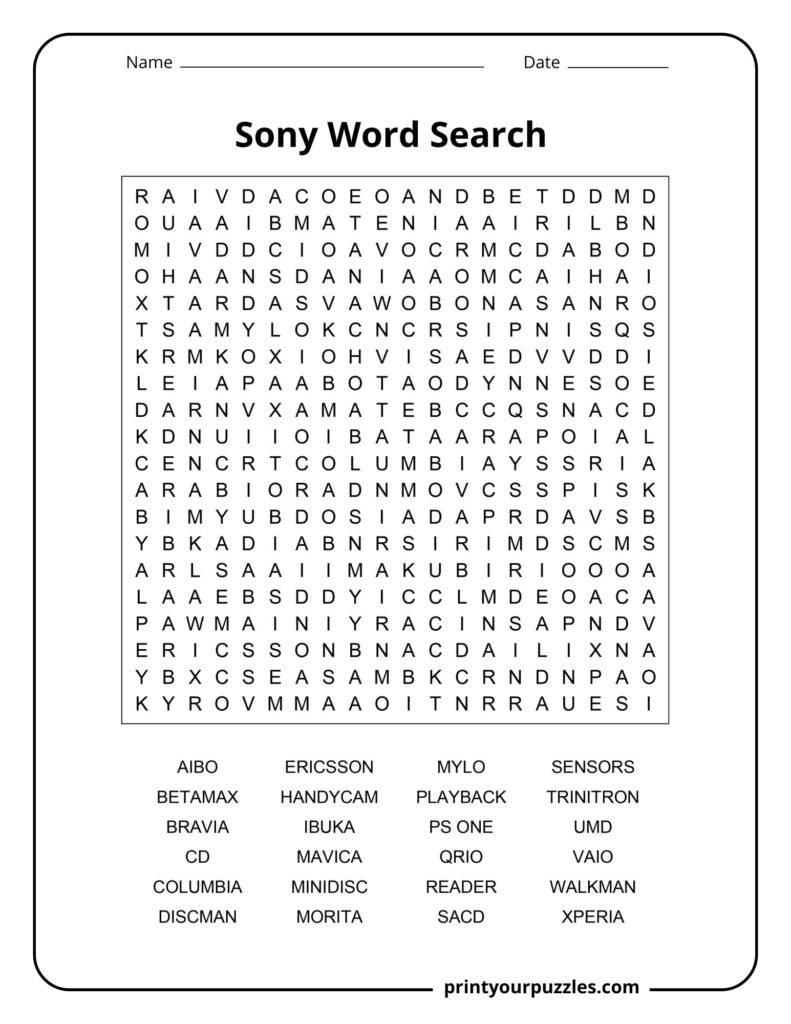
AIBO, BETAMAX, BRAVIA, CD, COLUMBIA, DISCMAN, ERICSSON, HANDYCAM, IBUKA, MAVICA, MINIDISC, MORITA, MYLO, PLAYBACK, PS ONE, QRIO, READER, SACD, SENSORS, TRINITRON, UMD, VAIO, WALKMAN, XPERIA
Sony was established in Tokyo in 1946 by Masaru Ibuka and Akio Morita as Tokyo Tsushin Kogyo, later renamed Sony Corporation in 1958 to appeal to global markets.
The TR-55, Japan’s first commercially successful transistor radio launched in 1955, established Sony as an innovative electronics manufacturer and demonstrated the company’s ability to miniaturize and improve existing technologies.
Introduced in 1979, the Walkman revolutionized personal entertainment by allowing people to listen to music privately anywhere, creating an entirely new lifestyle category and selling over 400 million units worldwide.
Sony entered gaming in 1994 with the PlayStation, which rapidly became the world’s best-selling console, dethroning Nintendo and establishing Sony as a dominant and enduring force in interactive entertainment.
Over decades Sony expanded strategically into music, film, gaming, and semiconductors, acquiring Columbia Records and Columbia Pictures, transforming from a hardware manufacturer into a diversified global entertainment and technology conglomerate.
Sony: The Private Life by John Nathan. Nathan masterfully draws on unrivalled insider access and deep Japanese cultural fluency to reveal the human bonds, brilliant rivalries, and restless genius that turned a Tokyo bomb shelter into a global icon.
Before becoming a global electronics giant, Sony’s founders attempted to build an electric rice cooker in 1946, but the unreliable prototype either undercooked or burned the rice and never reached market.
Sony combined the Latin word “sonus” meaning sound, with “sonny,” an American slang term popular in 1950s Japan suggesting youth and energy, creating a name both globally pronounceable and memorably modern.
Co-founder Akio Morita pushed the Walkman into production despite internal resistance from colleagues convinced nobody would buy a tape player without recording capability, proving every skeptic spectacularly wrong within months.
Sony’s Trinitron color tube technology, introduced in 1968, was so technically groundbreaking that the American Television Arts and Sciences Academy awarded Sony a special Emmy for its exceptional engineering achievement.
Sony initially partnered with Nintendo in the late 1980s to create a CD-ROM add-on for the Super Nintendo, but after Nintendo cancelled the deal, Sony independently launched the PlayStation in 1994.