
May is the fifth month of the year and a time often associated with flowers, warmer weather, outdoor activities, and the approach of summer in the Northern Hemisphere. It has 31 days and falls between April and June. In the Southern Hemisphere, May arrives during autumn, bringing cooler temperatures, shorter days, and changing leaves in many regions.
The month takes its name from Maia, an ancient Roman goddess connected with growth, fertility, and the natural world. This association fits May especially well because gardens, fields, and forests are often full of new life. Trees become greener, flowers bloom, birds build nests, and farmers continue planting or caring for spring crops.
May weather is usually milder in many northern countries, although conditions can still vary greatly. Warm sunshine may be followed by rain, thunderstorms, or cooler days. People often spend more time outdoors by gardening, hiking, cycling, visiting parks, attending festivals, or enjoying picnics. Farmers’ markets may begin offering strawberries, asparagus, peas, herbs, and other seasonal produce.
Several important celebrations and observances take place during May. May Day on May 1 has long been connected with spring traditions, flowers, dancing, and workers’ rights. Cinco de Mayo on May 5 commemorates the Mexican victory at the Battle of Puebla and is widely celebrated in many Mexican American communities. Mother’s Day is observed in the United States on the second Sunday of May, giving families an opportunity to thank mothers and other maternal figures.
Memorial Day takes place on the last Monday in May in the United States. It honors military personnel who died while serving the country and is marked by ceremonies, flags, cemetery visits, and moments of remembrance. The holiday weekend is also commonly viewed as the unofficial beginning of summer.
May includes graduations, school events, weddings, outdoor concerts, sporting competitions, and preparations for summer vacations. Its birth flower is traditionally the lily of the valley or hawthorn, while emerald is associated with the month as its birthstone.
Celebrate the fresh colors, changing weather, meaningful observances, and outdoor pleasures of late spring with this printable May word search, featuring 24 carefully selected words inspired by flowers, family occasions, seasonal foods, nature, remembrance, festivals, and the growing excitement of summer.
Related Word Searches:
Mother’s Day | Memorial Day | Cinco de Mayo | Spring | June | Star Wars Day
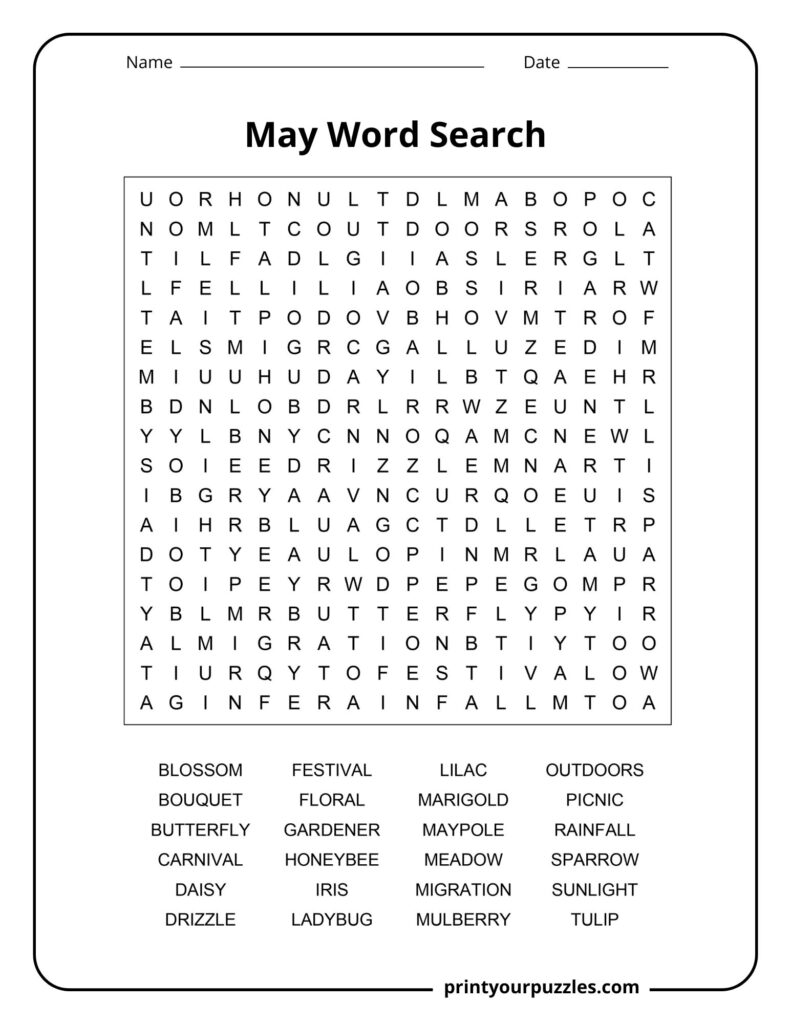
BLOSSOM, BOUQUET, BUTTERFLY, CARNIVAL, DAISY, DRIZZLE, FESTIVAL, FLORAL, GARDENER, HONEYBEE, IRIS, LADYBUG, LILAC, MARIGOLD, MAYPOLE, MEADOW, MIGRATION, MULBERRY, OUTDOORS, PICNIC, RAINFALL, SPARROW, SUNLIGHT, TULIP
BLOSSOM – The flower or mass of flowers that appear on trees and plants in spring, signaling new growth and the arrival of warmer weather after winter.
BOUQUET – A carefully arranged bunch of freshly cut flowers, often tied together with ribbon, given as a gift or used to decorate homes and celebration tables.
BUTTERFLY – A delicate winged insect that emerges in spring, known for its vibrant, patterned wings and its role in pollinating flowers across gardens and meadows.
CARNIVAL – A lively outdoor festival featuring rides, games, music, and food stalls, typically held in spring and early summer to celebrate community and seasonal joy.
DAISY – A small, cheerful wildflower with white petals surrounding a yellow center, commonly found in meadows and lawns during spring, symbolizing innocence and new beginnings.
DRIZZLE – A light, fine rain that falls gently and steadily, typical of spring days in May, keeping gardens moist and the air fresh and pleasantly cool.
FESTIVAL – A public celebration or event held outdoors, often in May, featuring music, food, art, and cultural activities that bring communities together in seasonal merriment.
FLORAL – Relating to flowers or their decorative patterns, used to describe the abundant blooms of May that fill gardens, parks, and countryside with color and fragrance.
GARDENER – A person who tends and cultivates a garden, spending May planting seeds, pruning shrubs, watering beds, and nurturing plants as the growing season begins in earnest.
HONEYBEE – A small, fuzzy, yellow-and-black striped insect that collects nectar from spring flowers to produce honey, playing a vital role in pollination and ecosystem health.
IRIS – A tall, elegant flowering plant that blooms in late spring, producing striking purple, blue, yellow, or white flowers with distinctive sword-shaped leaves in garden borders.
LADYBUG – A small, round beetle with a bright red shell dotted with black spots, commonly seen in May gardens where it feeds on aphids and other pests.
LILAC – A fragrant flowering shrub that blooms in May, producing dense clusters of small purple, pink, or white flowers whose sweet scent is one of spring’s most beloved fragrances.
MARIGOLD – A bright orange or yellow flower that blooms in spring and summer, known for its bold color, long-lasting petals, and ability to repel insects from vegetable gardens.
MAYPOLE – A tall decorated pole traditionally erected on May Day, around which people dance while holding colorful ribbons, weaving them into intricate patterns as part of spring celebrations.
MEADOW – An open, grassy field rich with wildflowers, buzzing insects, and birdsong in May, offering a peaceful natural landscape where wildlife thrives during the spring season.
MIGRATION – The seasonal movement of birds traveling from southern wintering grounds back to northern regions in spring, filling May skies and trees with newly arrived, singing species.
MULBERRY – A deciduous tree that leafs out in late spring, producing clusters of dark, berry-like fruits enjoyed by birds and humans alike throughout the warmer months ahead.
OUTDOORS – The natural world beyond walls and rooftops, especially inviting in May when mild temperatures, blooming scenery, and longer daylight hours encourage people to spend time outside.
PICNIC – A casual outdoor meal enjoyed in a park, garden, or meadow, typically in warm spring weather, with friends or family sharing food on a blanket on the grass.
RAINFALL – The precipitation that falls from spring clouds, nourishing soil, filling rivers, and sustaining the rapid plant growth that makes May one of the greenest months of the year.
SPARROW – A small, brown, chirping bird abundantly active in May, building nests and raising young chicks while foraging for seeds and insects in gardens, hedgerows, and urban parks.
SUNLIGHT – The warm, golden rays of the sun that grow stronger and last longer each day in May, energizing plants, lifting moods, and drawing people outdoors to enjoy nature.
TULIP – A classic spring bulb flower blooming in May, recognized by its smooth, cup-shaped petals in vivid shades of red, yellow, pink, and purple, adorning gardens worldwide.
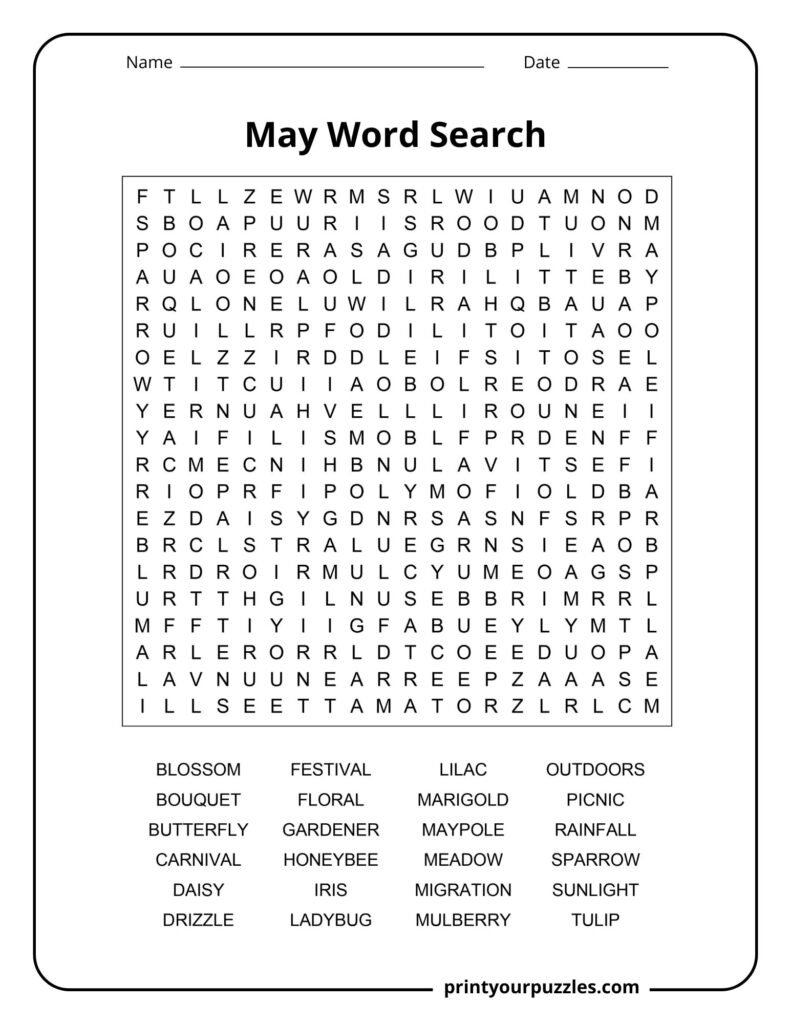
BLOSSOM, BOUQUET, BUTTERFLY, CARNIVAL, DAISY, DRIZZLE, FESTIVAL, FLORAL, GARDENER, HONEYBEE, IRIS, LADYBUG, LILAC, MARIGOLD, MAYPOLE, MEADOW, MIGRATION, MULBERRY, OUTDOORS, PICNIC, RAINFALL, SPARROW, SUNLIGHT, TULIP
May falls in the heart of spring in the Northern Hemisphere, when temperatures rise, flowers bloom abundantly, and longer daylight hours signal nature’s full reawakening after winter.
May Day has ancient roots in the Celtic festival of Beltane, marking the start of summer with bonfires, dancing around maypoles, and rituals celebrating fertility and seasonal renewal.
Lilacs, tulips, daisies, and lily of the valley are May’s signature blooms, symbolizing fresh beginnings, beauty, and the vibrant colors that define the peak of spring season.
May’s birthstone is the emerald, symbolizing love and rebirth, while its birth flower is the lily of the valley, representing happiness, purity, and the sweetness of renewed life.
Birds are actively singing, nesting, and migrating in May, insects emerge in full force, and mammals raise their young, making it the richest month for spotting diverse wildlife outdoors.
May is the year at its most generous — long evenings, open windows, everything in bloom. There is a luminous quality to May days that asks for books equally alive and radiant. These three rise to the occasion.
Mrs Dalloway – Virginia Woolf. One luminous London day, flowers, open windows, and life in full bloom. The most radiant, alive book for the most radiant month.
The Remains of the Day – Kazuo Ishiguro. A butler drives through the English countryside in late spring, quietly reckoning with a life of missed chances and closed doors.
Tender is the Night – F. Scott Fitzgerald. Glamour and slow collapse on the French Riviera as summer approaches. Beautiful on the surface, aching underneath — like May at its most bittersweet.
This quirk of the calendar makes May unique among all twelve months, a fun mathematical curiosity that puzzles many people when they first discover it.
This poetic name reflects the abundant wildflowers blooming across North America during May, a tradition passed down through generations to track seasonal changes throughout the natural year.
Romans avoided marrying in May because the month honored the dead during the Lemuria festival, a superstition so strong it influenced wedding planning across many European cultures for centuries.
As spring flowers reach peak bloom, honeybee colonies expand rapidly, with queens laying up to 2,000 eggs daily to build the workforce needed for summer honey production.
Founded in 1913, this iconic event attracts over 150,000 visitors annually, showcasing breathtaking garden designs, rare plant varieties, and cutting-edge horticultural innovations from around the globe.